Tag Archives: lock

The Gillogue railroad

Gillogue, in Co Clare, is the site of a former Burlington factory and of a Clare entrance to the University of Limerick. It is also the site of a lock on the Plassey–Errina Canal, a section of the old Limerick Navigation, and of quarries, gravel pits and lime kilns.

And, according to the 6″ Ordnance Survey map, of around 1840, Gillogue also had a railroad.

The Gillogue rail road

The Gillogue rail road (click to enlarge)

The railroad was almost certainly not for carrying passengers; it may have been a light railway, with small wagons pushed by men or pulled by horses, and designed to be taken up and moved elsewhere fairly easily. However, I have no hard information about who owned it, who built it or what it was for. I can make guesses, based on its closeness to the canal and to the quarries, but it would be nice to have evidence.

If, Gentle Reader, you know anything about it, do please leave a Comment below.

My OSI logo and permit number for website

G boats, Biffs, armoured cars and the Lagan

On the Grand Canal, M boats (boats with the letter M added to their numbers) were motor barges owned by the Grand Canal Company itself; E boats were engineering boats, used for canal maintenance and B boats (whether motor or horse-drawn) were bye-traders’ or hack boats, boats owned by traders other than the Grand Canal Company itself.

G boats were wooden horse-drawn boats, built to carry turf (peat) during The Emergency, which to the rest of the world was the second world war. Some of them [PDF] were built by Thompsons of Carlow, whose archives are now in the National Archives of Ireland; you can read about them in the Summer 2012 newsletter [PDF] of the Archives & Records Assocation.

The same organisation’s Autumn 2013 newsletter had an interesting article about Lagan Navigation archives in the Public Record Office of Northern Ireland. Unfortunately something has gone wrong with the links on its newsletter web page so the relevant PDF is not available at the moment.

h/t CO’M

Eglinton update

I have updated my page on the Eglinton Canal in Galway, adding some map extracts and some information about Parkavera Lock, kindly provided y Colin Becker.

Heritage nonsense and the Naomh Éanna

There was a Dáil debate last week about the scrapping of the Naomh Éanna; nobody gave any good reason for keeping the vessel. Preservation proponents decided not to ask for money: instead they wanted the thing left hanging around while they worked out an “investment plan“, something that they could have done at any time over the last twenty-five years.

The funniest part was the final paragraph of the third contribution by Éamon Ó Cuív [FF, Galway West], who said:

Agus muid ag caint faoi stair, is fiú a lua gur úsáid RTÉ an bád seo le haghaidh scannán an-mhaith a rinne siad, “The Treaty”. Nuair a bhí Collins ag dul go Sasana sa scannán, is ar an mbád seo, seachas bád amuigh i nDún Laoghaire, a bhí sé. Tá ceangal stairiúil le hócáidí thar a bheith stairiúil ag an mbád sin. Níl ag teastáil ach cúpla mí ionas go mbeadh deis ag daoine rud éigin a eagrú. Beidh beagáinín slándáil i gceist. B’fhéidir go mbeidh costas beag ar Uiscebhealaí Éireann. Ní dóigh liom go mbeidh sé suntasach i gcomhthéacs an maitheas a d’fhéadfadh sé seo a dhéanamh dá gcoinneofaí an bád. Má táimid ag lord eiseamláir don rud a bhféadfadh a bheith i gcest, níl le déanamh againn ach cuairt a thabhairt ar Faing agus dul isteach ar an flying boat ansin.

Learned readers will recognise that Google Translate’s version needs improvement:

And we are talking about history, it is worth mentioning that RTÉ use the boat for a very good film they made, “The Treaty “. When Collins was going to England in the film, most of the boats, except boat out in Dun Laoghaire, it was. There are historical connections with historical events particularly at this boat. All you need is a few months so that people have the opportunity to organize something. The security bit concerned. There may be a small cost of Waterways Ireland. I do not think it will be significant in the context of the good it could do this if the boat is kept. If we lord model for what could be gcest, we do not just visit Foynes and go flying into the boat then.

So the Naomh Éanna is valuable because it was used as a film set. And Foynes flying-boat museum shows what could be done.
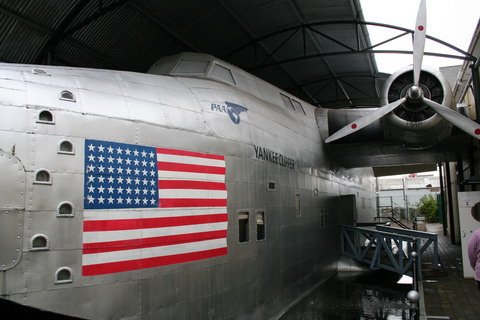
Foynes flying-boat

Foynes flying-boat

Up to a point, Lord Copper. You see — and I know this may come as a shock — the flying-boat on display at Foynes is not actually a real flying-boat. It’s not even a portion of a real flying-boat. It’s a reproduction of a portion of a flying-boat and it was built by a film-set designer.

If anyone really needs to be able to see around a small mid-twentieth-century ship, I suspect that the Foynes folk could provide a replica that would cost less to keep than the real thing.

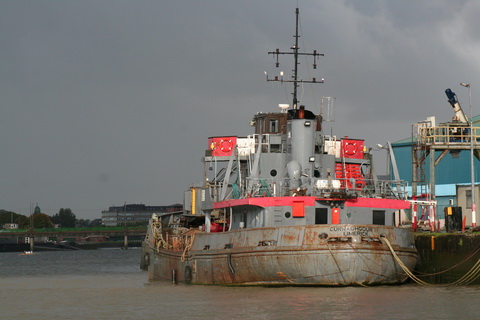
Alternatively, if Dublin needs another example of a locally built vessel, and one different in form from the Cill Áirne, it could take over the Curraghgour II or the Coill an Eo, both also built in Dublin. Maybe the preservationists should start now on their investment planning.
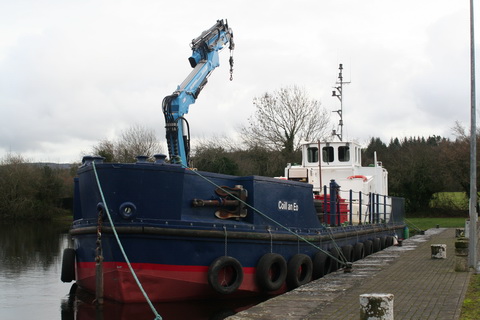
Coill an Eo
Coill an Eo

Limerick Port old dredger Curraghgour II 6_resize

Curraghgour II

An investment plan for the Naomh Éanna?

In a debate about the Naomh Éanna in the Dáil on 13 February 2014, Joan Collins TD [People Before Profit Alliance, Dublin South Central] said:

I understand the National Asset Management Agency and the Irish Ship & Barge Fabrication Company have expressed an interest in stepping in with an investment plan to restore her to her former beauty.

I see nothing about the ship on NAMA’s website, so I cannot provide any information about its views.

According to the most recent modified accounts for the Irish Ship and Barge Fabrication Company Ltd, on file at the Companies Registration Office, its total assets at 28 February 2013 were €286 in cash.

The company had no fixed assets.

Its called-up share capital was shown as €100000 and the balance on its profit & loss account was -€99714.

According to its Annual Return (B1), made up to 30 November 2013, its authorised share capital was €200000, made up of 100000 €1.00 ordinary shares and 100000 €1.00 Non Cum Red Pref shares. Only 100 of the ordinary shares were issued: 1 was owned by Saul Casey and 99 were owned by Sam Field-Corbett. All 100000 Non Cum Red Pref shares were issued and were held by Printation Limited.


A missed opportunity for railways

The Leeds Intelligencer of Saturday 16 September 1837 reported on the seventh annual meeting of the British Association for the Advancement of Science, which had begun at Liverpool on the previous Monday. The Mechanical Science section met, appropriately, at the Mechanics’ Institution with Professor Robinson of Armagh, President, in the chair.

It heard papers from Mr Williams on the Treffos Pump, Mr Kingsley on the Perspective Drawing Board, Mr Henwood on the Expansive Action of Steam in Cornish Mine Engines and Mr Russell on the Motion of Steamers in Shallow Waters. But the first and greatest paper was not delivered by its author, Mr G Remington [presumably George Remington, railway engineer], who was absent, but by Dr Lardner. Its subject was

… the Railway Balance Lock. The object of this was to do that upon Railways which is accomplished on Canals by means of Locks, namely, to raise the trains to any given height, according to the inequality of that surface.

You can read more about it here; interweb search engines will find more references. Perhaps it is not too late to have this innovation adopted.

Thump it on the thirteenth

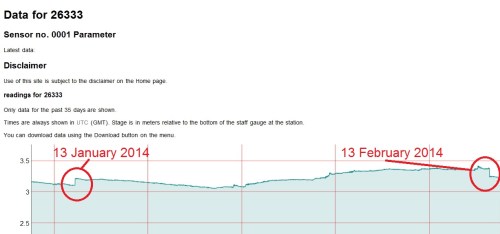
Here is a screenshot from the OPW’s online waterlevel gauge for Athlone Weir. It shows the levels for the past 35 days. In recent days the waterlevel website has ceased to show the names or locations of the gauges, but 26333 is Athlone Weir.

Athlone waterlevel: 35 days to 14 February 2014

Athlone waterlevel: 35 days to 14 February 2014

Note the odd discontinuities: the level jumped up on 13 February and fell back on 13 February. Does the gauge get stuck every so often and have to be thumped to free it?

I do not know. I have reported both the discontinuities and the disappearance of the station names to the OPW.


Canal tourists or canal pensioners?

The Village at Lyons 265_resize

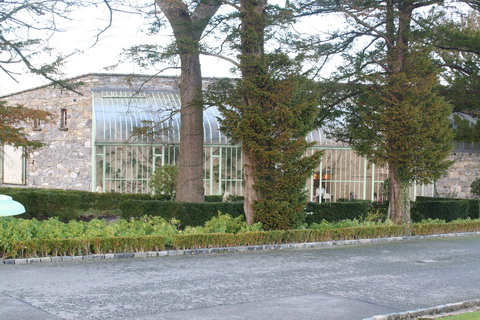
La Serre

Nibbling yesterday on a morsel of cured salmon, with fennel and apple salad, lemon crème fraiche and lavender jelly, at the excellent La Serre restaurant at the Village at Lyons, I looked forward to walking outside afterwards, on to the canal bank, to view the many boats that would undoubtedly be moored there, above the thirteenth lock, as their owners lunched at La Serre’s sister institution, the Canal Café.

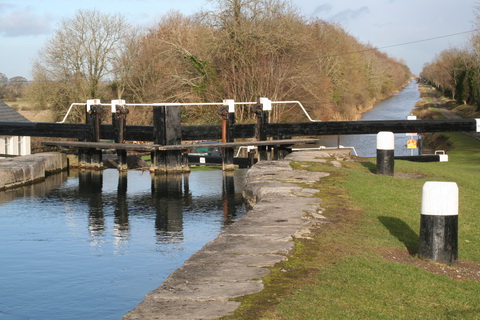
The thirteenth lock (and its wonderful O)

The thirteenth lock (and its wonderful O)

Judge of my surprise, then, when I found not a single boat outside. I realised, though, that boaters probably walked from nearby Hazelhatch and even from Sallins. For we know, do we not, that boaters are vital to tourism? Even Joe Higgins of the Socialist Party tells us so, which means that they must be out and about along the canals, spending money (and where better to spend it than at the Canal Café?).

The Canal Café, mere feet from the canal bank

The Canal Café, mere feet from the canal bank

But a difficulty has struck me. Mr Higgins’s position is that boaters have money available for discretionary expenditure, but Senator John Kelly tells us that most boaters are “retired couples from England who are receiving small English pensions”. So one politician tells us that boaters have disposable incomes and that they should not pay money to Waterways Ireland because they spend money in pubs and restaurants along the canals; another politician tells us that boaters should not pay money to Waterways Ireland because they have none to spare.

I find it difficult to reconcile these two positions.


Scrap the damn thing

The Irish Times reports today, in an article that will probably disappear behind a paywall sooner or later, that some folk don’t want the Naomh Éanna, a decrepit former ferry cluttering up the Grand Canal Dock, to be scrapped.

There seems to be a reluctance to accept that things, like people, have a lifespan. Keeping them alive indefinitely costs a lot of money. And none of those quoted in the article has put forward any good reason for keeping the damn thing, never mind any reason that would justify the spending of very large amounts of money on it.

Yes, it had some interesting (if minor) historical associations, but the best way of recording them would be to write a book, or create a website, or even make a movie, about the ship’s history. Money spent that way would be a far better investment than money spent on keeping the Naomh Éanna afloat. Its heritage or historical value lies in the associated information, not in the steel.

As it is, the vessel has been hanging around for about twenty-five years, since it failed a survey in 1986 or 1988 (I have found different dates). I don’t know how much it has done since then to advance appreciation of industrial or cultural history, or whatever it is that the complainants think is being vandalised, but I would have thought that anyone who wanted to gaze on an elderly vessel has had plenty of opportunity to do so.

Addendum: it seems some folk want to draw up an investment plan.

Send for the lifeboat

I read here that some folk want to remove the retired lifeboat Mary Stanford from Grand Canal Dock (a laudable aim, especially if it saves Waterways Ireland money), transport it to Ballycotton, Co Cork, and restore it.

It is to be hoped that their efforts will be more successful than those of the group that intended to restore the Clogherhead lifeboat Charles Whitton.