Tag Archives: Operations

Registered boats

Waterways Ireland (whom God preserve) tell me that, at end December 2013, there were

  • 8816 boats registered on the Shannon
  • 5570 boats registered on the Erne.

There are different requirements for registration on the two waterways. But the main problem with the figures is that there is no incentive to deregister if a boat is sold off the system. As there is no annual charge for registration (or anything else), an owner whose boat is sold to an owner overseas or indeed on the sea loses nothing by failing to deregister. it is therefore possible that the figures overstate the numbers of registrable boats on the two systems [on the Shannon–Erne Waterway, which registration on either of the other two is required]. And then there are the boats that are not required to be registered ….

But, for what they’re worth, there the figures are.
 

Big it up for the OPW

I’ve just been reading some particularly nitwitted Dáil discussions and I need some time to calm down enough to report on them to the Learned Readers of this site. Let me just say that anyone who thinks that politicians cannot distinguish fact from fiction is absolutely right. But enough of that for the moment.

I reported earlier on an oddity in the results from the OPW’s Athlone waterlevel gauge. I emailed the OPW about it and a helpful chap got back on more or less immediately.

He explained that the data we see on the waterlevel.ie site is, as it were, live: raw unfiltered data with nothing added, nothing taken away. The same data goes in to the OPW and they spotted that the Athlone gauge was reading too high. They found the sensor was faulty; they have now adjusted it and the new, lower readings are correct.

The disappearance of the placenames is because of some work in progress on improving the website; they will be back.

He kindly pointed me to a list, in .xlsm format, downloadable from here; it shows all hydrometric stations in Ireland. It shows who operates them, whether they’re active and whether they use telemetry (which I take to mean that they can be monitored remotely). Unfortunately OPW itself doesn’t seem to have any gauges on Lough Derg and nor does Waterways Ireland. OPW does have a rather excitable gauge at Scarriff and gauges upstream of Meelick Weir and Meelick (Victoria) Lock. The ESB has gauges with telemetry at Ballyvalley (25073) and Killaloe (25074) but I can’t find any website giving the levels. If, Gentle Reader, you can find one, perhaps you would let us know.

The consoling part of dealing with the OPW is that you get the distinct impression that they know some useful stuff. Unlike, say, some folk working in Kildare Street ….

Thump it on the thirteenth

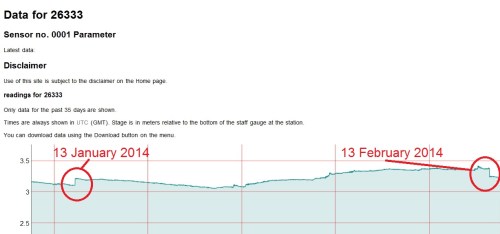
Here is a screenshot from the OPW’s online waterlevel gauge for Athlone Weir. It shows the levels for the past 35 days. In recent days the waterlevel website has ceased to show the names or locations of the gauges, but 26333 is Athlone Weir.

Athlone waterlevel: 35 days to 14 February 2014

Athlone waterlevel: 35 days to 14 February 2014

Note the odd discontinuities: the level jumped up on 13 February and fell back on 13 February. Does the gauge get stuck every so often and have to be thumped to free it?

I do not know. I have reported both the discontinuities and the disappearance of the station names to the OPW.


Doonbeg

It seems that this chap has bought the glof course near the (proposed) Doonbeg Ship Canal. I’m sure that any further development will be in the best possible taste.

More Pathé

A train ferry, claimed to be in service on the Liffey

Fishing at Ringsend the hard way

Turf by canal

Launching the Irish Elm in Cork

A Boyne regatta

Making and using a Boyne currach in 1921 (you can learn the art yourself here)

A non-watery film: Irish Aviation Day 1936


Pathé on Shannon

Shannon floods 1959 1

Shannon floods 1959 2

Pylons!

The Carrick-on-Suir creamery chimney (Shannon Scheme electrification)

Building the headrace


Relieving Athlone

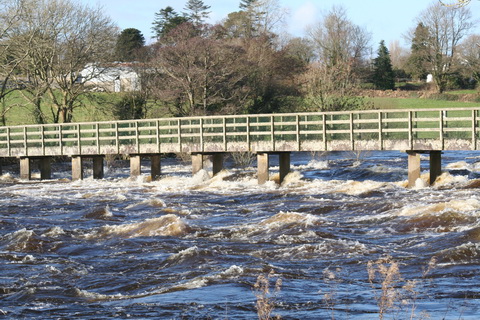
Parteen Villa Weir is sending large amounts of water down the original channel of the Shannon, and over the Falls of Doonass, to draw water off from the upper reaches of the river.

Castleconnell water level 20140210 264_resize

The footbridge at Castleconnell

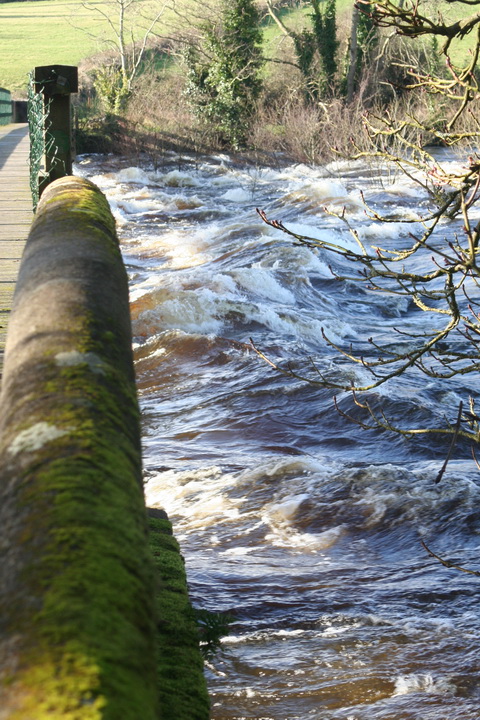
Castleconnell water level 20140210 267_resize

Above the bridge

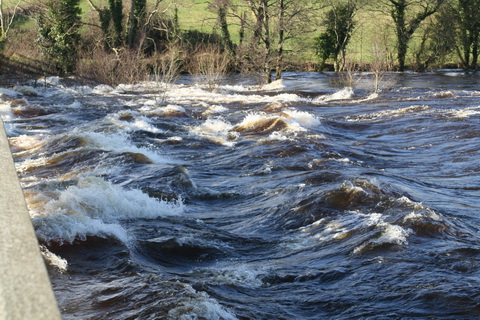
Castleconnell water level 20140210 269_resize

The downstream side of the bridge

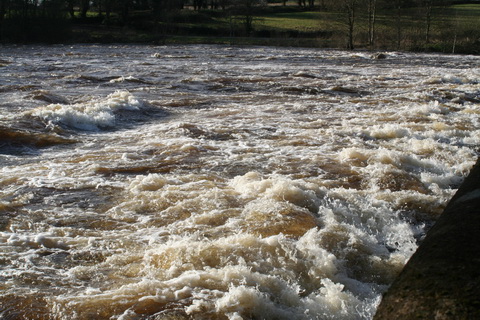
Castleconnell water level 20140210 271_resize

A bumpy ride

Castleconnell water level 20140210 273_resize

At normal levels the bottom of the wall is several feet above the water


Levels below Parteen Villa have not yet reached those of 2009 and the channel can probably take more before folk get flooded.

The Old River Shannon site has some photos taken at Parteen Villa Weir.

Canal tourists or canal pensioners?

The Village at Lyons 265_resize

La Serre

Nibbling yesterday on a morsel of cured salmon, with fennel and apple salad, lemon crème fraiche and lavender jelly, at the excellent La Serre restaurant at the Village at Lyons, I looked forward to walking outside afterwards, on to the canal bank, to view the many boats that would undoubtedly be moored there, above the thirteenth lock, as their owners lunched at La Serre’s sister institution, the Canal Café.

The thirteenth lock (and its wonderful O)

The thirteenth lock (and its wonderful O)

Judge of my surprise, then, when I found not a single boat outside. I realised, though, that boaters probably walked from nearby Hazelhatch and even from Sallins. For we know, do we not, that boaters are vital to tourism? Even Joe Higgins of the Socialist Party tells us so, which means that they must be out and about along the canals, spending money (and where better to spend it than at the Canal Café?).

The Canal Café, mere feet from the canal bank

The Canal Café, mere feet from the canal bank

But a difficulty has struck me. Mr Higgins’s position is that boaters have money available for discretionary expenditure, but Senator John Kelly tells us that most boaters are “retired couples from England who are receiving small English pensions”. So one politician tells us that boaters have disposable incomes and that they should not pay money to Waterways Ireland because they spend money in pubs and restaurants along the canals; another politician tells us that boaters should not pay money to Waterways Ireland because they have none to spare.

I find it difficult to reconcile these two positions.


Scrap the damn thing

The Irish Times reports today, in an article that will probably disappear behind a paywall sooner or later, that some folk don’t want the Naomh Éanna, a decrepit former ferry cluttering up the Grand Canal Dock, to be scrapped.

There seems to be a reluctance to accept that things, like people, have a lifespan. Keeping them alive indefinitely costs a lot of money. And none of those quoted in the article has put forward any good reason for keeping the damn thing, never mind any reason that would justify the spending of very large amounts of money on it.

Yes, it had some interesting (if minor) historical associations, but the best way of recording them would be to write a book, or create a website, or even make a movie, about the ship’s history. Money spent that way would be a far better investment than money spent on keeping the Naomh Éanna afloat. Its heritage or historical value lies in the associated information, not in the steel.

As it is, the vessel has been hanging around for about twenty-five years, since it failed a survey in 1986 or 1988 (I have found different dates). I don’t know how much it has done since then to advance appreciation of industrial or cultural history, or whatever it is that the complainants think is being vandalised, but I would have thought that anyone who wanted to gaze on an elderly vessel has had plenty of opportunity to do so.

Addendum: it seems some folk want to draw up an investment plan.

Send for the lifeboat

I read here that some folk want to remove the retired lifeboat Mary Stanford from Grand Canal Dock (a laudable aim, especially if it saves Waterways Ireland money), transport it to Ballycotton, Co Cork, and restore it.

It is to be hoped that their efforts will be more successful than those of the group that intended to restore the Clogherhead lifeboat Charles Whitton.