
Tag Archives: Royal Canal

Dublin docklands

A conference to be held on 21 September 2013.
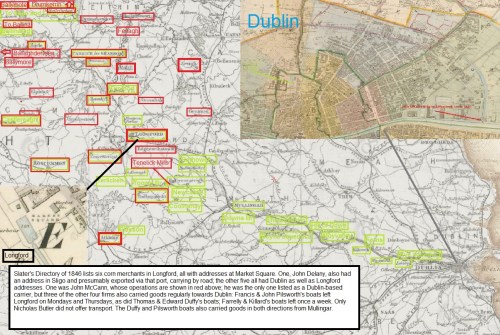
Canal carrying 1846: the Royal Canal

Isaac Slater’s Directory[i] of 1846 lists those carrying goods on inland waterways. There is a long list for Dublin; entries for other towns list those providing local services [there are some conflicts between the lists: see below]. However, the Dublin list shows only two carriers on the Royal Canal:

  • the Royal Canal Company [RCC] itself (Samuel Draper, Secretary) at the Broadstone in Dublin
  • John M’Cann & Sons, Liffey lock, North Wall, where the Royal Canal joins the River Liffey.

I noted here that two published histories of the Royal Canal, and a history of the Midland Great Western Railway [MGWR], suggested that the RCC/MGWR did not commence carrying goods themselves, on their own canal, until the 1870s. However, I had come across an MGWR ad, from 1853, beginning

The Directors will receive Proposals for the Haulage of their Trade Boats to and from Dublin and Longford and the River Shannon […].

The material in Slater’s Directory strengthens the notion that the RCC/MGWR did engage in carrying well before the 1870s, although the nature of the contractual relationships is not clear. Note also that Peter Clarke’s Appendix C[ii] lists “Boat Owners operating on the Royal Canal 1826 to 1847” including four RCC boats as well as four MGWR boats.

Destinations

M’Cann and RCC both provide long lists of the destinations they serve:

  • RCC: Athlone, Ballinafad, Ballymahon, Balnacarig, Balnalack, Boyle, Boyne aqueduct, Carrick on Shannon, Castlerea, Colooney, Coolnahay, Downs Bridge, Dromod, Drumsna, Ferns, Glasson, Hill of Down, Junction [which may be the junction between the main line and the Longford Branch], Kenagh, Kilcock, Lanesborough, Leixlip, Longford, Maynooth, Moyvalley, Mullingar, Newcastle, Newtownforbes, Rathowen, Roscommon, Ruskey, Rye aqueduct, Sligo, Terlicken, Thomastown, Toome Bridge
  • M’Cann: Arvagh, Athlone, Ballaghaderin, Ballina, Ballinamore, Ballyfarnon, Ballymahon, Ballymore, Ballymote, Boyle, Carrick on Shannon, Castlerea, Dromod, Drumkerrin [Drumkeeran?], Drumlish, Drumshambo, Drumsna, Dunmore, Edgeworthstown, Elphin, Fenagh, Granard, Lanesborough, Longford, Mohill, Roscommon, Ruskey, Strokestown, Tenelick Mills, Tulsk.

I thought it might be interesting to show these destinations on a map. Note that the map is from the 25″ Ordnance Survey map of around 1900 rather than the 6″ of around 1840: I used it because it was clearer, but it shows features (eg railway lines) that were not present in 1846.

Click on the map to get a slightly larger version.

Royal Canal carriers M'Cann and RCC 1846 (OSI)

Royal Canal carriers M’Cann and RCC 1846 (OSI)

I can’t stand over every location marked on the map (as it were). Spellings of place-names were sometimes not those in use today; some place-names (Ballinamore, Ballymore, Newcastle) are used of two or more places that might have been those intended; I could not identify two places, Dunmore and Junction, although I suspect the latter may be the junction between the main line and the Longford Branch of the canal.

What is interesting, though, is the different emphases in the two firms’ marketing. The Royal Canal Company lists almost every location along its canal; M’Cann offers a wide range of destinations beyond the canal, presumably linked by cars on the roads, into Counties Longford, Cavan, Roscommon, Westmeath, Mayo and Sligo. The RCC serves some such destinations, but a smaller number of them.

Some of the locations listed are small places; my presumption — which I have not yet checked, but for which I have found some supporting examples — is that such places have mills, quarries or other industries that provide cargoes for the canal.

The Shannon and the roads

Both operators offer to serve destinations on the River Shannon, to which the Royal Canal is joined at Clondra/Richmond Harbour:

  • RCC: Athlone, Carrick on Shannon, Dromod, Drumsna, Glasson, Lanesborough, Ruskey
  • M’Cann: Athlone, Carrick on Shannon, Dromod, Drumshambo, Drumsna, Lanesborough, Ruskey.

It is possible that goods to those places were carried by water, although (if steam tugs were not available) that would have been slow and uncertain; given that there were good roads leading from the west to the Shannon and throughout the region, it is, I think, likely that these destinations were served by road. I have no evidence on the matter save that the directory entries for Carrick-on-Shannon, Drumsna and Jamestown do not mention the availability of water transport.

Some of those destinations were served by direct road services from Dublin:

  • Athlone, Ballina, Castlerea, Dunmore, Longford, Roscommon, Sligo, Thomastown.

Competition presumably kept charges down.

Other carriers

Slater’s Directory lists six corn merchants in Longford, all with addresses at Market Square. One, John Delany, also had an address in Sligo and presumably exported via that port, carrying by road; the other five all had Dublin as well as Longford addresses.

One was John McCann, whose operations are shown in red on the map; he was the only one listed as a Dublin-based carrier, but three of the other four firms also carried goods regularly towards Dublin: Francis & John Pilsworth’s boats left Longford on Mondays and Thursdays, as did Thomas & Edward Duffy’s boats; Farrelly & Killard’s boats left once a week. Only Nicholas Butler did not offer transport. The Duffy and Pilsworth boats also carried goods in both directions from Mullingar. My guess is that carrying goods from others helped these merchants to cover the costs of their own fleets.

Peter Clarke’s Appendix C suggests that M’Cann’s fleet was the smallest of those based in Longford. The list is of “Boat Owners operating on the Royal Canal 1826 to 1847” but I am not entirely clear what the list shows. It seems unlikely, for instance, that the Midland Great Western Railway owned four boats throughout the period, as the company did not exist for most of it. Is the number of boats the largest that an owner had, or used, in a peak year, or an average over several years?

I don’t, therefore, know how to interpret the list but, assuming that the same methods were applied to all owners, it seems that the fleet sizes were these:

  • Duffy Bros 12
  • Pilsworths 9
  • M’Cann 5
  • Royal Canal Company 4.

Neither Farrelly nor Killard is listed, but there are many others: Dunne 8, Kelly 6, Murtagh 6, Murphy 5, MGWR 4, Williamson 4, and many others with 1, 2 or 3 boats each. Again, it is not clear in which years those owners had those numbers of boats.

More

As far as I know, little has been written about the carrying companies, especially those of the nineteenth century. I would be glad to hear from anyone who can correct, supplement or comment on this information.


[i] I Slater’s National Commercial Directory of Ireland: including, in addition to the trades’ lists, alphabetical directories of Dublin, Belfast, Cork and Limerick. To which are added, classified directories of the important English towns of Manchester, Liverpool, Birmingham, Sheffield, Leeds and Bristol; and, in Scotland, those of Glasgow and Paisley. Embellished with a large new map of Ireland, faithfully depicting the lines of railways in operation or in progress, engraved on steel. I Slater, Manchester, 1846

[ii] Peter Clarke The Royal Canal: the complete story ELO Publications, Dublin 1992

My OSI logo and permit number for website

Pumping algae

Do algae pass through pumps? I don’t know, but I ask because boating, bathing and animals have been banned in Lough Ennell where blue-green algae have been found. Lough Ennell is to supply water to the Royal Canal, although I presume it will take some time before it begins to do so. But perhaps, even if algae made it through the pumps, they would die in the Royal. If you know, Gentle Reader, do please leave a Comment below.

Longford

I thought I might make some rude remarks about Longford — the town rather than the county — but I felt I should investigate the case for the defence first. I decided to see what tourist attractions it had to offer, so I looked at the Longford page on the Discover Ireland website. It’s about the county, but that includes the town, whose many attractions will no doubt be listed. Clicking on the Highlights tab gave me a page listing three places for sightseeing:

  • Belvedere House and Gardens, which are in Co Westmeath
  • Strokestown Park House, Gardens and Famine Museum, which are in Co Roscommon
  • Corlea Trackway Visitor Centre, which is in a bog, although it is at least in a County Longford bog.

The Longford Tourism website is slightly more cheerful, mentioning walks by the Camlin on the north side of the town and along the line of the abandoned Longford Branch of the Royal Canal on the south. And the county council (I think) runs the Longford.ie website here.

Longford also has a place that fixes alternators and some nice bypasses, which is just as well as it also has the most infuriating one-way system in Christendom, allied with an almost complete lack of comprehensible signposts, especially if you want to go to Athlone, and a non-industrial wasteland to the south that adds nothing to the town’s charms.

What Longford doesn’t have is any particular reason for tourists to want to go there. So restoring the Royal Canal branch to Longford would not attract more people to the canal as a whole; it would simply displace them from elsewhere. For a boat entering the canal from the west, a night spent in Longford means a night not spent in Killashee or Keenagh or one day less to travel eastward.

The invaluable KildareStreet.com tells me that this point was not considered in a written question and answer in the Dáil on 11 June 2013.

James Bannon [FG Longford-Westmeath]: To ask the Minister for Arts, Heritage and the Gaeltacht if he will provide an update on the restoration plan for the section of the Royal Canal from Killashee, County Longford to Longford Town, in view of the fact that this has been characterised as the missing link on the Royal Canal system; and if he will make a statement on the matter.

Jimmy Deenihan [FG, Kerry North/West Limerick]: I can confirm to the Deputy that the Waterways Ireland Corporate Plan for 2011-2013, which has been approved by the North South Ministerial Council, plans for the completion of the feasibility study on the extension of the Longford Branch of the Royal Canal in December 2013, I am informed by Waterways Ireland that this study is presently on target.

I presume that, on the principle of a canal for everybody in the audience, an Inter-Agency Group will be set up shortly to find the money for the Longford Sheugh. But it makes no sense for the state to spend a penny on such a canal, although it might make sense for Longford Town Council (if it continues to exist) to spend its own money on the job of attracting visitors away from villages in County Longford.

Mr Bannon is known for his earlier attempt to promote the Irish organ.

Residential boating

Thanks to KildareStreet.com for alerting me to this written Dáil answer, to two questions, on Inland Waterways Development on 30 May 2013.

Clare Daly [Socialist Party, Dublin North]: To ask the Minister for Arts, Heritage and the Gaeltacht if he will engage with local stakeholders to develop a waterways strategy that facilitates those who want to live on houseboats.

Clare Daly [Socialist Party, Dublin North]: To ask the Minister for Arts, Heritage and the Gaeltacht if he will outline the contact he has had with Waterways Ireland to promote and facilitate houseboats as an alternative lifestyle choice, potential amenity and tourist asset.

Jimmy Deenihan [FG Kerry North/West Limerick]: I propose to take Questions Nos. 34 and 36 together. As the Deputy will be aware, I directly engage with Waterways Ireland through the Inland Waterways meetings of the North South Ministerial Council. I should say that officials in my Department also have ongoing engagement with Waterways Ireland and meet directly with the organisation on a regular basis. The issues referred to by the Deputy are operational matters for Waterways Ireland. However, I have been informed by Waterways Ireland that they have installed facilities for houseboats at Shannon Harbour and are in the process of developing facilities at Lowtown and Sallins.

I am also informed that Waterways Ireland is currently in negotiations in relation to the change of use of berths in Grand Canal Dock from short term mooring to long term mooring to facilitate houseboats. These developments are part of Waterways Ireland’s recognition of the potential amenity, tourism and lifestyle benefits that well managed houseboat locations with suitable houseboats can bring to the navigation network within its remit.

As regards engagement with local stakeholders in the development of a water strategy that facilitates houseboat dwellers, again this is an operational matter for Waterways Ireland. I encourage and support such engagement with local stakeholders. Waterways Ireland has informed me that they will continue to take into account the views of all its stakeholders when formulating policy in relation to the use of the waterways.

So “well managed houseboat locations with suitable houseboats”? Some current adopters of the “alternative lifestyle choice” may be worried about that. I don’t know what Ms Daly hoped to achieve there, but I don’t think Jimmy Deenihan was giving much away.


A picnic on the Barrow in 1896

[…] I recall a little arbitration case in which I was engaged. It was during the summer, in July I think. The Grand Canal (not the canal which belongs to the Midland and is called the Royal) is a waterway which traverses 340 miles of country. Not that it is all canal proper, some of it being canalised river and loughs; but 154 miles are canal pure and simple, the undisputed property of the Grand Canal Company. On a part of the river Barrow which is canalised, an accident happened, and a trader’s barge was sunk and goods seriously damaged. Dispute arose as to liability, and I was called on to arbitrate. To view the scene of the disaster was a pleasant necessity, and the then manager of the company (Mr Kirkland) suggested making a sort of picnic of the occasion; so one morning we left the train at Carlow, from whence a good stout horse towed, at a steady trot, a comfortable boat for twenty miles or so to the locus of the accident. We were a party of four, not to mention the hamper. It was delightfully wooded scenery through which we passed, and a snug little spot where we lunched. After lunch and the arbitration proceedings had been dispatches, our pegasus towed us back.

Joseph Tatlow Fifty Years of Railway Life in England, Scotland and Ireland The Railway Gazette, London 1920

The drums, Carruthers

I pointed out recently that some newspapers seemed to have reproduced, unquestioningly, what may have been press releases about the Clones Sheugh. On 25 April the Irish Independent, and other media, had a story, attributed to the Press Association, beginning:

Part of the cross-border Ulster Canal which has not been used for 80 years is to reopen, it has been revealed.

That followed the granting of planning permission, in Northern Ireland, for those portions of the proposed canal to Clones that lie with HM Realm. A couple of weeks earlier, Sinn Féin had been calling for taxpayers’ money to be spent on the project. And Brian Cassells was quoted in the Belfast Telegraph on 27 April 2013 in praise of walking in the country. I wondered whether there was a coordinated campaign to put pressure on the Irish government to come up with the loot for the Clones Sheugh: whether the jungle drums were being orchestrated.

Paying the piper

But none of those stories made it clear that the Irish taxpayers, who had been volunteered to pay for those sheugh, could not afford it. Then, last week, we had several stories making that very point — but without any reference to the stories of the previous week:

The Indo gives the cost of the Clones Sheugh as €35m and the BelTel as £29.6m; it is not clear whether they are repeating an outdated estimate or whether Waterways Ireland’s engineers have provided a new estimate.

Please put a penny

Both stories repeated the current Irish government’s current rather confusing story about where the money was to come from:

  • sale of Waterways Ireland assets (which Irish ministers are not empowered to sell)
  • annual budgetary allocations to Waterways Ireland
  • income from commercialisation of Waterways Ireland assets, which (as I interpret it) is not the same as revenue from the sale of assets.

But it is the journalism that concerns me again here. Newspapers have printed a story saying that there is no money for the Clones Sheugh but they have ignored their own stories, of only a week earlier, saying that the project was going ahead.

Given that, I find it difficult to believe that the newspapers (and the Press Association) have anyone taking an active interest in the Clones Sheugh: researching, investigating and reporting. I suspect — and I accept, of course, that I may be entirely wrong — that on both occasions the journos were simply presented with press releases, probably pre-digested.

Calling the tune

I think it would be interesting to know who has been issuing these various press releases and why they have been doing do. So I’d like journos to tell us the context and the background: that would be more interesting to read, and more worthy of the journos’ efforts, than the reproduction of the releases’ contents.

I don’t know who sent out the first set of releases, saying that the Ulster Canal was to go ahead, but I suspect that the second set was a damage-control effort by the current Irish minister. I suspect that he wanted to dampen down unrealistic expectations without actually the Clones enthusiasts to get stuffed (whether for the short or for the long term). What happened in between the two sets of releases was that a member of the minister’s own party, Heather Humphreys [FG Cavan-Monaghan], asked a Useful Question in the Dáil. That was no doubt entirely coincidental, and not in any way prompted by the minister or by the FG managers, but it allowed the minister to get his story out.

South of the border

The occasion was a Topical Issue Debate on Cross-Border Projects on 1 May 2013. Ms Humphreys was able to associate herself with the views of the local supporters of the project (who are not paying for it), to say how important it was and to claim that getting planning permission was a significant step forward. Which it might be, but it doesn’t help the project to get past the financing obstacle, although she did say that the government was hoping to nick some Euroloot (from PEACE IV; here’s some stuff about PEACE III) for the project.

The minister responded with a history of the proposed rebuilding; then he said [I’ve added extra paragraph breaks]:

The planning applications for this project are now likely to be determined in May 2013. The compulsory purchase order, CPO, land maps are well progressed. It is estimated that the CPO process will take approximately 12 months and, depending on the funding in place, the CPO process may proceed incrementally.

A decision on the construction of the project and on whether to have a single large contract or a number of smaller contracts will also have to be made.

As the project is above the EU procurement threshold the tender process will be required to comply with the EU procurement process and will take approximately six months to complete. Taking that into consideration the earliest the contract could be awarded would be late 2014 with a contract period of 24 months giving a completion date of spring 2017. If the project is to proceed in a more piecemeal fashion the completion date could be some years later, depending on the number and timing of individual contracts. Funding for the project very much depends on the availability of funding from the Exchequer. Deputy Humphreys referred to the possibility of funding from a European source. The Taoiseach referred to a similar possibility.

I established an inter-agency group comprising county managers from Monaghan and Cavan, the director of leisure, development and arts from Fermanagh, representatives from the Northern Ireland Tourist Board, Fáilte Ireland, the Strategic Investment Board, Waterways Ireland and senior officials from the Department of Culture, Arts and Leisure, Northern Ireland and the Department of Arts, Heritage and the Gaeltacht. The inaugural meeting was held on 20 September 2012 and the next meeting will take place shortly. Its challenge is to find alternative sources of funding. I again thank the Deputy for raising the matter. With the planning permission process completed, the next stage is to acquire the land and we will proceed with that immediately.

I feel sorry for the poor folk from the NI Strategic Investment Board, who barely mention the Ulster Canal in their Investment Strategy for Northern Ireland 2011–2021: building a better future [PDF], and who take care to mention the Unionist Lagan Navigation along with the Republican Ulster Canal. They must be wondering how their involvement is expected to help the southern government to meet its commitment to pay for the Clones Sheugh.

Along the banks

Anyway, back to the Dáil. Heather Humphreys, who may not have seen many canals, responded, saying (inter alia):

The canal is an iconic, achievable project that is worthy of support.

Naturally, I disagree about the “worthy of support” bit, but even “iconic” is nonsense. The Ulster Canal was a relatively minor, small, uninteresting waterway carrying insignificant cargoes, and there is little to attract the tourist. The Royal Canal is much more “iconic”, and even that pales by comparison with some canals elsewhere.

The minister finished by saying:

Potential funding from the €150 million PEACE IV programme is very important. If we could source funding from it that would give a greater possibility of the project progressing in the near future. I hope that having completed the CPOs we can make a start on the project in 2015 or 2016. As Deputy Humphreys indicated, it is an iconic project and it would give a major boost to that part of the country which has suffered considerably from rural depopulation. The farming community is under a lot of pressure as well.

Certainly, this project would be seen to be a major asset to the local community and local economy.

It seems that the rural seclusion of the area between Lough Erne and Clones will not be broken by the sounds of JCBs just yet.

Royal fire

From Canals of Dublin.

Royal Canal, Dublin

Some superb pics here, by Conor Nolan, of converted working boats on the final descent into Dublin on the recently reopened Royal Canal.


WI down wid da kidz

I have recently written, for publication elsewhere, an article comparing Waterways Ireland’s online presence unfavourably with that of the Canal & River Trust, which manages many waterways in England and Wales. WI clearly listened, because it has completely revamped its website.

Actually, that’s my little joke, because WI has clearly had folk working hard on this for some time. Its home page address remains as it was with (as I write) a clock ticking down to the official launch on 18 April 2013, but you can bypass that. Clearly not all the pages have yet been populated, but the overall design can be seen and it is several leagues ahead of the previous version.

It promotes a wider range of activities: walking, cycling, angling, boating, rowing, canoeing, sailing and power sports (but not, alas, campervanning). It has an events section, with events listed in chronological order by starting date; you can shorten the list by selecting a waterway, an activity or a date. This online listing is far more user-friendly than WI’s print equivalent. Sensibly, information on planning events is in the same section as the events listing.

The Clones Sheugh is listed amongst the waterways under Events, but no activities are planned there. However, the sheugh is not amongst the seven waterways listed under Our Waterways.

There’s a useful Do it Online section, with subsections called Register it, Pay for it, Apply for it and Report it. The last of those is rather disappointing, suggesting off-line communication; it would be more useful to have this sort of discussion between WI and its customers conducted in public. The promised form for online compliments and complaints isn’t there, but presumably will be added soon. Apply for it includes a procedure for applying for permission to film on WI property; this is something that BW (C&RT’s predecessor) had years ago.

The Learning section includes online games, the teachers’ resource pack and, encouragingly, information on arranging group tours of WI facilities and on accessing the archives; we are promised that some archive material will appear online.

The Corporate section includes About UsFAQs, Public Consultation, Research, Careers, Partner Information, Policies and Plans & Reports. There is little that was not on the previous version of the site. There are sections for the Media and on Commercial Activity; Visitors Centre leads to the existing pages on the Box in the Docks; there is a much better Contact Us page, with a classified list so that you can find the office you need.

The down-wid-da-kidz bit is that there are links to WI Facebook, Twitter and YouTube pages. There is nothing on the YouTube page yet; perhaps the first video will show Jimmy Deenihan cutting the ribbon on the new website tomorrow. The Twitter page — joy! — includes the marine notices, which makes this the first good reason I’ve come across for taking an interest in Twitter. The Facebook page seems to be no better or worse than other FB pages I’ve seen.

The new website does not seem to have anything about Nuttall’s Pondweed, which was the only thing on the old site that might attract nature-lovers. I see nothing on the new site to interest such folk; apart from the archives bit, WI’s wealth of industrial heritage is not represented. So, despite the much improved appearance and organisation, there are constituencies, or potential constituencies, that are not being addressed.

However, on the whole the new site does seem to fit in with and promote WI’s Marketing Strategy 2012–2017:

4.1 Marketing Mission

Essentially the marketing mission of Waterways Ireland is unchanged and is defined as increase awareness and promote greater use of Ireland’s 
Inland Waterways.

4.2 Strategic Marketing Objectives

Within the period 2012–2017, Waterways Ireland wishes to build on the success and achievements of the previous Strategy taking a more proactive approach in achieving the following strategic marketing objectives:

– promoting increased use of the Waterways including promoting the range of uses;

– creating awareness of the waterways including the commercial potential of thewaterways; and

– creating working relationships with other state and semi state, tourism, trade, recreational organisations and users.

What is not entirely clear to me, though, is whether this new and much-improved website is to continue the one-way communication process or whether WI will use the new media to their full potential, encouraging two-way communication (even if it includes criticism) and building a real waterways community. It will be interesting to see.

For far too long, the IWAI website was streets ahead of WI’s. The shoe is now on the other foot. Congratulations and best wishes to all involved in this major improvement to WI’s online presence.