Tag Archives: vessels

Levels

Folk who have boats tied to fixed jetties on Lough Derg might like to check their ropes: the water level has risen quite a bit and some ropes are bar-taut.
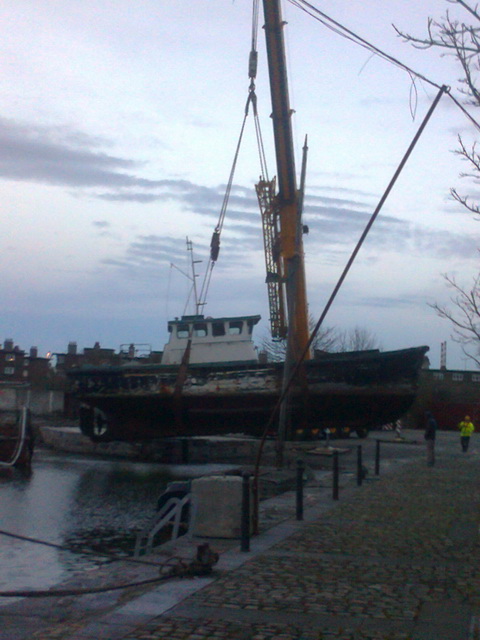
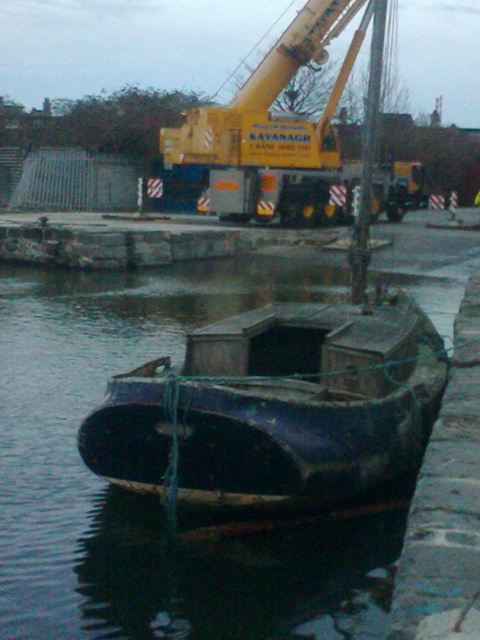
WI lifting boats

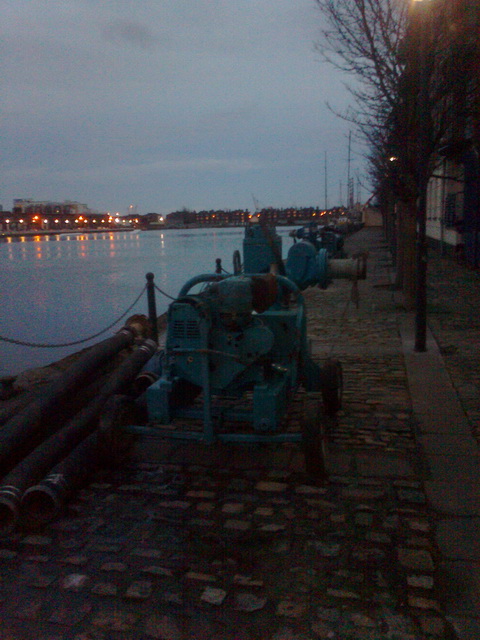
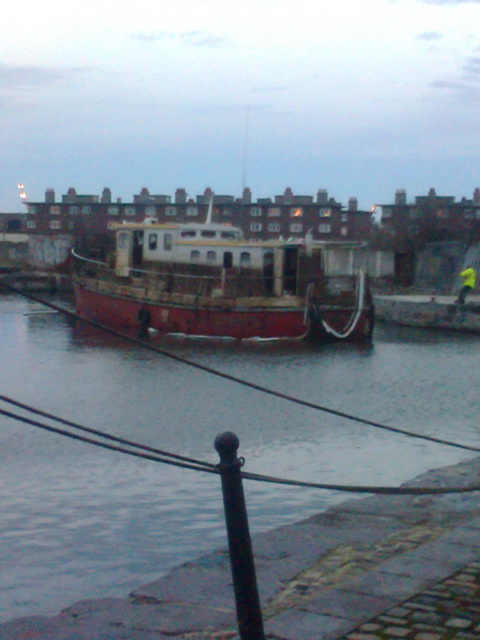
Waterways Ireland removed boats from Charlotte Quay in the Grand Canal Dock at Ringsend today.

being lifted_resize

Being lifted

getting ready_resize

Getting ready

pumps on quay_resize

Pumps on the quay

ready for the slings_resize

Ready for the slings

Thanks to Paul Quinn for the information and photos.

Money from the bog

To a small extent reclamation is now going on in Ireland; Mr M’Nab, of Castle Connell, county Limerick, has reclaimed 80 acres of the worst red bog, devoid of vegetation and 20 feet deep. It was drained, then coated with the subsoil, and the land which was not worth 2s 6d per acre is now worth 30s per acre.

Thus Robert Montgomery Martin in his Ireland before and after the Union with Great Britain third edition with additions; J D Nichols and Son, London; James McGlashen, Dublin 1848.

I have written here about Mr Macnab (that was how the spelling settled down) and his talent for extracting money from the bog at Portcrusha, which is between Castleconnell and Montpelier, Co Limerick. It seems that his achievements are still remembered — and emulated.

Incidentally, in the same work, published in 1848, Mr Martin refers to the

… large practical mind, great experience,  and Christian philosophy …

of Sir Charles Trevelyan.

“Ireland has no inland waterways …” says Minister for Transport

Those very words came from Leo Varadkar [FG, Dublin West], Minister for Transport, Tourism and Sport, in a written answer to a Dáil question on 3 December 2013.

I have, of course, quoted him selectively and out of context. The full sentence was

Ireland has no inland waterways within the definition of the EU legislation as Ireland’s inland waterways are not navigable for commercial traffic and we do not have any interconnected inland commercial transport for the purposes, or on the scale, envisaged by EU proposals in this area.

The poor man was responding to yet another question from the Pest of the Royal Canal, Maureen O’Sullivan [Ind, Dublin Central], who was continuing her misguided campaign to get public money from anywhere at all to replace Effin Bridge, the lifting railway bridge at Newcomen Bridge over the Royal Canal in Dublin 1. I reported on her campaign here, here and here, with the last of those showing that current demand for passages is less than the (admittedly restricted) supply. That being so, I cannot see how any expenditure on replacing Effin Bridge could be justified, especially in the country’s current situation and with Waterways Ireland desperate for money. I would, of course, have no objection to any voluntary fund-raising campaign that Ms O’Sullivan might initiate.

Ms O’Sullivan questioned two ministers on 3 December. She asked Leo Varadkar:

…  if his attention has been drawn to Inland Waterway Transport Funding, the Funding Guide for Inland Waterway Transport in Europe published by the European Commission’s Directorate General for Energy and Transport in 2008; the reason the 19 countries’ inland waterways systems referenced in the publication does not include Ireland; if he will ensure that any future edition of the guide will contain a country profile for Ireland including information on major inland waterways and ports together with an overview on the national inland waterways transport funding policy, funding programmes and institutions; and if he will make a statement on the matter.

The saintly and erudite minister replied:

The Funding Guide that the Deputy refers to was published following the launch of the 2006 NAIADES Action Programme, a multi-annual programme on the promotion of inland waterways transport. The Commission has recently decided to update and renew this programme until 2020. Ireland does not have a country profile in the Funding Guide as, in general, Ireland is exempt from EU inland waterways rules and proposals since they relate to waterways of a greater size and carrying a greater capacity of goods than exist in Ireland. The European Union’s inland waterway network spans 20 Member States with about 37,000 kilometres of inland waterways. Every year, these transport around 500 million tons of cargo, in particular in the densely populated and congested areas of Germany, the Netherlands, France and Belgium.

Ireland has no inland waterways within the definition of the EU legislation as Ireland’s inland waterways are not navigable for commercial traffic and we do not have any interconnected inland commercial transport for the purposes, or on the scale, envisaged by EU proposals in this area.

My Department is responsible for licensing all commercial inland craft in Ireland. There are no commercial cargo craft on Ireland’s inland waterways, apart from some small workboats. There are a number of domestic passenger boats and ships operating locally as tourist excursion vessels.

Ireland keeps a watching brief on EU inland waterways matters, mainly to ensure that any proposals do not conflict with, or overlap, the existing maritime safety regimes.

I expect that Ms O’Sullivan will be back shortly to propose the setting up of a horse-drawn barge fleet on the Royal Canal, returning Ireland to the late eighteenth century, to which the Irish left (and republicans) seem so devoted.

Her other questions were to Jimmy Deenihan [FG, Kerry North/West Limerick], Minister for Arts, Heritage and the Gaeltacht. She asked:

… if he will identify the various State agencies whose operations bear upon the management of the Royal Canal and the steps they are taking, individually or collaboratively; if he will increase commercial-leisure use of the Royal Canal since the reopening of Spencer Dock to navigation in 2010; and if he will make a statement on the matter.

… if the European Regional Development Fund has been considered as a possible source of funding towards the costs, estimated at over €5 million, of overcoming obstacles to navigation, namely, the lifting bridge and the fixed Spencer Dock bridge on the sea level of the Royal Canal; and if he will make a statement on the matter.

The patient and polite minister said:

[…] Waterways Ireland is the navigation authority for the Royal Canal and is responsible for the management, maintenance and development of the Royal Canal, principally for recreational purposes. Waterways Ireland undertook the work to re-commission the Royal Canal prior to its reopening in 2010 and continues to develop the canal and its facilities, and promote its use for recreation.

I am advised that Waterways Ireland has not sought funding to redevelop the lifting bridge referred to by the Deputy and has no plans to seek such funding at this time. Ongoing operation of the bridge continues to be kept under review with Iarnród Éireann, while Dublin City Council remains responsible for the operation of the Spencer Dock Bridge at Sheriff Street.

And rightly so.

Note that the €5 million figure referred only to Effin Bridge; replacing Sheriff Street Bridge would be another kettle of fish.

Lowtown Canal Yard is for sale

Details here.

If I won the lottery I’d buy it myself. Sad to see Robert and Caroline Few selling, after many years of service to the canal; I wish them all the best in the future.

Another tour-Limerick-by-water idea …

… but this one, unlike the rest, might actually make financial sense: it uses existing infrastructure, it probably has a low capital requirement (as the firm presumably already owns the kayaks) and it seems to offer the prospect of extra income, without much extra cost, in the off-season, with low fixed costs. Furthermore, it covers the more scenic parts of the city: the Park Canal is not, alas, one of them when seen from water level, because the banks are so high you can see nothing else.

The Limerick Post covered the venture here.

Setback for Sheugh

The likelihood that limitless wealth will result from the construction of the Clones Sheugh was reduced recently with the closure of the cruiser-hire base closest to the Ulster Canal: the Emerald Star (Le Boat) operation at Belturbet.

Perhaps, though, it reflects a wider decline in the hire business rather than disappointment at the delay in the canal’s reconstruction.

Sallins delay?

Waterways Ireland has readvertised for a contractor to build a houseboat facility at Sallins on the Grand Canal:

Waterways Ireland seeks tenders from experienced and competent contractors for the construction of a House Boat Mooring Facility in Sallins, Co Kildare.

Shannon traffic figures to September 2013

The current (November 2013) issue of the British magazine Waterways World (available online only to subscribers) has an interview with Dawn Livingstone, new CEO of Waterways Ireland. There was a question about visitor numbers:

How are boating visitor numbers holding up in the recession?

The type of boating is changing — more sports boats for example, and numbers, after an initial decline, have held steady in the cruiser hire and private boat fleets. But more customers are investing in active recreation — canoeing, sailing, rowing, and these clubs and holiday types are growing rapidly.

My sense of the types of boating is the same, but I do not know of any source of reliable data. I think it would be useful if Waterways Ireland were (somehow) to collect and then to publish data on these activities and their economic costs and benefits.

But I was amused by the statement that …

[…] numbers, after an initial decline, have held steady in the cruiser hire and private boat fleets.

I’m not sure what useful data there are for the Lower Bann, Shannon–Erne Waterway, Grand, Royal and Barrow, though perhaps enhanced enforcement of the regulations will improve the data for the last three of those waterways. For the Shannon and Erne, the numbers in the fleets are, I presume, derived from the numbers of registered vessels, but there is no annual re-registration and I am not clear how many boats that are removed from the navigation are removed from the registers.

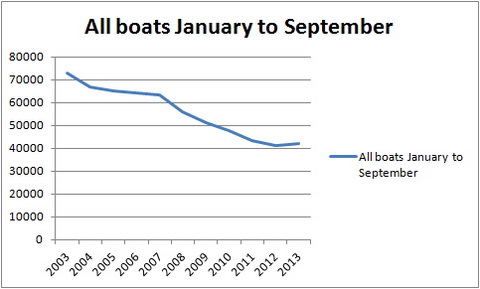
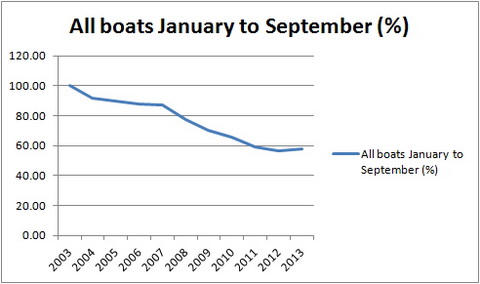
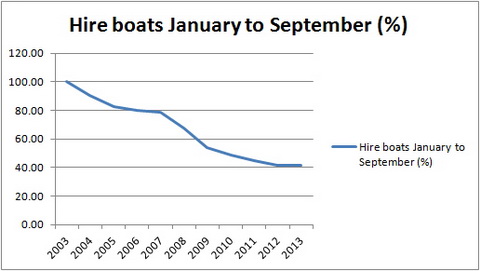
The other, indirect, measure, which applies only to the Shannon, is of passages through locks and moveable bridges. And, for hire boats, the “initial decline” has been 60% since 2003. If the numbers are now holding steady, it is at a very much lower level than ten years ago.

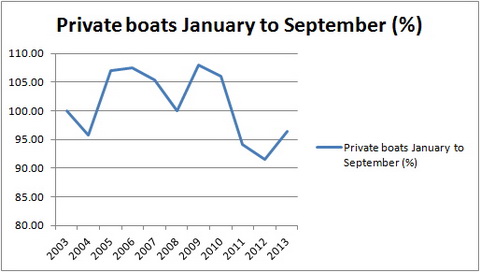
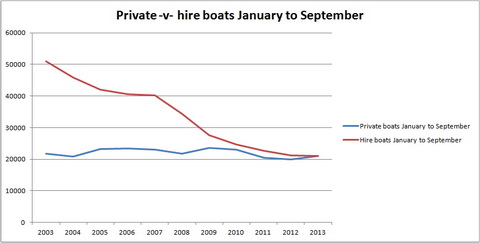
I was able to report in August that the better weather in July seemed to have led to an increase in the number of passages by private boats [the usual caveats apply]. Furthermore, for the first time that I knew of, the number of passages by private boats in the first seven months of the year exceeded the number of passages by hire boats in the same period.

I now have the figures for two more months, August and September, kindly supplied by Waterways Ireland, who are not to blame for my delay in getting the information up here.

All boats JanSept nos_resize

Look! An increase!

All boats JanSept percent_resize

Total passages are now almost back up to 60% of the levels of ten years ago

Hire boats JanSept percent_resize

Hire boat numbers are down by only a tiny amount

Private boats JanSept percent_resize

Private boat numbers are up

Private -v- hire JanSept nos_resize

Hire boat numbers are slightly above private boat numbers

Private boat numbers are ahead of hire in the three main summer holiday months of June, July and August and, although the numbers are tiny, in the winter months as well; hirers are ahead in spring and autumn.


Effin stats

I wrote here about Maureen O’Sullivan’s questioning of ministers about Effin Bridge, the lifting railway bridge below Newcomen Bridge on the Royal Canal in Dublin. It seems that she would like a drop-lock to replace the bridge, thus enabling boats to pass under the railway at any time without interfering with the operation of the trains. Which would be very nice, but that it would cost over €5 million and cause significant disruption to the railway during construction.

I was distressed by Ms O’Sullivan’s failure to make any sort of economic case for the drop-lock or for any other measure that might allow for free movement of boats on that section of the Royal Canal. I said:

As the expenditure on reopening the Royal Canal is a sunk cost, I am all in favour of making its use easier — provided that it can be demonstrated that (a) there is a demand for increased use, (b) such increased use will have benefits that outweigh the costs of any improvements and (c) no alternative investment offers better returns. As far as I can see, Ms O’Sullivan has demonstrated none of the three: indeed I see no evidence that she has even considered them.

Ms O’Sullivan’s position might be described as favouring an increase in the supply of possible passages along that section of the canal, but I thought it might be interesting to know what the demand for such passages was, so I asked Waterways Ireland how many boats had passed under Effin Bridge in 2013.

I was wrong about the number of days on which the bridge was lifted: nine lifts were available altogether. Six were on Tuesdays, two on Saturdays and one on a Sunday (to facilitate the Dublin boat rally):

Tuesday 16 April 2013:           0 boats
Tuesday 30 April 2013:         10 boats
Sunday 5 May 2013:            24 boats
Tuesday 21 May 2013:           0 boats
Saturday 1 June 2013:           8 boats
Tuesday 18 June 2013:           2 boats
Saturday 20 July 2013:          3 boats
Tuesday 13 August 2013:       7 boats
Tuesday 17 September 2013:  4 boats

So that’s 58 boats in a year.

I asked what the cost was: I was told that Irish Rail charges €1200 per weekday lift and €2000 per weekend lift. I presume that Waterways Ireland itself incurs other costs, perhaps overtime at weekends, but I don’t know what they are. The cost per boat for each lift was:

Tuesday 16 April 2013:           0 boats: lift cancelled as no boats wanted it
Tuesday 30 April 2013:         10 boats: €120.00 per boat
Sunday 5 May 2013:            24 boats: €83.33 per boat
Tuesday 21 May 2013:           0 boats: lift cancelled as no boats wanted it
Saturday 1 June 2013:           8 boats: €250.00 per boat
Tuesday 18 June 2013:           2 boats: €600.00 per boat
Saturday 20 July 2013:          3 boats: €666.67 per boat
Tuesday 13 August 2013:       7 boats: €171.43 per boat
Tuesday 17 September 2013:  4 boats: €300.00 per boat

The total charged to Waterways Ireland (not to the boaters) by Irish Rail was €10800.00.

Suppose that a drop-lock had been built for €5000000. Would it be worth investing that amount to save an annual expenditure of €10800? I suspect not, although I am open to correction by anyone capable of calculating NPVs or other relevant measures.

It seems to me, though, that the case for any capital expenditure is weak while demand for passages is lower than supply. Perhaps Royal Canal enthusiasts might work on attracting more boats to the Dublin end, whether from the Shannon end or from the Grand and Liffey.