Tag Archives: Waterways Ireland

DUKWs? Fiat lux

I have written here about a series of misfortunes suffered by DUKWs in Liverpool and London. On 16 June 2013 I put up some photos of DUKWs in Dublin and Liverpool; I pointed to what seemed to me to be two differences between practices in the two cities:

First, before they enter the water at Grand Canal Dock, Ringsend, the DUKWs are fitted with extra buoyancy in cylinders that slide into racks along their sides. I saw the VikingSplash crew removing the cylinders from the yellow DUKW; it took only a couple of minutes, and I presume that it didn’t take much longer to put the cylinders on.

Second, the Dublin passengers are issued with buoyancy aids before they take to the water. I can’t see any buoyancy aids on the Liverpool passengers, although it’s possible that they are out of camera shot.

There are links on that page to photos, news reports and a seriously scary video of the sinking of a DUKW in Liverpool. Then, in September 2013, a DUKW went on fire on the Thames; my brief report and links here. In October 2013 the UK Marine Accident Investigation Branch issued a safety bulletin (my report here, with links) pointing to foam buoyancy as a common factor. The Liverpool DUKWs did not have enough buoyancy to keep them afloat if they started taking water and MAIB thought it would be impossible to get enough into them. On the London vessel,

… the most likely cause of fire was the action of the rotating drive shaft (or other moving parts) on the oil contaminated surfaces of the buoyancy foam blocks.

In November 2013 I noted that the wearing of lifejackets had been discussed in London and I commented on the policy of the Dublin operator, VikingSplash:

The point that strikes me is that, in both UK accidents, passengers had little time to don lifejackets and would have been trying to put them on in a confined space and under less than ideal conditions. It seems to me that Viking Splash’s policy [having passengers don lifejackets before taking to the water] is the right one.

In December 2014 the MAIB published its report into the two accidents. There’s a Guardian news report here [h/t gjb] and you can download the MAIB’s full report and annexes from this page. The London and Liverpool accidents are covered in the same report.

It’s well worth reading and pulls (as far as I could tell) no punches, even tearing strips off the Maritime and Coastguard Agency and the Vehicle and Operator Services Agency, both within the UK Department for Transport and both involved because the DUKW is an amphibian.

I took three main points from the report.

The Irish approach

First, the Irish authorities seem to have thought seriously about the safety problems. My understanding of the buoyancy requirements was mistaken: the UK DUKWs had added buoyancy (although not enough, and adding more foam caused fire) and the Irish buoyancy cylinders are not designed to keep the vessel afloat. Here’s what MAIB says:

In Ireland, APV operators have been permitted to operate vintage DUKWs without having to provide any residual buoyancy. To mitigate the consequences of serious flooding, the Irish regulator required the operators to:

  • Fit external buoyancy tubes designed to slow the sinking process and make the vehicle sink bodily [my emphasis].
  • Retract the canopy roof and open the side curtains prior to entering the water.
  • Require passengers and crew to wear PFDs while on the water.
  • Provide a fast rescue craft, rescue crew and an inflatable liferaft at the slipway.
  • Limit operations to a non-tidal area.

This approach focused on passenger survivability by reducing the risk of entrapment and drowning, rather than vehicle survivability, and introduced several of the interim measures recommended by the NTSB following the sinking of Miss Majestic.

The Irish model demonstrates that open topped APVs can be operated successfully in similar weather conditions to those experienced in the UK, and that passengers are willing to wear PFDs.

So big it up for the Irish Maritime Administration.

The speed of the sinking

Second, if you’ve seen the video of the Liverpool sinking you may have been struck by its speed. In both Liverpool and London passengers had very little time to get out and the report’s synopsis says

In both instances, the crew had little time to co-ordinate the evacuation process and the confined nature of passenger spaces made it almost impossible for them to control or assist the passengers.

And in 4.3 Common safety issues:

8.  It was extremely fortunate that all on board WQ1 and Cleopatra were able to evacuate into the water unharmed. In both cases the passengers were forced to act on instinct and exit the vehicles under their own initiative.

Any of several issues could have cut the time available and “the risk of entrapment and the likelihood of loss of life would have been considerably higher”.

So Figure 63 of a Dublin DUKW doesn’t just show the external buoyancy cylinders: the passengers are wearing buoyancy aids, there is a crewman already stationed at the stern and the side and roof canopies are open, all giving more chance of escape.

I’m not in any position to assess the overall safety of the Irish DUKW operation. What interests me here is a more general point about the evacuation of passengers from trip vessels: getting a large number of people out of a small space in a short time is not easy. And the recent problem of getting people off the Norman Atlantic didn’t make me feel any better.

Photo

Third, I am delighted that my photo of a DUKW in Liverpool was useful to the  UK Marine Accident Investigation Branch (see the report’s Figure 16) but they really should have asked for permission to use it.
 

Royal water

An interesting piece of information from Waterways Ireland’s feasibility study on the restoration of the Longford Branch of the Royal Canal. We learn on page 44 that the Royal Canal needs, on average, 10 million gallons of water per day to cope with “lockages, leakage, seepage and evaporation” and that the current supply arrangements, with much pumping, are costing €300,000 a year.


Sorry, Longford

Waterways Ireland’s Feasibility Study into the Restoration of the Longford Branch of the Royal Canal is available for download [7 PDFs: main report + 6 appendices]. Skip straight to page 59:

6.5 Recommendation

Given the current financial climate and because of the associated costs, environmental issues and uincertainty regarding planning approval it is not recommended to pursue this project any further at this time.

The recent work undertaken in regard to the shared walkway/cycleway has protected the asset as a publicly owned recreational amenity and it is recommended that any outstanding property issues be resolved and finalised in order to complete the protection of the asset.

I hope that admirable recommendation survives the pre-election period.

By the way, there’s a snail ….

The Black Bridge at Plassey

I am repeating here a point I made in response to a comment on this page. I do so because the point is, I think, an important one: some readers don’t check the comments and might miss this.

I have an imperfect copy [with some lines missing] of an indenture made on 8 July 1949 between the Minister for Finance and Limerick County Council under which the Council leased from the Minister

… all that those parts of the lands of Garraun and Sreelane on which Plassey Bridge abuts on both banks of the River Shannon and the site and piles of said Plassey Bridge together with said Plassey Bridge […].

I am not a lawyer, so my interpretation may be misleading, but I think that there are two points of interest.

The first is that, under the indenture, the Council is obliged to “well and sufficiently repair cleanse maintain amend and keep the hereby demised premises”, which includes the bridge. The Council is also required to “use the said demised premises as a public highway”.

The second is that, if the Council fails to do so, the Minister, and his agents the Commissioners of Public Works in Ireland, are entitled (after giving due notice) “to enter upon the hereby demised premises and to execute and to do the necessary repairs and works and the Lessees [ie Limerick Councy Council] shall repay the expenses of such repairs to the Lessor on demand […]“.

As far as I can see, Limerick County Council is in breach of its agreement with the Minister for Finance, and that Minister is entitled to repair the bridge and charge the Council for the cost.

If only there were a Minister for Finance who had an interest in Limerick (or in bridges) ….

Willie Penrose notices the cuts

It is nice to know that at least one politician has spotted the most important issue affecting Waterways Ireland. Here’s what the minister told him about the 85% of WI’s current budget that comes from her department:

Funding allocated to Waterways Ireland 2011-2014
Year €m
2011 €30.300m
2012 €27.099m
2013 €25.463m
2014 €24.183m

Now, Willie, ask her how much of each year’s allocation is gobbled up by pensions.


Fuel consumption

The Dublin Monitor of 3 December 1839 quoted the celebrated Dublin-born adulterer and polymath Dionysius Lardner [who said that Victorians were prudish?] as saying

A train of coaches, about eighty tons, and transporting 230 passengers, with their luggage, has been taken from Liverpool to Birmingham, and from Birmingham to Liverpool, the trip each way taking about four hours, stoppages included. The distance between these places by the railway is ninety-five miles.

This double journey of 190 miles is effected by the mechanical force produced in the combustion of a quarter of a ton of coke, the value of which is 6s.

To carry the same number of passengers daily between the same places by stage coaches, on a common road, would require twenty coaches, and an establishment of 3,800 horses, with which the journey in each direction would be performed in about twelve hours, stoppages included.

Dr Lardner on the Steam Engine

The fuel consumption figure seemed odd to me, because I had recently read about the fuel consumed by a steamer on the Shannon in 1851. This was evidently one of the two screw steamers put to work by the Grand Canal Company in 1851, on which Sir John MacNeill conducted the experiments described here.

A luggage boat propelled by steam, on the screw principle, has been for the first time placed on the waters of the Shannon between Shannon Harbour and Limerick, taking in Portumna, Dromineer, Williamstown [probably Hollands], Killaloe, and the river and canal, to the terminus lock at Limerick.

As a specimen of aquatic architecture, the boat presents no very peculiar or striking features; it is built of iron, with a flush deck; it is capable of carrying about thirty tons, and the rate at which it goes on the canal, is about three and a half miles an hour, whether singly, or as a tug boat with two or three heavy lighters after it; whilst on the broader waters of the river, it is capable of going at a rate of seven and a half miles an hour!

This phenomenon may be explained by the fact that on the canal, which is comparatively narrow, there is no expansion of the waters displaced by the boat, whilst there is always a considerable swell raised about the prow, causes which conspire to retard her speed, and which do not operate when she is on the river.

The expense of working this boat is considerably less than that of the ordinary boat drawn by horses. A ton of coal supplies the engine between Limerick and Shannon Harbour; whereas the horsing alone of a boat between Limerick and Killaloe amounts to something about ten shillings.

The experiment, however, has not been sufficiently tested; and there is some doubt that it may succeed according to the expectations of its projectors. Just now several industrious persons with horses are employed on the canal: and it is to be hoped that in this season of dearth and destitution, no hasty means will be adopted to force them for subsistence on overgrown poor rates.

Limerick Reporter 27 May 1851

The Limerick Reporter article does not say, and I cannot determine, whether this was  Towing steamer No 2 [Appendix 3 in Ruth Delany The Grand Canal of Ireland David and Charles, Newton Abbot 1973], the twin-screw vessel which MacNeill, confusingly, called the No 1 Boat, or the single-screw Towing steamer No 1, which MacNeill called the No 2 Boat.

But I was surprised that the railway train could do 190 miles on a quarter ton of coke while the steamer required a ton for the (roughly) 54 miles from Shannon Harbour to Limerick.

On consulting the online Gutenberg version of the seventh edition of Dionysius Lardner The Steam Engine explained and illustrated; with an account of its invention and progressive improvement, and its application to navigation and railways; including also A Memoir of Watt Taylor and Walton, London 1840, I found that there were some differences between that and the Dublin Monitor‘s version:

A train of coaches weighing about eighty tons, and transporting two hundred and forty passengers with their luggage, has been taken from Liverpool to Birmingham, and back from Birmingham to Liverpool, the trip each way taking about four hours and a quarter, stoppages included. The distance between these places by the railway is ninety-five miles.

This double journey of one hundred and ninety miles is effected by the mechanical force produced in the combustion of four tons of coke, the value of which is about five pounds.

To carry the same number of passengers daily between the same places by stage-coaches on a common road, would require twenty coaches and an establishment of three thousand eight hundred horses, with which the journey in each direction would be performed in about twelve hours, stoppages included.

So 240 passengers, not 230; 4¼ rather than 4 hours — and most significantly 4 tons of coke, costing about £5, rather than ¼ ton costing 6s [£0.3].

Did the Dublin Monitor get it wrong — and, if so, why and how? Or were the lower figures in some earlier edition of Lardner’s work?


The agency model

I have been told that, until recent years, travel agents in Germany and elsewhere would buy packages of weeks on Irish hire-boatsa and then sell them on to their own clients. I have also been told that this “agency model” ceased to be used [or became less used], perhaps because of the growth of internet booking. And it has been suggested that this was one of the factors in the decline of the Shannon hire-boat trade, to which I have repeatedly drawn attention [most recently here].

I do not know whether this phenomenon has been documented or formally studied. If it has, I would be grateful if any reader can point me to the documents or studies. I would also welcome other Comments on the proposition.

Packaging and marketing

I mention it now because, when launching the Shannon Blueway project, the waterways minister Heather Humphreys said:

The launch of the Blueway will allow local businesses [to] capitalise on an increase in demand for transport, equipment hire, accommodation and entertainment.

I think that the Blueway is an excellent idea, but I am concerned about whether small local companies will be able to package and market it effectively to overseas tourists. If the long-established cruiser-hire-firms were or are finding effective marketing difficult, why would (say) a canoe- or bicycle-hire-firm in Drumshanbo find it any easier?

Marketing to anglers

There was an interesting discussion at the Joint Oireachtas Committee on Transport and Communications about “Depletion of Inland Fish Stocks and Impact of Estuary Poaching: Inland Fisheries Ireland” on 22 October 2014. Note in particular the contributions of Dr Ciaran Byrne from 10:25 onwards about how Inland Fisheries Ireland markets Irish angling to overseas anglers.

What struck me was not that IFI uses any particularly magical marketing methods but that it is dealing with a well-defined interest group: people who are committed to a particular activity and have invested heavily in it (buying rods and stools and nets and umbrellas and maggots and whatever else anglers use).

Identifying potential customers

Anglers form one segment of the market for inland waterways holidays, but the task of selling to other segments is harder if they lack a single compelling interest. Hence, no doubt, those rather demented attempts by Fáilte Ireland or Tourism Ireland to categorise potential customers as ‘Sightseers and Culture Seekers’, ‘Family & Loved Ones’, ‘Relaxers’ and ‘Outdoor Actives’. None of their interests strikes me as being exactly compelling: there are several countries where you can relax, engage in outdoor activities or look at sights.

What you really need is obsessive customers: folk, with money to spare, who are really interested in one thing. Then you entice them to your area and take their money from them: not, as Brian Ború would have done, by hitting them over the head and stealing it, but by selling them overpriced goods and services.

Lough Derg

If you don’t have obsessive customers, who are compelled by their inner urges to dangle maggots in your waters (or whatever else turns them on), then you might try offering a compelling attraction: something that is so interesting that folk put it on their to-do lists. Unfortunately, as Fáilte Ireland’s Lakelands Lough Derg Roadmap [PDF, 6.7MB; well worth reading] admits,

Lough Derg does not have suffient key attractions that act as a draw to the area.

The same thought has often struck me. As you drive around the lake, you see signs pointing towards it. But suppose you’re a casual tourist who hasn’t already booked an activity. When you get to the lake, about the only thing you can do is look at the water (which becomes less interesting after a while) or at the jolly people enjoying themselves on boats (ditto).

You can, in some places, go to a pub or eatery, but you don’t need to come to Ireland to do that. Or you can paddle. If you fish, you can fish, but I’m trying to think of things for non-anglers. In Killaloe, you can take a boat trip; in Dromineer, you can hire a sailing boat; in Mountshannon, you can visit Holy Island. But there is nothing you would come to Ireland for: nothing you can’t do in other places.

Roadmap remedies

The Roadmap proposes these remedies:

The following three key tourism products are proposed:

  • A Discovery Point and Trailhead at the Portroe lookout
  • A Lough Derg Canoe/Kayak trail
  • An enhanced offering and facilities at University of Limerick Activities Centre (ULAC).

Two additional tourism products are proposed:

  • Portumna eco-park (masterplanning required)
  • Publications to promote and support active enjoyment of Lough Derg and surrounds.

There is, alas, another set of categories of potential visitors:

The three market segments identified with the best potential for delivering international visitors to Lough Derg have been identified as Curiously Cultural, Great Escapers and Nature Lovers.

Other, less exploitable, market segments are identified too, but I can’t bring myself even to name them.

Finding the punters

I’d hate it to be thought that I was a marketing expert, but it seems to me that this segmentalisation is coming at things from the wrong end. In effect, it’s saying “We have these things; what sort of person might be induced to buy them?” Then you give each of those sorts of person a category and say that you’ve found your market.

But compare that with what the fisheries folk do. They can identify magazines that anglers read, maybe (for aught I know) television programmes they watch, trade shows they visit. Identification is easy: the titles will include words like “fishing” or “angling”.

But what magazines — other than those on the top shelf — have “Curiously Cultural” or “Nature Lovers” in the title? How do you track down “Great Escapers”? It seems to me that these categories might help you to tailor a message that is broadcast to large audiences through mass media: in such cases it doesn’t matter if you appeal to only 1% of the audience, provided that that audience is large enough. However, that’s not an option available to those with small budgets: they need cheaper marketing through channels that will provide much higher returns.

Small operators

And that’s where we come back to the fact that most of the potential tourism operators around Lough Derg are pretty small. Who is going to put together packages of activities that will appeal to the curiously cultural? I’m interested only in filling my B&B and you’re interested in hiring out bicycles. I’m happy to refer customers to you and vice versa, but are we going to get together to provide packages and to share our marketing budgets? There is a Lough Derg Marketing and Strategy Group, but it seems to be dominated by representatives of public sector bodies, and there is a limit to what they can do.

To compete on a European scale, what’s really needed is a large commercial organisation. I suggest, therefore, that the best thing to do would be to get Goldman Sachs to advise on how Lough Derg might be privatised.

Second-best would be the formation of a tourism cooperative.


Royal Canal water supply

On 26 November 2012 I noted that

The Royal Canal water supply applications have been approved by An Bord Pleanala. There were two separate applications […] but they were in effect treated as one.

There were conditions attached, but I concluded that

If I remember correctly, the amount of water available from Lough Ennell will not always provide enough (eg in a dry season) to keep the canal full. Still, this is a significant advance for Waterways Ireland and for Royal Canal enthusiasts.

So here we are, almost two years later, and the work of providing a supply from Lough Ennell to the Royal Canal, reckoned to be about a five-month job, has doubtless been long completed, no?

No.

The work has not yet started and Waterways Ireland will be lucky if it gets done within the next year.

As I understand it — and if, Gentle Reader, you have more information, do please leave a Comment below (your name can be kept out of public view if you like) — there are three sources of delay:

  • first, I understand that there is a technical issue about one of the conditions attached to the approval; it is felt that the condition is unworkable, but that getting it changed might take some time. I presume it’s one of the conditions 2(a) to 2(d) that I quoted two years ago and, looking at the proposed orders published in the press [PDF], I suspect it might be the requirement to maintain the lake level at or above 79.325 mOD Malin Datum. However, I don’t really know
  • second, Waterways Ireland took over Clonsingle Weir, at the outlet from Lough Ennell, by Compulsory Purchase. Owners of mills, who generate electricity from the Brosna, have submitted claims for compensation. I understand that an arbitration hearing, lasting four days, is scheduled to be help in May 2015
  • third, responsibility for the scheme has moved from Westmeath County Council to Irish Water. Which may have other things on its mind.

Irish Water has published its proposed Capital Investment Programme [PDF] but Appendix 1, the Investment Plan Project Summary, is in a separate file [PDF]. Category B is headed Review Scope and Commence Construction and it includes

Mullingar Regional Water Supply Scheme (G) … Lough Ennell Abstraction.

I can’t work out what “(G)” means. A few items are so marked; a few others are marked “(H)”; most items have neither.

The Capital Investment Programme [CIP] document says:

 The CIP is dominated by contractual commitments entered into previously by Local Authorities, and which have now transitioned to Irish Water. In the 2014-2016 period, Irish Water will fund these contracts to completion and bring forward programmes and prioritised projects to commence. At the same time, it will progress a large portfolio of projects that are at the planning and design stage, reviewing their scope, budgets and, where appropriate, timing to favour maximising the performance of the existing assets through intensified capital maintenance that might allow deferral of major capital investment.

Emphasis mine. So that raises the possibility that Irish Water will decide not to fund the abstraction scheme but will rather opt to pay for continued pumping.

It is, of course, quite possible that I have misunderstood these difficult matters, so I will be glad to hear from anyone with better information.

Incidentally, reviewing Irish Water’s documents suggests to me that there are people there who know what they are doing and who have the expertise to manage large and complex operations. That differentiates them from the politicians in government and opposition, few of whom (as far as I can see) have any experience of running anything more complex than a parish social.


Airholes

My attention was recently drawn to an article [PDF] by Mike Clarke about airholes.

The article is in Clogs and Gansey, the newsletter of the Leeds & Liverpool Canal Society, of which Mike is Founder and President. He is an extraordinarily knowledgeable person and it is well worth while looking around his website: for instance, there’s some material of Irish interest here, a list of publications here and material about the Leeds & Liverpool Canal here including a really excellent document about locks [PDF].

But back to the airholes.

Not being an engineer, or at all technically competent, I’m always reluctant to try explaining these mysteries, so I’ll welcome corrective Comments from any more technically-minded folk.

Water levels

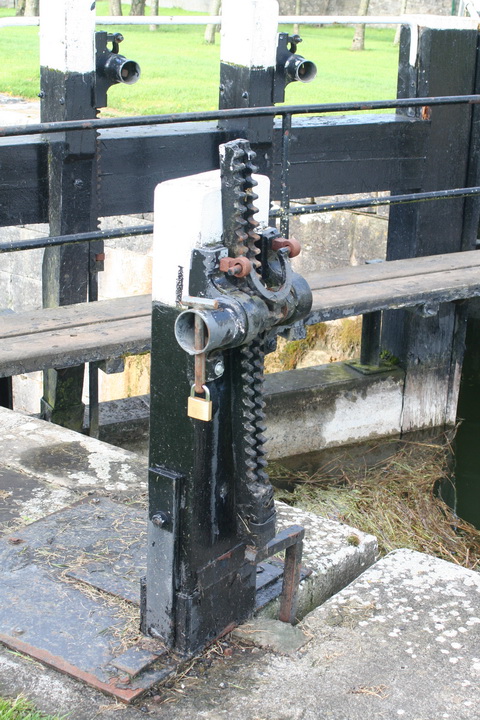
If the water level on the upstream side of a lock gate is higher than that on the lower, the gate will be difficult to open. If the gate is the tail gate [bottom or lower gate] of a lock, you can raise a rack [paddle] and allow water to flow from the upstream side, which is the chamber of the lock, to the downstream side, thus making a level and allowing the gate to be opened easily.

If the gate is the breast gate [head or upper gate] of a lock, the same applies: you can lift a rack [paddle] in the upper gate, allowing the excess water to flow into the lock chamber.

However, the relationship between the heights of the two gates (or pairs of gates) then becomes important: if the breast gates are higher than the tail gates, the water level in the lock chamber will not be able to reach the height of the water above the lock (at least until you’ve drained down the entire level [pound] back to the next lock upstream).

But for efficient operation, you want to reduce the amount of adjustment that has to be done after the boat reaches the lock but before it can enter the lock chamber. You want a system that is, as far as possible, automatically self-adjusting. That means, in particular, one that ensures that the level of water above the lock is not too high.

Byewashes

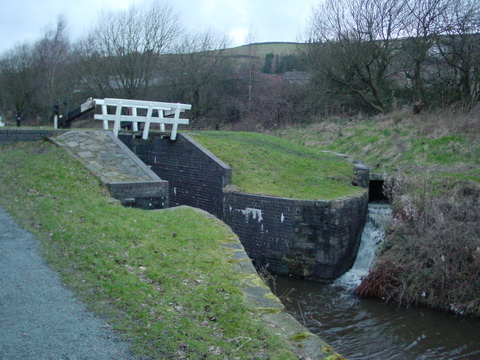
On many English canals, that is done by using byewashes.

Byewash on the Huddersfield Narrow Canal (E) at Marsden

Byewash on the Huddersfield Narrow Canal (E) at Marsden

As far as I know, though, few Irish canal locks have them, and I have heard British boaters comment on their absence. If memory serves, the canal (Leitrim) end of the Shannon–Erne Waterway does, but I have no suitable photo. I should confess that I have no idea what proportion of Irish and English canal locks are so equipped; I will be glad if anyone who can supply, or point to, the information will leave a Comment below.

Airholes

Mike Clarke’s PDF article, to which I pointed at the top of this page, provides a possible explanation for the absence of byewashes on Irish canals. He says that airholes were used instead on canals “built or influenced” by William Jessop. Jessop worked on the Grand Canal as assistant to John Smeaton from 1773 and was consultant engineer to the Grand Canal Company until 1802 [Ruth Delany The Grand Canal of Ireland David & Charles, Newton Abbot 1973].

Mike Clarke also says that Jessop trained John Killaly: Killaly joined the Grand Canal Company in 1794 and became its engineer in 1798 [Delany op cit]; furthermore, his designs were used on the Royal Canal from Coolnahay to the Shannon [Ruth Delany and Ian Bath Ireland’s Royal Canal 1789–2009 The Lilliput Press, Dublin 2010].

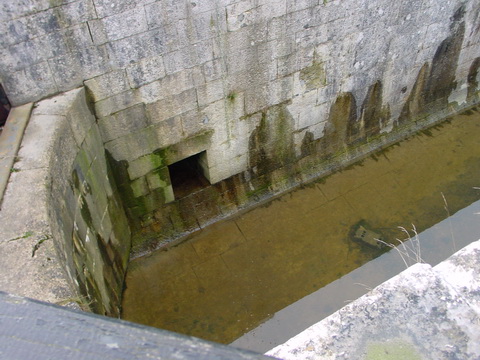
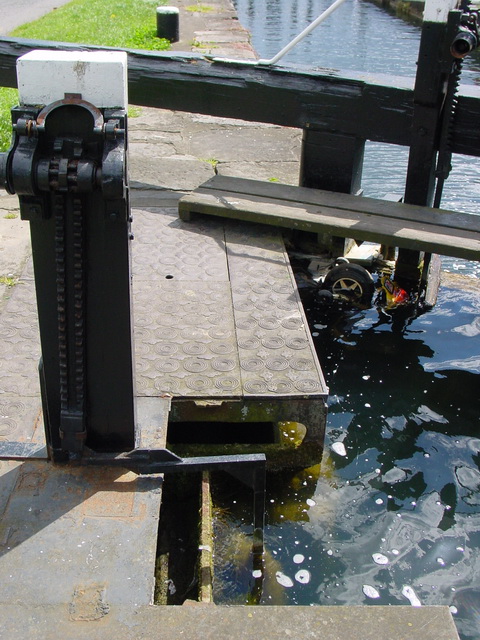
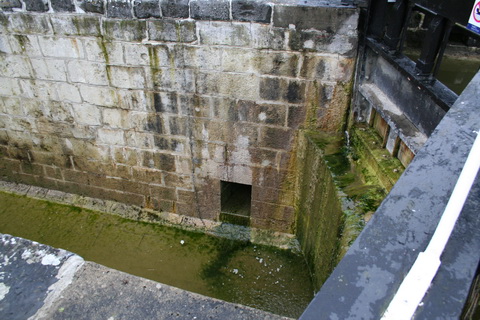
If I’ve understood Mike Clarke’s article correctly, the airhole system uses the channel for the ground paddle [land rack] sluice instead of building a separate byewash channel. From his photograph, I gather that there is a separate letterbox-like slot in the recess for the rack mechanism: I presume that excess water flows in through the slot, falls to the level of the sluice or channel from there to the lock chamber and thus flows into the chamber. If the tail [lower] gates are left open, or with one rack [paddle] lifted, the water can then flow out into the lower level.

Questions about Irish locks

Is my understanding correct?

What proportion of locks on each Irish waterway are equipped with airholes?

Are they still maintained and used?

Belmont Lock May 2009 IHAI 5_resize

Land rack [ground paddle] outlet, Belmont Lock, Grand Canal

Royal Lock 43 Killashee 18-02-2007 01_resize

Ground paddle [land rack] outlet, Lock 43 Killashee, Royal Canal

Royal Lock 6 02_resize

Possible inlet, Lock 6, Royal Canal

The next three photos were taken at Coolnahay, on the Royal Canal, during the period of very low water levels in 2012.

Coolnahay in drought April 2012 08_resize

Letterbox-like slot at Lock 26, Coolnahay, Royal Canal. I must look for similar features on Grand Canal locks and photograph them (if they exist)

Coolnahay in drought April 2012 19_resize

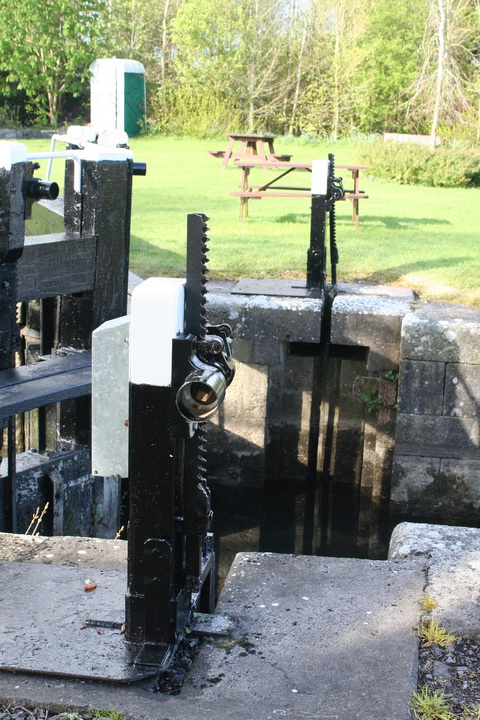
A second slot forward of the first (hidden by the land rack mechanism in the previous photo)

Land rack locked open at Lock 35_resize

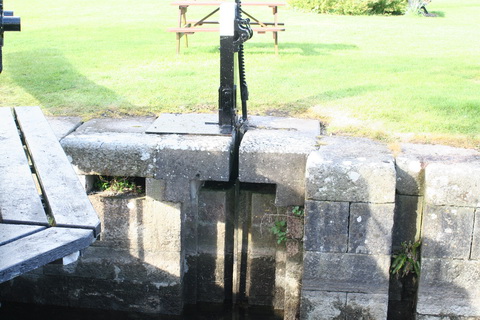
Land rack mechanism locked slightly open: the slots were well above the water level at the time

It is of course entirely possible that all of this is so obvious that everybody else already knows all about it, but that I just didn’t understand what I was looking at. I read WI’s Heritage Survey of the Royal Canal [PDF], but it didn’t say anything about this sort of thing: or at least if it did I didn’t spot it. The report uses some non-standard terminology [eg “head gates”] so I may have missed its identification of the canal’s water-management features.

If, Gentle Reader, you know of the existence of papers or other published materials on these arcana, do please leave a Comment and, if possible, relevant links to online sources. It seems to me that there is a shortage of information about these technical matters as they apply to Irish waterways; it would also be nice if we were able to say which technologies were applied when to which waterways. I do not know whether, for example, we can assume that the lock gate designs in use today were always used on all Irish waterways.

The captain and the perjurer

Mary Meehan’s was a dramatic story.

In April 1847 she had gone to the house of William Dwyer at Cuphaunhane [Cappanahanagh?]. She heard voices inside and stopped to listen. The door opened and William Dwyer ran out. She went in and saw William’s wife Mary dragging the seemingly lifeless body of Ellen Dwyer, William’s sister, into the room. Mary Dwyer then ran off and Mary Meehan raised Ellen’s head; she saw blood on the left side of the head.

She went home and told her husband about it; he told her to say nothing. About two hours later she was in the haggard and saw William and Mary Dwyer digging at the brink of the ditch. She gave a deposition to Edward J Bell RM on 8 October 1849, adding on 16 December 1849 that, if Bell were to dig in the field near the Dwyers’ house, or in the nearby quarry, he would find the remains of a human body.

Bell, with Mr Head and the Castleconnell police, dug more than forty times in the field in question, but with no success. They then drained four feet of water from the quarry and found a skull and some human bones in the mud. Constable Swan delivered them to Dr Thomas Travers Riordan at Castleconnell.

Dr Riordan thought that the skull was more likely to be that of an old woman than that of a fifteen-year-old girl. The bones had been in water or earth for much more than two years and belonged to a tall muscular person: the skull and the bones were almost certainly from two different people. The church at Abington was close to the quarry.

On 14 March 1840 Mary Meehan was indicted …

… for that she with felonious intent to injure William Dwyer …

… did swear to an untrue story. She was described as …

… a woman of about forty years of age, […] dressed in a blue cloth cloak, clean white cap, and white woollen shawl, as the wife of a farmer in comfortable circumstances. Her appearance was not unprepossessing, but there was a peculiarly sinister expression about the eyes.

Mr Bell had taken depositions from William and Mary Dwyer; they contravened Mary Meehan’s statements but she stuck to her story. No witnesses supported her.

William Dwyer said that he had sent his sister to England [en route to America?] that April: his wife had accompanied her to Killaloe and seen her aboard one of the [City of] Dublin Steam Packet Company’s boats. He had not heard from her since then.

Mary Dwyer said that she and her sister-in-law had slept at the house of Mary’s father Michael Healy, in Killaloe, the night before Ellen’s departure. The following morning they went to the house of Nancy Preston, who accompanied them to the steamer to help Ellen get a cheaper fare. Michael Healy confirmed that evidence, as did Nancy Preston. Mary Dwyer said that she was on board with her sister-in-law until the boat left.

The final witness was the steamer’s captain, Captain Winder. He said he remembered the circumstances perfectly and had charged Ellen only 4s 3d for the passage to Dublin.

His Lordship charged, expatiating on the enormity of the prisoner’s offence, and the revolting exhibition of the remains of the skull and bones of a human being on the table, and adding that from the evidence they could hardly hesitate in finding a verdict of guilty.

The Jury returned a verdict of Guilty accordingly.

The Limerick Reporter and Tipperary Vindicator 15 March 1850