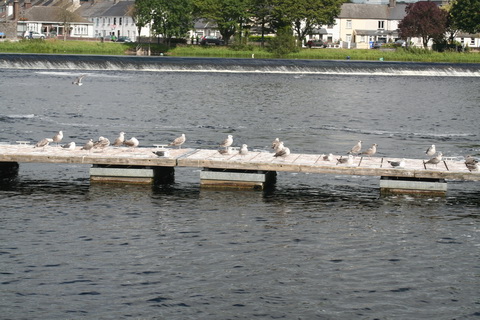
Tag Archives: Waterways Ireland

WI and the RoI budget for 2016

Budget documents [available here] include the Part IV Estimates for Public Services 2016 [PDF]. The Summary of Gross Expenditure (Capital and Current) by Ministerial Vote Group shows that the Department of Fairytales [aka Arts, Heritage and the Gaeltacht], RoI parent of Waterways Ireland, is to get an increase in its budget.

Its forecast outturn for 2015 matches its estimate for the year at €277,434,000, of which €215,854,000 is current and €61,580,000 is capital spending. However, the estimates for 2016 show €234,430,000 current + €76,000,000 capital = €310,430,000 total, an increase of €32,996,000. Current spending is up 8.6% and capital by 23.4%; total spending is up by 11.9%. Perhaps the extra €14,420,000 in capital spending is to extend Saunderson’s Sheugh to Clones?

Skipping the numerous tables that repeat more or less the same gen in different ways, and skipping too the unimportant government departments, we zoom forward to the details of the Department of Fairytales estimates.

But there we find, alas, that while the department as a whole has secured lots of extra lolly — and it’s going to be shovelling 18% more to the luvvies [Arts, Culture and Film], 11% more to heritage and 3% more to the BéalBochters — it intends to cut spending on North-South Cooperation, which is where Waterways Ireland gets its money.

The 2015 estimate for NSCoop current expenditure was €35,072,000; the 2016 estimate is €34,925,000, which is a cut of only about half of one per cent. But capital spending on NSCoop is down almost 20%, from €3,487,000 to €2,799,000, and total spending down 2% from €38,559,000 to €37,724,000.

The NSCoop figures are “subject to the North-South Ministerial Council”, which means that the (southern, Fine Gael) Minister for Fairytales has to persuade the (northern, Sinn Féin) Minister for Marching Bands that the cross-border language and waterways bodies aren’t getting any increase in their funding from the Free State, at least not while there is an election to be won. However, HM Devolved Administration didn’t seem too keen on allocating extra money to waterways last time I looked.

Regular readers will not need to be reminded that 85% of WI’s current budget is supplied by the RoI government and 15% by the NI administration, while capital expenditure is paid for by the state in which it occurs.

The estimates figures as shown don’t tell us the precise impact on Waterways Ireland’s current budget: the money is divided between WI and the language shamrock but the document doesn’t tell us which gets how much. [The last time a breakdown was given was in 2011, when WI got roughly 60% of the total.] However, most of the department’s NSCoop capital expenditure is undertaken by WI, and little or none of it by the language shamrock, so we can say that the 20% cut in NSCoop capital spending means a 20% cut in capital spending on waterways in the Free State.

The breakdown of the Multi-Annual Capital Investment Framework confirms that: in 2015 €3,368,000 of the €3,487,000 NSCoop capital budget (96.5%) went to WI, and in 2016 WI will get €2,680,000 of the €2,799,000 NSCoop capital budget (95.7%). I imagine that the language folk prefer sitting i dtóin an tí and don’t want fancy buildings.

WI’s capital budget for RoI is down from €11,000,000 in 2008.

According to the Multi-Annual Capital Investment Framework 2016 to 2021 (Table 1), the Department of Fairytales as a whole is getting an unusually large amount, €76,000,000, of Exchequer Capital Funding in 2016; the total is to fall back to €45 million in 2017 and €43 million in 2018, before rising to €46 million in each of the years 2018, 2020 and 2021. So, in a year in which the department is getting much more money for capital spending, NSCoop and, specifically, waterways are getting significantly less.

Looking at the breakdown (Table 2), it seems that the big changes in the department’s capital spending are:

  • a major cut in the grant-in-aid to the Crawford Gallery (€12,100,000 to €6,100,000)
  • cuts of €1,312,000 to the National Parks and Wildlife Service and €1,000,000 to Údarás na Gaeltachta
  • a cut of €688,000 to WI
  • an extra €1,150,000 for Teach an Phiarsaigh under the Decade of Centenaries heading
  • a new thing called Built Heritage Jobs Leverage Scheme gets €2,000,000
  • another new thing called Cork Event Centre gets €5,000,000
  • and, the biggest of the lot, Decade of Centenaries 1912–1922 gets an extra €15,270,000, to bring its capital budget to €28,800,000, by far the largest item in the budget.

There are a few other minor changes, but the increased allocation of €15,270,000 to the main Decade of Centenaries item has more than swallowed the extra €14,420,000 allocated to the department. Three other significant items — Teach an Phiarsaigh, the Cork Event Centre and the Built Heritage Jobs Leverage Scheme, which between them have been given an extra €8,150,000 — have been funded by the reduced allocations to the Crawford Gallery, the National Parks and Wildlife Service, Údarás na Gaeltachta and Waterways Ireland.

So there’s no money for Sinn Féin’s beloved Clones Sheugh.

Victoria Lock, Meelick

Waterways Ireland has applied to Offaly County Council for planning permission for work on Victoria Lock:

REPLACING THE EXISTING LOWER LOCK GATES, LAND-TIES AND LAND-TIE ANCHORS, ALONG WITH ANY ASSOCIATED SITE WORKS. THIS WILL INVOLVE WORKS TO A PROTECTED STRUCTURE RPS NO: 38-05 AND WILL BE CARRIED OUT WITHIN THE CURTILAGE OF A PROTECTED STRUCTURE RPS NO: 38-04

The decision is due by 4 September 2015.

RVRC joy at Portumna

Our friends in the Recreational Vehicle Rights Campaign tell us that they are happy to see that Waterways Ireland has received conditional planning permission for improvements at Portumna Castle Harbour:

The development will consist of the refurbishment of existing harbour area including re-decking of existing mooring fingers with the provision of new service bollards. Refurbishment of existing service block providing disabled toilet and shower facilities. Resurfacing of the existing vehicle parking area incorporating a new facility to accommodate a serviced area for recreational vehicles. Gross floor space refurbishment 73.38sqm.

WI said, as part of its submission, that “a new water supply to be metered and installed in accordance with the requirements and standards of Irish Water and GCC [Galway County Council]”. For wastewater, “Established system whereby a holding tank is regularly maintained and emptied/treated in Portumna WWTP”. WI had to submit a full Natura Impact Assessment.

The eight conditions seem to be fairly harmless but they include a requirement that WI install three bat boxes and another that WI has to show how public lighting will provide for both public safety and the desires of our feathered friends, the bats and the various creepy crawlies around the place.

The disused pumpout in the first bay to the left as you enter will be replaced by a “Hoist for disabled access to boats”; the working pumpout on the entrance (aka the barge berth) will be replaced and “connected to existing foul pumping main”.

The isolated dolphins, which were practically impossible to tie to, will be integrated into the finger jetties, which will be covered by timber surface and cladding. Some mooring bollards will be removed; the fingers will have cleats for mooring, while service bollards will supply shore power, light and water. However, the berths along the wall at the north end will have only light and water. CCTV is to be installed.

There will be spaces for 18 camper vans (RVs), with light, water and power available. There will also be a “New ticket kiosk for RV parking”; I don’t know how that is to be managed or any restrictions on numbers are to be enforced.

Fáilte Ireland is to pay for this out of its Lough Derg Stimulus Fund.

Notes from the north

Some observations from a trip to the hyperborean regions.

Navigation

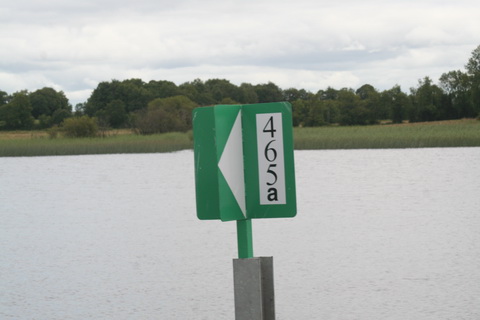
The 2015 edition of Shannon Leisure Development Company’s Navigational Guide to the Shannon and Erne Waterways includes the numbers of some of the markers; I found that helpful, especially on the longer river stretches.

The Guide is wrong about Clonmacnoise: there is no water supply. At Hodson Bay, a suggested course appears to cross a shoal.

Eh?

Eh?

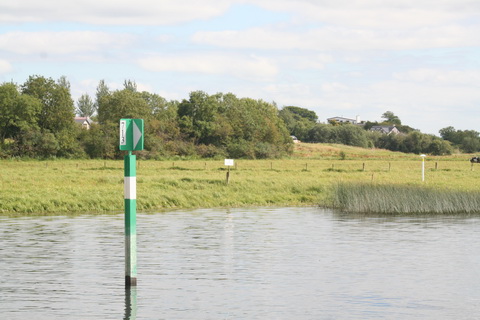
This was the first marker I noticed with a suffix to its number; I presume that means it’s a new marker.

Boxty

As far as I know, boxty is the only contribution made by the north midlands to world cuisine. We bought several varieties in Lanesborough, and jolly good they were too; I regret that I did not record the manufacturers’ names so that I could provide links to their websites.

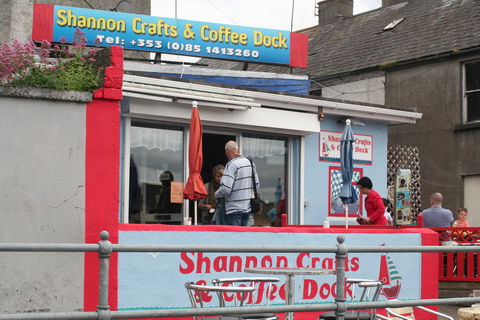
However, boxty was not the only comestible to be found north of Portumna Bridge. Shannon Crafts and Coffee Dock in Athlone, on The Strand across the river from the lock, provides excellent cakes; boaters can tie up outside and stock up.

TripAdvisor folks liked it too.

Had I been there on a Saturday, I’d have had bratwurst.

Shannon Crafts and Coffee Dock

Shannon Crafts and Coffee Dock

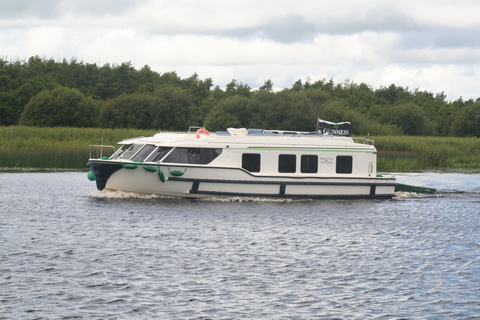
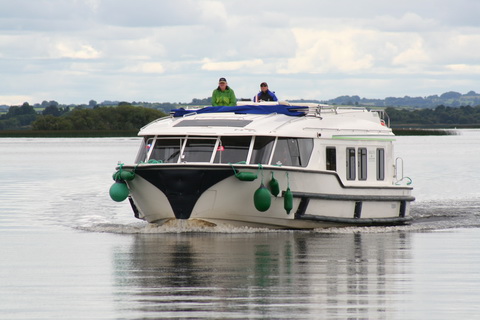
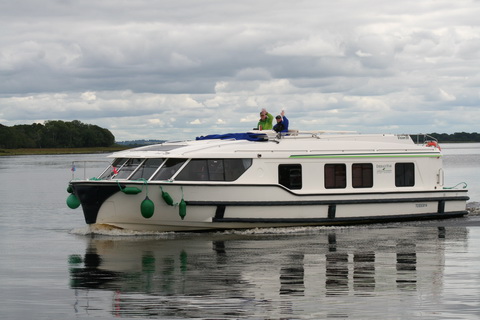
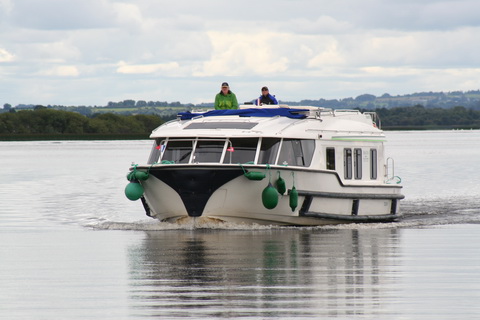
The Em’raldstar Galactica

Les grands bateaux de Monsieur Thibault must have been breeding: we met several of the things.

Emraldstar Galactica 2015 01_resize

It’s big …

Emraldstar Galactica 2015 03_resize

… and, I’m told, luxuriously fitted out …

Emraldstar Galactica 2015 04_resize

… with good outdoor space on the roof …

Emraldstar Galactica 2015 02_resize

… and it accelerates quickly and smoothly from rest, suggesting a good underwater shape …

… but I still think it’s the boating equivalent of the SsangYong Rodius.

Work in progress

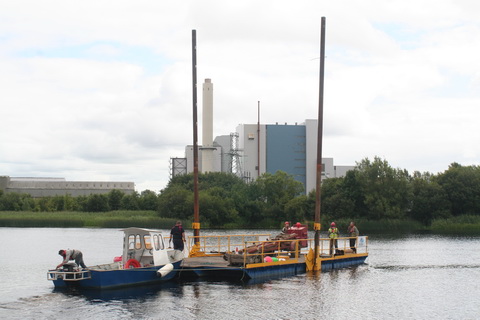
Geotechnical investigation works on the N63 bridge at Lanesborough were being carried out from this pontoon, which was assembled at Hanleys Marina at Ballyleague.

Moving the pontoon into position

Moving the pontoon into position

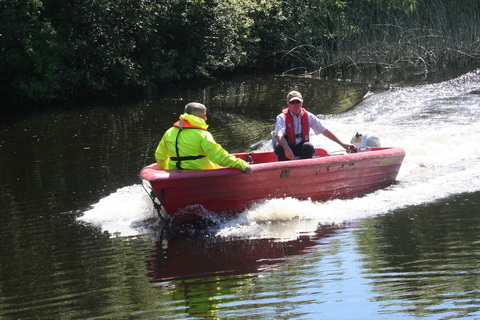
And here’s a Waterways Ireland boat, a Pioner I think, returning upstream to its launch site at Meelick Quay. Perhaps it had been investigating the possibility of providing berths near Meelick village.

WI Pioner

WI Pioner

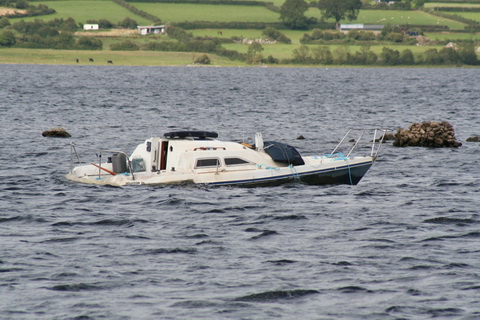
Wrecks?

Iskeraulin wreck 03_resize

On the Iskeraulin shoal on Lough Ree

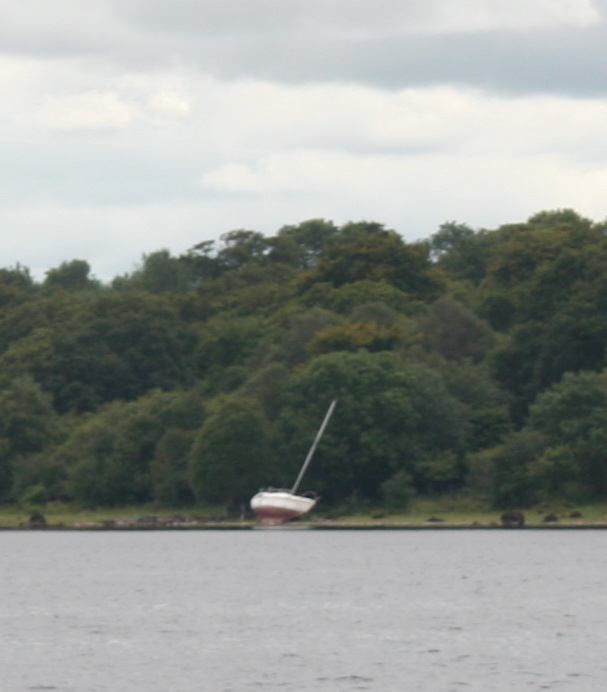
Copy of Boat ashore between Blackbrink and Galey bays

On shore between Blackbrink and Galey bays

I don’t know anything about either of these vessels. The second might, I suppose, have been careened for work on its hull.

Out to lunch

The closing of locks at lunchtime has got to stop.

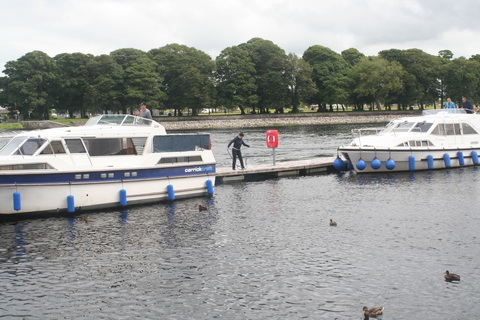
At Meelick, on a windy day, the lower gates were open at lunchtime and two boats were blown forward on to the sill. There, and at Athlone, the waiting pontoons and quays are utterly inadequate to the volume of traffic. Two boats occupied the whole of the Athlone pontoons and only two boats (one a barge) were able to fit on the quay wall. The combined length of boats waiting was about two and a half times the length available for tying to.

Athlone waiting pontoons

Athlone waiting pontoons

Why is it not possible to have staggered lunchtimes? Or to come up with some other arrangement that puts the interests and the safety of the boaters first?

Oddities

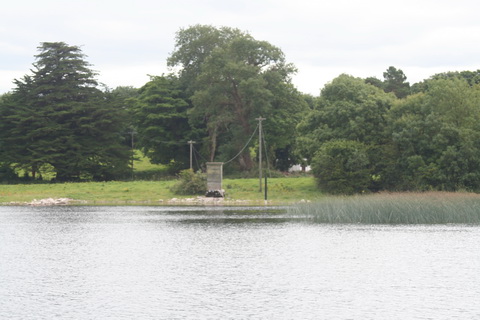
Is this a waterside thunderbox or privy?

Perh privy above Athlone_resize

Outdoor sanitation above Athlone?

In the next photo, the small white sign in the middle says “No shooting”, which is about tweetiebirds rather than citizens. But what is the long-stemmed mushroom on the right? It looks like those gas thingies youo see scattered around the countryside, presumably to provide shelter while you strike a match to light your pipe, and there’s another on the other side of the river. Does that mean that there’s a gas pipe under the river? Or what?

Mushroom_resize

What’s the white thing on the right?

Imperfections

The pale patch of concrete suggests that the corner bollard is missing at the quay below the bridge in Shannonbridge. That makes the short angled section of wall very difficult to use.

Missing bollard at Shannonbridge_resize

Missing bollard?

At Portrunny, some of the timber edging to the pier has rotted; it may be a trip hazard.

Portrunny pier edge 2015_resize

Portrunny pier

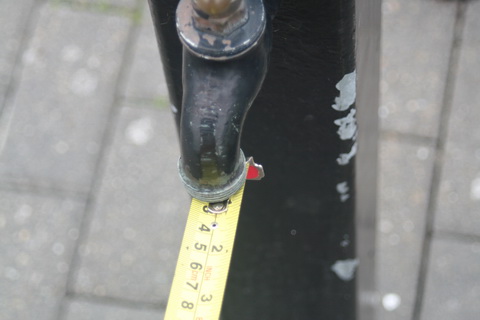
The taps on Portrunny pier defeated us. I would be grateful to anyone who could give me the specification of the adapter required to connect these taps to standard garden/boat hoses.

Portrunny tap

Portrunny’s giant taps

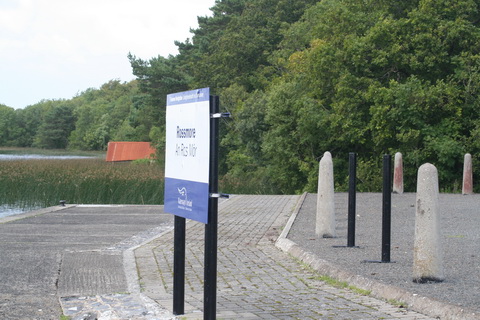
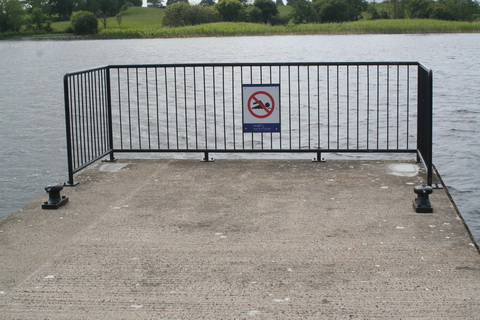
Back on Lough Derg, we found that a barrier had been erected at the end of the pier at Rossmore.

Rossmore barriers 01

Rossmore

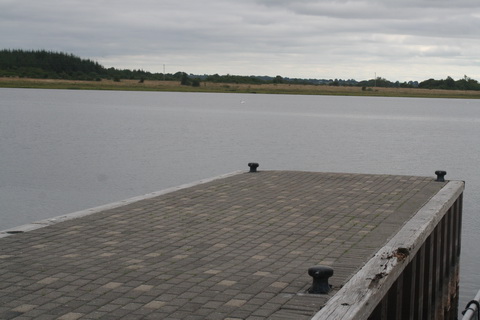
This barrier makes the end of the pier unusable by boats. I have twice seen the end used when strong winds, and waves rolling into the bay, made conditions dangerous.

On one occasion a boat, pinned against the outer (upwind, exposed) side of the pier, worked around to the other side with ropes around the end of the pier; the barrier would have made that manoeuvre impossible.

On another, again with wind and waves coming into the bay, and with the head of the T occupied by other boats, a boat tied to the end of the pier, with its bow into the waves, using strong ropes from bow and stern to bollards along the pier. Again, the barrier would have made that impossible.

Rossmore barriers 02

The barrier

I do not know whether such considerations affected the decision to erect this barrier. If they did not, I suggest reconsideration.

Enterprise

Romaris in Athlone

Romaris in Athlone (no, no: I took this one)

Romaris Motor Yacht is offering upmarket cruises in Athlone. And Baysports water park in Hodson Bay seems to attract favourable reviews.

Richmond Harbour

Finally, some thoughts on Richmond Harbour, our terminus ad quem. It is quite a delightful place and Waterways Ireland has done much to improve the amenities and maintain its appearance. Furthermore, Paddy, the patroller who let us up into the harbour, is helpful, friendly and enthusiastic about the Royal Canal.

But what a pity that WI doesn’t do more to promote both Richmond Harbour and the Royal Canal.

First, the Guide might usefully include Paddy’s phone number so that boaters, especially those (like hirers) without lock keys, might be enabled to get into the harbour. The numbers given on p15 don’t include Paddy’s.

Second, the text of the Guide might be updated: it makes it clear (p7) that some hire boats are allowed to use the Grand Canal but makes no equivalent statement about the Royal.

Third, WI might do more to establish an identity for Richmond Harbour itself, with information about its history, layout, buildings and other features. Maybe there was an information display; if so, I missed it.

Fourth, WI might provide information at Richmond Harbour (and perhaps elsewhere) to encourage boaters to venture even a few miles up the Royal. Such information might say what’s where (village X is Y miles/Z hours away), why X is worth a visit, what help is available, where a boat can turn, why it’s worth doing, what boaters should watch out for (mainly, I imagine, weed on prop or in filters). Or perhaps the RCAG or IWAI could do that.

Fifth, folk who use Richmond Harbour for free parking should find their boats below (or even above) the 45th Lock, thus leaving more space for visiting boats.

Boats arrive at the end of the Royal Canal; the canal itself, and the Harbour, should be promoted to them.

Incidentally, the Clondra Canal needs traffic lights: the cheerful and inventive keeper does his best with hand signals, but the systemn is scarcely foolproof. And it would be useful to have something (other than trees) to tie to at either end of the canal.

Weather

There were days to make Tim O’Brien eat his heart out. But some really bad days that are likely to damage next year’s tourism. I’ll get to the traffic figures anon.


€200 million for the sheugh?

What does Chris Lyttle [Alliance Party MLA] know that I don’t?

On 16 June 2015 he submitted this written question [AQW 47282/11-15], to which he has yet to receive an answer:

To ask the Minister of Culture, Arts and Leisure what consideration the Executive has given to supporting the Lagan Canal Trust objective of reopening the Lagan Canal from Belfast Harbour to Lough Neagh in light of the Irish Government’s approval of €200 million investment by Waterways Ireland in the Ulster Canal.

To the best of my knowledge, the WI “investment” is €2 million, not €200 million. But perhaps I’m missing something? If, Gentle Reader, you can explain Mr Lyttle’s figure, please leave a Comment below.

Given that the restoration of the Lagan would be quite as insane as that of the Clones Sheugh, it seems that the Alliance Party gets its economic ideas from the Shinners.


Waterways Ireland draft heritage plan

Boogie on over to the WI website for a copy of the WI draft heritage plan, and send WI your comments by 6 November 2015.

WI staff have put a lot of work into this and consulted various people, including me. I argued for a more activist approach, with more history and less about communities, and I would have let the twitchers and other nature-lovers look after themselves and their little feathered friends …

Birds hijacking facility at Athlone intended for (and paid for by) humans

Freeloading birds hijacking facility at Athlone intended for (and paid for by) humans. And who’s going to have to pay for cleaning it? Humans, that’s who. Human rights, that’s what we need …

… but I quite appreciate that Waterways Ireland has to be polite to all these people and can’t disobey the law, no matter how insane the legislation is.

But I digress. Get some comments in, preferably plugging industrial and transport heritage and economic history.

WI and oral history

I learn from the Heritage Council that Waterways Ireland is seeking tenders for a pilot oral history project. The winner is to

  • Undertake a minimum of 3 interviews per waterway under our jurisdiction (see list above in Introduction). Any interviews relating to the Ulster Canal will be included as part of the Lough Erne Collection for the purposes of this pilot project. […] The interview questionnaire (to be agreed with Waterways Ireland) should endeavour to elicit material that adds to our existing archive, would be beneficial in our schools education programme and used in a broader promotion capacity.

  • Devise an oral history handbook for Waterways Ireland so staff members and community groups can advance this project in years to come.

  • Deliver training on best practices and guidelines in oral history interview skills and techniques. All training to be delivered in Waterways Ireland offices.

This is very interesting for several reasons. Let me get two quibbles out of the way first:

  • Why is the Clones Sheugh treated as part of the Erne? And why mention that specifically? What sensitivity is being addressed here?
  • Why is this tender not mentioned on WI’s Tenders page or the Current tenders page to which it links or anywhere else that the WI search engine can find?

I think there are four important points about this.

First, it is good that WI is devoting resources to the collection of oral history.

Second, it is good that it has applications in mind for the material: it may be used both in WI educational programmes and in marketing.

Third, the requirement for a training programme and a handbook is yet more evidence [on top of Éanna Rowe’s appointment to manage the Shannon] that the balance of skills required within Waterways Ireland nowadays is different from that of the past. While engineering will always be important, given the extent of the waterways infrastructure that has to be maintained, WI needs a higher proportion of people engaging with users, potential users and communities or devising product variants to attract such users. The marketing department can’t do all the work by itself.

Fourth, it is good that “community groups” as well as “staff members” will be able to use the oral history handbook. I hope that the term “community groups” won’t be interpreted too strictly — that individual amateur historians, for example, will be able to use the handbook — so that all waterways oral history can follow a common format, that the records are conserved properly and that the appropriate consents to the use of the material are collected at the time of the interview.

I should perhaps make a declaration of non-interest: I am much occupied with the waterways of the early nineteenth century but have not, so far, found any survivors from that time whom I could interview. But I might, perhaps, be allowed to express the hope that WI won’t altogether neglect such earlier history, about which there is much yet to be learned.


Mathew Bridge

In the news again.

Cots and canoes at Castleconnell

Castleconnell, in Co Limerick, is on the section of the River Shannon that includes the (broadly defined) Falls of Doonass. That section was bypassed by the Plassey–Errina Canal, one of the five parts of the Limerick Navigation, which navigation was largely abandoned after the construction of the Shannon hydroelectric power scheme in the 1920s. After that, vessels used the headrace, lock and tailrace of the Ardnacrusha power station to pass between Lough Derg and Limerick.

On 27 May 2015 I noted a statement by the Limerick and District Anglers Association about the Castleconnell section of the Shannon:

Therefore canoeists who enter this section of river without permission are trespassing.

Cots

That section of river was not, as far as I can tell, navigated by cargo-carrying vessels; it would be surprising had they been able to do so, even downstream. However, it was navigated by narrow cots. Lady Chatterton in her Rambles in the South of Ireland during the year 1838 [Vol II Saunders and Otley, London 1839], wrote

We have passed the last few days at Doonass, a beautiful place near the rapids of the Shannon. The sound of those rushing and falling waters was most soothing and melodious, as heard from the house, which is situated at some distance, in a beautiful park, sloping down to the river.

I walked several times on its banks to enjoy the splendid sight, and to watch some people who were fishing for salmon. It made me quite nervous to see the boats shoot some of the falls, knowing that unless they had kept exactly the right course, they would have been inevitably dashed to pieces.

In A Week at Killarney [Jeremiah How, London 1843] Mr & Mrs Samuel Carter Hall wrote

Castle Connell, a village about six miles from the city [of Limerick], is perhaps unrivalled in the kingdom for natural graces; and immediately below it are the Falls of Doonas, where the river rushes over huge mountain-rocks, affording a passage which the more daring only will make, for the current — narrowed to a boat’s breadth — rushes along with such frightful rapidity, that the deviation of a few inches would be inevitable destruction. [*]

This, although the most remarkable of the falls, is succeeded by several others, between Castle Connell and Limerick — the whole scene, however discouraging to the political economist, as presenting a picture of wasted strength, being delicious in the highest degree to the lover of natural beauty.
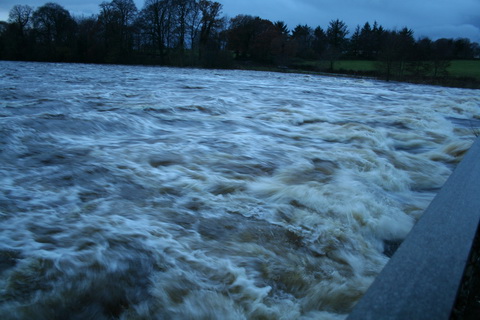
0125 The Falls of Doonass_resize

The river at Castleconnell by night in the floods of 2009

[*] We cannot easily forget our sensations of mingled alarm and enjoyment, while rushing along this course — at night, but by the light of a brilliant moon; it was exciting to the highest degree. We had confidence in our helmsman (if so we must term the man with the paddle-rudder he held in his hand); yet every now and then the voyage was a startling one, and the danger quite sufficient to shake stronger nerves than ours. He had nothing to do but to keep a keen eye upon the rocks at either side, and guide his “cot” by pushing aside a wave with a strong arm, so as to keep in the centre of the current; and he did so with wonderful accuracy.
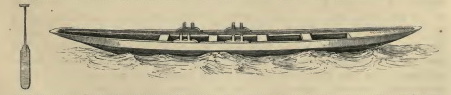
Copy of 0107 Mr & Mrs S C Hall at Doonass (1843)

The Halls’ sketch of a cot

We were afterwards convinced that there was in reality no more peril than there would have been upon the Thames; for the boatmen are so skilful and so well-practised, that they govern their boats with absolute certainty.

The boats are flat-bottomed (for often the stream is not above a few inches deep), narrowed, and squared at the stem and stern. The paddle is a piece of flat wood, about three feet long, increasing from the handle to the breadth of about ten inches; only one is used, which the man changes from side to side according to the direction in which he desires to proceed — using it alternately to advance the boat, and as a helm to steer its course. We refer more especially to the boats used by the fishermen, in which the oars are seldom resorted to; for they are pushed up the stream by a long pole, and the current takes them down it without an effort.

And who can forget the stirring scene in L A Hall’s short story “Which was the bravest?” [in The Magnet Stories for Summer Days and Winter Nights Groombridge and Sons, London, no date, but my copy was a Christmas present in 1862, albeit not to me] in which Herbert, the English youth, falls over when attempting to pole a cot up the river at Castleconnell? The boatman, Lawlor, speaks:

“Sure the young gintleman wanted to try what stuff the Irish poles were made of, and small blame to him if the Irish rock and the Irish ash were too hard for him.”

This was all the work of a moment, during which Lucius [Herbert’s cousin, who lives near Doonass], well accustomed to the Shannon navigation, manfully stemmed the torrent with his single pole.

Not many Etonians could manage that nowadays, I imagine. But then there may not be as many Etonians around Doonass.

The Shannon Navigation

Note that L A Hall [of whom both Google and I are largely ignorant] used the term “Shannon navigation”. I had initially assumed that the Limerick Navigation Company, in its several manifestations, would have had no interest in this stretch of river and that therefore the Shannon Commissioners, and their successors the Board of [Public] Works and, now, Waterways Ireland would not have acquired any interest in its navigation.

I thought that there might have been a public right of navigation, as outlined by Douglas Caffyn, but that in any case such a right had been protected by the beneficence of Her late Majesty Victoria, by the Grace of God of the United Kingdom of Great Britain and Ireland Queen, who caused Her ministers to insert this provision in the Shannon Navigation Act 1839 [CAP LXI An Act for the Improvement of the Navigation of the River Shannon 17th August 1839]

XXXVI. And be it enacted and declared, That the said River Shannon is and for ever hereafter shall be, to all Intents and Purposes a public navigable River; and that all the Queen’s liege Subjects may have and lawfully enjoy their free Passage in, along, through, and upon the said River Shannon, with Boats, Barges, Lighters, and other Vessels, and also all necessary and convenient Liberties for navigating the same, without Let, Hindrance, or Obstruction whatever, on paying such Rates, Tolls, and Duties as are by this Act appointed to be paid, and complying with such Rules, Orders, Regulations, and Bye Laws as shall be made by the said Commissioners under the Provisions of this Act: Provided always, that nothing herein contained shall be construed to exempt any Person or Thing from the Payment of any Tonnage, Quayage, Rateage, or other Dues payable under an Act passed in the Fourth Year of the Reign of His late Majesty King George the Fourth, intituled An Act for the Erection of a Bridge across the River Shannon, and of a Floating Dock to accommodate sharp Vessels frequenting the Port of Limerick, and of an Act passed in the Fourth and Fifth Years of the Reign of His late Majesty King William the Fourth, intituled An Act to amend an Act passed in the Fourth Year of the Reign of His late Majesty King George the Fourth, intituled “An Act for the Erection of a Bridge across the River Shannon, and of a Floating Dock to accommodate sharp Vessels frequenting the Port of Limerick”, or from Compliance with any Rules or Regulations imposed or to be imposed by the Commissioners appointed under the said Two last-mentioned Acts.

There is one possible complication in the same act:

XXXIX. And be it enacted, That the said Commissioners shall, within Six Months from the passing of this Act, or at such other Time or Times as shall seem to them most expedient, fix and determine the Limits of the said River Shannon, and such of the Rivers aforesaid, or Parts thereof, as shall be improved under this Act, as to them shall seem expedient, within which all the Powers and Authorities by this Act given to the said Commissioners for the Care and Conservancy of the said Rivers respectively shall and may be exercised; and a printed Notice giving such Description of the Limits so fixed, with such Map or Plan thereof as to the said Commissioners shall seem expedient, shall be posted on each Toll House on or near the said River Shannon, and such of the Rivers aforesaid as to them shall seem expedient, and at every Place where a Table of the Tolls or Rates to be taken on the said River respectively shall be posted, and at such other Places as to the said Commissioners shall seem expedient.

The limits were set out in maps and minute books, which are listed in Schedule E of the Third Report of the Commissioners for the Improvement of the Navigation of the River Shannon published in 1842 [I don’t think that report is available online]. I’ve never seen the maps and minute books and so I don’t know whether they say anything about navigation on the relevant stretch of river, but the list includes:

Map 2 Map of part of the Shannon and the Canal, from Arthur’s Ferry to Castleconnel and World’s End (County of the City of Limerick, Counties of Limerick and Clare); Minute Book pages 7 to 11 inclusive; also 14 to 21 inclusive […]

Map 2B Plan and Sections of Clareville, or Prospect Mill-dam (County of the City of Limerick, County of Clare); Minute Book pages 9, 10, and 11

Map 2C Plan and Sections of Doonass Salmon-cribs, and of Water Park Bleach Mill-dam (Counties of Limerick and Clare); Minute Book pages 9, 10, 11, and 12

Map 3 Map from World’s End to Killaloe (Counties of Clare, Limerick, and Tipperary); Minute Book pages 11 & 12; also 21 to 26 inclusive; also 30 to 32 inclusive.

Apart from Map 2, those seem to be about water (mill) rights and salmon rather than about navigation, but I hope to check that with Waterways Ireland. The Commissioners may have decided that the Castleconnell stretch of the river lay outside the limits of the Shannon, and that navigation thereon was not therefore protected by the provisions of Section XXXVI. Even then, though, a public right to navigate may have continued to exist. On the other hand, the Commissioners’ limits may not have affected navigation on this stretch of river.

It is also possible that some later enactment affected navigation.

the ESB

An entire series of enactments, from the Shannon Electricity Act 1925 onwards, empowered either the Minister for Industry and Commerce or the Electricity Supply Board [ESB] to do various things connected, more or less, to the construction and operation of the hydroelectric power station at Ardnacrusha. Under the 1925 act, for instance, the minister was empowered [inter alia] to

3. […] (b) impound, hold up, divert, take, and use the waters of the River Shannon and any river or stream tributary thereto and any lake, pond, or canal thereon or connected thereto;

(c) embank, dam, dredge, deepen, widen, straighten, divert, and otherwise alter the River Shannon or any river or stream tributary thereto;

(d) embank, dam, dredge, alter the level of, and otherwise affect any lake, pond, or other water on or connected directly or indirectly with the River Shannon;

(e) remove, or alter, repair, construct, and maintain such sluices, weirs, dams, embankments, and other works as may be necessary for or incidental to the doing of any of the things mentioned in the foregoing paragraphs […].

Under the Electricity (Supply) Act 1927 the minister was empowered to prohibit navigation during construction; blocking off the river with Parteen Villa Weir probably made that easy to enforce. The Board was also empowered to prohibit navigation after taking over the works:

(3) When the handing over of the Shannon works to the Board under this Act is completed the Board, notwithstanding any such enactment as aforesaid, may by order, for the purposes of the operation of the Shannon works or of the exercise of any of the powers or the performance of any of the duties or functions conferred and imposed on the Board by or under this Act prohibit navigation in or upon the River Shannon or any particular part thereof specified in such order for such limited period of time specified in that behalf in such order as may be required by the Board for the purposes aforesaid.

That came before the ESB got the fisheries rights, so I can’t see that it’s relevant to any restriction of navigation in the interests of fisheries.

I searched the splendid Irish Statute Book for both Acts and Statutory Instruments with combinations of terms like Shannon, electricity, navigation, salmon and fishery. I then read — well, searched and skimmed — every relevant enactment I could find. I am not a lawyer, but it seemed to me that the only enactment under which the ESB might restrict, or have restricted, navigation, by kayaks or canoes or anything else, on the Shannon through Castleconnell, is the Shannon Fisheries Act 1935, of which more below.

Just for completeness, I should say that the Shannon Fisheries Act 1938 includes this section:

3.—Nothing in this Act shall operate to prejudice or affect any right of the Commissioners of Public Works in Ireland in relation to the navigation of the waters of the River Shannon.

That’s a useless provision, I think, because if the Commissioners of Public Works lost anything it was under the 1935 Act; the 1938 Act did nothing to restore any rights lost under the 1935.

Finally, the Electricity (Supply) (Amendment) Act 1945 allows the ESB to prohibit navigation but it doesn’t seem to apply to the Shannon: only to rivers on which power stations were to be built after 1945.

The Shannon Fisheries Act 1935

The most important part of the act is Section 9 (1) (d) but 9 (2) (a) may also be of interest:

(1) It shall be lawful for the Board to do all such things, carry out all such transactions, and fulfil all such functions as shall be necessary or proper for or incidental or ancillary to the due performance of the duties in relation to the Shannon fisheries imposed on the Board by this Part of this Act, and in particular and without prejudice to the generality of the foregoing powers, it shall be lawful for the Board to do all or any of the following things, that is to say:—

[…]

(d) terminate, restrict, or otherwise interfere with, either permanently or temporarily and either compulsorily or by agreement, any easement, way-leave, water-right, fishing right, or other right over or in respect of any land or water;

[…]

(2) Nothing in this section shall operate to authorise the Board—

(a) to do anything compulsorily without paying compensation therefor […].

Implementation

In order to check my conclusion, I emailed the ESB fisheries department on 26 May 2015:

I note that you say that canoeists and kayakers must seek your permission to use the Shannon at Castleconnell. I would be grateful if you could tell me:

(a) the legislation (Acts or Statutory Instruments) empowering you to make that stipulation

(b) the details of the Board decisions making it and

(c) the details of the stipulation itself. Does it, for instance, apply only to kayaks and canoes or are other vessels, and non-vessels such as jetskis or hovercraft, covered too?

The fisheries department very kindly replied on the same day:

Please note that ESB is not seeking to prevent kayakers or canoeists from using the river but as we operate the stretch of the Shannon River in Castleconnell as a private salmon fishery we are obliged to consider the interests of the anglers who use the fishery and pay to do so.

Since we introduced the requirement for kayakers to contact ESB Fisheries when intending to use the river at Castleconnell, no kayaker has been refused permission.

The legislation empowering ESB to regulate activity on the Shannon is contained in the Shannon Fisheries Act 1935 – Section 9.1 (D).

If you wish to discuss the matter please contact [name and telephone number redacted].

I prefer to have records of such discussions so I replied by email on 27 May 2015:

[…] I should say that I have no interest or stake in either angling or canoeing/kayaking per se. My interest is in the management of the Shannon, and in particular in navigation thereon, past and present.

[…] my interest in the navigation of the Shannon from Castleconnell downstream was excited recently by some comments by anglers on what kayakers might or might not do. Accordingly, I searched the Irish Statute Book database for all Acts and Statutory Instruments dealing with the ESB, the Shannon and salmon fisheries. I read every Act or SI I found on those subjects.

I found nothing to indicate that the right to navigate the Shannon, from Castleconnell downstream, had been extinguished or that the ESB had been appointed as a navigation authority with the right to control navigation; I note that the ESB makes charges for boats on some other fisheries but not on the Shannon.

I acknowledge of course that there may be documents I have not seen and that I may have missed or misinterpreted something in those I did read.

ESB> Shannon Fisheries Act 1935 – Section 9.1 (D)

That was the only enactment I found under which I thought the ESB could take any action that affected navigation. Indeed the section appears to allow the ESB to use helicopter gunships to deter poachers if it so desires.

However, that is an extremely broad enactment, and I have not found, in the Irish Statute Book or anywhere else, any information about these matters:

  • what strategic decisions the Board has made on this subject, or what decision-making powers it has conferred on its fisheries staff
  • in the implementation of that Section, what decision-making process the ESB followed and how it consulted citizens (other than anglers)
  • whether the Board has actually decided to “terminate, restrict, or otherwise interfere with, either permanently or temporarily and either compulsorily or by agreement, any easement, way- leave, water-right, fishing right, or other right over or in respect of any land or water”
  • if it has so decided, what the details of the decision are: details both of its making and of its application
  • how such decision is consonant with other legislation
  • how the decision was promulgated and where the details can now be found
  • what appeal and compensation mechanisms have been set up to enable the Board to meet the provisions of Section 9.2 (a)
  • what case law exists on the subject.

I have also been unable to find any enactment providing that citizens are obliged to obey any such decision or that any action can be taken against them if they decide to ignore it.

Let me say again that I acknowledge that my inability to find information doesn’t mean that it does not exist. However, I would have expected that, in any case where my [presumed] rights [eg to navigate] were affected, the relevant regulations would be readily available and the authority under which they were made would be clear. I would therefore be grateful if you would let me have the details, which I would like to publish on my website.

I sent that two weeks ago today; I have not yet had a response.

My current understanding

I acknowledge that the ESB has the right to ban navigation on the Shannon through Castleconnell if it wants to do so. I also acknowledge that it is possible that it has done so and even that it may have taken its decision validly and in accordance with the principles of natural or constitutional justice.

However, the ESB has not yet shown that it has taken that decision and done so validly and in accordance with the principles of natural or constitutional justice. I have found no evidence that it has and, in two weeks, the ESB has not provided any. All we have to go on is a pair of unsupported assertions, one by the  Limerick and District Anglers Association [whose concept of trespass I do not understand] and the other by the ESB fisheries department, saying that would-be navigators must contact them, but without citing any authority for that demand.

As matters stand, I see no reason why that demand should be complied with. But, again, I acknowledge that I do not have full information.

Clobber

Clothing

The action of paddling keeps you warm above the waist and the canoe and spray cover keep you warm below the waist, so that heavy clothing is rarely necessary when canoeing, whatever the time of year. For normal purposes all that is necessary is a shirt and shorts and a pair of light rubber or string-soled shoes or sandals.

Carry warmer clothing in a waterproof bag to put on when you go ashore.

For windy weather a hooded ‘Anorak’ is useful (Fig 41).

For wet weather wear a sou’wester and an oilskin or plastic jacket (and trousers for going ashore). If you wear gum boots when you are ashore TAKE THEM OFF before getting into your canoe.

That’s from Know the Game: Boating: rowing, canoeing, punting published by Educational Productions Limited of East Ardsley, Wakefield, Yorkshire in 1960.

Its cover has a drawing of three chaps: one is canoeing, clad as recommended in shorts and shirt; one is punting; the third is sculling, and he has a passenger, a young lady wearing a (below the knee) frock who is steering the boat using the rudder lines. Apart from the cover, none of the book’s 86 illustrations shows a female.

O tempora, O mores! Buoyancy aids, helmets and fluorescent clothing are now required, as shown in the pics on the Shannon Blueways site. [Incidentally, if there’s a link to that site from the Waterways Ireland site, I was unable to find it.] I’m all in favour of safety, but I wonder whether the amount of extraneous kit and clobber needed to go boating nowadays is a deterrent to potential newcomers.