Category Archives: Built heritage

Carrick-on-Shannon in 1949

T W Freeman “The town and district of Carrick-on-Shannon, Co Leitrim” in Irish Geography (Bulletin of the Geographical Society of Ireland) Vol II No 1 1949:

There is no mill in use now, though flour is sent from Rank’s in Limerick by barge to Carrick, but no farther. Before the 1939–1945 war general cargo was also brought to the town by barges which could convey 50 tons of coal; other goods included timber and galvanised iron for builders. At present, stout is the only commodity brought by barge to the solidly-built stone warehouse of the early nineteenth century, whence it is distributed for some twenty miles in every direction.


The best-value CEO

Mary Lou McDonald [SF, Dublin Central] asked Jimmy Deenihan [FG, Kerry North/West Limerick], before his departure from the waterways (and other stuff) department,

… if he will provide in tabular form a list of the annual salaries of the chief executive officers of all non-commercial State sponsored bodies under his remit.

Which he did; you can see it here.

I thought it might be interesting to see how the salaries of the CEOs relate to the numbers of staff and the budgets they control. It’s not easy to compare them. The salary figures are presumably current; the various bodies offer, on their websites, accounts for years ending anywhere from 31 December 2011 to [well done, the National Concert Hall] 31 December 2013. In some cases I could find no proper accounts, but at least the Crawford Art Gallery gave a figure for its income, which is more than the Chester Beatty Library did [as far as I could see].

There were several other minor difficulties, but the big problem is that some bodies distribute grants to others, so their business is processing money: as a result, their income (usually from, or mostly from, the state) is higher than it would be for non-grant-distributing bodies. I have made no attempt to allow for that.

To make comparisons easier, I divided the number of staff in each body by the CEO’s salary (converted to euro where necessary) and multiplied the result by 1000 to remove leading zeroes. That tells you how many employees you get managed for each euro of CEO salary. Waterways Ireland is by far the biggest organisation, but has the second-lowest CEO salary.

Similarly, I divided the organisation’s income by the CEO’s salary to provide a crude measure of how much activity you get for each euro of CEO salary. Bodies dispensing grants look better than they otherwise might using this measure.

This is then a very crude comparison, with many caveats, but I think that Dawn Livingstone of Waterways Ireland is the best-value CEO of those running bodies under the aegis of the Department of Arts, Heritage and the Gaeltacht.


Organisation Staff Budget (m) CEO salary Staff X 1000/salary Budget/salary
Arts Council 48[1] €63.9[2] €85,750 0.56 745.19
Chester Beatty Library 37[3] ?[4] €90,591 0.41 ?
Crawford Art Gallery 15 €1.1[5] €72,124 0.21 15.25
Foras na Gaeilge 64[6] €21.5[7] €113,429 0.56 189.55
Heritage Council 18[8] €7.8[9] €113,123 0.16 68.95
Irish Film Board 15[10] €20.2[11] €97,981 0.15 206.16
Irish Museum of Modern Art 83[12] €8.3[13] €85,720 0.97 96.83
National Concert Hall 103[14] €4.6[15] €101,056 1.02 45.52
National Gallery of Ireland 117[16] €9.5[17] €93,297 1.25 101.83
National Library of Ireland 93[18] €9.5[19] €81,080 1.15 117.17
National Museum of Ireland 176[20] €17.6[21] €96,148 1.83 183.05
Údarás na Gaeltachta 86[22] €40.2[23] €126,200 0.68 318.54
Ulster-Scots Agency 20[24] €3.4[25] €61,997[26] 0.32 54.81
Waterways Ireland 328[27] €41.0[28] €77,071[29] 4.26 531.98

I’m sorry the table spreads so far to the right; I can’t work out how to narrow the column widths.


[1] 41 full time and 7 part time WTEs, according to note 2c to accounts in Arts Council Annual Report 2012

[2] Total income y/e 31 December 2012 from Arts Council Annual Report 2012. €56.6m was dispensed to other bodies in grants

[3] Excluding volunteers and vacant posts shown in the Staff List in Report of the Trustees Chester Beatty Library 2012

[4] The annual report for 2012 available here http://www.cbl.ie/About-Us/The-Chester-Beatty-Library/Reports.aspx does not include accounts. There is a one-page balance sheet, without the associated notes, from which I am unable to form any idea of the cost of the institution

[5] I am unable to find any accounts on the Crawford Art Gallery’s website http://www.crawfordartgallery.ie/aboutus1.html. Its Annual report 2011, the most recent available, says “The Department of Arts, Sport and Tourism pay allocation to the Gallery for 2011 was €475,000, while the non-pay allocation was €600,000. The capital allocation for 2011 was €275,000.” I have used the (rounded) sum of the first two figures

[6] Staff Costs and Board Remuneration in Foras na Gaeilge section of The North/South Language Body Annual Report and Accounts for 2011

[7] Total income y/e 31 December 2011 from Foras na Gaeilge section of The North/South Language Body Annual Report and Accounts for 2011

[8] Heritage Council website www.heritagecouncil.ie

[9] Total income y/e 31 December 2013 from Heritage Council Annual Report for 2012

[10] Note 6 to accounts in Annual Report 2011

[11] Sum of total income figures from Capital Income and Expenditure Account and Administration Income and Expenditure Account y/e 31 December 2011 in Annual Report 2011

[12] Note 9 to accounts in Irish Museum of Modern Art Annual Report 2011

[13] Total income y/e 31 December 2011 from Irish Museum of Modern Art Annual Report 2011

[14] Note 2 to accounts in National Concert Hall Annual Report 2013

[15] Gross income y/e 31 December 2013 from National Concert Hall Annual Report 2013

[16] Note 7 to accounts in National Gallery of Ireland Annual Report 2012

[17] Total income y/e 31 December 2012 from National Gallery of Ireland Annual Report 2012

[18] Rounded. From Human resource management and development in National Library of Ireland Annual Report 2011

[19] Total income y/e 31 December 2011 from National Library of Ireland Annual Report 2011

[20] Note 13 to accounts in The National Museum of Ireland Financial Statements for 2011

[21] Total income y/e 31 December 2011 from The National Museum of Ireland Financial Statements for 2011

[22] Údarás na Gaeltachta Annual Report and Accounts 2012

[23] Total income y/e 31 December 2012 from Údarás na Gaeltachta Annual Report and Accounts 2012

[24] Staff Costs and Board Members in Tha Boord O Ulster-Scotch section of The North/South Language Body Annual Report and Accounts for 2011

[25] Total income y/e 31 December 2011 from Tha Boord O Ulster-Scotch section of The North/South Language Body Annual Report and Accounts for 2011

[26] £49,244

[27] Excluding student placements and temporary and agency staff (total 19). Note 4 to accounts in Waterways Ireland Annual Report and Accounts 2012

[28] Total income y/e 31 December 2013 from Waterways Ireland Annual Report and Accounts 2012



Shannon traffic figures for June


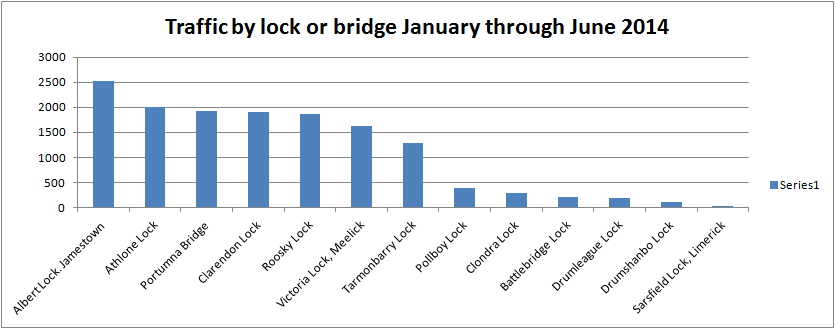
I am grateful to Waterways Ireland for letting me have the Shannon traffic figures for June 2014. All the usual caveats apply:

  • the underlying figures do not record total waterways usage (even for the Shannon) as, for instance, sailing, fishing or waterskiing on lakes or river stretches, which did not involve a passage through a lock or Portumna Bridge, would not be recorded
  • the passage records would not show, for instance, a change in the balance of types of activities from those in larger cruising boats to those in smaller (sailing, fishing, waterskiing) boats
  • figures like these, for a small number of months, will not necessarily be representative of those for the year as a whole. The winter months, January to March, see little traffic in any year; for April, May and June, the weather can have a large influence on the amount of activity especially, I suspect, in private boats.

On the other hand, the figures do include the Shannon’s most significant tourism activity, the cruiser hire business. And they are our only consistent long-term indicator of usage of the inland waterways.

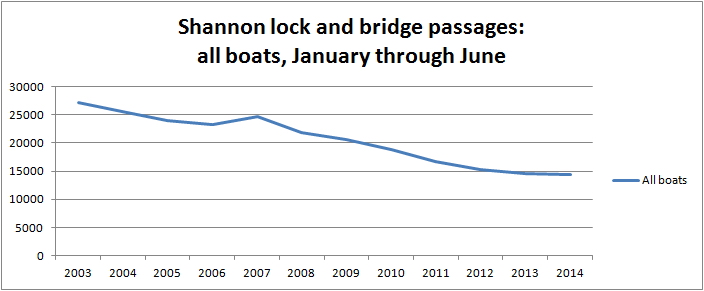
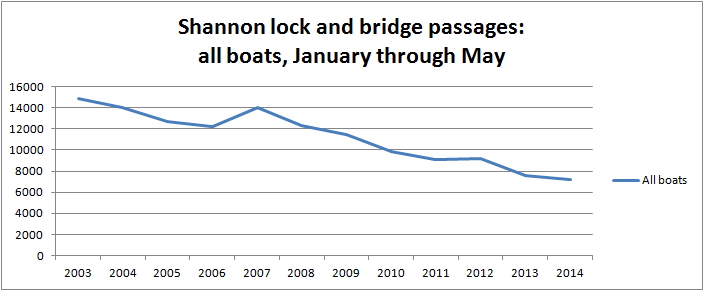
Total (private + hired) traffic for the first six months of each year

Total (private + hired) traffic for the first six months of each year

Total traffic is down again, but only slightly. The decline does seem to be levelling off and a continuation of the relatively good weather could increase usage.

SnnNav JanJun 2

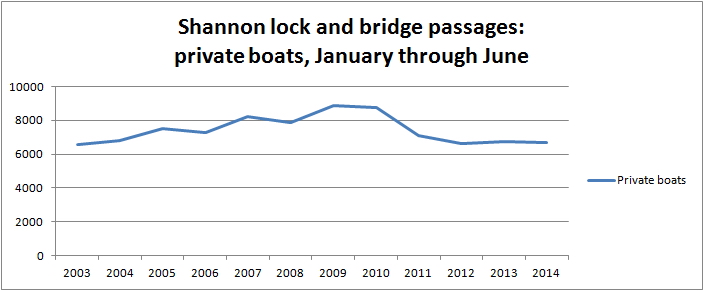
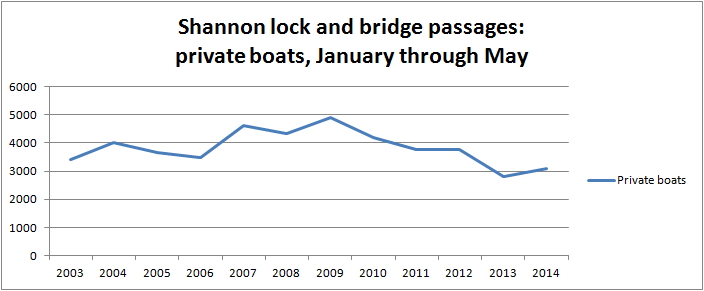
Private-boat traffic for the first six months of each year

Private traffic is down slightly on last year, but it has been pretty much the same for three years. I had thought that the good weather might have caused something of an increase, but on the other hand my own impression of Lough Derg traffic (not reflected in the passage figures) is that it has been fairly light.

SnnNav JanJun 3

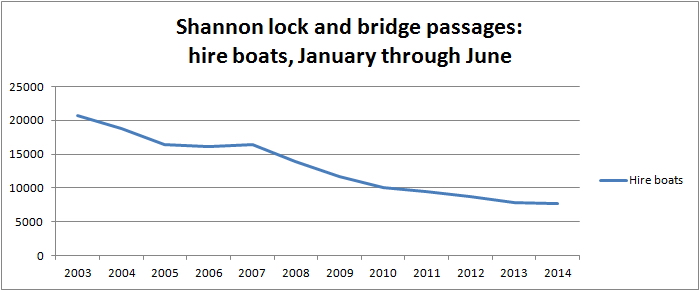
Hire-boat traffic for the first six months of each year

For hire-boat traffic, there is no sign of an upturn, although the drop on last year’s figures is not very large.

SnnNav JanJun 4

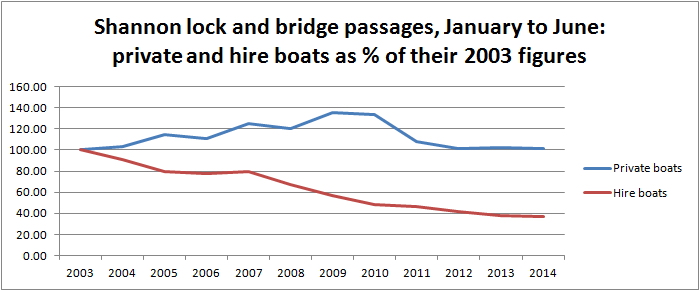
Changes since 2003: private and hired boats

That table amalgamates the two before it, but shows the figures as percentages of the 2003 figures. For private boats, the Celtic Tiger (nach maireann) caused an increase; that effect has worn off and usage has not changed much since about 2011. For hired boats, the decline began long before the Celtic Tiger idiocy.

SnnNav JanJun 5

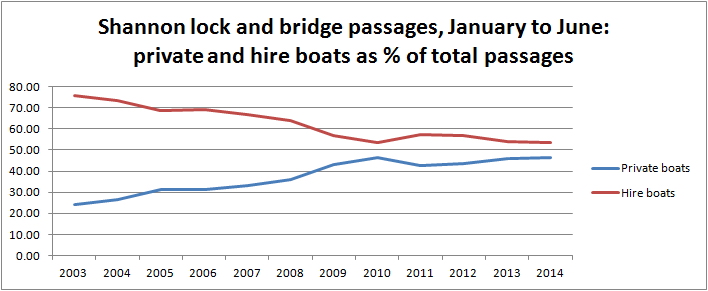
From 75/25 to 50/50

Hired boats were once the major users; private boats have almost caught up.

SnnNav JanJun 6

How to save money

I don’t know how much the various locks cost to run, so I can’t work out any measure of value for money, but the sea lock in Limerick and the Lough Allen Canal must surely be candidates for the chop.


The OPW’s 1969 restoration of Richmond Harbour and the Clondra Canal

Read about it here.

The Brosna: fish and mills

Two reports from Dr William O’Connor about fish on the Brosna here at Clara and here at Belmont. Both are mill sites, now generating electricity, and the difficulty lies in providing for fish to get past.

Dear Mr Bannon

I would be grateful if you could explain why any government in its right mind would restore the Longford branch of the Royal Canal given that (a) canal traffic in Ireland is so small as to be insignificant, (b) the upkeep of the Royal’s main line is causing severe budgetary strain and (c) the Irish hire boat industry is in decline.

If you have conducted any analyses of the costs and benefits of such restoration, I would be grateful if you would publish them.

bjg

Note: Mr Bannon is a Fine Gael TD. But that’s no excuse.


The hire business, as we know and love it …

… is screwed.

That is my interpretation [and not, I should stress, to be attributed to the report’s authors, sponsors or supporters] of the results of the June 2014 report Ireland’s Inland Waterways – Review & Outlook  prepared by  Tourism & Transport Consult International for the Irish Tourist Industry Confederation “with support from the Irish Boat Rental Association (IBRA)” and downloadable here [PDF].

The report is well worth reading. I’ve been charting the decline in the cruiser hire industry, as indicated by Shannon lock passages, for some time now; a source within the industry told me recently that the decline was actually worse than those figures indicated. The report shows that the IBRA fleet size went from 388 in 1992 to a peak of 533 in 1997 but down to 225 in 2013.

The fleet refinancing problems look to be horrific and it doesn’t seem to me that more marketing (if marketing is taken to be Promotion rather than any of the other Ps) is going to be enough: another P, Product, needs to be redefined rather more usefully than in Tourism Ireland’s segmentation waffle about “Great Escapers” and the “Culturally Curious”. Tourism is good for waterways, but products other than (or as well as) straightforward cruising need to be offered.

And consider this:

Over the past 10 years upwards of €200 million in state expenditure has been invested in upgrading infrastructural facilities along the waterways. The investment has helped to transform the quality and quantity of moorings, navigational aids, signposting. Mooring capacity has been doubled over the period as well as the developments of several integrated harbors including berths with associated on-shore facilities including toilet and shower blocks, picnic and play areas, looped walks, etc. Such developments have taken place at locations on the Shannon and Grand Canal, including Boyle, Clondara, and Killaloe.

No wonder WI’s budget is being cut, if €200 million went to subsidising the Irish bourgeoisie rather than to bringing in more tourists. Of course if the Clones Sheugh were reconstructed tourists would come flocking from Germany, Austria and Switzerland: indeed from all around the world.

And the report says of the Lakelands and Inland Waterways Initiative, about which I have expressed scepticism,

The relevance of the well intentioned initiative and proposed branding to the cruising business was diluted by the large area encompassed by the new regional initiative and the less than adequate resources invested in effective marketing in key source markets. Unfortunately the results of the marketing effort do not appear to have raised the profile of Shannon and linked waterways.

I did think it odd that Abbeyleix got funding ….

This report is a very welcome dose of realism. I want to give it more thought before commenting on individual points, so I’ll come back to it again, but in the meantime I urge everyone to read it (it’s pretty short).

h/t Antoin Daltún

[amended]


Thon sheughery business

It will be recalled that Her Majesty’s Loyal Home Rule Government in Belfast is considering investing in the Clones Sheugh [aka Ulster Canal] and that I asked DCAL, the department responsible, for a copy of the Business Case. To my surprise, it said:

Your request is being treated as a Access to Information request and will be handled under either Freedom of Information Act 2000 or the Environmental Information Regulations 2004.

Either way, DCAL has now told me that I can’t see it. The Business Case, which is apparently an addendum to the 2007 Business Case (which was rotten: see here passim), won’t be complete until November. I have made a note to remind myself to ask for it then.

I quite sympathise with the DCAL folks: it can’t be easy thinking of any good reason to spend taxpayers’ [British or Irish] money on the Clones Sheugh. But perhaps DCAL can spin it out until the Shinners have taken over the Free State, at which point the economics of Grattan’s Parliament will be in vogue and we can all take up growing flax, spinning and weaving, giving grants for canals and making money out of the slave plantations.

Speaking of Shinners, there’s one called Cathal Ó hOisín, a member of HM Loyal Home Rule Government in Belfast representing East Londonderry, who said there recently:

The possibility of the reopening of the Ulster canal would open up limitless opportunities in tourism. The idea that, once again, we could travel from Coleraine to Limerick, Dublin and Galway by boat would be absolutely wonderful.

Well, you can do that: by sea. There was never an inland navigation from Coleraine, Limerick or Dublin to Galway, despite the urgings of Lord Cloncurry and the nitwitted ideas of Sir Edward Watkin.

As for a connection between Limerick or Dublin and Coleraine, I suspect that Mr Ó hOisín is perpetuating the error into which Her late Majesty Victoria, by the Grace of God of the United Kingdom of Great Britain and Ireland Queen, etc, seems to have fallen when she appointed

Commissioners to inquire respecting the System of Navigation which connects Coleraine, Belfast, and Limerick

which Commissioners reported in 1882. There was no such system and, if Mr Ó hOisín can provide evidence that any vessel ever travelled by inland navigation between Coleraine and Limerick, I would be glad to hear of it. I prefer to think of the Commissioners’ conclusion that

As an investment for capital the whole canal system in Ireland has been a complete failure.

I see no reason why politicians of the twenty-first century should repeat the errors of their predecessors in the eighteenth, nineteenth and twentieth centuries.

You expect the Parnellite members to have a bit more sense, but one John Dallat said in the same debate:

[…] when the Ulster canal is open, tourists will come in their thousands and that will benefit the Lower Bann, the Foyle as well, and right over to Scotland.

Er, John? There are actually canals in other countries. Even in Scotland. Folk are familiar with canals. They’ve seen them before. And a short sheugh to Clones is not going to attract tourists (apart from the relatively small number of canal twitchers, who will need to tick it off on their lists) unless the town of Clones is particularly attractive. Which … well, let me put it this way: why not look it up on TripAdvisor?

Of course I’m all in favour of Clones myself: I am quite interested in concrete engine-sheds and former canal stores.


Shannon traffic to May 2014

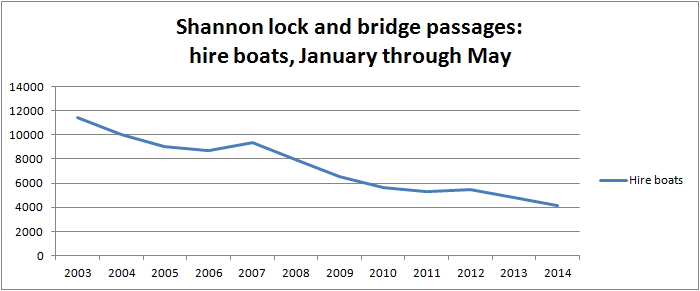
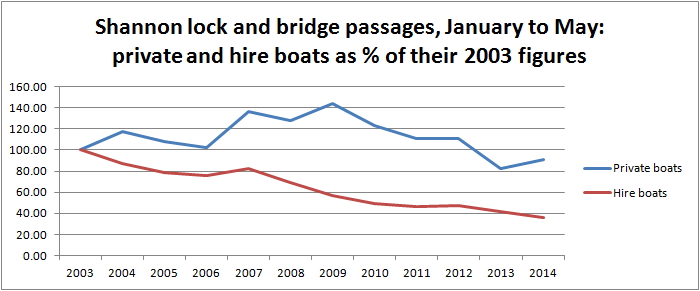
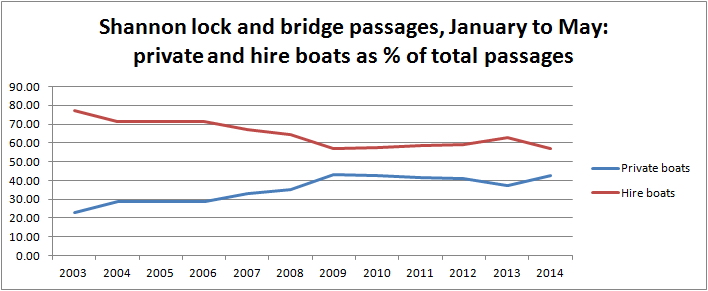
I am grateful to Waterways Ireland for letting me have copies of the recorded numbers of boat passages through Shannon locks and Portumna Bridge for the first five months of 2014. All the usual caveats apply:

  • the underlying figures do not record total waterways usage (even for the Shannon) as, for instance, sailing, fishing or waterskiing on lakes or river stretches, which did not involve a passage through a lock or Portumna Bridge, would not be recorded
  • the passage records would not show, for instance, a change in the balance of types of activities from those in larger cruising boats to those in smaller (sailing, fishing, waterskiing) boats
  • figures like these, for a small number of months, will not necessarily be representative of those for the year as a whole. The winter months, January to March, see little traffic in any year; for April and May, the weather can have a large influence on the amount of activity especially, I suspect, in private boats.

On the other hand, the figures do include the Shannon’s most significant tourism activity, the cruiser hire business. And they are our only consistent long-term indicator of usage of the inland waterways.

Shannon passages May 2014 01


The total amount of traffic continues to decline.

Shannon passages May 2014 02

Private-boat traffic is still below its average for the period but increased slightly on the same period of the previous year [but see the third caveat above].

Shannon passages May 2014 03


Hire-boat traffic is just over one third of its 2003 level.

Shannon passages May 2014 04


Since 2003, both private and hired traffic have fallen, from the highest figures attained within the period, by about 60% of the 2003 figure. But private traffic first rose by 40% of the 2003 figure, so it is now only about 20% below that figure. Hire traffic has fallen pretty consistently since 2003.

Shannon passages May 2014 05


Hire traffic is usually greater than private traffic between April and October (roughly speaking), but the gap is closing.

Carál Ní Chuilín, NI’s [SF] waterways minister, said the other day:

Waterways Ireland delivered a presentation to Ministers entitled ‘Ireland’s Inland Waterways — Building a Tourism Destination’. The presentation provided an overview of the progress that Waterways Ireland is making in placing waterways and the waterway experience at the centre of the tourism offering in Ireland and internationally.

And a good thing too, but the waterways need new water-based tourism products to complement, and perhaps to replace some of, the hire-boat cruising business. Opening new waterways — Royal Canal, Longford Branch, Ulster Canal, Kilbeggan Branch or anything else — is a waste of money until demand, domestic and visitor, private and hired, exceeds existing capacity.


Euroloot for the Clones Sheugh?

According to today’s Irish Times [which will disappear behind a paywall at some stage]

EU seeks feedback on plans to invest €500m in North and Border counties.

For full information, go to the SEUPB website. The Consultation Information Document [PDF may open or download as soon as you click] is the more useful and most readable document, but there are several others, including drafts of the PEACE and INTERREG Cooperation Programmes.

I have not myself been initiated into the Mystical Brotherhood of Euroloot Interpreters, so I can’t be sure, but I don’t think that either of these programmes contains, or could contain, anything that could fund the Clones Sheugh. It is difficult to see how a Sheugh-related action could be made to fit any of the objectives of either programme. But who knows what Fine Gael’s desperation might drive it to do? It faces the threat, in Monaghan, that the Shinners might arrive from Stormont bearing money from Her Majesty’s Treasury [NI branch office].