Category Archives: Canals

The Hind

The River Hind Navigation is not well known, which may be attributable to its non-existence. There were several proposals to make the Hind navigable, to link the town of Roscommon to Lough Ree on the Shannon, but none of them were implemented. One of them almost made it, though, and such interest as the topic has is the result of the Hind’s inclusion (or semi-inclusion) on the list of navigations for which W T Mulvany, Commissioner for Drainage, was responsible in the late 1840s and early 1850s.

Mulvany was responsible for five drainage-cum-navigation projects (and many drainage projects), whereof the Hind was the least important. The other four were

  • the Lough Oughter navigation, upstream on Lough Erne from Belturbet, which was never completed: various (mostly Fianna Fáil) insane politicians in the area are still trying to have it completed
  • the Cong and Belturbet Canals, which were abandoned before they were finished
  • the Junction Canal in the Ballinamore and Ballyconnell Drainage District, later known as the Ballinamore and Ballyconnell Canal, which had a brief and notoriously unprofitable existence, but which was later transformed into the Shannon—Erne Waterway, which was a good investment for Ireland because the Germans [or someone] paid for it
  • the Lower Bann navigation, linking Lough Neagh (which already had two links to coastal ports) with the North Atlantic in the middle of a beach near Coleraine. This was the only one of Mulvany’s navigations that was completed and that remained open, despite its complete uselessness, as the railways got to the area before the navigation did.

In this catalogue of commercial nitwittedness, the Hind had the advantage that it was delayed: an even more insane proposal, to drain the Suck into the Hind, meant that the Hind navigation scheme was deferred long enough to be abandoned altogether, which was just as well as the railway soon made any navigation unnecessary.

However, the proposal was there and, if you are very bored, you might like to read about it. But this is for anoraks: the subject is unimportant, the detail [163 endnotes] outweighing what little interest the scheme possesses. There are no photos of boats or of locks, because there weren’t any; there aren’t even any cat videos.

 

They haven’t gone away, you know ….

There we were, about to breathe a sigh of relief that the Clones Sheugh had been buried at the crossroads, with a stake through its heart and numerous rows of garlic planted around it, when a crack appeared in the earth and the shriek of the undead made the night hideous.

Yes, it seemed that the Minister for Fairytales had successfully diverted everyone’s attention away from Clones by (a) designating the River Finn as the Ulster Canal, which would lead to a scout camp at the spiritual home of Ulster Unionism rather than to Clones, and (b) supporting a greenway walking route to take care of the handsacrosstheborder bit (although ministers from up there seemed to be scarce at the launch. I suppose they’re scarce anyway).

The greenway seems like a better idea to me, given that it’s significantly cheaper than canal restoration and likely to attract far more users, although I wasn’t impressed by the economic assessment in Waterways Ireland’s Ulster Canal Greenway draft strategy document from April 2017 [PDF]. Here is the assessment in full:

6.2 Economic Assessment
Ultimately, the cost of developing a route will play a part in the decision-making process. It may be technically possible to overcome an obstacle, but the cost might make it unfeasible and a longer route chosen. All factors in the Greenway Strategy will be assessed and the most sustainable routes chosen.

That seems to suggest that the costs and benefits of the plan have been thought through with as much care and attention as Her Majesty’s Government over the way has given to Brexit. Which, I imagine, will put paid to much handsacrosstheborderism anyway; I hope it doesn’t put paid to Waterways Ireland as well, although it’s bound to increase the difficulties under which that body labours.

But revenons à nos moutons. Just when we thought it was safe to go out, the dead arose. Sinn Féin MEP Matt Carthy said

Clones needs the Ulster Canal if it’s to have a viable tourism future.

Also from the report of the meeting:

A presentation at the meeting revealed that over 50 percent of buildings in Fermanagh Street in Clones are derelict.

Frustration at the lack of progress with the Ulster Canal was voiced, with representatives stating that it was on the agenda in 1999 and is still on it now.

Perhaps Clones has not got the message: the Ulster Canal is off the agenda. But there is a more fundamental problem: [some] small rural towns are dying because there is no longer any economic need for them. The scale of things has changed since the late nineteenth century; consumers can travel to Aldi and Lidl in larger towns; local markets and fairs are no longer how business is done.

Tourism is unlikely to rescue Clones: if it could do so, why isn’t the town already a tourist destination? Why aren’t its attractions well known throughout Germany and wherever else tourists come from? Enabling tourists to visit by water is not going to attract significant numbers from abroad: there are more scenic and interesting waterways elsewhere, in Ireland and on the continent. There would be a very poor return on the millions that a canal to Clones would cost — not helped by proposals for significant overpayment for land.

I still don’t understand why Sinn Féin is so keen on canals generally and the Clones Sheugh in particular. But Clones might find a new economic role as a post-Brexit smuggling centre.


The vast utility of internal navigation

As a manifest proof of the vast utility and advantage of internal navigation, the present price of land carriage to Banagher, which is that particular part which the Canal is to extend to in its Westerly progress, is 2s 4d per hundred weight, or 2l 6s 8d the ton, but the freightage and tonnage by the Canal cannot exceed thirteen shillings, which in some articles, either sent to or from the capital, must reduce the price upwards of forty per cent.

From this calculation we suppose the tonnage to be three halfpence a mile and the freightage a penny, but there will be many loadings that will not be rated or charged at so high a price; as for instance, lime, stones, flag and slate, which are to pay but a halfpenny, fuel a farthing, and dung, marl, and gravel for manure, entirely exempt from any charge.

Of what infinite use it will be to the manufactures of this kingdom in the article of fuel only, may be evinced by the price of Kilkenny coal being reduced more than one-half, and corn, flour, with an infinite variety of other matters, being sent much cheaper to this city. The profits resulting will enable this useful design to be still extended, by forming collateral branches, with all the navigable rivers in the central counties, and perhaps making communication with the remotest part of this kingdom.

Saunders’s News-Letter 24 October 1785

Ballycuirke Canal photos

Declan Maher has very kindly sent me five photos of the Ballycuirke Canal. I have put one of them on the canal’s main page and the others on the page of notes on navigating from Lough Corrib to Ross Lake.

Willie Leech interview

This article, about the last of the Royal Canal boatmen, was based on an interview, arranged by Niall Galway, with Willie Leech of Killucan. Niall has now made the original interview available on YouTube, in two parts [Part 1, Part 2], with apologies for the sound.

Big it up for Banagher

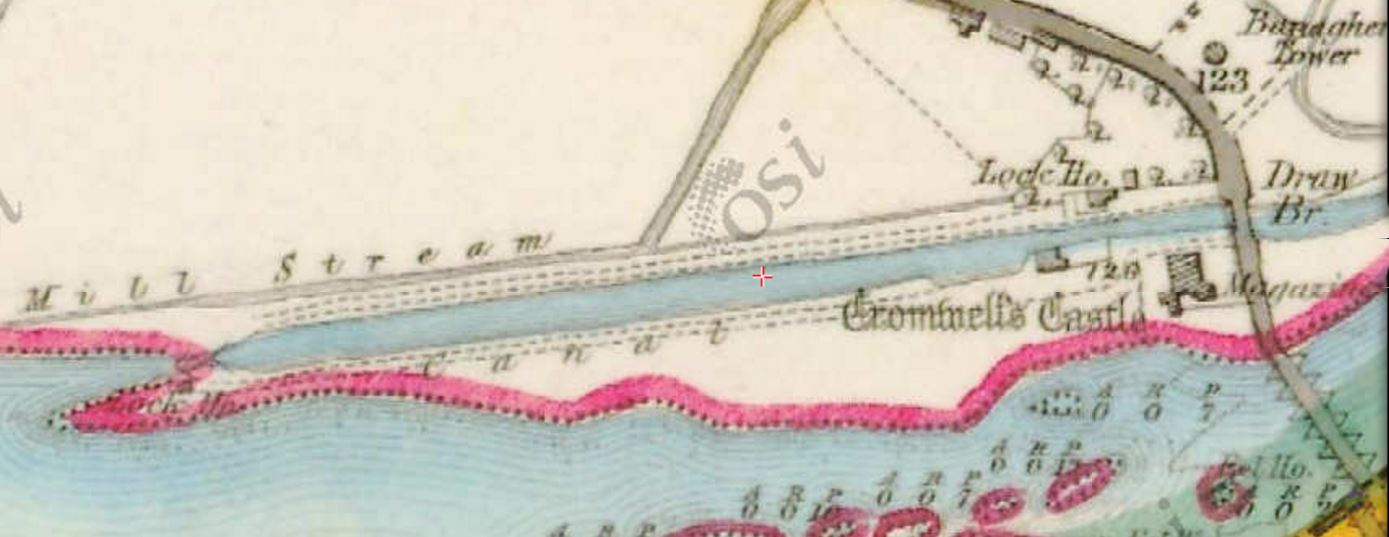
Banagher: the old canal (OSI 6″ map ~1830s)

I was in Banagher yesterday, visiting the site of the old (pre-Shannon Commissioners) canal on the north (virtual west) bank. The area is a park operated by a community group [I would welcome details and a link] and includes a pitch-and-putt course, an outdoor swimming pool in the river and storage for canoes (a group of young people was about to get afloat as I left).

It is also, as the map above shows, rich in waterways and military artefacts. Much of the waterways material can still be seen and a series of signs shows old drawings and provides useful information (though the lock, surprisingly, has no sign). I think I am right in deducing that the signs reflect the work of historian James Scully, one of those who gave an extremely enlightening and entertaining talk about Banagher Bridge a few years ago.

The park is well used by local people but it should also attract many tourists to take the short walk from their boats on the far side of the bridge. It is an excellent example of local initiative drawing on local expertise to illuminate local history and create a sense of place and it could be emulated at many other waterways sites along the Shannon.

Furthermore, added to Banagher’s other historic and literary associations, it shows the wealth of interesting material offered in this town. It is not, unfortunately, on the main tourist routes by road, but it should be possible to attract the interest (and the spending) of water-borne visitors.

I hope that will work for the community; in the meantime, I applaud their initiative.


Royal Canal water supply

Midland great western railway of ireland
notice to contractors
tenders for water tanks &c

The Directors of this Company will receive Tenders for providing and erecting (exclusive of masonry) two Wrought Iron Water Tanks, each to contain, when full, 6000 gallons of water, and each to be connected with two swing water cranes, with proper valves, &c. Also, for two Water Cranes, connected by pipes, 6 diameter [sic], with the water in the Royal Canal. Tenders to quote price per 100 feet, length of pipes, and to be sent in with a drawing and short specification, addressed to the Chairman at 23 College-green, Dublin, and endorsed, “Tender for Water Tanks and Cranes”, on or before Noon of 9th November, 1846. The whole to be completed on or before the 20th January, 1847, under a penalty of £2 per day. If further information is required apply to G W Hemans Esq, Engineer to the Company, at 53 Upper Sackville-street, Dublin; and the Directors do not bind themselves to take the lowest tender.

By order, Henry Beausire, Sec, Dublin, 23 College-green, 26th Oct, 1846

Saunders’s News-Letter 3 November 1846

Gambling for the Grand

In the 1770s a group of trustees conducted an annual lottery to raise funds for a “canal of communication” between the Grand Canal and the River Liffey in Dublin. The intention was to go north from the area of the Grand Canal Harbour to reach the Liffey opposite the barracks. It seems that some construction work was done but no lottery was organised in 1780 or thereafter, perhaps because an Irish state lottery was instituted. The plan to build a link to the north was abandoned; the Circular Line was built instead.

Here is an incomplete account of the Grand Canal lottery. I would be glad to hear from anyone who knows more about it.

Developments in lock design

A model for a Canal Lock of a very ingenious and curious construction, has lately been presented to the Company of Undertakers of the Grand Canal, by an artist in this city [Dublin], having among some other improvements on the old locks the following remarkable ones:

  1. That of raising or falling a boat from a level of sixty feet by a single lock.
  2. That of obviating, by a single contrivance, the waste of water, so that at the passage of any boat through it, more than nine-tenths of the water will be retained for the next occasion: this lock will therefore not require a sixth part of the water now expended in the smallest lock on the navigation.

The model is now in complete order at the Navigation House, and was particularly intended by the inventor to answer the great fall from the level of the Canal at James’s-street to the river Liffey; an object not yet fully determined upon by the Company, which Company has, however, as a token of its approbation of so very ingenious a contrivance, presented the inventor with twenty guineas, and should his plan be ever executed by them, there is no doubt but he will be rewarded according to his merit.

Saunders’s News-Letter
12 September 1787

Grand Canal announcements

The Grand Canal Company do hereby give Notice, that they are ready to receive Proposals for supplying Ashler Stones for repairing the Locks upon the Grand Canal; the Stretching Stones to be twelve Inches Bond, and the Heading Stones two Feet Bond. All Persons willing to furnish the same, are desired to apply to Captain Charles Tarrant, No 45, Cuffe street, who will inform them where the same are to be layed down. —

Proposals will be received for Building, by Contract, two Boats on the Canal (the Size and Dimentions to be known upon Application as above), the Contractor finding Timber and every Article requisite.

Also for furnishing Lime per Hogshead, in the Neighbourhood of Ballyfermott Bridge.

June 18, 1777. Signed by Order, R BAGGS, Sec

WHEREAS the Sluice erected upon the Canal in the Barrenrath Level, has been wantonly and feloniously broken down, a Reward of Twenty Guineas shall be paid for discovering and prosecuting to Conviction the Person or Persons who have committed the said Offence.

By Order of the Grand Canal Company, June 7, 1777, R BAGGS, Sec

Saunders’s News-Letter 23 June 1777