Category Archives: Canals

The opening of the Royal Canal

On 27 May 2017 the Royal Canal Amenity Group and Waterways Ireland are to commemorate the fact that

In May 1817 the Royal Canal was officially opened from Dublin to the Shannon ….

[Unfortunately I am unable to find anything about the commemorative event on WI’s website, although they did send me some information about it.]

I wondered how the opening might have been celebrated in 1817, but I haven’t been able to find out anything about it. I am hoping that some more knowledgeable person might be able to provide information: please leave a Comment below if you can help.

Ruth Delany gives 26 May 1817 as the date on which the contractors said that the western end of the canal (to the Shannon at Richmond Harbour) would be ready to hand over to the Directors General of Inland Navigation, who were running the show after the Royal Canal Company collapsed under the weight of its debts.

However, as far as I can see, the British Newspaper Archive contains no mention of any opening ceremony at any time in 1817. The Lanesborough Trader, the first boat to travel from the Shannon to Dublin did so in January 1818 [Saunders’s News-Letter 2 February 1818] and in May Mr Peel moved that a further £15000 be granted for completion of the navigation, where “shoals were
found to interfere” [Dublin Evening Post 23 May 1818].

Traffic increased later in 1818: in October the directors of the New Royal Canal Company went by boat

… from Dublin to Tarmonbury, and thence to the termination of the Canal, near the river Shannon, to inspect the works and give every necessary direction for the entire completion of that great and important undertaking ….
[Dublin Evening Post 20 October 1818]

The same newspaper reported that several boats of coal, found on the banks of the canal near Tarmonbury, had arrived in Dublin. It seems, therefore, that the canal was usable even if not entirely finished.

Later that month Christopher Dillon of Athlone, who had been trading on the Grand Canal and the Shannon, announced that he was moving his boats to the Royal Canal — but the western terminus for his boats was at Ballymahon, from which (although he did not say so) goods could be carried by road to Athlone: just the situation the Grand Canal Company had feared. [Dublin Evening Post 27 October 1818]

I have found no evidence of an opening ceremony in 1817; nor have I found evidence that the canal was actually open from the Shannon to the Liffey (or the Broadstone) in 1817, in that no boat seems to have travelled between the Shannon and the Liffey. At least one boat did so in 1818, but again I have no evidence of any opening ceremony.

There is one further mystery. The Royal Canal harbour at the junction with the Shannon is called Richmond Harbour. I presume that that is a compliment to the Lord Lieutenant of Ireland, His Grace Charles Lennox, 4th Duke of Richmond, 4th Duke of Lennox, 4th Duke of Aubigny, KG, PC. But he had ceased to be Lord Lieutenant in 1813 and was presumably unable to dispense favours after that, so why was the harbour named after him? I don’t know when the construction of the harbour was begun or finished.

I have not visited the National Archives in Dublin to look at the papers of the Directors General of Inland Navigation, which may have something on the events of 1817 and 1818. Perhaps WI’s archive has something relevant too. I would therefore be glad to hear from anyone who has searched those archives or found other evidence about the period.

Newspapers cited here were accessed through the British Newspaper Archive.

 

Redirecting the Grand Canal

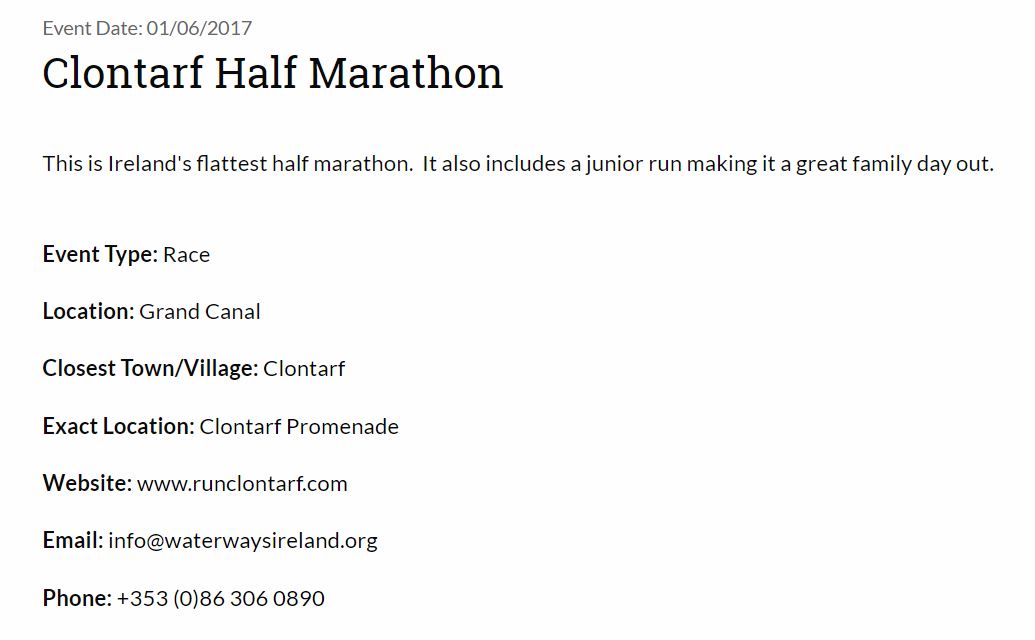
According to Waterways Ireland’s website, there is to be a half Marathon [a marathon is an old chocolate bar, my advisors tell me] in Clontarf on 1 June 2017. No doubt some politician will be on hand to emulate the miracle of the loaves and the fishes; otherwise most of those attending are likely to go hungry.

But what interests me is Waterways Ireland’s assertion that the location of this chocolate bar is the Grand Canal.

Now, when ah wur a lad, it was generally understood that Clontarf was on the north side of the Liffey, where the natives ate their babies, whereas the Grand Canal was on the south side, where the better element of the population resided. We don’t, of course, talk about that sort of thing nowadays, but I am still surprised to find that the Grand Canal, or any part of it, has been relocated to the north side of the Liffey. Where, I ask myself, is the aqueduct on which it crosses the Liffey?


Waterways History Conference

The ninth Waterways History Conference will be held at the University of Birmingham, UK, on Saturday 24 June 2017. The programme and other details are available here. The theme is Waterways Research? and one of the topics is the Cong Canal.

The Lanesborough Trader

Inland Navigation

The numerous individuals interested in the prosperity of the Royal Canal, as well as the Public at large, must be highly gratified to learn, that the trade on the extended line of that navigation has commenced with all the spirit and activity that could have been anticipated by the most sanguine. The first boat from the Shannon (the Lanesborough Trader, Patrick Connor, owner) arrived at the Broadstone harbour on Saturday [31 January 1818], amid the cheers of numerous spectators, with a fiddler playing merrily upon her deck.

Saunders’s News-Letter 2 February 1818

The Dublin to Cork Canal

A Dublin paper has promulgated, at some length, a plan for the improvement of Ireland, which, we are confident, were it brought forward in Parliament, would be unanimously approved of, especially as it can be effectually done without any expense to the Nation. The plan is, a Canal, to be joined to the Grand Canal at Dublin, and to extend, in a Southern direction, to the County of Cork, a distance of 131 miles, which will, at once, penetrate into the centre of the great agricultural districts of Ireland. The expense, calculated at £400000 or £3000 per mile, to be raised by Lotteries, the tickets to be drawn in London, and conducted under the eye of Government Commissioners as our former National Lotteries.

Lancaster Gazette 24 February 1827

New locomotive power

Mr Mullins, MP for Kerry, has made a very important discovery in the scientific world, that of applying galvanism, instead of steam, for propelling vessels and carriages. He is now building a carriage upon this principle, and several of the first engineers, who have seen it, say there is every prospect of success, and that it will supersede steam. — Limerick Star. The Dublin Evening Post claims the merit of this invention for the Rev J W M’Gawley, one of the clergymen of the Roman Catholic Cathedral in that city, who, that Journal says, explained it at the meeting of the British Association of Science there last August. “The discovery,” proceeds our Dublin contemporary, “has excited considerable interest amongst the savans of Germany by Mr M’Gawley’s interesting and important invention, which is to form one of the most attractive features of the proceedings of the British Association at its approaching meeting in Bristol.”

Berkshire Chronicle 13 August 1836

How nice to know that a current MP TD for Kerry, noted for his scientific knowledge, is continuing a great tradition.


Quadrupling Kerry’s canals

I thought there was only one canal in Co Kerry, but there were three more at Lixnaw. They’re still to be seen and they have interesting associations.

Thanks to Ewan Duffy of Industrial Heritage Ireland for the tip-off.

Sunday travel

The Rev Mr Stavelly said that he would avail himself of the present occasion to draw the attention of the directors to a subject in which he felt much interest — namely, the propriety of the company discontinuing the plying of their passage-boats on Sundays, and he moved a resolution to that effect, which was seconded by Mr Robert Guinness.

The Chairman stated that the subject of the rev gentleman’s motion had been already, on various occasions, under the consideration of the Court of Directors, but, with any desire, on their part, to meet the views of those who objected to Sunday travelling, it had been hitherto found impracticable to reconcile the proposed change with the convenience of the public or the interests of the company. He believed it was not in his power to put the resolution from the chair, as by the laws which governed the proceedings of the company, no resolution could be put to any meeting which had not direct reference to the objects for which it was called, but that he would again draw the attention of the directors to the subject on the very earliest occasion.

The meeting then adjourned.

From the report on the stated half-yearly meeting of the Grand Canal Company held on Saturday 23 October 1841 in the Dublin Morning Register 25 October 1841


A Bourne mystery

Here is an ad, from 1785, offering to let flour-mills at Portlaw, Co Waterford, and a bake-house in John Street, Waterford, to a “tenant possessed of abilities”.

The ad is interesting in several respects. First, although the location of the flour-mills is not clear, they may have preceded the iron-works, the famous Malcolmson cotton-mill and the later tannery on the site; they certainly seem to have used the water power of the Clodiagh.

Second, the ad suggests that flour could be carried from the mills by three rivers to Waterford: the Clodiagh, the Suir and St John’s Pill, which is another navigation featured on this site.

Third, the ad invites applications to be sent to either John Thomas Medlycott in Dublin or John Edwards Bourne in Mayfield, Waterford. The Post-Chaise Companion [4th ed] says

Within half a mile of Portlaw, on the L is Glen-house the seat of Mr Bourne.

At Portlaw are the extensive mills built by Edward May Esq, and about a quarter of mile beyond Portlaw on the L is a large house built by the same gentleman.

About a mile from Portlaw, on the R situated on the banks of the Suir, is Mayfield, the noble and delightful seat, with very extensive and beautiful demesnes and plantations, of William Watson Esq and on the L is Coolfin, the seat of the Rev Thomas Monck.

That puts a Mr Bourne in Portlaw, though in Glenhouse rather than Mayfield. The Glenhouse address is confirmed by Matthew Sleater in 1806.

But what interests me is whether the John Edwards Bourne mentioned in the ad is related to John Edwards Bourne of Dunkerrin, Co Offaly, formerly of Nenagh, Co Tipperary, who died in 1799 or so. The Offaly Bourne seems to have had four brothers and three sisters.

I would be glad to hear from anyone who knows anything about the Portlaw Bourne (or indeed any of the other Bournes). If you can help, please leave a Comment below.


Grand Canal Navigation

Alloway and Boake, No 85, Bride-Street, inform the Public, that they now carry in commodious Boats, of from thirty to forty tons burthen, heavy Goods of all kinds, between the Canal harbour in St James’s-street and Sallins, near Naas, at 2d per hundred weight, or 3s 4d per ton, which is less than one-third of the average price of land carriage for that distance.

The advantages of this Navigation to the Public, in addition to the great reduction in the price of carriage, are, that all Goods carried by the Canal are exempted by act of Parliament from all duties, rates, tolls and customs whatsoever, in all places whatsoever, save the Canal tolls, which are included in the price before mentioned; and the flour, malt, and corn premiums are the same on carriage to Dublin, by the Canal, as by land carriage.

Proper persons attend at the Canal Stores, James’s-street, Dublin, and at Sallins, to receive all Goods addressed to the care of Alloway and Boake; for the safe carriage and delivery of which, they hold themselves responsible to the public.

Dublin Evening Post 8 April 1784