Category Archives: Drainage

Royal water

An interesting piece of information from Waterways Ireland’s feasibility study on the restoration of the Longford Branch of the Royal Canal. We learn on page 44 that the Royal Canal needs, on average, 10 million gallons of water per day to cope with “lockages, leakage, seepage and evaporation” and that the current supply arrangements, with much pumping, are costing €300,000 a year.


Sorry, Longford

Waterways Ireland’s Feasibility Study into the Restoration of the Longford Branch of the Royal Canal is available for download [7 PDFs: main report + 6 appendices]. Skip straight to page 59:

6.5 Recommendation

Given the current financial climate and because of the associated costs, environmental issues and uincertainty regarding planning approval it is not recommended to pursue this project any further at this time.

The recent work undertaken in regard to the shared walkway/cycleway has protected the asset as a publicly owned recreational amenity and it is recommended that any outstanding property issues be resolved and finalised in order to complete the protection of the asset.

I hope that admirable recommendation survives the pre-election period.

By the way, there’s a snail ….

Down to the sea in steps

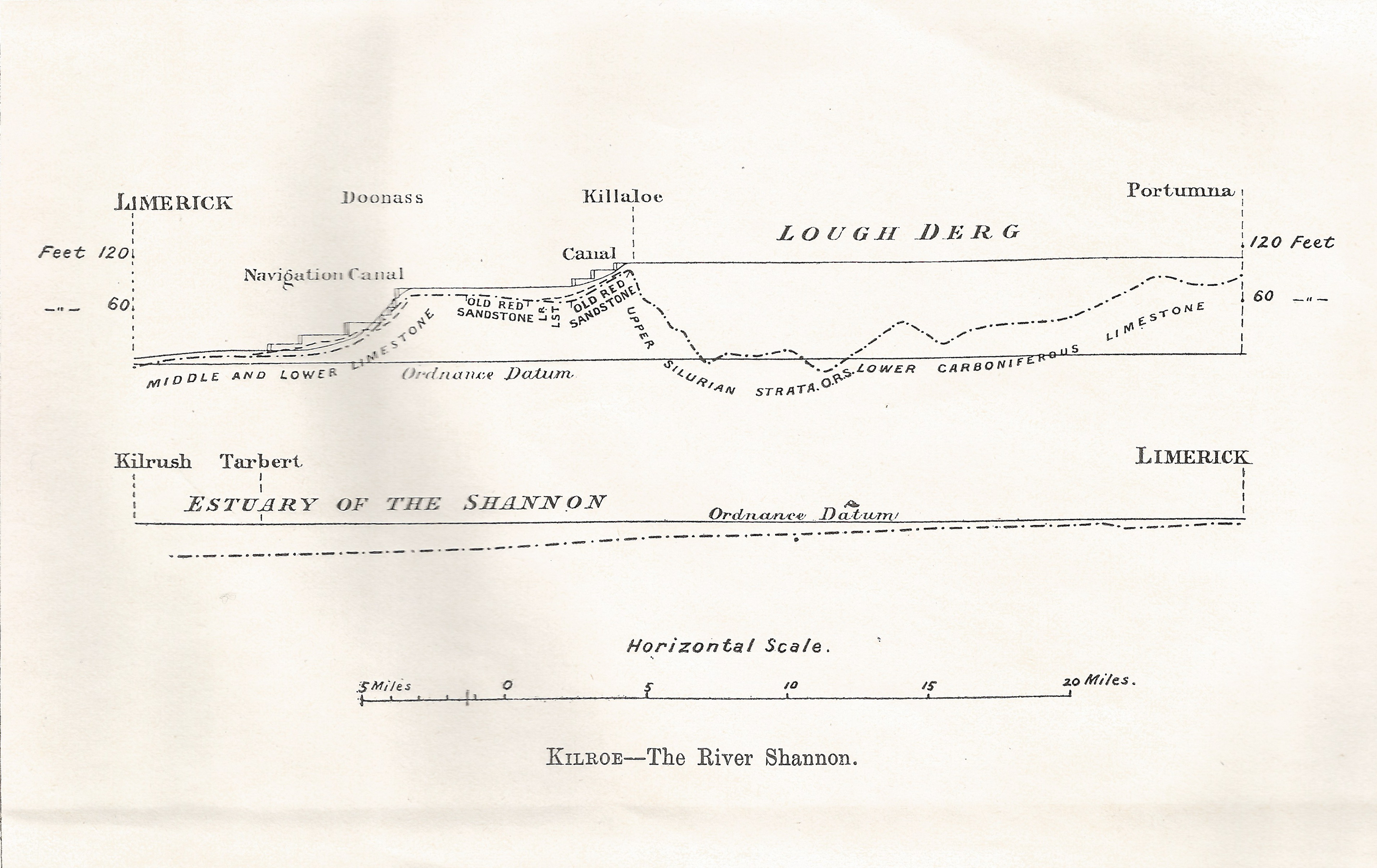
On 28 January 1907 James Robinson Kilroe [near the bottom of the page] of H M Geological Survey read to the Royal Irish Academy a paper on “The River Shannon: its present course and geological history” [Proceedings of the Royal Irish Academy Vol XXVI Section B No 8 Hodges, Figgis & Co Ltd, Dublin; Williams & Norgate, London 1907]. I thought that Plate V was interesting.

Shannon Derg to sea

Plate V

Kilroe wrote:

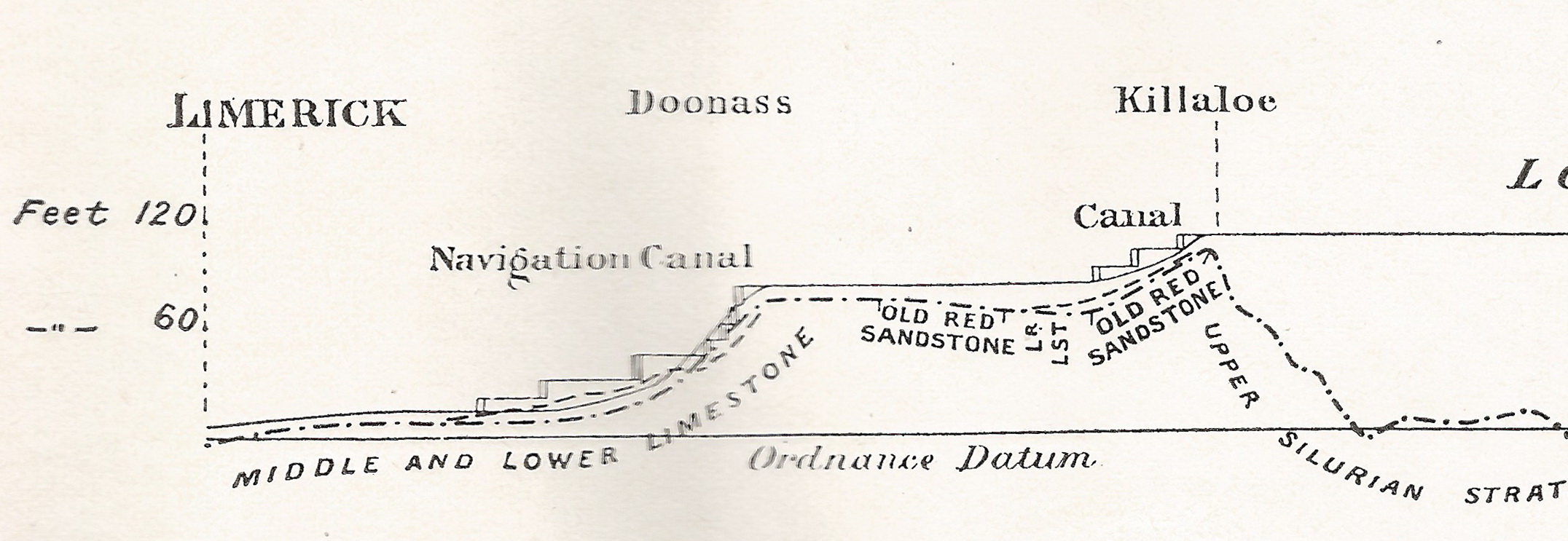
It will be perceived that instead of the river being shallow over the unyielding Silurian slate-rock, set almost vertically, and striking across the river-course, it is deeper than over the limestone of Lough Derg, and much deeper than over the comparatively easily eroded Old Red Sandstone at Killaloe. The river-bed actually drops below the datum line above the town, while at the town it is 100 feet above datum.

Old Red Sandstone strata are here to be seen in the river-bank, and Silurian rocks in situ in its bed. A barrier is thus formed, partly of Silurian, and partly of Old Red Sandstone rocks, which without the artificial impounding weir would retain the waters of Lough Derg to a depth of some 104 feet opposite Derrycastle — two miles above Killaloe.

One might have expected to find a fairly level shallow bed from Killaloe northward, a sudden drop from slate-rock to the sandstone floor, and  a pronounced wide, well-formed valley in the limestone district southward to Limerick.

None of these elements exist; instead, we have the formidable barrier at Killaloe, naturally damming up a considerable depth of water in Lough Derg, and the river falling away southward by a series of rapids which correspond with drops in the canal, south of O’Briensbridge […], along an alternative course, possibly one used by a branch of the Shannon.

Here is an extract from the Plate V map, showing the steps of the (pre-Ardnacrusha) Limerick Navigation between Lough Derg and the sea.

Shannon Killaloe to Limerick

The steps of the canal (click to enlarge)

Upstream

Kilroe wrote of Lough Ree:

The waters of Lough Ree stood some 10 feet higher within recent times than they now do, as proved by evidence of solution, with under-cutting of limestone blocks, to be seen about five miles north-west of Athlone, close to the railway, in the townland of Cornaseer.

Under these conditions the lake must have been, perhaps, twice its width, and for a considerable period. Its ancient surface-level is clearly indicated by the caps of the mushroom-shaped blocks.

And of the Shannon between Lough Ree and Lough Derg:

The extreme flatness of the river between Athlone and Meelick is such that, consequent upon the completion of the Suck Drainage-works in 1892, it was found that the callows along the Shannon above the confluence of the Suck at Shannonbridge were much more liable to sudden and frequent floodings than they previously had been.

The more rapid discharge of the Suck waters into the Shannon, before ordinary extra water had time to pass away, had the effect of modifying the regimen of the main stream to an extent which resulted in an action at law [La Touche -v- The Suck Drainage Board].

I have found only one account of that case, in the Freeman’s Journal of 1 July 1893. The plaintiffs, Messrs Harrison and La Touche, owned land at Cappaleitrim, on the west bank of the Shannon above Shannonbridge. They said that the actions of the Suck Drainage Board had caused their lands to be flooded:

[…] that the defendants brought water from the Suck into the Shannon, containing a drainage of 40 miles, with such velocity and such volume that the Shannon was penned back, and that the back water caused the damage to the lands complained of.

[…] The jury disagreed and were discharged.

I don’t know whether the matter ever again came before a judge.

A little rain goes a long way

Here are some water level readings from Athlone Weir. I’ve taken them from the OPW’s very useful water levels site, where you can monitor levels from the comfort of your own armchair. [If only there were a gauge at Killaloe ….]

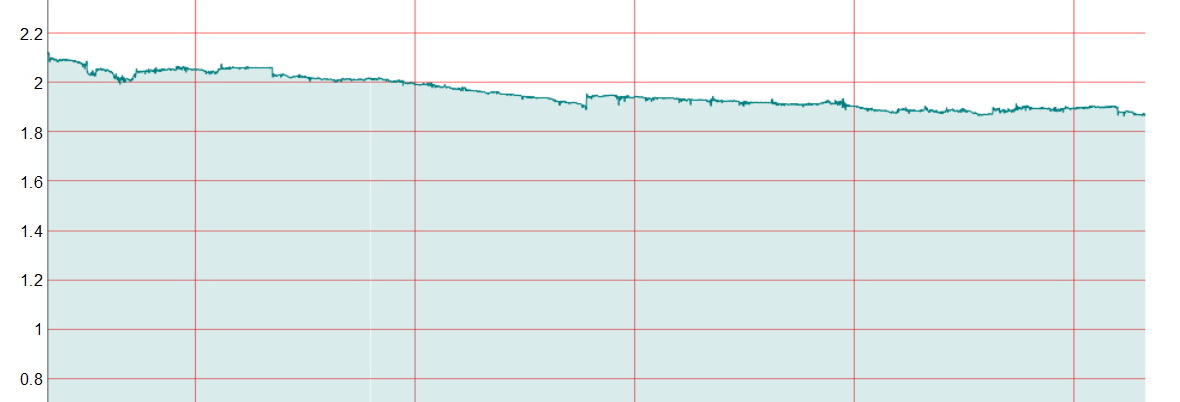
At Athlone, staff gauge zero is 35.360m above Poolbeg datum (from 18 Oct 2003). I chopped the bottoms off the first two graphs. The first one shows the level for 35 days to 30 September 2014; I presume that the level of Lough Ree was being reduced to enable it to hold some of the autumn’s rainfall.

Athlone Weir 20140930

Athlone Weir 35 days to 30 September 2014 (truncated)

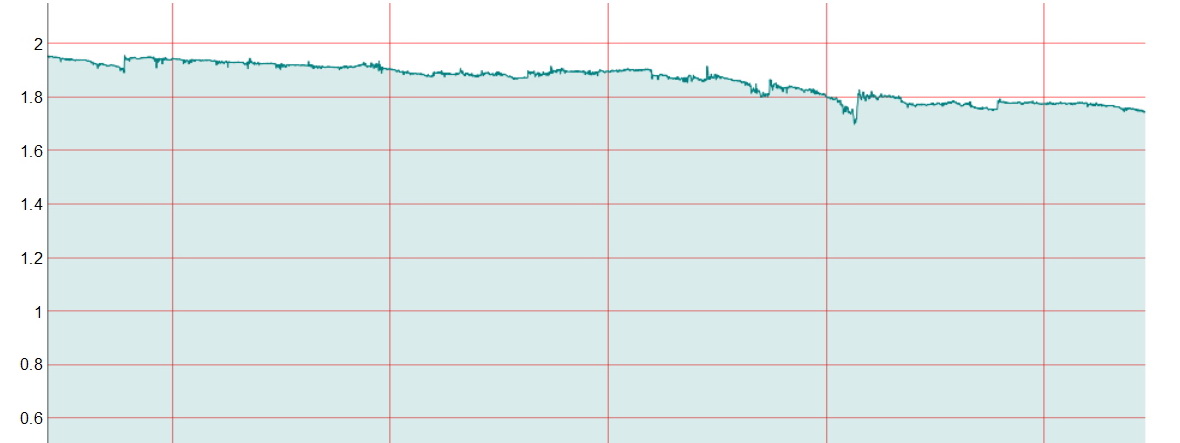
Here’s the graph for the 35 days to 15 October 2014.

Athlone Weir 20141015

Athlone Weir 35 days to 15 October 2014 (truncated)

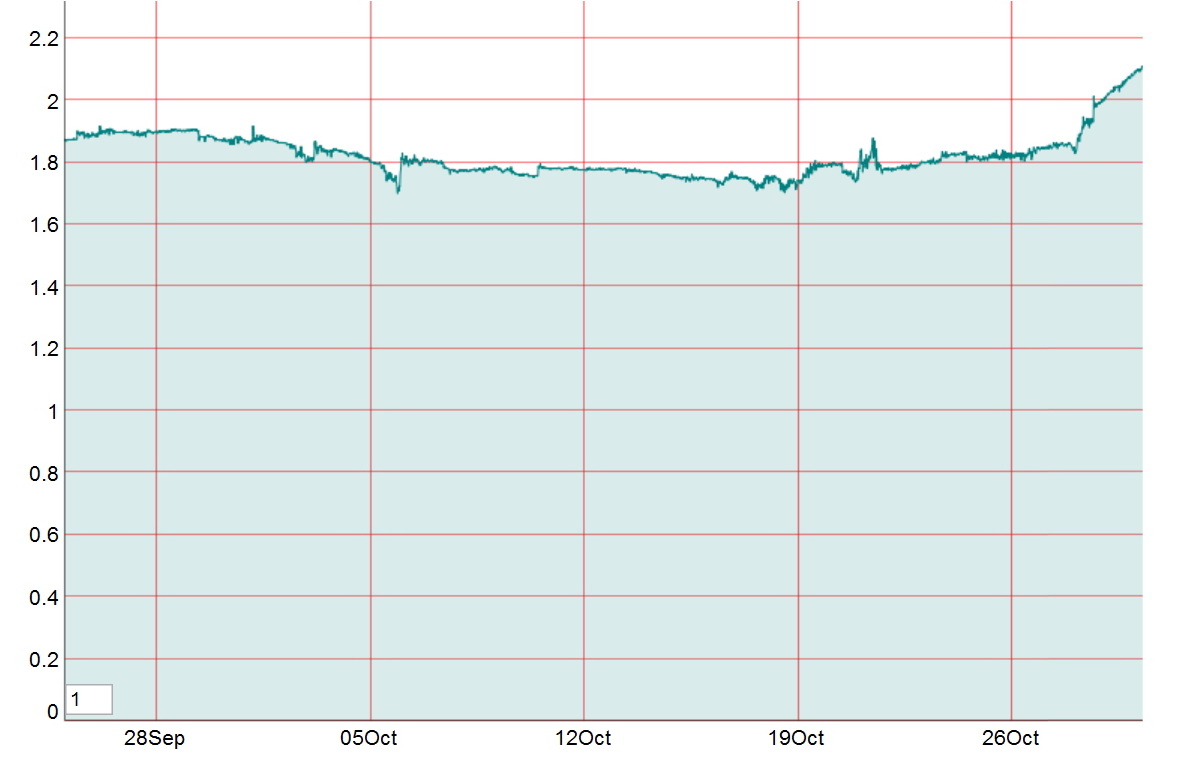
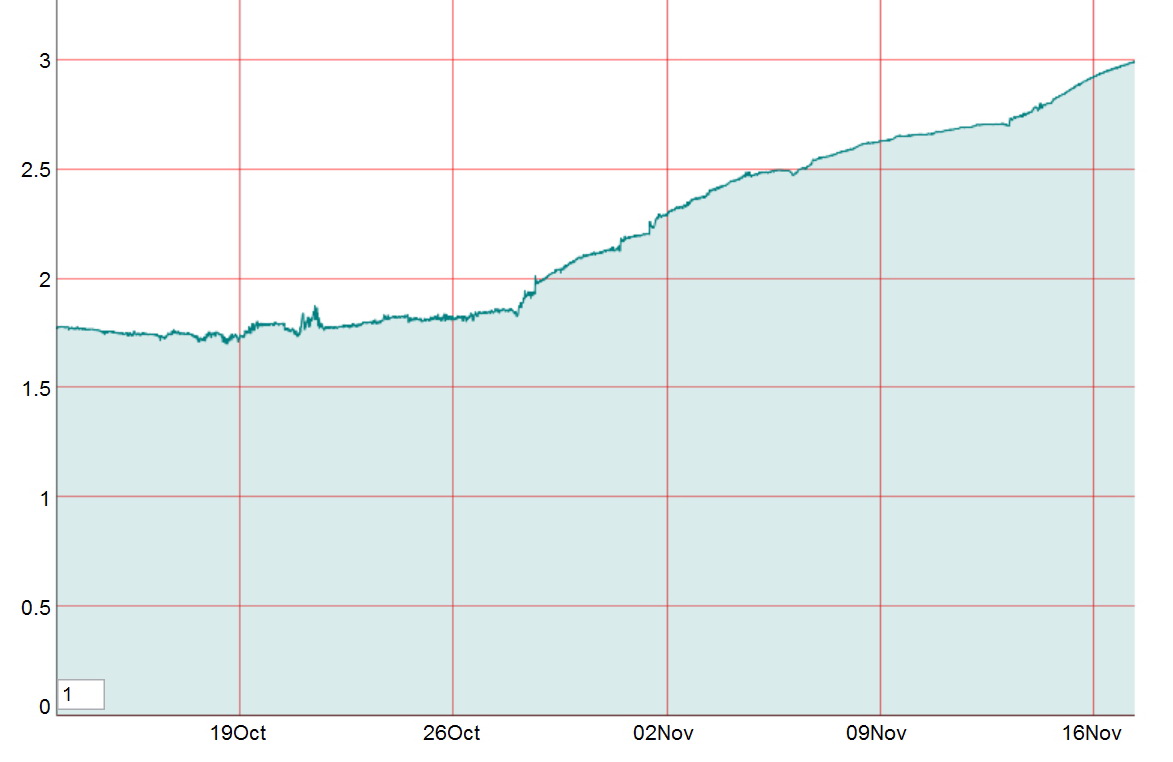
Then, in October, the level began to rise again. By 30 October, it was back to about 2.1 metres, roughly the starting point on the first of the graphs above.

Athlone Weir 20141030

Athlone Weir 35 days ro 30 October 2014

And since then it has continued to rise.

Athlone Weir 20141117

Athlone Weir 35 days to 17 November 2014

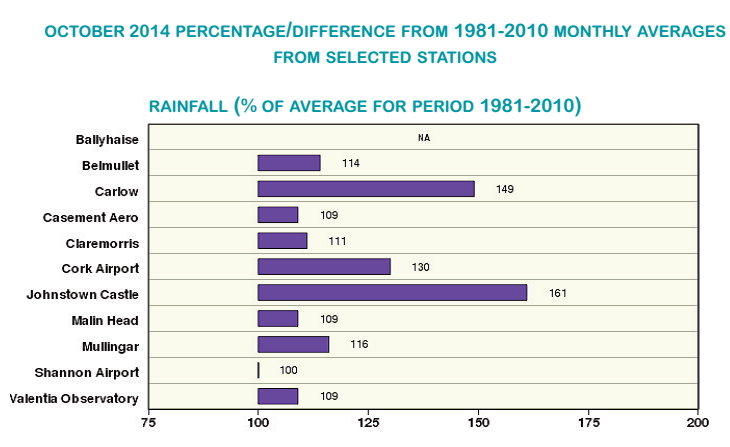
Met Éireann’s weather summary for October 2014 [PDF] has this chart:

Met Eireann weather Oct 2014

Met Éireann rainfall October 2014

It says:

Rainfall: wet conditions nearly everywhere

Monthly rainfall totals were above-average nearly everywhere with the exception of stations in coastal areas in the Northwest and West and in parts of the Midlands. Percentage of Long-Term Average (LTA) values ranged from 81% at Gurteen to 161% at Johnstown Castle, which recorded it wettest October since 2002.

Fermoy (Moore Park) reported 135% of its LTA with 153.6 mm and its wettest October in 10 years. The wettest days were mainly the 3rd, 5th and 28th, with the month’s highest daily rainfall reported on the 5th at Cork Airport with 38.6 mm, its wettest October day in five years. Mullingar reported its wettest October day in 12 years on the 28th with 26.4 mm. The number of wet days (days with 1 mm or more rainfall) ranged from 12 at Casement Aerodrome to 24 at Valentia Observatory and Claremorris, with Claremorris reporting its highest number of October wet days since 1973.

Use of the OPW charts is licensed under Directive 2003/98/EC [PDF] of the European Parliament and of the Council on the re-use of public sector information. Met Éireann allows use of “the web pages, and the information contained within them, for private and non-commercial purposes, for teaching, and for research […] is allowed subject to the condition that the source of the information is always credited in connection with its use”.


Airholes on the Kennet & Avon Canal

John Ditchfield very kindly photographed some airholes on the Kennet & Avon Canal and sent on the photos. The captions are his comments.

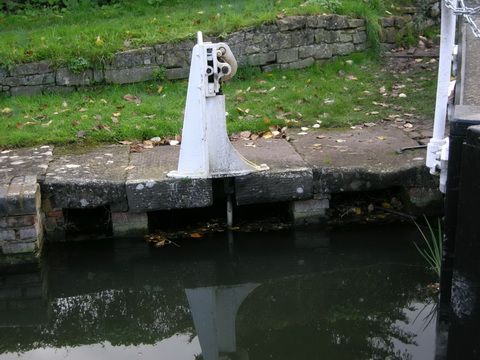
Bath05_resize

Good length of overflow. Water flowing.

Bath07_resize

No overflow.

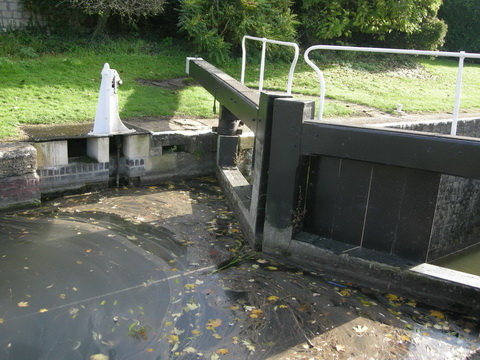
Bath06_resize

(Rebuilt) small openings are above the level of the top of the adjacent lock gate. However, just upstream there is another paddle or sluice gate on the canal side (next photo), so perhaps that is used to control the level.

Bath08_resize

The upstream paddle or sluice gate.

Bath09_resize

Overflow in action, preventing water overflowing gates.

Note: this lock connects the canal with the River Avon, and the building in the background was a steam pumping station, presumably for topping up the canal from the river.

Many thanks to John for taking the trouble.

Royal Canal water supply

On 26 November 2012 I noted that

The Royal Canal water supply applications have been approved by An Bord Pleanala. There were two separate applications […] but they were in effect treated as one.

There were conditions attached, but I concluded that

If I remember correctly, the amount of water available from Lough Ennell will not always provide enough (eg in a dry season) to keep the canal full. Still, this is a significant advance for Waterways Ireland and for Royal Canal enthusiasts.

So here we are, almost two years later, and the work of providing a supply from Lough Ennell to the Royal Canal, reckoned to be about a five-month job, has doubtless been long completed, no?

No.

The work has not yet started and Waterways Ireland will be lucky if it gets done within the next year.

As I understand it — and if, Gentle Reader, you have more information, do please leave a Comment below (your name can be kept out of public view if you like) — there are three sources of delay:

  • first, I understand that there is a technical issue about one of the conditions attached to the approval; it is felt that the condition is unworkable, but that getting it changed might take some time. I presume it’s one of the conditions 2(a) to 2(d) that I quoted two years ago and, looking at the proposed orders published in the press [PDF], I suspect it might be the requirement to maintain the lake level at or above 79.325 mOD Malin Datum. However, I don’t really know
  • second, Waterways Ireland took over Clonsingle Weir, at the outlet from Lough Ennell, by Compulsory Purchase. Owners of mills, who generate electricity from the Brosna, have submitted claims for compensation. I understand that an arbitration hearing, lasting four days, is scheduled to be help in May 2015
  • third, responsibility for the scheme has moved from Westmeath County Council to Irish Water. Which may have other things on its mind.

Irish Water has published its proposed Capital Investment Programme [PDF] but Appendix 1, the Investment Plan Project Summary, is in a separate file [PDF]. Category B is headed Review Scope and Commence Construction and it includes

Mullingar Regional Water Supply Scheme (G) … Lough Ennell Abstraction.

I can’t work out what “(G)” means. A few items are so marked; a few others are marked “(H)”; most items have neither.

The Capital Investment Programme [CIP] document says:

 The CIP is dominated by contractual commitments entered into previously by Local Authorities, and which have now transitioned to Irish Water. In the 2014-2016 period, Irish Water will fund these contracts to completion and bring forward programmes and prioritised projects to commence. At the same time, it will progress a large portfolio of projects that are at the planning and design stage, reviewing their scope, budgets and, where appropriate, timing to favour maximising the performance of the existing assets through intensified capital maintenance that might allow deferral of major capital investment.

Emphasis mine. So that raises the possibility that Irish Water will decide not to fund the abstraction scheme but will rather opt to pay for continued pumping.

It is, of course, quite possible that I have misunderstood these difficult matters, so I will be glad to hear from anyone with better information.

Incidentally, reviewing Irish Water’s documents suggests to me that there are people there who know what they are doing and who have the expertise to manage large and complex operations. That differentiates them from the politicians in government and opposition, few of whom (as far as I can see) have any experience of running anything more complex than a parish social.


Airholes

My attention was recently drawn to an article [PDF] by Mike Clarke about airholes.

The article is in Clogs and Gansey, the newsletter of the Leeds & Liverpool Canal Society, of which Mike is Founder and President. He is an extraordinarily knowledgeable person and it is well worth while looking around his website: for instance, there’s some material of Irish interest here, a list of publications here and material about the Leeds & Liverpool Canal here including a really excellent document about locks [PDF].

But back to the airholes.

Not being an engineer, or at all technically competent, I’m always reluctant to try explaining these mysteries, so I’ll welcome corrective Comments from any more technically-minded folk.

Water levels

If the water level on the upstream side of a lock gate is higher than that on the lower, the gate will be difficult to open. If the gate is the tail gate [bottom or lower gate] of a lock, you can raise a rack [paddle] and allow water to flow from the upstream side, which is the chamber of the lock, to the downstream side, thus making a level and allowing the gate to be opened easily.

If the gate is the breast gate [head or upper gate] of a lock, the same applies: you can lift a rack [paddle] in the upper gate, allowing the excess water to flow into the lock chamber.

However, the relationship between the heights of the two gates (or pairs of gates) then becomes important: if the breast gates are higher than the tail gates, the water level in the lock chamber will not be able to reach the height of the water above the lock (at least until you’ve drained down the entire level [pound] back to the next lock upstream).

But for efficient operation, you want to reduce the amount of adjustment that has to be done after the boat reaches the lock but before it can enter the lock chamber. You want a system that is, as far as possible, automatically self-adjusting. That means, in particular, one that ensures that the level of water above the lock is not too high.

Byewashes

On many English canals, that is done by using byewashes.
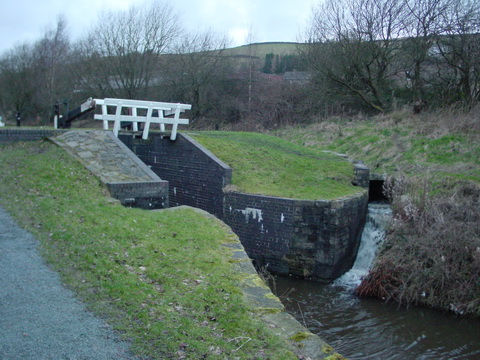
Byewash on the Huddersfield Narrow Canal (E) at Marsden

Byewash on the Huddersfield Narrow Canal (E) at Marsden

As far as I know, though, few Irish canal locks have them, and I have heard British boaters comment on their absence. If memory serves, the canal (Leitrim) end of the Shannon–Erne Waterway does, but I have no suitable photo. I should confess that I have no idea what proportion of Irish and English canal locks are so equipped; I will be glad if anyone who can supply, or point to, the information will leave a Comment below.

Airholes

Mike Clarke’s PDF article, to which I pointed at the top of this page, provides a possible explanation for the absence of byewashes on Irish canals. He says that airholes were used instead on canals “built or influenced” by William Jessop. Jessop worked on the Grand Canal as assistant to John Smeaton from 1773 and was consultant engineer to the Grand Canal Company until 1802 [Ruth Delany The Grand Canal of Ireland David & Charles, Newton Abbot 1973].

Mike Clarke also says that Jessop trained John Killaly: Killaly joined the Grand Canal Company in 1794 and became its engineer in 1798 [Delany op cit]; furthermore, his designs were used on the Royal Canal from Coolnahay to the Shannon [Ruth Delany and Ian Bath Ireland’s Royal Canal 1789–2009 The Lilliput Press, Dublin 2010].

If I’ve understood Mike Clarke’s article correctly, the airhole system uses the channel for the ground paddle [land rack] sluice instead of building a separate byewash channel. From his photograph, I gather that there is a separate letterbox-like slot in the recess for the rack mechanism: I presume that excess water flows in through the slot, falls to the level of the sluice or channel from there to the lock chamber and thus flows into the chamber. If the tail [lower] gates are left open, or with one rack [paddle] lifted, the water can then flow out into the lower level.

Questions about Irish locks

Is my understanding correct?

What proportion of locks on each Irish waterway are equipped with airholes?

Are they still maintained and used?
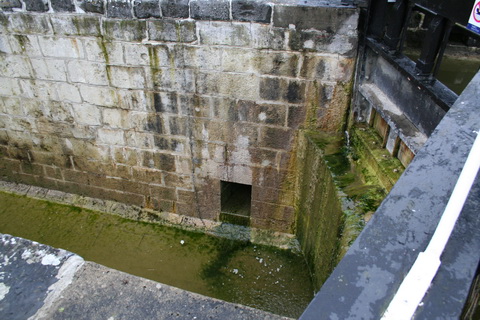
Belmont Lock May 2009 IHAI 5_resize

Land rack [ground paddle] outlet, Belmont Lock, Grand Canal
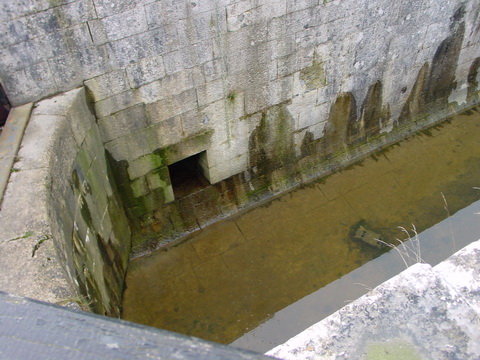
Royal Lock 43 Killashee 18-02-2007 01_resize

Ground paddle [land rack] outlet, Lock 43 Killashee, Royal Canal
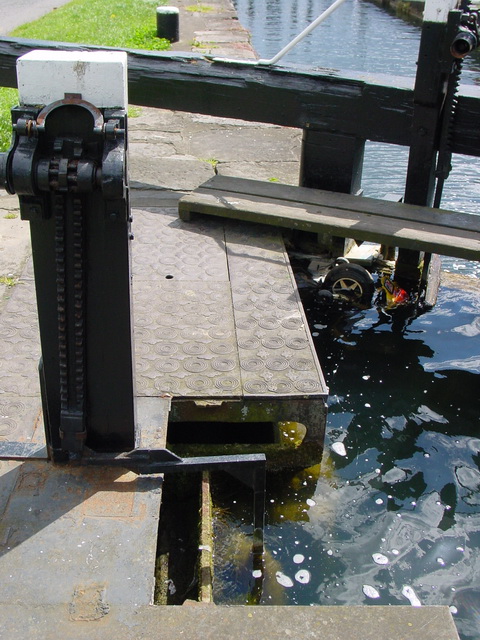
Royal Lock 6 02_resize

Possible inlet, Lock 6, Royal Canal

The next three photos were taken at Coolnahay, on the Royal Canal, during the period of very low water levels in 2012.
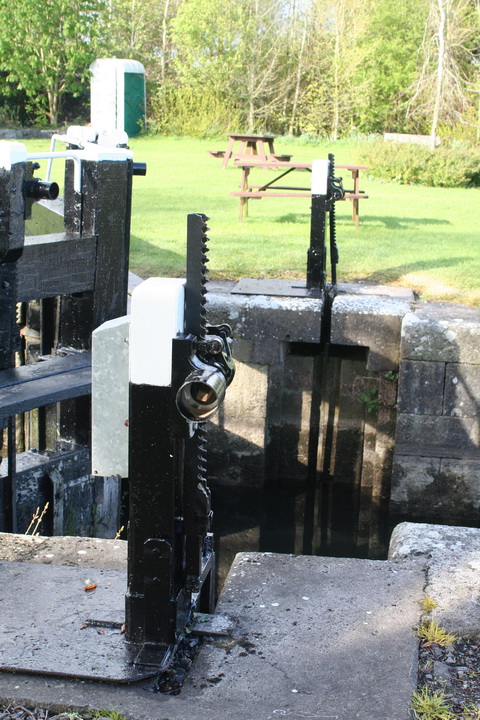
Coolnahay in drought April 2012 08_resize

Letterbox-like slot at Lock 26, Coolnahay, Royal Canal. I must look for similar features on Grand Canal locks and photograph them (if they exist)
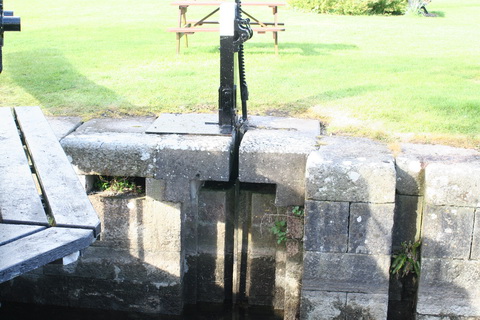
Coolnahay in drought April 2012 19_resize

A second slot forward of the first (hidden by the land rack mechanism in the previous photo)
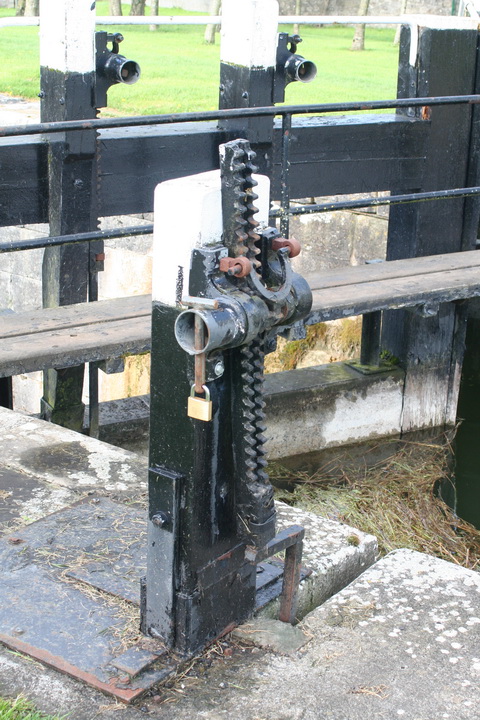
Land rack locked open at Lock 35_resize

Land rack mechanism locked slightly open: the slots were well above the water level at the time

It is of course entirely possible that all of this is so obvious that everybody else already knows all about it, but that I just didn’t understand what I was looking at. I read WI’s Heritage Survey of the Royal Canal [PDF], but it didn’t say anything about this sort of thing: or at least if it did I didn’t spot it. The report uses some non-standard terminology [eg “head gates”] so I may have missed its identification of the canal’s water-management features.

If, Gentle Reader, you know of the existence of papers or other published materials on these arcana, do please leave a Comment and, if possible, relevant links to online sources. It seems to me that there is a shortage of information about these technical matters as they apply to Irish waterways; it would also be nice if we were able to say which technologies were applied when to which waterways. I do not know whether, for example, we can assume that the lock gate designs in use today were always used on all Irish waterways.

Pumps and crisps

Thanks to Colin Becker, I have updated this page to show the location of the ESB’s third pumping station between Meelick and Portumna: I had known only where two of them were.

I have also added to the page some rude remarks about the ESB’s policy of not revealing the clearance of their cables above navigable waterways. If, dear reader, you know of a change in the policy, or if you can effect such a change, or if you know the clearances, do please let me know by leaving a Comment.


Before Ardnacrusha

Waterworks sluices 06_resize


The power of the Shannon, falling 100 feet in 15 miles from Killaloe to Limerick, is nowadays tapped by the hydroelectric power station at Ardnacrusha. But in earlier times it did not go entirely unused. I have already written about the bleach mill at Doonass; here is a page about the other bleach mill, at Clareville, and about the water works in the same area. These works are on a stretch of the Shannon navigable only by cots (then) and kayaks and canoes (now).


Carpenters Road Lock in London

Carpenters Road Lock in 2003

Carpenters Road Lock in 2003

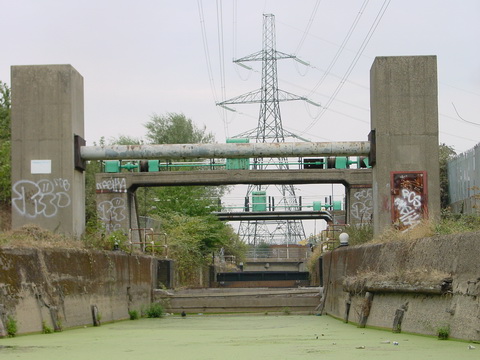
Here is a page about an art (craft?) project happening at Carpenters Road Lock on the Bow Back Rivers in London: the lock has changed quite a bit since I took the photo (above) in 2003.

I should warn you that the link is to a very long web page, but the section headings stay on top so you can move around. However, if you allow Javascript, you’ll find that two places on the page show those very annoying sequences of photographs that change automatically.

What I thought was most interesting was the set of events organised at the lock. Canals of Dublin organises canal walks in, er, Dublin, but what about Waterways Ireland having lockkeepers doing talks and demonstrations?

Here are some links to sites with more information about the Bow Back Rivers in London:

London Canals and associated blog

An extensive Wikipedia article with schematic diagram

A political view from Mick Hartley

London’s Lost Rivers on pre-Olympic scenery (black background makes the text hard to read but the photos are good)

The most informative page I found: a superb piece of work. Well done Richard Thomas, to whose Steamers Historical site I have a permanent link.

h/t celr