Category Archives: Economic activities

Fuel for Athlone

The Messrs Robinson of Athlone, having supported Captain Mathew, the Conservative Member for the town, last election, threats have been offered and violence used to the boatmen conveying turf to their distillery, and in consequence the establishment will henceforth burn coal in the concern, a great loss to the country people.

Clare Journal, and Ennis Advertiser 23 February 1835

The level of the Shannon

I want to see these 16 pinch points dealt with because in removing them we will drop the levels of the Shannon downstream of Athlone right down to where Deputy Harty lives. We are talking about dropping the level of the Shannon a foot and a half. The number of people who would benefit from this – the local farmer, the local business, BirdWatch Ireland – is enormous. The Government is committed to putting huge money into this.

Kevin Moran TD (Ind, Longford-Westmeath), minister for draining the Shannon,  in a Dáil Topical Issue Debate on Flood Risk Management on 16 October 2019.

I wonder which level he’s talking about.

Royal Canal greenway

Big it up, says Sarah Carey in the Indo.

Kerrygold

It is, no doubt, well known that the first transatlantic steam shipping company was founded by a Kerryman and was to be based in his home county: indeed on his own estate at Valentia Island. The transatlantic steamers would run thence to Halifax, Nova Scotia: that was amongst the shortest possible ocean crossing, which was important in the early days of steam navigation, when inefficient engines required prodigious quantities of coal. There were to be feeder services at both ends of the route, thus linking London with New York, and a second line from Valentia to the West Indies.

The Kerryman was Sir Maurice Fitzgerald MP, the 18th Knight of Kerry.  A meeting of supporters was held in London in June 1824 and, a year later, an Act of Parliament permitted the formation of a joint stock company with limited liability for its shareholders. However, the American and Colonial Steam Navigation Company did not last long: it softly and suddenly vanished away in 1828, its single steamer, the Calpé, sold to the Dutch government before completing a single voyage (although, under her new ownership, she ran a successful transatlantic mail service to Surinam and Curacao).

The prospectus, published before the meeting in June 1824, said of Valentia:

Ballast cargoes may be obtained there in slates, butter, and coarse linen, for the American markets.

However, Alexander Nimmo, writing to Fitzgerald, said

Remember, your whole peninsula only affords 100 tons of butter per annum, and all Kerry would not provide for a constant trade.

The gallant knight would therefore, I am sure, be delighted with the news from the Americas that “Irish Butter Kerrygold Has Conquered America’s Kitchens“. I hope he would have known enough to realise that “[…] Ireland’s landscape and economy, which both remain dominated by agriculture” may be true of the landscape but is not true of the economy.

Sources

John Armstong and David M Williams “The Perception and Understanding of New Technology: A Failed Attempt to Establish Transatlantic Steamship Liner Services 1824-1828” in The Northern Mariner/le marin du nord XVII no 4 [October 2007]

Letters and papers of Maurice FitzGerald in Public Record Office for Northern Ireland ref MIC639/6

Public Ledger and Daily Advertiser 28 June 1824

Beeb Brexit border boating

Here

Liveaboards and planning permission

The minister speaks.

Expected benefits of the Ulster Canal (aka the Clones Sheugh)

The members for Donegal, Cavan, Fermanagh, Monaghan, and Tyrone, assisted by the leading gentry of each county, have joined in the grand object of improving the navigation of Lough Erne, and are at present in communication with sseveral experienced civil engineers, the Board of Works, and Colonel Burgoyne. Mr Saunderson, of Castle Saunderson, is indefatigable in improving the Upper Lough, and it is probably his exertions will be met and well seconded by John Creighton Esq, Crom Castle.

Already have several gentlemen been summoned from Enniskillen to value the land at Newtownbutler through which the Ulster Canal is to pass; and when its junction with Lough Erne is effected, and a stream of Commercial communication is opened between Ballyshannon and Belfast, the central point of which must be Enniskillen, enterprising individuals will not be wanted to establish steamboats and vessels of large tonnage upon the lake, which will render such encouragement to manufacturers and commerce by the quick and cheap transmission of goods and mails, as will in a few years render this a most flourishing town.

Ballyshannon Herald 20 April 1838

Thon sheugh and the paddling pool

Exciting news from the Minister for Fairytales about the Clones Paddling Pool, which is now called the Terminus Project. I see they’re worried about the water supply: not a new problem for water-using structures in that area.

Irish slobs

The word “slob” is a provincial term, and applied to banks of mud in the same way that the word “warp” is used to signify similar formations in the River Humber.

Second Report of the Commissioners appointed pursuant to the Act 5 & 6 William IV cap 67 for the improvement of the navigation of the River Shannon; with maps, plans, and estimates HMSO, Dublin 1837

Staffing the Shannon

According to the eleventh and final report of the Shannon Commissioners, published in 1850 but covering the year 1849, each of the quays built by the commissioners on the Shannon Estuary had an officer stationed at it to collect tolls and other charges. Five of the six — Querrin, Saleen, Kilteery, Kildysart [aka Cahircon] and Clare [now Clarecastle] — had Second Class Collectors; Kilrush, being busier, had a First Class Collector.
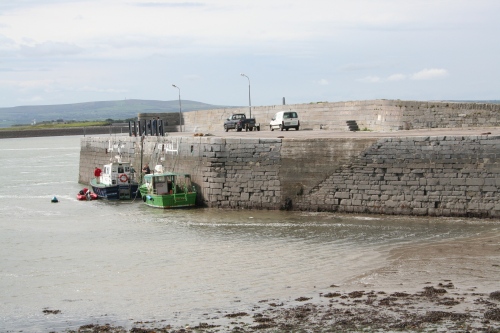
Cappa [Kilrush] pier

Moving upriver, Limerick was one of only two places on the Shannon to have an Inspector; it also had a First Class Collector and a Lock-keeper. Park, the next lock up on the Limerick Navigation, also had a keeper, as did five of the six locks on the Plassey–Errina Canal — Plassey [aka Annaghbeg], Gillogue, Newtown, Cloonlara [so spelt] and Errina. Presumably the Cloonlara keeper also locked after the nearby Monaskeha Lock. Preusmably, too, the keepers collected any tolls or charges due at the locks: there were no separate collectors, yet from other evidence we know that tolls and wharfage were collected at Plassey [Annaghbeg] and Errina.
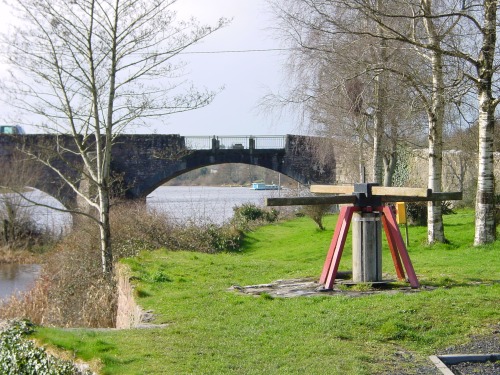
O’Briensbridge modern [ie 1830s] navigation arch

Back on the river, O’Briensbridge had a Second Class Collector. On the Killaloe Canal, each of the three locks — Cussane, Moyse [sic] and Killaloe — had a keeper; the Cussane keeper must have collected tolls and wharfage. Killaloe had a First Class Collector.

On Lough Derg, Scarriff and Portumna each had a Second Class Collector. Portumna, like several places upstream, had an opening bridge, but the Shannon Commissioners did not employ a bridge-keeper: the bridge was not built, owned or operated by the Shannon Commissioners.

Back on the river, on what used to be called the Middle Shannon, the commissioners employed both a Second Class Collector and a lock-keeper at Victoria Lock (Meelick). There was another Second Class Collector, and a bridge-keeper, at Banagher. At Wooden Bridge, the crossing of the Shannon from the Grand Canal’s main line to its Ballinasloe line, the commissioners employed two ferry boatmen: by that stage the bridge no longer existed and the commissioners had installed a ferry to carry horses and tow boats between the canals.

Shannon Bridge had a Second Class Collector and a bridge-keeper; Athlone had a bridge-keeper but earned itself a First Class Collector. On Lough Ree, Lecarrow and Lanesborough each had a Second Class Collector but Tarmonbarry had nobody: a First Class Collector was assigned to Cloondragh [so spelt] but presumably had to look after Clondra and Tarmonbarry locks, the weir, Tarmonbarry bridge and the collection of tolls. Mighty men they had back then.

The second Inspector was based at Rooskey, along with a lock-keeper who presumably also operated the bridge and did anything that needed doing on the weir. Albert Lock on the Jamestown Canal had a lock-keeper but Kilbride, the quay at the upper end of the canal, had a wharfinger, the only one on the Shannon.
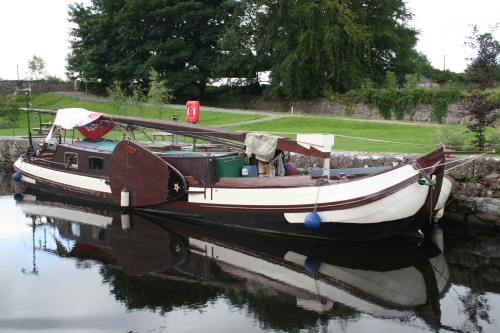
Fermate at Kilbride Quay

The collection of tolls (presumably by the wharfinger) did not begin at Kilbride until March 1849 but in that year it took in £6 in tolls and £1 in wharfage, compared with £1 + £2 at Drumsna and £0 + £0 at Jamestown. Perhaps the road beside the quay made it a suitable place for cargoes from Roscommon to transfer from road to water transport.

Carrick-on-Shannon, not an important station on the Shannon, had just a Second Class Collector; there was a lock-keeper at Knockvicar for the Boyle Water and another at Battle Bridge who presumably looked after all the locks on the Lough Allen Canal.

Cranes were provided at several places but there is no mention of designated crane-operators.

Source: Eleventh and Final Report of the Commissioners under the Act 2 & 3 Vict c61 for the improvement of the Navigation of the River Shannon, Ireland; with an appendix Ordered, by The House of Commons, to be Printed, 3 June 1850 [407]

