Category Archives: Engineering and construction

A lesson to estate agents

The Derry Castle Estate and splendid Demesne, near Limerick, on the Bank of the Shannon, exceeding 4500 Acres, with its vast Lake.

MR GEORGE ROBINS is flattered by having received the instructions of the excellent Proprietor,

Michael Henry Head Esq,

to SELL (without any limit as to protecting price), by PUBLIC AUCTION, at the GRESHAM HOTEL, in SACKVILLE-STREET, DUBLIN, on THURSDAY, the 27th of AUGUST, at Twelve o’Clock, in One Lot,

The magnificent ESTATE, which is Freehold of Inheritance, and designated

THE DERRY CASTLE PROPERTY,

which, for its splendour and renown, stands high amongst the most favoured throughout Ireland. This circumstance is not a little refreshing, inasmuch as the writer is relieved from an attempt to do it adequate justice, and to content himself with a mere outline.

It may be well, first, to observe that, fortunately, the Estate is free from that fearful pest to agricultural improvement and the yeomen’s comfort — the middle men. All are yearly tenants; the tithe is commuted; and it is a fact of no small importance to know that the use of spirituous liquors is unknown throughout this vast district; the necessary consequence is a total absence of

POLITICAL DIFFERENCES, OR DISTURBANCES

of any kind. Having thus cleared the ground of the great difficulty that has but too frequently prevailed in the minds of

THE TIMID ENGLISH CAPITALIST,

it may be well to point out a few of its multifarious advantages.

The Mansion is of importance; it stands on an elevated position above the level of the water, and is entirely suited to a family of high pretensions, with corresponding offices within and without. This edifice and its noble demesne is on the

BANK OF THE FAR-FAMED SHANNON,

the finest river in the empire. In front is a

SPLENDID LAKE, EMBRACING ONE HUNDRED SQUARE MILES OF WATER

20 miles in length, adorned by several delightful islands, whereon are interesting ruins of ancient castles.

The whole comprehends about

FOUR THOUSAND FIVE HUNDRED ACRES

of land, highly cultivated, and in the occupation of a happy and contented tenantry. The best illustration of this circumstance is the fact that the arrear is literally a mere bagatelle.

The mountain scenery, which forms a magnificent amphitheatre, is really of surpassing beauty; the cloud-capp’d mountains rising in majestic grandeur until they seem to approach the clouds — the mighty lakes like oceans of liquid silver — the valleys teeming in fertility — present a scene of such grandeur, beauty and variety, as quite to forbid the hope of conveying a just idea of it by description. The views are extensive and indescribably beautiful, extending over the rich surrounding country, and including

THREE WHOLE PROVINCES OF IRELAND,

and alone terminated by

THE VAST ATLANTIC OCEAN,
“Its mighty waters, ever rolling on
Their myriad countless waves.”

Nature has vouchsafed its kindness to a degree infinitely beyond comparison anywhere, and presents a scene well calculated to elevate and impress the human mind, and incline it better to estimate “THE PERFECT PARADISE BELOW”.

THE FISHERIES AND THE FIELD SPORTS

may safely challenge competition throughout the civilised world. Millions of water fowl congregate on the vast lake. It should be remarked that, independently of

THE IMMENSE ANNUAL REVENUE

from the Lands, there are

EXTENSIVE SLATE QUARRIES

of which the engineers’ report speaks most intelligibly: proving, past doubt, that for quality, extent, and situation, Mr Pennant’s favoured works, now producing

FIFTY THOUSAND POUNDS PER ANNUM

are not at all superior. Copper and Lead Mines are also on this estate, which, if worked, would realise an immense income. Much more might, and perhaps ought to be said, in praise of Derry Castle. Mr Robins, however, prefers to entreat of the intended competitors to seek ocular demonstration. He knows full well that this hasty and imperfect sketch will not impress them with half the delight they are sure to find there.

To those who may still be sceptical it may be added that the vast renown acquired by this

PRINCELY TERRITORY

has rendered it indispensable to indulge the nobility and travellers visiting Ireland by throwing open wide the demesne two days in each week throughout the year.

To conclude — an immense additional income is within reach by those who have money at command, by building

FIFTY OR ONE HUNDRED VILLAS ON THE BANKS OF THE LAKE.

The estate is in the quiet, unpolitical part of Ireland, thirteen miles only from the city of Limerick.

Particulars and Plans, and a drawing of the Castle, are in progress, and may be had 28 days antecedently, at the mansion — of Mr Salmon, at his Offices, 44, Moorgate-street, or Mr David Daly, Solicitor and Receiver, Fitzwilliam-street, Dublin — at Messrs Pyne and Richards’s, George-street, Hanover-square — Gresham Hotel, Dublin — the Auction Mart — and at Mr George Robins’s Offices, London.

PS — The title is clear, concise, and intelligible.

Dublin Evening Mail 7 August 1840

It is possible that Robins was brought in, with his purple pen, after earlier ads failed to attract a buyer. In March 1840 the Limerick Reporter carried an ad that concentrated on the estate’s earning potential.

FEE SIMPLE ESTATES.

To be sold, the
NOBLE DEMESNE AND ESTATES
of
DERRY CASTLE,
With Mansion House, and suitable Square of Offices; Extensive Old Plantation of  Valuable

TIMBER

Generally of above 100 years’ growth, situate on that part of the River Shannon

Which forms that Beautiful Expanse of Water, called

LOUGH DERG.

Above 20 Miles long, and 4 broad, on which STEAMERS and TRADING VESSELS ply between Limerick and Shannon Harbour, giving this Estate all the advantages of the

SHANNON AND CANAL NAVIGATION,
And Trade between Limerick and Dublin.

THE HOUSE stands in a most commanding position with respect to this Magnificent LAKE, with most picturesque Mountain Views, and overhung by ranges of nearly 100 Acres of young plantation along the adjoining slopes, planted from 20 to 30 years’ since, by the late Michael Prittie Head, Esq. It is impossible adequately to describe the

BEAUTY OF THE SCENERY

The town and harbour of Killaloe is distant about 3 miles, Nenagh about 9, and Limerick about 12 miles, by land or water.

The Mail Coach Road, from Dublin to Limerick, runs through the detached part of the Estates, called Burgess.

MANURE

Of a most Peculiar and Valuable quality (and the quantity inexhaustible) is obtained from Lough Derg, for the entire Estate, at all seasons.

It is a BLUE SHELLY MARL, which is dredged from the bottom of the Lake into boats by the Tenantry, for which Quays and Harbours are arranged. It has been analysed, and was found to contain 50 per Cent of CARBONATE OF LIME, with other valuable properties set forth in the Analysis.

The more elevated divisions of these Estates abound in

SLATE QUARRIES

So long celebrated as SUPERIOR to any in EUROPE, and are now in full operation, with the splendid outlay of capital by the IMPERIAL SLATE COMPANY, in whose employ several hundred men are permanently engaged to the great advantage of the proprietor of the Estates, who participates in the income under the deeds of contract.

The specimens of COPPER and LEAD MINES afford every reason to believe that, if properly brought into operation, they may become

A RICH SOURCE OF WEALTH.

The MOUNTAIN COMMONAGE comprises about 550 Acres, which has

GREAT CAPABILITIES FOR IMPROVEMENT,

having regard to the MARL raised from the LAKE, being far superior to lime, and an

INCALCULABLE SOURCE OF WEALTH TO THESE ESTATES.

The extensive ranges of

YOUNG PLANTATIONS

Outside the Demesne, along the elevated Divisions of the Estate, are also of GREAT VALUE, comprising large sections of

OAK, LARCH, FIR, &c &c

The thinnings of which would materially tend to the improvement and growth of the Timber.

THE OLD AND YOUNG PLANTATIONS

Are estimated at considerably above £10000.

The Estimated PRODUCTIVE RENTAL VALUE of the Estate, exclusive of the Mansion, Offices, &c may be set down by way of General outline, at £3000 per annum, with the ADDITIONAL INCOME to be derived from the vast outlay of capital by the Imperial Slate Quarry Company, to a proportion of which Mr Head is entitled.

Mr Head had arranged with the principal incumbrancers to the amount of about £30000, to allow their demands to remain outstanding at 5 per cent interest, being disposed to pay off other claims by instalments; but some creditors becoming pressing, he has at length decided upon selling the entire Estate, or a competent part, to pay off the Incumbrances, and a purchaser may, if so disposed, avail himself of

LEAVING ABOUT SAID £30000 OUTSTANDING

to suit his convenience.

Any further particulars will be explained by Michael Henry Head, Esq, Derry Castle, Killaloe.

David Daly, Solicitor, No 26, Fitzwilliam-street, Dublin, is Receiver and Land Agent of the Estates, and has all Rentals, &c and will give every information, furnish statements of title, and receive propositions from purchasers, and under Mr Head’s sanction, will at once conclude a contract for sale.

Te title is perfectly clear, concise, and intelligible, and all seaarches ready for inspection.

The Estates contain 4347 statute Acres, and the young plantations 74800 Trees, exclusive of the old plantations in the Demesne.

February 21

Limerick Reporter 20 March 1840

Neither ad was successful; the estate was not sold until 1844.

The Derry Castle and Burgess estate, county of Tipperary, was knocked down to Francis Spaight, Esq, of Limerick, for £39500 at the Chambers of Master Goold, on Tuesday. The highest bona fide offer for this property at the sale last May was £37500, and it was then bought in at £38000. The estate comprises 3000 acres of land, with mansion house, and offices, on the most picturesque and frequented part of the Upper Shannon, near Killaloe.

Statesman and Dublin Christian Record
16 August 1844



Hamilton Lockhouse …

… is for sale.

h/t Ewan Duffy

Killaloe in the age of steam

That’s November’s talk at the Killaloe-Ballina historical society; details here and an account of Sandra Lefroy’s talk about the Phoenix here.

Phoenix

On Wednesday 25 October 2017, at 7.00pm, Sandra Lefroy will be talking about the Phoenix, the (formerly steam-powered) vessel built in 1872, at the Malcolmson-owned Neptune Iron Works in Waterford, for Francis Spaight of Derry Castle on Lough Derg. The venue is the library in Killaloe, which is on the site of the lockhouse.

History afloat. The life and times of the Phoenix: a unique 1872-vintage heritage boat of Killaloe and Ballina

Now almost unique, the nineteenth-century Phoenix is one of the most historical boats in Ireland. She has been based in Killaloe for much of her life, mostly in the ownership of the Lefroy family. Sandra Lefroy will tell us something of the history of this wonderful craft, and what it is like to live on board a heritage vessel.

Details here.

Canals and popery

Between 1768 and 1774

… means were devised to provide secure investment facilities for Catholics in projects of national and public utility, which at the same time left the whole system of the popery laws intact.

The earliest example I have found of this opening of the back door to Catholic investment was an act of 1768 for improving navigation between Limerick and Killaloe. To encourage Catholics to invest in the enterprise all shares were to be regarded as ‘personal estate and not subject to any of the laws to prevent the growth of popery’. Thus the indirect ownership of land involved in such investment would not be at the mercy of Protestant discoverers.

A blanket concession on similar lines was given in 1772 to Catholic shareholders in all inland navigation companies and in insurance companies. The fact that these acts now made it possible for Catholics to become shareholders and sometimes directors in such companies as the Grand Canal Company, must have served to break down segregation barriers to some slight extent.

Maureen Wall “Catholics in Economic Life” in L M Cullen ed The Formation of the Irish Economy The Mercier Press, Cork 1969, rp 1976


Boris the Shinner

I have suspected for some time that Britain’s Brexiteers are actually Sinn Féiners.

After 1916 the Irish Shinners decided to leave a larger economic and political entity and to do so without any business plan or any realistic idea of how their proposed state would make a living.

After 2016 the British Shinners decided to leave a larger economic and political entity and to do so without any business plan or any realistic idea of how their proposed state would make a living.

One lot of Irish Shinners, led by the lunatic Éamon de Valera, wanted a hard Irexit and started shooting the soft Irexiteers who, happily, managed to keep control; it is to be hoped that matters don’t go that far in Britain.

It may be objected that the evidence for this contention, that Brexiteers are Shinners, is a little light, but I have now found confirmation: Boris Johnson is an enthusiast for insane canal construction projects.

The mark of the Shinner is upon him.

How to civilise Co Galway

An article from the Dublin Penny Journal of 13 September 1834 [Vol III No 115], conducted by P Dixon Hardy MRIA, solves that and other longstanding problems.

Public works in Ireland

The tunnel or archway through Lord Cloncurry’s grounds

Having in our last described the line of railway from the entrance station in Westland-row to the Pier at Kingstown, we now take the opportunity, while presenting our readers with two other views of the road, of inserting an article which, since our last publication went to press, has appeared in The Sun newspaper, relative to the carrying on of public works in Ireland. Our readers will perceive that its general bearing is in perfect accordance with the opinions we have more than once before expressed, when speaking on the subject of railways. We have already stated our reasons for giving a preference to railways over other modes of conveyance; but we fully agree in opinion with the writer of the article to which we refer, that no greater benefit could be conferred upon Ireland than the introduction of a cheap and expeditious means of conveying her agricultural produce from the heart of the country to the extremities — whether this be by canals or railways is a matter to be decided by the locality of those districts through which the lines of road may pass.

“We do not often derive so much pleasure from the perusal of a public document as we have from a careful inspection of the plans, and consideration of the suggestions, contained in the Second Report of the Commissioners of Public Works in Ireland, just printed by order of the House of Commons. Notwithstanding the low ebb at which the tide of Ireland’s prosperity stands at present, we predict, from the great improvements that are now being carried on, in clearing harbours, opening canals, and making roads along the eastern, southern, and northern coast, that the day is not very long distant when Ireland will, from being a bye-word among the nations of Europe, become equal to some of its proudest states in industry, wealth, intelligence, and love of order.

The worst crimes of Ireland are the results of the poverty and despair, rather than the evil disposition of her population. Public works, besides giving employment to thousands of her labouring poor, whom want has rendered almost desperate, will be the means of inducing capitalists to establish factories where facilities are afforded for carrying on an extensive trade; and will enable agriculturists to raise produce wherever a line of good road, a cheap water carriage, or convenient shipping, supplies them with a sure market for the fruits of their industry.

During the last eighteen months the sum of one hundred and twenty-nine thousand, six hundred and thirty-three pounds were expended in the improvement of Kingstown and Dunmore harbours, the making of roads on the Antrim coast, and the building of bridges, and other improvements in different parts of Ireland. The consequences of these works are already beginning to be manifested in the improved condition of the inhabitants in their vicinity, and the altered aspect of the immediately adjoining face of the country.

The commissioners themselves say that ‘Wherever a new road is constructed, flourishing farms at once spring up, and the carts of the countrymen press on the heels of the road-makers as the work advances’. And in a preceding paragraph the following most important information is given: — ‘In traversing a country covered with farms, and in a high state of cultivation, showing every sign of a good soil and of amply remunerating produce, it becomes difficult to credit the fact that, ten or twelve years since, the whole was a barren waste, the asylum of a miserable and lawless peasantry, who were calculated to be a burden rather than a benefit to the nation; and that this improvement may entirely be attributed to the expenditure of a few thousands of pounds, in carrying a good road of communication through the district’.

What Ireland stands most in need of at the present moment is, a cheap and expeditious means of having her agricultural produce conveyed from the heart of the country to the extremities. Now, in our judgment, the best way of effecting this would be by canals, of which she stands in the greatest need.

The first of these should be a canal from Dublin to Galway, which would cut the whole island across, from east to west, uniting St George’s channel with the Atlantic ocean. This line of communication between the capital of Ireland and a great commercial town on the extreme coast, would be of immense importance to the inhabitants of both, but of still more so to the whole population of Connaught, among whom it would be the direct means of introducing manufacturing industry, and a taste for the arts, enjoyments, and elegancies of civilized life. The distance between Dublin and Galway is about one hundred and four miles, through which a direct line of canal has already been carried for forty-two miles — namely, from Dublin to Philipstown; so that in point of fact the work is already begun, and only wants the aid of government, and the assistance of the landed proprietors in King’s County, Roscommon, and Galway, the value of whose estates would be trebled by it, to effect its entire completion.

The next line of canal should be from Ballyshannon Harbour to Dundalk, by Enniskillen, by which the greatest facilities would be given to agriculture and manufacturing improvements in the counties of Donegal, Fermanagh, and Leitrim; and more especially to the trade of Ballyshannon and Dundalk, which, though capable of being made emporiums of provincial industry and wealth, are now little better than marts for the fish caught along their coasts. However, great praise is due to Colonel Conolly, the member for Donegal, who has advanced a thousand pounds, and given security for four thousand more, for repairing the harbour of Ballyshannon, which, when finished, will be of great benefit to the people of the town, and the inhabitants along the western coast, from Sligo to Killybegs.

The last line of communication which we would suggest to the government, besides the navigation of the Shannon, which is sufficiently dwelt upon in the reports of the select committee on that subject, is a canal from Waterford to Sligo, intersecting the canal from Dublin to Galway, somewhere about Philipstown.

This, with such a line of communication from Dublin to Belfast, would unite all Ireland; and in a very few years would render the country as prosperous, as rich, and as contented as any in Europe. The intercourse which those canals would give rise to between the people in every part of the provinces, would extinguish that spirit of religious animosity which now divides and destroys them. Bring men only together, and they will soon remove the prejudices of each other.

The people of Ireland are at present as much removed from each other at the distance of fifty miles apart, as if the whole Indian ocean rolled between them. Hence, the jealousies, and hatreds, and cherished recollections of feudal wrongs, so common in almost every district of Munster and Connaught. But let once manufacturing industry prevail in these districts — let the voice of the mechanic be heard in the villages — and we will pledge ourselves that the people of Ireland, with all their alleged love of mischief, will find other employment than that of parading nightly in a Captain Rock uniform, or recording vows of vengeance against Sassenachs and collectors of king’s taxes.”


Sinn Féin asks useful PQ about waterways shock

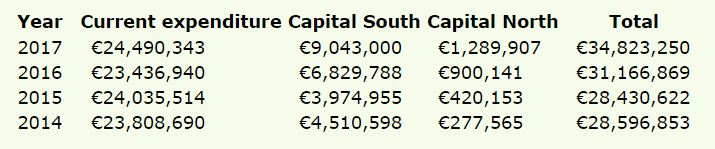
Yes, Caoimhghín Ó Caoláin, SF TD for Cavan-Monaghan, has asked a useful question about waterways, one that doesn’t seem to have been designed to promote an insane restoration proposal. He asked for “the current and capital expenditure by Waterways Ireland in each of the years 2014 to 2016; the estimated level of current and capital expenditure for 2017″. The answer included this table:

WI budgets


Current spending comes 85% from the Free State and 15% from Norn Iron; capital spending is paid for by the administration in whose territory the montey is to be spent.

There may be a problem here in that I have a feeling that, if there is no NI Executive, spending is limited to 90% of the previous year’s figure [I am open to correction on this], which might cut the NI contribution to current spending: I presume that the RoI contribution would then be cut too, to maintain the 85:15 ratio.

The Minister for Fairytales also said that WI gets money from “third-party funding contributions towards specific projects and from its own income from licences and property.” However, its own income is pathetically small.

I am writing less about current waterways affairs because I’m concentrating on those of the nineteenth century (unlike Sinn Féin, which focuses on the eighteenth), but I did read WI’s Annual Report and Accounts for 2016 [PDF] with interest. Despite the considerable challenges it faces [including the pensions nightmare], the organisation has been expanding its range of activities and looking to new users and new uses. I hope that the Brexit hard border, which I suspect is now unavoidable, doesn’t completely bugger things up.

If it does, we might need to ask Sinn Féin whether it can think of anyone who could help smuggle motor-cruisers across the border to enable boats to move between the Shannon and the Erne. Perhaps their day will come.


Mr Moran’s delusions

Kevin Moran is an independent TD for Longford-Westmeath and is now Minister of State for the Office of Public Works and Flood Relief. On 12 October 2017 he said in the Dáil:

I thank the Acting Chairman for giving me time to speak on the very important issue of budget 2018. Flooding is a huge issue that falls under the remit of my Department. Not one Deputy spoke about flooding during the budget debate. Nobody has come to my door to talk about flooding. Deputy Canney has not spoken yet. I assure the House that I have a sum of €432 million, which is a huge investment in flooding measures by the Cabinet. The funding for flooding schemes will increase from €45 million to €70 million next year. There will be a roll out of more schemes to protect people in their homes. There will be €5 million for the minor works scheme which is very important to protect people. Everyone has talked about putting diggers on the Shannon. I am the first Minister in the House to put a machine on the Shannon since Queen Victoria. I have heard every political party in here talk about it but they could not do it.

If Mr Moran would care to glance at this page on this site, he could look at photos of workboats and dredgers employed by Waterways Ireland (and some of them before that by his own department) on the Shannon and elsewhere — and considerably later than the time of Her late Majesty Victoria.

I am not sure, though, that “diggers on the Shannon” would be very useful: they would probably sink.

Broharris and Ballykelly

I have revised and expanded my page on the Broharris Canal, distinguishing between it and the Ballykelly Canal. However, there are still mysteries, and I will welcome comments from anyone who can cast light on the two subjects.