
… with this site, reporting on both Seol Sionna and the gandalows, which were covered here and here.
According to the Irish Times:
Ahead of the summit later this month, Government departments have been told to draw up lists of capital projects with potential to create thousands of jobs for which funding would be sought if EU leaders agree on the package at the meeting to be held a week before polling day here.
Will DAHG be able to resist the temptation of suggesting the Clones canal? I’m sure that, since it discovered the project was going to cost almost one third more than it had originally believed, it has had teams of economists busily reassessing its, er, viability (and I’m expecting a visit from the easter bunny at any moment) so it will have its “business case” ready.
Still, there’s a slightly more cheering take on the matter here, where Michael Taft suggests that the government won’t be able to get much money for “stimulus”. I like the idea of using project bonds for the Clones Canal, though it might be hard to show that it qualified as “key strategic EU infrastructure in transport, energy and broadband” despite the Irish state’s delusions.
Posted in Economic activities, Engineering and construction, Foreign parts, Industrial heritage, Irish waterways general, Operations, Politics, Restoration and rebuilding, Ulster Canal, waterways, Waterways management
Tagged canal, Clones, department of arts heritage and the gaeltacht, Erne, Ireland, Lough Neagh, Ulster Canal, waterways, Waterways Ireland
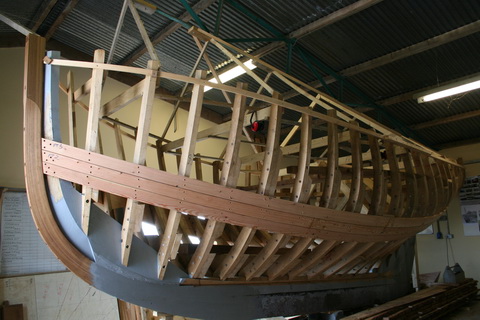
Seol Sionna under construction
The reproduction 25′ Shannon estuary hooker Seol Sionna will be launched at Querrin, Co Clare, on Saturday 19 May 2012, with celebrations continuing at Carrigaholt (home of the sublime Long Dock pub and eatery) on the following day [h/t dbm].
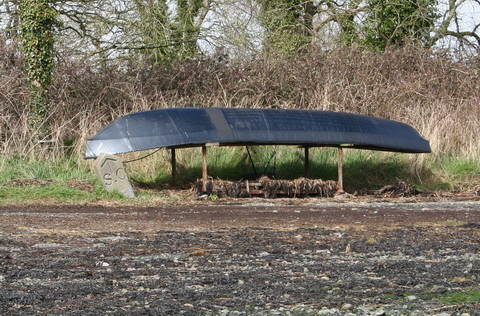
Canoe at Querrin. The second syllable of “canoe” rhymes with “go”
The pier at Querrin was built by the Shannon Commissioners; one of their marker stones (there are four at Querrin) is shown above.
Whaddya mean, you don’t know where Querrin is?
Remember, if the turf boats had not established the tourist traffic to Kilrush and Kilkee, the Shannon estuary steamers might never have got going and there might never have been a P&O line.
Posted in Built heritage, Charles Wye Williams, Economic activities, Engineering and construction, Extant waterways, Forgotten navigations, Industrial heritage, Ireland, Irish inland waterways vessels, Operations, People, Restoration and rebuilding, Scenery, shannon estuary, Sources, Steamers, The turf trade, Tourism, waterways
Tagged boats, estuary, Ireland, Kilkee, Kilrush, Querrin, Seol Sionna, Shannon, steamers, turf, turf boats, vessels, waterways
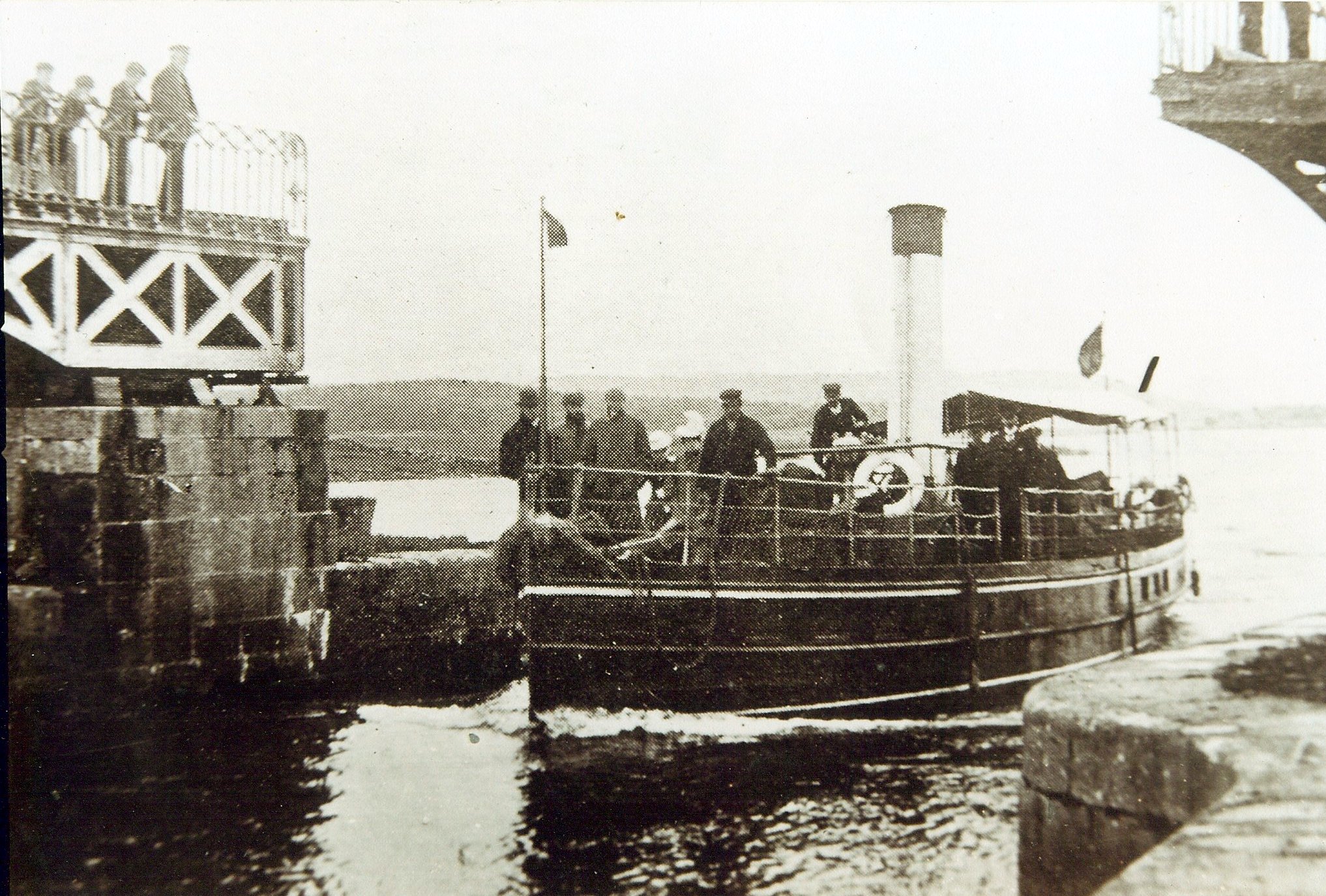
I am grateful to Liam Kelly for sending me this photo of a steamer on the Shannon. He says that the photo is believed to show a steamer belonging to Lord Granard (Bernard Forbes, 8th Earl of Granard) passing through Lanesborough Bridge in 1900.
Here is a map showing Lanesborough and Castle Forbes.
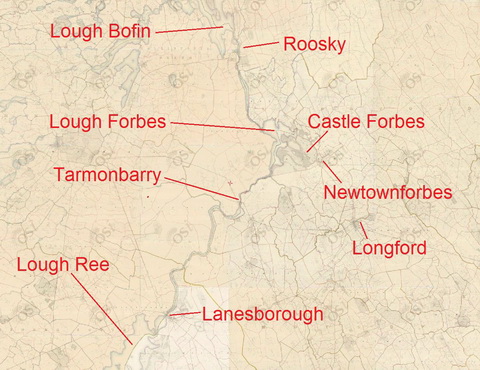
Lanesborough and Lough Forbes (OSI ~1840)
And here is Castle Forbes shown in relation to Lough Forbes.

Castle Forbes and Lough Forbes (OSI ~1900)

According to a programme reproduced on page 200 of Ruth Delany’s The Shannon Navigation (Lilliput Press, Dublin 2008), Lord Granard (Right Hon the Earl of Granard, KP, GCVO) was Commodore of the 1929 Lough Forbes Regatta, held under the auspices of the North Shannon Yacht Club Flag and the Motor Yacht Club of Ireland. Page 197 of the same work has a photo of a North Shannon Yacht Club regatta on Lough Boderg in 1903; it includes a large steam yacht, but with a white rather than a black hull.
Page 181 of the same work has a photo of a passenger steamer, the Fairy Queen, one of the six operated by the Shannon Development Company, which was set up in 1897: the Fairy Queen and the Shannon Queen worked the confined waters of the Shannon above Athlone. The same photo of the Fairy Queen can be seen here.
To my eye, the steamer in the Lanesborough photo looks rather like the Fairy Queen, although I don’t think I could go so far as to suggest that they are one and the same. They’re shown from different angles and, anyway, similarities between steamers of the same era are to be expected. The reason I comment on the matter is that, while looking into the history of the Fairy Queen, I found that the invaluable Clydebuilt Ships Database had a photo of the 1893 Fairy Queen that served on the Shannon (not to be confused with her 1897 replacement). And, again to my eye, the Fairy Queen in the Scottish photo does not seem to be the same as that in the Irish photo. I would welcome other people’s comments on the matter.
The story is here. There is more on the family’s collection of animals here.
Posted in Ashore, Built heritage, Engineering and construction, Extant waterways, Ireland, Irish inland waterways vessels, Natural heritage, Operations, Shannon, Steamers, Tourism, waterways
Tagged boats, Castle Forbes, Clyde, Earl of Granard, fairy queen, Forbes, Ireland, Lanesboro, Lanesborough, Lord Granard, Lough Forbes, motor yacht, Newtownforbes, Shannon, squirrel, steam yacht, steamer, vessels, waterways
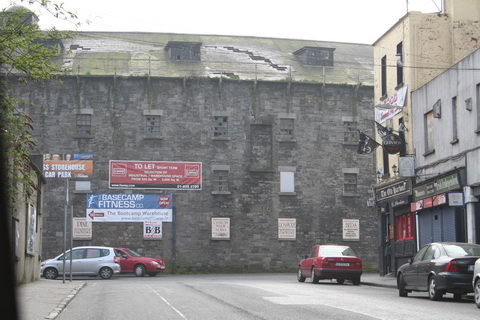
The curved building in March 2011 …
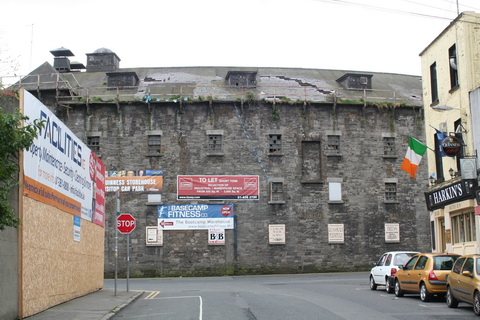
… and in May 2012
No sign of any improvement or of anything done to protect the building.
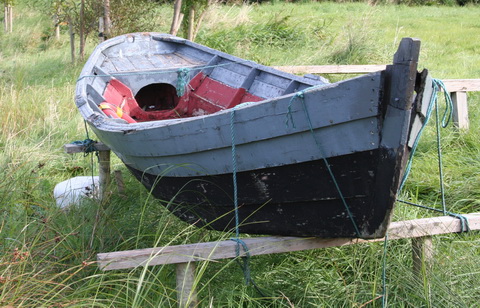
Bunratty Gandalow 2008
Gandalows (there are several spellings) are boats of the upper reaches of the Shannon Estuary. They come in several shapes and sizes and have been covered in several books. There is an opportunity to see some of them on the water, in Limerick, on Saturday 19 May 2012, when the ILEN School & Network for Wooden Boat Building has organised a day of talks and races. Full details here.
Posted in Built heritage, Engineering and construction, Extant waterways, Industrial heritage, Ireland, Irish inland waterways vessels, Operations, Restoration and rebuilding, Shannon, shannon estuary, Water sports activities, waterways
Tagged a k ilen, boats, gandalow, gandelow, Ireland, Limerick, Shannon
On 9 May 2012 the Irish Times carried a large ad offering for sale a “landmark site situated in a prestigious location on the North Circular Road/O’Callaghan’s Strand” in Limerick. The site is being sold by DTZ Sherry Fitzgerald but I can’t find it listed on their website; nor can I find, on the Irish Times website, the article “Toffee factory to test sticky Limerick market” that, coincidentally, appeared on the page after the ad.
However, the Limerick Post has a brief history of the site, which is shown on the OSI map of ~1900.

The Condensed Milk Manufactory ~1900
The waterways interest is actually in the dockyard, with its dock and slip, on the river just south of the manufactory. The yard also appears on the ~1840 map.
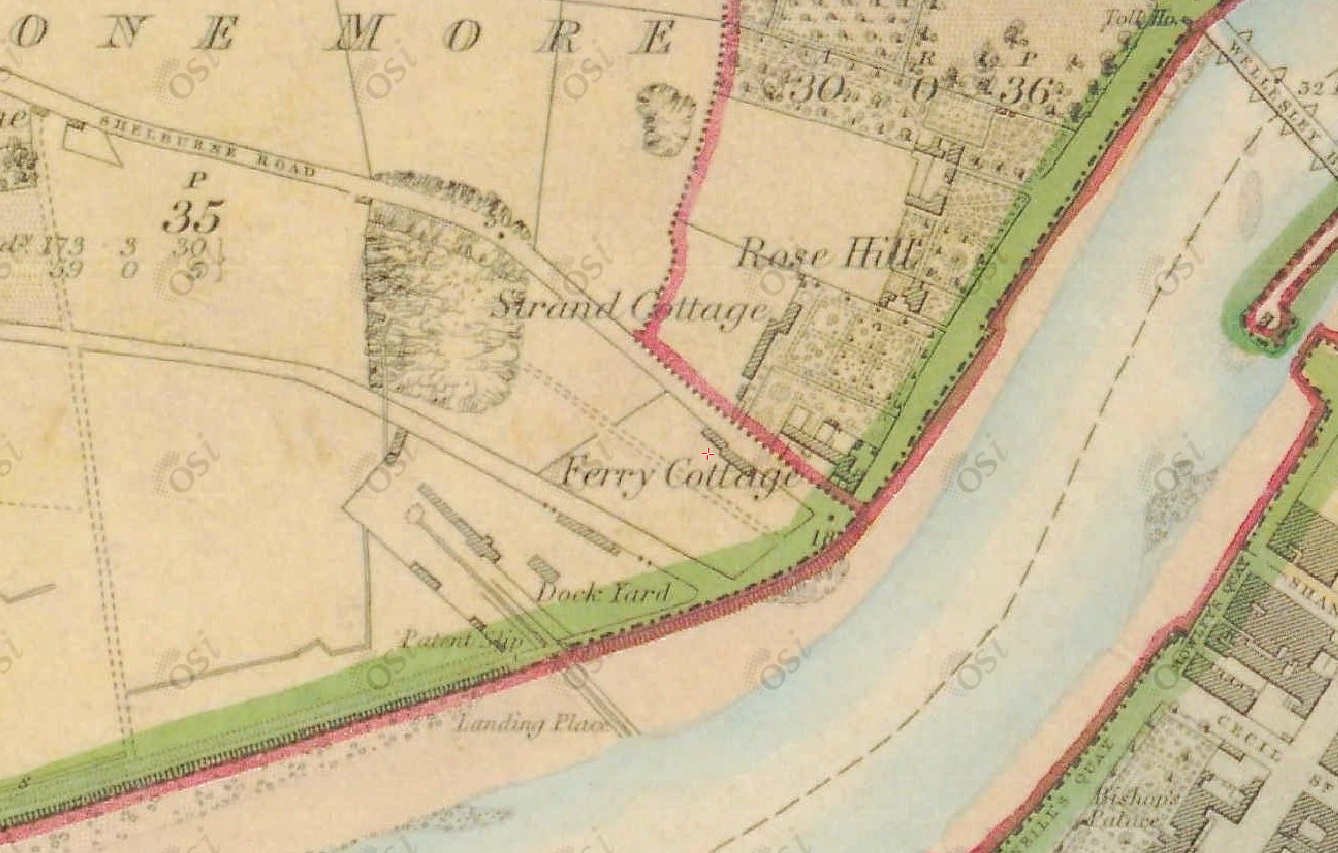
The dockyard ~1840
You can see the site on this Google photo …
… but the dockyard is gone.

Posted in Ashore, Built heritage, Economic activities, Engineering and construction, Extant waterways, Industrial heritage, Ireland, Non-waterway, Shannon, Sources, waterways
Tagged chimney, Cleeves, condensed milk, Dawn, Glanbia, Golden Vale, granite, Ireland, Kerry Group, Lansdowne, Limerick, North Circular, O'Callaghan's Strand, Shannon, toffee
On 18 April Michael Noonan, Minister for Finance, responded in the Dáil to three questions from his party colleague Eoghan Murphy about the cost to the exchequer (ie the taxpayer) of tax breaks, exemptions and allowances.
The minister’s response included an “Estimate of cost of certain property-based tax incentives and incomes exempt from tax for 2008 and 2009”. I am interested in one of these schemes, the Mid-Shannon Corridor Tourism Infrastructure investment scheme, which I have been trying to find out about for some years.
Note that my link is to a Shannon Development page on the subject but the scheme extended to some areas outside Shannon Development’s region: it covered district electoral divisions [I wonder why they were chosen as the relevant units ….] for counties Clare, North Tipperary and south Offaly, while Fáilte Ireland covered DEDs in counties Galway, Roscommon, Westmeath and north Offaly. The term “mid-Shannon” seems to reflect 19th century thinking, when estuary and freshwater were seen as a unit: the scheme’s coverage extended as far south as O’Briensbridge, just above tidal waters at Ardnacrusha.
The scheme seems to have been intended to cover areas that were not eligible for the disastrous Upper Shannon Rural Renewal Scheme, which has left the area strewn with unfinished houses. As far as I can see there is no overlap between the two schemes in the DEDs they cover in Co Roscommon, which is the only county covered by both. However, while the focus of the Upper Shannon scheme was on housing (with provision for some “commercial” activities), the Mid-Shannon scheme provided for:
According to the minister, in 2008 12 €1.8 million was claimed under the Mid-Shannon scheme, by 12 claimants, at an assumed maximum tax cost of €0.7 million.
In 2009, though, there were only 2 claimants, who claimed €0.6 million at an assumed maximum tax cost of €0.2 million.
The minister said:
The figures shown include the amounts claimed in the year but exclude amounts carried forward into the year either as losses or capital allowances, and include any amounts of unused losses and/or capital allowances which will be carried forward to subsequent years.
… not consistent with the actual data on the numbers of successful applications for approval under the scheme. Not that I blame the minister for being confused, because I found it very difficult to track down information about the implementation of the scheme. However, as the details were handled by the Mid-Shannon Tourism Infrastructure Board, which was to report annually to two ministers …
The [mid-Shannon Tourism Infrastructure] Board shall prepare and submit to the Minister for Arts, Sports and Tourism and the Minister for Finance an annual report on the administration of the Scheme.
… and [EU] Commission Regulation (EC) No 794/2004 of 21 April 2004 implementing Council Regulation (EC)No 659/1999 laying down detailed rules for the application of Article 93 of the EC Treaty required the submission of an annual report to the European Commission, I can quote from the Board’s report for 2008:
Fáilte Ireland and Shannon Development currently have over twenty projects under discussion with the promoters. There were no projects presented for consideration in 2008, but the Board expects that some projects will be presented to it for consideration during 2009.
And for 2009:
Four projects were presented to the Board for consideration. After review, three projects received Approval in Principle and one project was rejected. […] The list of potential projects was in excess of twenty at the end of 2009 but many are prevented from being progressed by a number of factors including planning referrals and funding difficulties. There was zero expenditure incurred during 2009 by projects that received Approval in Principle under the Scheme.
And for 2010:
The Board met on four occasions during the year and reviewed two applications. They granted Approval in Principle to one project and rejected the second project. […] The Board […] was notified of the decision by [promoters of a scheme approved in principle in 2009] not to proceed to certification under the Scheme. […] There was zero expenditure incurred during 2010 by projects that received Approval in Principle under the Scheme.
I understand that none of the projects given approval in principle has proceeded and that nor has any other project. Thus the minister’s €0.9 million assumed maximum cost of the tax breaks for 2008 and 2009 overestimates the true position by, er, €0.9 million. I don’t understand why the minister’s department thinks any provision is necessary.
The initial deadline the Mid-Shannon scheme was extended to 31 May 2010 and money had to be spent by 31 May 2013 if investors were to get their capital allowances.
The insane policies of the Fianna Fáil-led governments, and the greed and stupidity of investors and lenders, have caused such a destruction of capital that schemes like this are unlikely to succeed. And anyway, it might be better to take steps — like reducing the costs of starting and running businesses — that would reward labour rather than capital: steps that would encourage folk along the waterways to start small enterprises, or ancillary enterprises, using such resources (location, skills or whatever) as they already have.
Posted in Ashore, Economic activities, Engineering and construction, Extant waterways, Ireland, Operations, People, Politics, Scenery, Shannon, Sources, Tourism, Water sports activities, waterways, Waterways management
Tagged Article 93, Arts Sports and Tourism, boats, capital allowance, Department of Finance, European Commission, michael noonan, mid-shannon tourism investment scheme, Operations, Shannon, tax breaks, upper Shannon rural renewal, waterways
Her Late Majesty Victoria, by the grace of god of the United Kingdom of Great Britain and Ireland Queen, had at least two locks named after her on this island: one at Meelick on the Shannon and the other at Upper Fathom on the Newry Ship Canal. This page gives a brief account of the canal’s history; it has links at the bottom to six pages (made up almost entirely of photographs) on aspects of the lock and its operation. Several of those aspects are not clear to me and I would welcome enlightenment about both the former manual operations and the current hydraulic operations.
Posted in Ashore, Built heritage, Economic activities, Engineering and construction, Extant waterways, Foreign parts, Industrial heritage, Ireland, Natural heritage, Operations, People, Restoration and rebuilding, Scenery, Sources, Waterways management
Tagged Albert, basin, Carlingford, Ireland, lock, Newry, Northern Ireland, ship canal, upper fathom, Victoria

 Irish waterways history