
Category Archives: Extant waterways

Kilrush fisheries

Letter from James Patterson, Kilrush, to the Commissioners of Fisheries, 31 May 1823

Sir

Encouraged by the erection of the fishery piers on this coast, two persons registered themselves as fish-curers, viz Francis Coffee, on the 10th of March, at Liscannor, and James Shannon, on the 26th of April, at Seafield.

On the 26th instant I had a request note from the former to attend at his curing-house on the 28th, to inspect seven hundred and sixty ling, and nine hundred and ninety-six cod; I accordingly attended, and have great pleasure in saying, that a finer parcel of fish I never beheld; I at the same time registered twenty-six row-boats.
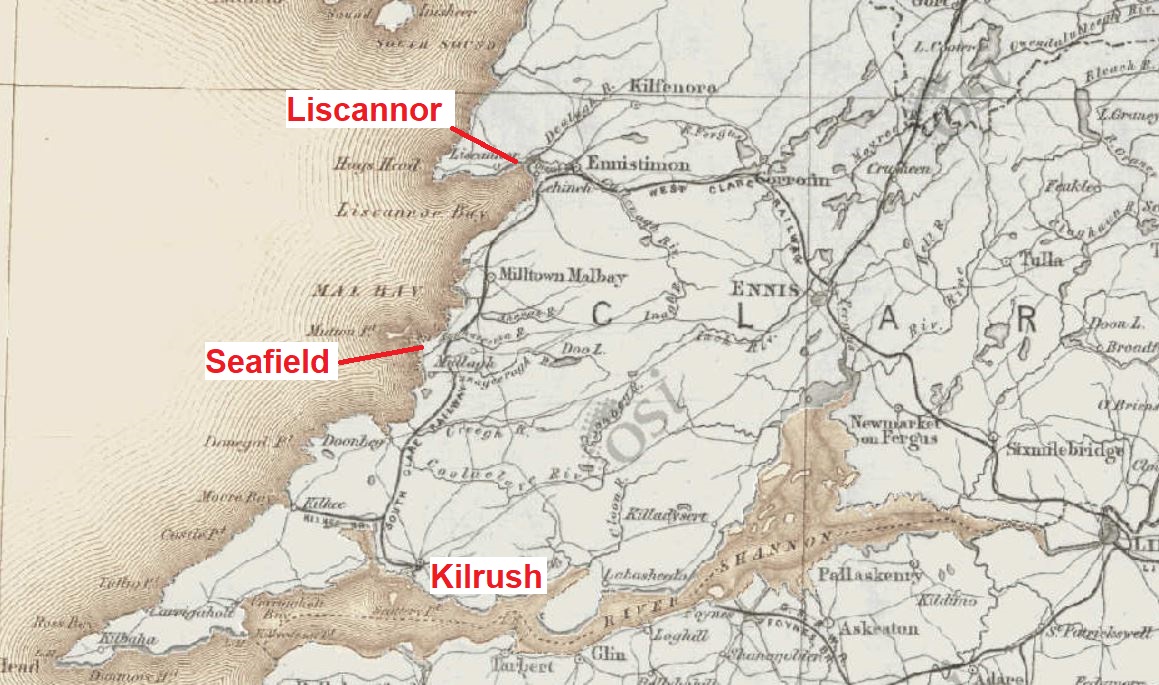
Kilrush, Seafield and Liscannor, Co Clare (OSI 25″ ~1900)

From thence I proceeded to Seafield to see what was going on there, where, I am sorry to say, I found the fishermen very desponding; they had an immense quantity of fish, offering at 1½d per dozen; but few purchasers, Mr Shannon not having as yet begun to cure. At Liscannor, agreeable to a previous arrangement made with the fishermen, Mr Coffee pays 3½d per dozen.

It would tend greatly to promote this speculation if some little additions were made to the bounty in lieu of the drawback on the salt, which they find it very difficult to recover, principally owing to the great distance to any custom-house, and the difficulty of travelling bad roads.

I send herewith the production bounty debenture. As the curer has but a small capital, I hope the board will order payment with as little delay as possible; every little encouragement that can be given this speculation in its infancy will greatly tend to promote it; and I have no doubt, in a short time, it will become very general, and productive of great advantage to the country.

I am, Sir, &c, &c, (signed) James Patterson

Report from the Select Committee on the Employment of the Poor in Ireland Ordered, by The House of Commons, to be Printed, 16 July 1823 [561] with edits by me


Navigating Ardnacrusha

The Western Mail & South Wales News of 19 April 1929 had an article by M Franklin Thomas about “Ireland’s Big Engineering Scheme”. The article was illustrated with a map and three photographs were reproduced on the newspaper’s “picture page”. It had a couple of interesting points about the headrace and tailrace considered as navigations; I can’t recall seeing these points made elsewhere.

Current

This [headrace] canal is level, but a flow of about 3½ miles per hour will be maintained owing to the water released through the turbines and navigation locks.

I don’t recall seeing a figure for the current. I presume that that is with three turbines running flat out.

There is an interesting account of the laying of the concrete apron that protects the banks against the “wave action set up by navigation, and the flow of the stream, wind, &c”. And the lock was to have an “ingenious arrangement by which the entering streams of water neutralise each other’s effect”.

Tailrace

Mr Thomas says

The tail race is one mile and a half long, cut from the solid blue limestone, and one of the most interesting points was the method adopted to permit barges to ascend the tail race against the enormous scour from the turbine discharges.

A special navigation channel is cut from the locks to a point some 200 yards below the outfall, and the bed of the tail race rises 20ft in the mile and a half, so that the depth of water will be 35ft at the outfall from the turbines and 15ft at the junction with the Shannon.

This will give a cushioning effect, and the rate of flow will be thus reduced to enable barges to navigate upstream. A bend is also provided where the special navigation channel joins the tail race and the rate of flow is estimated to be the same as that of the head race — 1.5 metres per second, or about 3½ miles per hour.

I would be glad to hear from anyone who can cast further light on this, and especially on whether the rising bed does have the intended effect.

Fuel for Athlone

The Messrs Robinson of Athlone, having supported Captain Mathew, the Conservative Member for the town, last election, threats have been offered and violence used to the boatmen conveying turf to their distillery, and in consequence the establishment will henceforth burn coal in the concern, a great loss to the country people.

Clare Journal, and Ennis Advertiser 23 February 1835

The level of the Shannon

I want to see these 16 pinch points dealt with because in removing them we will drop the levels of the Shannon downstream of Athlone right down to where Deputy Harty lives. We are talking about dropping the level of the Shannon a foot and a half. The number of people who would benefit from this – the local farmer, the local business, BirdWatch Ireland – is enormous. The Government is committed to putting huge money into this.

Kevin Moran TD (Ind, Longford-Westmeath), minister for draining the Shannon,  in a Dáil Topical Issue Debate on Flood Risk Management on 16 October 2019.

I wonder which level he’s talking about.

Royal Canal greenway

Big it up, says Sarah Carey in the Indo.

Pondweed photosynthesising

You’ve always wondered what it sounds like, haven’t you?

You can hear it, and many other canal sounds, on Rob St John’s “ambient sound portrait” from the Leeds & Liverpool Canal here.

Take five minutes off from work and listen to the canal.

h/t our Yorkshire correspondent

Beeb Brexit border boating

Here

Liveaboards and planning permission

The minister speaks.

Expected benefits of the Ulster Canal (aka the Clones Sheugh)

The members for Donegal, Cavan, Fermanagh, Monaghan, and Tyrone, assisted by the leading gentry of each county, have joined in the grand object of improving the navigation of Lough Erne, and are at present in communication with sseveral experienced civil engineers, the Board of Works, and Colonel Burgoyne. Mr Saunderson, of Castle Saunderson, is indefatigable in improving the Upper Lough, and it is probably his exertions will be met and well seconded by John Creighton Esq, Crom Castle.

Already have several gentlemen been summoned from Enniskillen to value the land at Newtownbutler through which the Ulster Canal is to pass; and when its junction with Lough Erne is effected, and a stream of Commercial communication is opened between Ballyshannon and Belfast, the central point of which must be Enniskillen, enterprising individuals will not be wanted to establish steamboats and vessels of large tonnage upon the lake, which will render such encouragement to manufacturers and commerce by the quick and cheap transmission of goods and mails, as will in a few years render this a most flourishing town.

Ballyshannon Herald 20 April 1838

Scratch-cards on the Shannon

Mr O’Connell and a very numerous deputation had an interview yesterday with the Chancellor of the Exchequer in Downing-street, respecting a lottery for the improvement of the Shannon.

London Courier and Evening Gazette
10 July 1835