Category Archives: Natural heritage

Ballylongford (and Inishmurray/Cahircon)

SHANNON-RIVER. This is by far the most considerable river in Ireland, or perhaps in any known island, not only on account of its rolling 200 miles, but also of its great depth in most places, and the gentleness of its current, by which it might be made exceedingly serviceable to the improvement of the country, the communication of its inhabitants, and consequently the promoting inland trade, through the greater part of its long course, being navigable to a considerable distance, with a few interruptions only of rocks and shallows, to avoid which there are in general small canals cut, to preserve and continue the navigation.

Thus Wm Wenman Seward, Esq [correspondent of Thomas Jefferson], in his Topographica Hibernica; or the topography of Ireland, antient and modern. Giving a complete view of the civil and ecclesiastical state of that kingdom, with its antiquities, natural curiosities, trade, manufactures, extent and population. Its counties, baronies, cities, boroughs, parliamentary representation and patronage; antient districts and their original proprietors. Post, market, and fair towns; bishopricks, ecclesiastical benefices, abbies, monasteries, castles, ruins, private-seats, and remarkable buildings. Mountains, rivers, lakes, mineral-springs, bays and harbours, with the latitude and longitude of the principal places, and their distances from the metropolis, and from each other. Historical anecdotes, and remarkable events. The whole alphabetically arranged and carefully collected. With an appendix, containing some additional places and remarks, and several useful tables printed by Alex Stewart, Dublin, 1795. [Google it if you want a copy.]

Seward was one of many people who saw the Shannon as a valuable resource, even if they were vague on how it was to yield a return. I was reminded of that on reading the Strategic Integrated Framework Plan for the Shannon Estuary 2013–2020: an inter-jurisdictional land and marine based framework to guide the future development and management of the Shannon Estuary. The Introduction includes this:

The Shannon Estuary is an immensely important asset and one of the most valuable natural resources in Ireland and the Mid-West Region in particular — the fringe lands and the marine area both provide space and location for development, activities and opportunities to progress economic, social and environmental growth within the Region.

This report is an attempt to show how the estuary could deliver a return. The core point seems to be that a small number of areas are designated as “Strategic Development Locations for marine related industry and large scale industrial development”, thus protecting them from the attentions of the environmentalists: the whole of the estuary is a Special Area of Conservation and a Special Protection Area.

Almost all the Strategic Development Locations are already industrialied in some way:

  • Limerick Docks (in Limerick city)
  • Ballylongford (of which more below)
  • Tarbert (power station)
  • Aughinish Island (alumina)
  • Askeaton (Nestlé)
  • Foynes Island and land to the rear of Foynes (main port on the estuary)
  • Moneypoint (power station).

There is one more, Inishmurry/Cahircon (which is not boring), which is even more interesting because there is no industry there at present. It was used as a resting place for certain vessels, but it was also proposed as the site for an explosives factory. Perhaps the designation as a Strategic Development Location suggests that that proposal is not dead but merely sleeping.

Ballylongford is equally lacking in industry, despite activity at Saleen in the early nineteenth century. However, Shannon Development assembled a large landbank nearby; the report’s Executive Summary says:

The Ballylongford Landbank benefits from a significant deepwater asset and extant permission for a major LNG bank.

Here is the area in question. Note that the red oval is just to indicate the rough location; it does not show the boundaries of the landbank.

Ballylongford (OSI ~1840)

Ballylongford (OSI ~1840)

You can see a proper map and a marked-up aerial photo in Volume 1 of the report [PDF] on page 73 (77/174).

Shannon Development agreed to give a purchase option on a little uder half of the site to Shannon LNG Ltd, which proposed to build a liquefied natural gas terminal there, to be supplied by ship; much information is available here.

The Commission for Energy Regulation decided to introduce charges that would have increased Shannon LNG’s costs; the company took the matter to court but, yesterday, lost its case. The Irish Times report here will probably disappear behind a paywall at some stage; the Irish Independent report is here and the Limerick Leader‘s here (its photo shows Tarbert and Moneypoint; the Ballylongford site is off to the left).

If the Ballylongford development does not proceed, plans for economic growth on the Shannon estuary may prove to be for the birds.

My OSI logo and permit number for website

Levels

On 9 October 2013 minister Brian Hayes spoke in the Dáil about Shannon water levels, saying:

A meeting between the ESB, Waterways Ireland and the Office of Public Works to review the interim operating regime is due to take place shortly.

On 17 and 18 October 2013, in correspondence with Waterways Ireland, I learned that the meeting had not then taken place and that no date had been set. I have now sent WI another note asking whether the meeting has been held and, if it has, requesting a report on the proceedings and outcome.

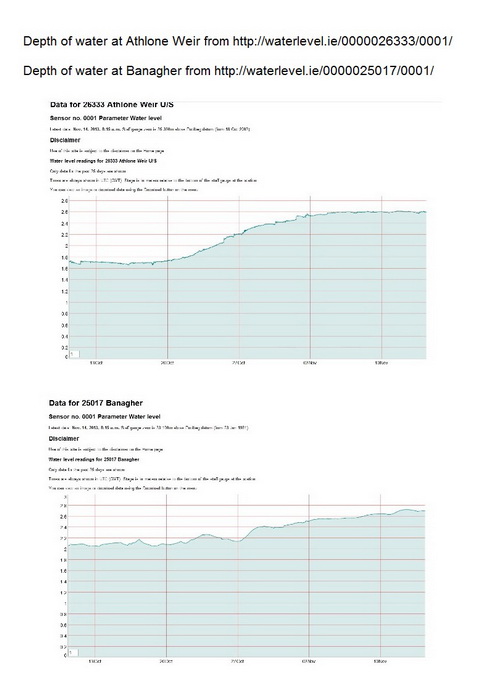
In the meantime, I have put together two charts nicked from waterlevel.ie for Banagher and Athlone:

Athlone and Banagher water levels

Athlone and Banagher water levels

Both of them show the levels for the last 35 days. I’m sure that more data and much more sophisticated analysis would be required to reach any reliable conclusion, but my untutored impression is that, in what has been a fairly dry autumn, keeping Lough Ree low didn’t do much to keep Banagher low. If that is so, and if I’m right in thinking that this autumn was dry (see below), the outcome would not show whether lowering Lough Ree would help in a very wet season; it may be necessary to repeat the experiment next year while performing rain dances. I would be glad, though, to have comments from more erudite folk and, if I get any information from TPTB, I’ll publish it here. In the meantime, this CFRAM PDF provides background reading.

On the dryness: Met Éireann’s monthly report for September 2013 is headed “Dry everywhere; warm and dull in most places” while that for October says “Rainfall was above average except in parts of the West, Northwest and North”. Its report doesn’t, AFAIK, specify any stations in the Shannon catchment (apart from Shannon Airport), but those to the west were generally below average while whose to the east were above; it may be that the Shannon rainfall was moderate.

Ticking all the boxes

Sometimes an idea comes along that is just so good, so right, so advantageous on all counts that it is simply irresistible. This idea comes from the Americas, from the US Coast Guard. Adapted to the Irish inland waterways, and specifically to the Shannon, it could:

  • help to promote industry in recession-hit rural areas
  • create direct employment
  • help to stimulate indirect employment
  • promote Irish energy independence by reducing reliance on imported hydrocarbons
  • counter pollution of water-courses
  • reduce the number of heavy trucks using remote rural roads
  • use environmentally-friendly water transport, by barge along the Shannon
  • honour and promote the industrial heritage of Co Leitrim and the transport heritage of the Shannon
  • help to defray the costs of maintaining the Shannon Navigation
  • solve Dublin’s water supply problem, at least for non-potable water.

How could anybody resist?

The US Coast Guard has proposed that wastewater from fracking [PDF] should be transported by barge, rather than by truck or railway train, from the fracking sites to remote storage or treatment facilities. So, when fracking begins around Lough Allen, the wastewater could be carried down the Shannon by barge and, if necessary, pumped to Dublin.

It sounds like a winner to me.

Wasting sewage

An inquest has recently been held in Limerick, on the bodies of three seamen; and the jury gave a verdict, founded on the evidence of seamen and medical men, that the deaths had been caused by drinking the water of the Shannon, which the drainage of gas works and the common sewage had rendered poisonous. We trust that this unfortunate event, will induce the authorities of Limerick to take measures for applying sewage to the legitimate puspose of manuring the ground, instead of allowing a valuable material to go to waste, and to poison the waters of their river.

The Artizan July 1846

Water levels in Athlone

At time of writing, the depth of water at Athlone Weir is 1.7m. “Staff gauge zero is 35.360m above Poolbeg datum”, which means the water level is 37.06m OD (Poolbeg). According to Bob Cullen’s 2002 article for Inland Waterways News [PDF], “The minimum navigation level in Lough Ree is 36.88m OD”, so if the level drops another 0.18m, about 7 inches, there may be a WI Marine Notice.

It seems that the dropping of the level of Lough Ree is intended to provide a buffer against flooding in the area from Athlone downstream to Meelick. According to Brian Hayes “A meeting between the ESB, Waterways Ireland and the Office of Public Works to review the interim operating regime is due to take place shortly.” [I have asked Waterways Ireland for a report on the meeting.]

But, if we are to believe the Dublin Evening Mail, the Shannon Commissioners took a rather more robust attitude to flooding downstream of Athlone: steamers [and PR] came first.

Edenderry ducks …

… in the Irish Times [article will become inaccessible at some stage].

Hands across the water

Another bit of northsouthery seems to be crumbling around its proponents’ ears, according to a report in today’s Irish Times [which will disappear behind a paywall at some stage]. It seems that, in July, TPTB approved the spending of €18.3 million on a bridge at Narrowwater [or Narrow Water], upstream of Warrenpoint and downstream of Newry (and of Victoria Lock). However,

The leading bid has costed the bridge at over €30 million […].

I presume that inflation does not account for the 66% increase but I am surprised that the proponents’ estimate was so far off. Perhaps omitting the opening span (intended to cater for the small number of tall vessels that use the Ship Canal to visit Newry) would save a few quid.

There is a discussion of the bridge project here and some useful information here; there isn’t here, although you might expect it.

It is certainly true that anyone wanting to drive from, say, Greenore or Carlingford to, say, Kilkeel or even Warrenpoint faces a long drive around Carlingford Lough. What is not clear to me is whether very many people want to do that: I haven’t investigated the matter, so I don’t know, but the main north/south traffic passes to the west and there are crossings at Newry.

A ferry service might be cheaper; it might also allow the real strength of demand to be gauged. Ferry terminals might be constructed by the local authorities and leased to an operating company.

And the service would probably be more useful than the Clones Sheugh: I see that yet another member of Sinn Féin got to ask about that in the Dáil recently, as did a Fianna Fáil chap from the area; they elicited the standard answer. The minister may be hoping that the cost estimates for the sheugh are more robust than those for the Narrowwater bridge.

Not weed?

Waterways Ireland and the Japanese knotweed, courtesy of KildareStreet.

Mountshannon seaplane

News from the Clare Champion about the possible cessation of commercial seaplane activities at Mountshannon. The article reports comments by Mr Emelyn Heaps, chief executive officer of Harbour Flights Ireland Ltd.

Harbour Flights

The Companies Registration Office finds four occurrences of the term “Harbour Flights”, all giving their address as 13 Parnell Street, Ennis, Co Clare. One is a business name; the others are:

  • Harbour Flights (Ireland) Limited
  • Harbour Flights (Couriers) Limited
  • Harbour Flights (BES Nominees) Limited.

According to the B1 Annual Return for Harbour Flights (Ireland) Limited to 30 September 2012 [the most recent available], the directors of the company are:

  • Ronan Connolly of Ennis, Co Clare, who is the Secretary; he holds seven other directorships of companies, two of which are Harbour Flights (Couriers) Limited and Harbour Flights (BES Nominees) Limited
  • Emelyn Heaps of Tulla, Co Clare; he holds nine other directorships of companies, two of which are Harbour Flights (Couriers) Limited and Harbour Flights (BES Nominees) Limited.

In the Clare Champion article, Mr Heaps “said the four directors and five shareholders will meet this weekend”; it is to be presumed that the two extra directors have recently joined the Board. The B1 return does say that the company had five shareholders:

  • Mr Heaps with 300000 ordinary shares
  • Mr Connolly with 300000 ordinary shares
  • Mr Adam Cronin of Cobh, Co Cork with 300000 ordinary shares
  • Mr Stewart Curtis of Bodyke, Co Clare with 100000 ordinary shares
  • Harbour Flights (BES Nominees) Limited with 4152 “A” ordinary shares.

The company’s authorised share capital is €105000 made up of half a million “A” ordinary shares at 1c and ten million ordinary shares, also at 1c; the issued share capital is €10041.52, of which €41.52 is the “A” ordinary shares and the rest the one million ordinary shares at 1c.

The financial statement of Harbour Flights (Ireland) Limited

The company has lodged abridged financial statements for the year ending 31 December 2011 [they refer to the company as Harbour Flights Limited, omitting “(Ireland)”].

The independent auditor said:

There is an excess of liabilities over assets, as stated in the Balance Sheet, and, in our opinion, on that basis there did exist at 31 December 2011 a financial situation which under Section 40(1) of the Companies (Amendment) Act 1983 requires the convening of an extraordinary general meeting of the company.

The abridged balance sheet shows a loss of €103944 in 2010 and €295130 in 2011. The Capital and Reserves section showed

  • Called up share capital 10042
  • Share premium account 26946
  • Profit and loss account (295130)
  • Shareholders’ funds (258142).

The other two companies

The balance sheet of Harbour Flights (BES Nominees) Limited as at 31 December 2011 showed current assets of 100 financed by called up share capital of 100. The company had two directors, Mr Connolly and Mr Heaps, and two shareholders, Mr Connolly and Mr Heaps, each with 50 shares.

The balance sheet of Harbour Flights (Couriers) Limited as at 31 December 2011 showed current assets of 100 financed by called up share capital of 100. The company had four directors, Messrs Connolly, Cronin, Curtis and Heaps, and four shareholders, the same four people, each with 25 shares.

Almost 21 months have passed since then and it is possible that all three companies have prospered greatly since 31 December 2011, especially after flights began in July 2013.

Operations

In January 2013 the Irish Independent reported that the company hoped to acquire a seaplane and its own website suggests that it made its first flight in July 2013 and intended to carry 10000 passengers in its first year. However, it seems that the Air Operator Certificate is held by National Flight Centre, Dublin, which says it will be operating the floatplane (seaplane) “in conjunction with Harbour Flights“.

I know nothing of aeroplanes, but the plane seems to be EI-CFP, a Cessna 172, which is said to carry three passengers. Assuming a seven-month tourist season (April to October) and seven-day-a-week operation, there are 214 days available for carrying passengers. The target of 10000 passengers a year would mean carrying 47 passengers a day, which means 16 flights a day, every day.

However, the first year’s operations do not seem to have started until 10 July, leaving only 113 days to carry 10000 passengers. That would mean 89 passengers a day, which would require 30 flights. The shortest flight time is 20 minutes (at €85 a head; longer flights are available) but I imagine that at least ten minutes are required at start and finish for boarding, so the operation must have been working 20-hour days all summer. I haven’t been in Mountshannon for some time, so I was unaware of the frenetic level of activity, but it must have been exciting.

addendum

I see that RTÉ reported, on 3 September 2013, a “test flight” to Galway. Such “test flights” have taken place to other locations, eg Cork, although it is not clear what distinguishes a test flight from, say, a marketing opportunity. RTÉ said that the flight was by a Cessna 206, which takes five passengers, but the photo shows EI-CFP, which is not (as far as I can tell) a Cessna 206 but a smaller Cessna 172.

There have been earlier announcements of services, eg to Limerick, where services were to begin in summer 2011. This website mentions an earlier proposed start. Some folk don’t seem confident of the soundness of the original business model.

Lakeland Seaplane Tours, based on Lough Erne, seems to have ceased operations.


Eel update

Thanks to KildareStreet.ie for drawing our attention to a useful update, in a Dáil written answer, on the state of Ireland’s eels and the eel management plan.