Category Archives: Natural heritage

Flood plains

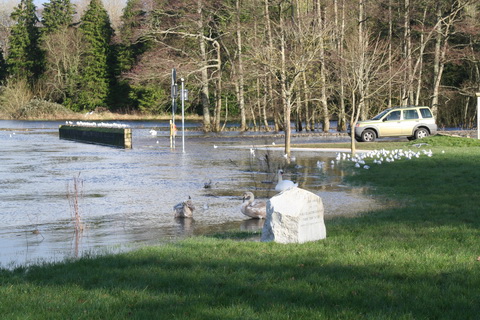
Patrick O’Donovan [FG, Limerick] wants to drain the Shannon. Or wants farmers to do it. He doesn’t want the “multiplicity of agencies [which] have made it virtually impossible for anything to be done with the river and the rivers and streams draining into it”; he wants a non-multiplicity of agencies — “the OPW, the Department of the Environment, Community and Local Government, Inland Fisheries Ireland or whoever” — to dig sheughs and stop flood plains flooding. He says

The one group of people who seem to have no say are those who live on the banks of the rivers or who have watched thousands of gallons of water coming in their front door and out their back door.

But he is wrong. That is the one group of people who can stop flood waters coursing through their houses and who can do it most quickly, most easily and without the permission of a single state agency.

The solution is simple: they should move house, away from the flood plains to higher ground.
Lowering Lough Derg

Boat-owners concerned about high water levels on Lough Derg will be glad to know that relief is in sight, although it may take a little while to arrive. Irish Water has taken over the project to send Shannon water to Dublin and is procuring something, although it is not at all clear what that is. The, er, news item is so far leading in the competition for least informative press release of the year.

Doonbeg

It seems that this chap has bought the glof course near the (proposed) Doonbeg Ship Canal. I’m sure that any further development will be in the best possible taste.

More Pathé

A train ferry, claimed to be in service on the Liffey

Fishing at Ringsend the hard way

Turf by canal

Launching the Irish Elm in Cork

A Boyne regatta

Making and using a Boyne currach in 1921 (you can learn the art yourself here)

A non-watery film: Irish Aviation Day 1936


Relieving Athlone

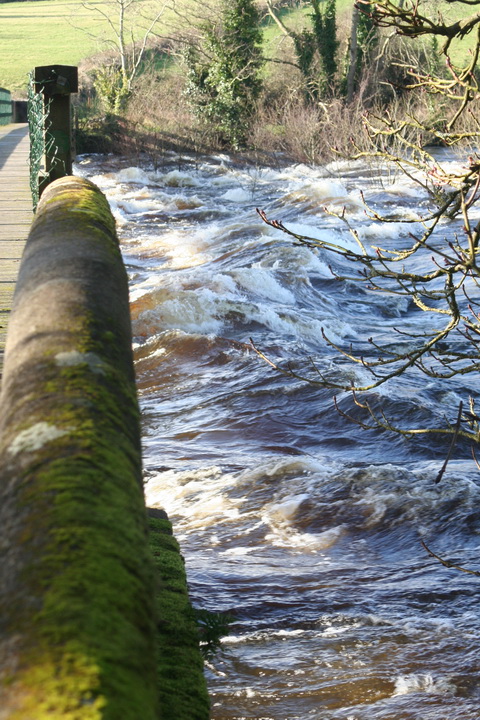
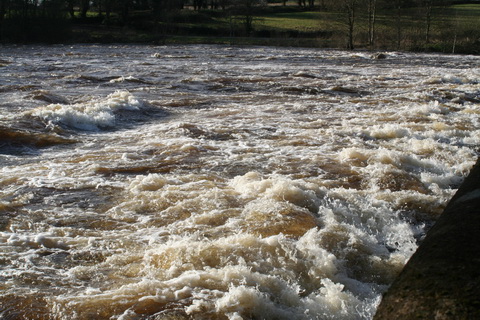
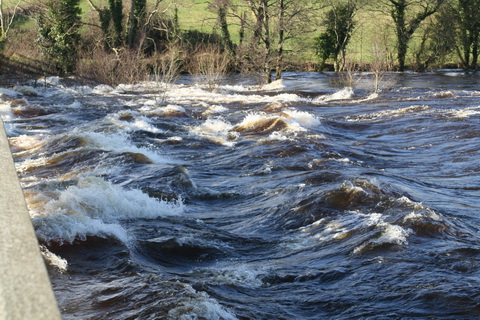
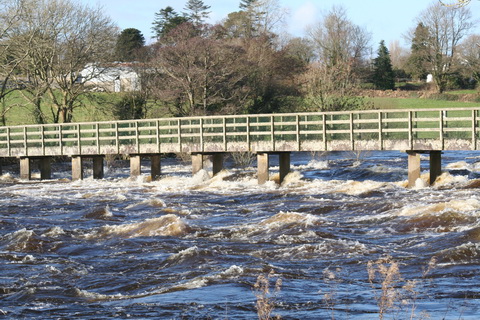
Parteen Villa Weir is sending large amounts of water down the original channel of the Shannon, and over the Falls of Doonass, to draw water off from the upper reaches of the river.

Castleconnell water level 20140210 264_resize

The footbridge at Castleconnell

Castleconnell water level 20140210 267_resize

Above the bridge

Castleconnell water level 20140210 269_resize

The downstream side of the bridge

Castleconnell water level 20140210 271_resize

A bumpy ride

Castleconnell water level 20140210 273_resize

At normal levels the bottom of the wall is several feet above the water


Levels below Parteen Villa have not yet reached those of 2009 and the channel can probably take more before folk get flooded.

The Old River Shannon site has some photos taken at Parteen Villa Weir.

Snails

Snails may save us from restoring the Longford Branch of the Royal. Industrialheritageireland has the story.

Might be an idea to start breeding these snails for judicious use elsewhere.

Shinners losing patience over sheugh

Caoimhghín Ó Caoláin [SF, Cavan-Monaghan] in the Dáil on 5 February 2014:

There is no excuse for either the British or the Irish Governments to stand over any delay in advancing with key cross-Border infrastructural projects such as the Carlingford Narrow Water bridge and the Ulster Canal. With regard to the Ulster Canal, I have been in touch with the office of the Northern Ireland Minister for Culture, Arts and Leisure, Carál Ní Chuilín MLA, my party colleague. She assures me that both she and her counterpart here, the Minister for Arts, Heritage and the Gaeltacht, Deputy Jimmy Deenihan, are fully committed to this project, and I welcome that affirmation. As I pointed out in the debate on the Six Counties last year, the North-South Ministerial Council agreed to proceed with the Ulster Canal project in 2007. In the intervening period, we have seen the economic collapse in this State and a parallel contraction in the North. Despite this, the Ulster Canal project was kept alive.

Permission was granted last year for the Northern section by Environment Minister, Alex Atwood, and by Clones Town Council and Monaghan County Council for the section in this jurisdiction.

The Minister for Arts, Heritage and the Gaeltacht, Deputy Jimmy Deenihan, has advised that the earliest the contract could be awarded would be late 2014 with a completion date in spring 2017. I urge the Minister to do all in his power to expedite this process and to encourage his colleagues to do so. I also urge him to maximise the possible EU funding for the project from the Peace IV programme.

The Ulster Canal project is about greatly enhancing one of the finest landscapes in Ireland for locals and tourists alike, regenerating rural areas that have long been neglected and delivering a tangible peace dividend to Border communities that were neglected for far too long. It is time to get the work on the ground under way.

Yes …. Sinn Féin’s faith in the economic potential of canals is touching, if slightly worrying for anyone who believes that the world economy has changed since the late eighteenth century.

But wait: as far as I can see, SF is one of the few groups that has not asked Jimmy Deenihan about Waterways Ireland’s proposed new byelaws, which might force boaters to pay slightly more of the cost of their hobby. Perhaps SF is secretly hoping that user charges on the Clones Sheugh will be high enough to pay at least the interest on the construction cost? That would be nice.


An eels update, updated

Pat Rabbitte’s reply to Michael Colreavy; thanks to KildareStreet.

Update 6 February 2014: Fergus O’Dowd [FG, Louth] responded to the Dáil’s most famous canoeist, Ming Flanagan [Ind, Roscommon/South Leitrim], the Rockville navigator, with some more information about eels.

Lowering Lough Ree

I reported in October and in November on the lowering of the level of Lough Ree, in advance of heavy rain, to see whether that would help to manage flooding on the Shannon Callows further downstream.

The interim data from the experiment is available on the OPW website here [seven-page PDF]. The conclusion is:

Conclusion
From the water level records, it is apparent that the closing of the gates at Athlone weir in anticipation of a rise in water levels on Lough Ree led to a temporary lowering of the Shannon water levels immediately downstream of Athlone. This possibly delayed inundation of the Shannon callows downstream of Athlone by a number of days. To determine whether the extent or depth of eventual inundation was in any way reduced by the experiment will require more detailed analysis by the CFRAM consultants. Data is available on request from Hydrometric Section if required.

It should be stressed that this is an interim report. This CFRAM background document [PDF] is still useful.

It is not clear to me why the state should spend any money improving the value of privately owned riverside land that is of marginal benefit to the economy.


Cutting and pasting

One of the problems with all this newfangled technology is that some things — like, for instance, copying a block of text from one document into another – are so easy that folk may forget to check their work afterwards.

Consider, for instance, the Office of Public Works, which seems to have a block of boilerplate text ready for answering written boilerplate questions from midlands TDs who have discovered that things get wet when it rains.

On 22 January 2014 Denis Naughten [Ind, Roscommon/South Leitrim, which — let it be admitted — The Lord intended to be rather boggy and sad] had this question:

To ask the Minister for Public Expenditure and Reform the steps being taken to address flood risks within the Shannon basin; and if he will make a statement on the matter.

The answer tells Mr Naughten about CFRAM — nothing he didn’t know before he asked, I imagine — but it included this sentence:

On foot of discussions between my colleague, Minister of State Hayes and the IFA, and with the cooperation of both the ESB and Waterways Ireland, a water level monitoring exercise is being carried out as part of the CFRAM process which will allow for analysis of water flows and levels at key points around the Lough Ree and Callows areas.

The highlighting is mine: it seemed a bit odd because this written answer was allegedly being given by Mr Hayes.

Mr Naughten had another Q&A here, but it’s not very interesting.