Category Archives: Non-waterway

The [non-]Royal Lough Ree Yacht Club

Devoted as this site is to the memory of Her late Majesty Victoria, of the United Kingdom of Great Britain and Ireland Queen, Defender of the Faith, Empress of India, we are always gratified to find evidence of Loyalty to Crown and Empire. Along the Shannon, we are never surprised to find such evidence around Lough Derg (at least in North Tipperary), but we had not realised how well-affected the good people of Lough Ree were towards Royalty, even after the foundation of the Irish Free State and its succession by the state of Ireland.

On 28 October 1947 the Lough Ree Yacht Club wrote to Her Majesty’s Under Secretary of State at the Home Office in London SW1:

Sir

I have been looking over some old papers belonging to this Club.

There was some discussion among members about trying to get it raised to the status of “Royal”.

I should be greatly obliged if you would let me know what would have to be undertaken and what cost would be involved. Also would a club in this country be eligible.

This Club which was founded prior to 1836 is the second oldest in Ireland.

A Home Office Minute of 6 November 1947 said:

The whole of Lough Ree is in Eire and it would seem desirable in the first place to refer the letter to the Commonwealth Relations Office on the question of procedure.

In this country freshwater Yacht Clubs are not now granted the title Royal.

Send a copy semi-officially to the Commonwealth Relations Office for observations regarding procedure.

That was done on 13 November 1947. The covering letter said (amongst other things):

There has been no grant of the Royal Title to a fresh water sailing club in England since 1887 when the practice relating to the grant of the Title Royal was not stabilised.

I wonder whether you could let us have particulars about this club; its membership, reputation, and the number of yachts it owns with their tonnage. We should also welcome any suggestions relating to procedure on the assumption that the application will be pursued.

The Commonwealth Relations Office replied to the Home Office on 6 December 1947 with these (amongst other) paragraphs:

I enclose a copy of a note, prepared in July last year, on the general principles covering the grant of the title “Royal” in the various Commonwealth countries.

You will no doubt appreciate that in the case of Eire, difficulty would arise in the application of these principles. It would appear, however, from paragraph III of the enclosed note that consideration would only be given to applications from institutions similar to the Club in question if exceptional circumstances exist.

We feel that in this particular case no indication should be given in any reply which you may make to the Club of the likelihood or otherwise of any application meeting with success, and that they should only be informed that, being in Eire, the matter should be raised through the appropriate authorities in Eire.

On 17 December 1947 the Home Office wrote to the Club saying:

With reference to your letter of the 28th October last regarding the procedure and the cost involved in making an application for the grant of the title Royal to the Lough Ree Yacht Club, I am directed by the Secretary of State to say that as the Club is in Eire, the matter should be raised through the appropriate authorities in Eire.

Ireland at the time had a Fianna Fáil government, led by George de Valero Éamon de Valera, who was not known for being well-affected towards Crown and Empire.

On 29 April 1948 the Club responded to the Home Office:

Sir

Referring to your letter of 17th December 1947.

We have been in communication with the Irish Government + I enclose their reply, from which I understand that they will not interfere either for or against. I sent their letter to the UK Representative + enclose his letter also.

As the Irish Government has not refused permission for the Club to be raised to the status of Royal would His Majesty therefore be gracious enough to confer on the Club the Title of Royal.

On 10 May 1948 the Home Office replied:

With reference to your letter of the 29th April as to the application for the grant of the title Royal to the Lough Ree Yacht Club, I am directed by the Secretary of State to say that as the Club is situated in Eire, the Secretary of State for the Home Department has no jurisdiction in the matter, and can add nothing to the letter addressed to you on the 21st April, by the United Kingdom representative to Eire.

The enclosures to your letter are returned herewith.

The return of the enclosures has deprived us of the opportunity to see exactly what the Irish government and the UK representative said to the Club.

By then, the Irish general election of 4 February 1948 had returned the First Inter-Party government, led by John A Costello and with Seán MacBride, leader of Clann na Poblachta, as Minister for External Affairs. The Republic of Ireland Act was signed into law on 21 December 1948, depriving the King of Ireland of his last functions in the former Free State — and depriving the Lough Ree Yacht Club of its last chance to acquire the Title Royal.

It would be interesting to know what Seán MacBride, who had been boating on Lough Ree since the 1930s, thought of the Club’s application.

The story is not included in the brief history on the Club’s website or in the more extensive history included in the booklet produced for the LRYC/Waterways Ireland Classic Boats Regatta in 2007, but I have not seen Lough Ree Yacht Club: a memoir, published in 1970.


Elfin safety

Messrs Build.ie draw my attention to the formation of an Irish branch of the Visitor Safety in the Countryside Group, with members including the State Claims Agency, the OPW, Coillte, Waterways Ireland and the Department of Environment, Community and Local Government. The matter was mentioned in a Dáil written answer on 16 July 2013 and there is a ministerial statement on the formation here including this:

[…] it is essential that these visitors have safe access to our valuable assets […].

There is a list of VSCG members here. It will be nice for the Irish members to be able to converse with those from Manx National Heritage without having to use English, but the Waterways Ireland delegates will no doubt be disappointed that the Scottish bodies don’t seem to give much attention to the Scots language.

One of the VSCG case-studies is about Gas Street Basin in Birmingham; Waterways Ireland may be thinking about its applicability to the Grand Canal docks in Ringsend.

The involvement of the State Claims Agency suggests that the concern for visitors’ safety is not entirely altruistic: that the members may wish to keep down the costs of legal claims against them. Nothing wrong with that: it is in the interests of the citizenry that costs be kept down; that means managing risks and protecting against vexatious claims. If that isn’t done, there is a danger that public access to these bodies’ estates might be restricted.


After the summer

I don’t really know much about politicians, local or national, but I presume that, in the summer recess, they retire to their country estates for a bit of huntin, shootin and fishin, with breaks for trips to agreeable parts of foreignlandia (Tuscany, perhaps) and with occasional visits from other gentlefolk.

At any rate, something distracts them and keeps them quiet, but summer is now giving way to autumn and, er, innovative suggestions are coming thick and fast from politicos anxious to get other people to contribute to social and economic development in their constituencies (or to get reelected, whichever comes first).

So we have one who wants a walkway across Meelick Weir and another who wants a riverbus service on the Park Canal in Limerick.

Meelick turns up in another story from the past week, by John Mulligan in the Irish Independent. But despite the silly headline and subhead, the body of the article is a thorough and balanced account of flooding on the Shannon. Mr Mulligan is to be commended.


Catalina

Anyone interested in seeing a Catalina flying-boat, like those based at Castle Archdale on Lough Erne during Hitler’s war, might like to troll on over to Portrush this weekend, 31 August and 1 September 2013, where Coleraine Borough Council is putting on the Northern Ireland International Airshow: a Catalina will be amongst the aircraft present.

Mad foreigners

The August 2013 issue of Practical Boat Owner has just arrived. It has an article by Dick Everitt called “Mind your head …” in which he talks of dangers to boats from above rather than below: dangers from bridges and from electric power lines. He points out that electricity can jump to a metal mast and says:

So a safe clearance distance is given on the chart with a lightning-type symbol and in some countries a big warning sign is positioned nearby too. But do check local Notices to Mariners as long power cables can sag over time, reducing their official charted clearances.

Aren’t foreigners funny? Imagine having electricity suppliers actually telling boaters about the safe clearance under power cables! That would never happen here ….

I have spent several years trying to get ESB to tell me the safe clearances for cables across the Shannon. I thought I was getting somewhere at one stage but nothing happened. Perhaps ESB would prefer boaters to fry than risk getting sued for getting the clearance wrong.

Bock goes boating …

… on the Shannon Estuary, the second most interesting coast of Clare (the inland coast is the most interesting, the north-west coast the least). Includes nice pics of the Scattery battery.

The Ulster Orangeway

I am happy to say that the ineffable Professor Billy McWilliams [Visitin’ Lekturer at the Ulster Scots School o’ Dancin’, Ballymena] has provided the answer to one of WI’s problems. I have pointed out that a walking route along the Clones Sheugh would be much cheaper than a restored canal; Professor McWilliams has shown how to make such a route more attractive to members of the Ulster-Scots Community. WI could adopt his idea from Comber and declare the route to be the Ulster Orangeway.

The decreasing importance of cruising

I wrote here about the continuing decline in the numbers of boats recorded as passing through locks (and moveable bridges) on the Shannon. For the first five months of the year, the total number of recorded passages was jusst over half what it was in 2003. Maybe the current hot weather will increase the numbers, but the long-term trend has been downward for ten years, despite a Celtic-Tiger-inspired spike in usage by private boats.

I don’t know to what extent that decline affects Waterways Ireland’s policy-making. Are the hundreds of economists, marketing gurus, MBAs and other high-powered bods in WI’s marketing department engaged in a major search for new and profitable markets? Certainly its sponsorship programme [can’t find info on the WI website], its lists of events and its descriptions of activities are much broader in scope than mere boating, and even within that category small-boat activities are prominent.

WI is cooperating with other official bodies in developing walking [h/t Industrial Heritage Ireland] and cycling routes [h/t KildareStreet] and. with the Irish Sports Council and Irish Leisure Consultants, it has recently published A Guide to Planning and Developing Small Vessel Water Trails in Ireland [PDF]. WI does not, as far as I know, have a strategy for promoting increasing use of its waterways by cruising boats (private or hired), although I’d be happy to be corrected about that if I’m wrong.

All of this is good stuff, and I’m all in favour of widening the, er, user base (apart from those events for which people dress in fluorescent underwear and run around the streets: I share the late Mrs Patrick Campbell’s concern for the horses).

But three points strike me. The first is that the older waterways businesses — hotel boats, hire firms, marinas — involved capital investment and created reasonable numbers of jobs. I do not know whether Waterways Ireland measures employment, or other economic benefits, as an output of its sponsorship, marketing and organisational activities but it seems to me that it would be nice if it were able to show that the benefits outweigh the costs. It would also be interesting to know to what extent the newer activities can profitably attract tourists from overseas: with the water trails, for instance, is it possible for anyone to make a profitable business out of overseas visitors, given the costs of marketing and selling, or are these trails purely for the domestic market?

The second point is that one sector, that of professional event organisers, may indeed be benefiting from WI’s support. But if that disempowers local or voluntary groups, renders them unable to run events without professional assistance or makes the cost of doing so too high, it may not be an unmixed blessing.

The third is that there is a representative body for owners of inland cruising boats, but these new activities do not have inland-waterway-specific user bodies (if they have user bodies at all). That, I think, must make for a different type of relationship between the service provider, Waterways Ireland, and the users: most inland cruiser owners have nowhere else to go, but canoeists or anglers or walkers can easily switch to the sea or to non-WI inland waters, so WI has to compete for their custom.

This piece is written not to provide answers but to ask some questions.


The Exchequer Bill Loan Commission

I noted the other day that the North South Ministerial Council’s inland waterways meeting discussed how it might get the Irish government off the hook of its rash promise to fund the Clones Sheugh. It noted that:

[…] sponsor departments have agreed to examine the potential social benefits and leveraged funding opportunities in that context.

The interesting point is that the blasted thing wonderful investment opportunity was originally funded, using the same excuse, by a loan from the Exchequer Bill Loan Commission set up under the Poor Employment Act 1817. John Strettell Brickwood, Secretary to the Exchequer Loan Commissioners for Public Works [sic], said* that the Commission’s first £1.5 million was allocated in 1817 and that by 1835 £5.5 million had been advanced.

Of that, £200,000 (at 3¼% interest) was allocated to Ireland in 1827 and the Ulster Canal was allocated £120,000 of that; it drew down £40,000 in 1833 and the same again in 1835. Mr Blackwood said that the Ulster Canal money was issued under an express act of parliament, leaving the commissioners no discretion. There would be no repayment until the canal was complete, with the interest and principal payable only from the prospective income.

Isn’t economic development wonderful?

First and Second Reports from the Select Committee appointed to inquire into the amount of advances made by the Commissioners of Public Works in Ireland with the Minutes of Evidence, Appendix and Index Ordered, by the House of Commons, to be Printed, 26 June and 27 August 1835


Searching Lough Derg

Last Friday evening, 21 June 2013, was not a good time to be out on Lough Derg. We were heading north, with the waves behind us, and had little difficulty until entering port, but we could hear on the VHF what must have been one of the biggest search and rescue operations on the Shannon in recent years.

We had switched on at what seemed like a fairly early point in the proceedings, and kept listening until the Coast Guard were assured that everybody was accounted for. We weren’t able to attend to the whole thing, as manoeuvres during and after berthing occupied our attention for some time, but we got a pretty clear picture. The Irish Times report (which will probably disappear behind a paywall at some stage) is here; I think it has some minor details wrong but the gist of it is correct; its later report is here. The Clare Herald has a very detailed account here, the Clare Champion account is here and the Limerick Post adds some information here.

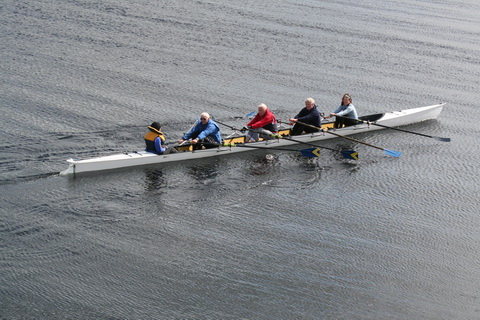
The event was said by the Irish Times to be “hosted for FISA in Ireland by St Michael’s Rowing Club of Limerick” but I can’t see anything about it on either organisation’s website. I presume that the boats were something like this one.

Quad at Clonlara in 2011

It’s a quad, with each rower using two oars; it carries a cox and it’s used for touring rowing, so it’s not as slim as a standard racing shell.

By the way, just to be clear, none of the photos on this page were taken during last Friday’s operation.

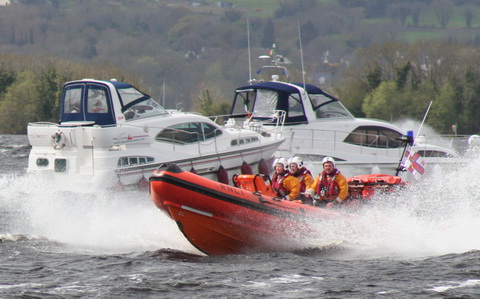
RNLI Lough Derg lifeboat

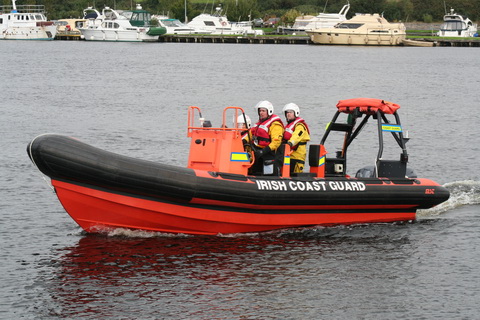
From what we could hear, the operation involved volunteers from Killaloe Coast Guard, the RNLI at Dromineer, the Community Rescue Boats from Mountshannon and Limerick and at least one yacht, which (I think) took one of the rowing boats in tow; that yacht’s participation and careful provision of information to the Coast Guard was admirable.

Killaloe Coast Guard RIB

Killaloe Coast Guard RIB

We heard discussion of proposals to ask the Civil Defence to participate as well, and the Clare Herald confirms they did turn out. It seems that the University of Limerick Activity Centre boat was out too, as was Peter Hooker of RNLI in his own boat.

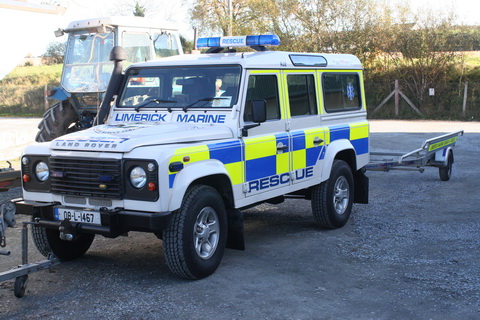
Limerick Marine SAR Land Rover

Limerick Marine SAR Land Rover

That’s just the volunteers, and if I’ve left anybody out I’m sorry; let me know and I’ll amend this.

Then there were the professionals: the Coast Guard staff on VHF, the Gardaí on shore, the helicopter crew. And, again, the Clare Herald makes it clear that lots of other people were involved too: fire brigade and ambulance units, paramedics and a hospital consultant.

All in all, this was a major operation and a lot of people put in a lot of effort that night, in bloody awful weather.

Communications

I formed the impression that communication amongst the members of the rowing fleet, and between them and the rescue services, was poor. It was difficult to establish what rowers were where and how many were unaccounted for. The Clare Herald story seems to support that conclusion: it says that Gardaí had to travel to the rowers’ hotel to make sure that everybody had turned up and that the search was not formally stood down until 11.30pm.

I don’t know what communications equipment and what sort of organisation and safety procedures the rowing group had, so I’m not going to comment on them. Instead, I want to go off at a tangent. It struck me that life would have been easier for everybody if each boat had had a handheld VHF and someone able to operate it. Such sets can be bought for as little as £50 in the UK or €75 in Ireland.

So the technology is now very cheap and, for short range work as on Lough Derg, a handheld VHF should be adequate. But if you want to be legally entitled to use a VHF set, matters are much more complicated. I’ll discuss that in another post.