Category Archives: People

Northern enterprise

On Friday, 25th ult, the Antrim and Tyrone Lough Neagh Steam Ferry Company’s first boat, the Enterprise, was launched from Port Armagh, on the Tyrone side of Lough Neagh. She is a most beautiful boat, and does great credit to Mr Hiram Shaw, of this town, for his exertions in bringing her out in such fine style. Her engines were built by M’Adam, Currell, and Company, of Belfast.

The Vindicator, Belfast 7 August 1839

From the British Newspaper Archive run by Findmypast Newspaper Archive Limited, in partnership with the British Library.

[Notes: I do not know where Port Armagh is or was. The Enterprise is not mentioned in D B McNeill Irish Passenger Steamship Services Volume 1: North of Ireland Augustus M Kelley Publishers, New York 1969]

The mystery of Mr Worrall

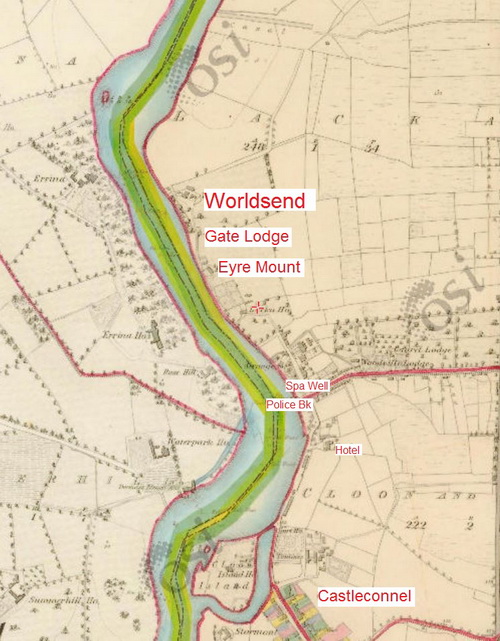
Castleconnell and Worldsend, Co Limerick (OSI 6" ~1840)

Castleconnell and Worldsend, Co Limerick (OSI 6″ ~1840)

The authors of a book called Village by Shannon, about Castleconnell, Co Limerick, say that the area of Worldsend, at the northern end of Castleconnell, derives its name from Worrall’s Inn, an establishment operated by a Mr Worrall in the early eighteenth century.

That may be so, but the book’s accounts of river-borne traffic — to a quay at the inn — do not seem to accord with what is known about the history of the Shannon navigation, and in particular of the Limerick Navigation between the city and Killaloe. Here are some of the problems.

My OSI logo and permit number for website

Crime at Castleconnell

Charles Connors, of Castleconnell, cot builder, has been committed to Killaloe bridewell, for violating the person of a servant girl on Monday morning, at the Doonass side. He crossed the river in a boat, upon the pretence of ferrying her over, and then committed the offence.

Tipperary Vindicator 9 December 1859

From the British Newspaper Archive run by Findmypast Newspaper Archive Limited, in partnership with the British Library.

Drowning at Doonass

Melancholy and distressing accident

By a Letter received at our Office, from Doonas, County Limerick, we regret to announce a melancholy accident having happened on Sunday the 9th inst in that neighbourhood. Mrs Massey, the wife of the Hon William Massy accompanied by her butler and two boatmen were attempting to cross the Shannon to Sir Hugh Masseys, where Mrs Massey was to dine. The evening was dark, accompanied by a dense fog, the boatmen lost their way, the boat was carried down by the current, and precipitated over the Leap, and melancholy to relate the entire party in the boat were drowned. During the entire of yesterday, the boatmen at Castleconnell were dragging for the bodies, but without success.

So dense was the fog that on the road between Kilmastulla, and Sallymount, the guard of the Coach was obliged to walk for upwards of 3 miles of the road, at the heads of the leading horses, and the coach agent was obliged to send a man on horseback with a lantern in his hand before the coach as far as Newcastle.

Dublin Mercantile Advertiser, and Weekly Price Current 17 January 1831

From the British Newspaper Archive run by Findmypast Newspaper Archive Limited, in partnership with the British Library.

Cardboard and paper

Some folk have been sailing on the Thames in a boat made of cardboard.

Over two hundred years ago, Isaac Weld navigated the lakes of Killarney in a boat made of brown paper:

Whilst engaged in illustrating the scenery of that beautiful locality, Mr Weld derived additional pleasure from the occupation, in introducing a young and amiable wife to scenes so familiar to himself. To facilitate their rambles, and profiting by his Canadian adventures and his skill as a “voyageur“, he constructed with his own hands the model of an Indian canoe. In the absence, however, of birch bark, he had recourse to successive layers of stout brown paper, creating a sort of papier-maché boat, sufficiently roomy for two. In this paper skiff he actually had the hardihood to intrust himself and fair companion in sundry adventurous voyages on the Lakes.

That is from “Mr Foot’s Memoir of the late Isaac Weld, Esq” in The Journal of the Royal Dublin Society Volume I 1856–57 Hodges, Smith & Co, Dublin 1858. Wikipedia offers a shorter account of the life of the remarkable Mr Weld. His Statistical Survey of the County of Roscommon, Royal Dublin Society 1832, is an invaluable source of information about the Shannon and the Royal Canal, but Mr Weld is also notable for his voyage, along with his equally adventurous wife, on the steamer Thames [originally Argyle] from Dublin to London in 1815. There are brief accounts of the journey here and here; the captain, George Dodd, wrote a book An Historical and Explanatory Dissertation on Steam-Engines and Steam-Packets; with the evidence in full given by the most eminent engineers, mechanists, and manufacturers, to the Select Committees of the House of Commons; togerther with the Committees’ reports, distinguishing and defining safe and unsafe steam-engines, and their proper management: comprising particulars of the fatal explosions of boilers at Norwich, Northumberland, Wells-street, and in America: concluding with a narrative, by Isaac Weld Esq, of the interesting voyage of the Thames steam-yacht, from Glasgow, in Scotland, to Dublin and London [published for the author, London 1818] available here, and Isaac Weld’s account is available here. Mrs Weld may have been the first woman to take an extended sea voyage in a steam vessel.


Horses for towing? Bullocks!

The Colthurst canals.

Shannon Regatta

The Shannon regatta commenced on Tuesday at Kilrush, which is crowded with visitors from Limerick, Tarbert, Ennis, and the sea coast frequenters at Kilkee and Malbay. In respect to the memory of the late Judge Vandeleur, it was supposed the stewards would defer the annual gala for a fortnight, but as several yachts had arrived from distant stations, a majority of the committee decided on proceeding. A stiff breeze from the North West, with occasional squalls, prevailed for the last three days. The prizes on Tuesday for the rival yachts were — Kent cup, a purse of £20, and two purses of £10 each.

The Cork Harbour Regatta will hold four days, 11th, 12th, 13th and 14th August. The highest prize is one of £60 for all yachts.

The Marquis of Waterford’s yacht, Gem, now at Cove, is a beautiful specimen of naval architecture, and it is hard to know which to admire, the beautiful symmetry of her construction, or the perfect seamanlike manner in which she is rigged and fitted up. She is a Polacca schooner, of about 110 tons, carrying 6lb brass guns, and a swivel forward. Capt Lane RN is sailing master.

Dublin Morning Register 26 June 1835

From the British Newspaper Archive run by Findmypast Newspaper Archive Limited, in partnership with the British Library.

Kilkee Bathing

The Fashionable Lounge and Temple of Fancy

Mr J Ely has now open for inspection at Russell’s Lodge (next the Post-office) a splendid Fancy Bazaar, consisting of Parisian, Geneva, Vienna, and Berlin

fancy goods,

which for taste and fashion may safely challenge comparison with the assortment of Paris and London. The splendid Stock of elegant Articles is such as cannot fail to gratify the taste of the most curious; but puffing not being the custom of the Proprietor, he will feel obliged by an early visit — occular demonstration being the best proof.

This elegant Stock comprises Musical Clocks, with Fountains; Alabaster Clocks, Musical Boxes, playing from two to twelve tunes each; Accordians of all sizes; a magnificent collection of Dresden China, with Flemish Paintings; a large assortment of newly invented Dresden Mat Glass; American Glasses; a fashionable assortment of Bracelets, Snaps, and Crosslets; a truly splendid assortment of the very best manufactured London Jewellery, best Sheffield Plate, finest Persian Perfumery, and a great number of other Articles too numerous to mention; also a large quantity of German Silver Plate, which the Proprietor pledges himself are of the very best description, imported by him from the Continent.

NB — The Proprietor begs to state the terms on which he disposes of his Goods will be found to be most inducing and advantageous to the public.

(2p)                                                                                  Kilkee, August 15

The Clare Journal, and Ennis Advertiser
20 August 1838

From the British Newspaper Archive run by Findmypast Newspaper Archive Limited, in partnership with the British Library.

Mr Paterson, General Lake and Napoleon Bonaparte

Dublin

On Tuesday sennight sailed his Majesty’s gun-boat, the General Lake, commanded by Mr James Patterson; and on Wednesday the Bishop, Lieut S Dunn, an experienced officer, who had served in the Royal Navy during the whole of the American war — these, with two others now fitting out, are to join the Kingsmill and Gen Duff gun boats at Carrigahoult bay, where they are to be stationed for the purpose of defending the entrance of the Shannon, the whole under the command of Lieut Augustus Margett, senior officer of division.

The Hon Capt Pakenham, who arrived at Limerick some time back to survey the works on the river, had the boats constructed upon his own plan, and they are found to be in every respect both capable of standing the shock of cannonading, and of annoying an enemy. There is a signal post, with a proper person to conduct it, stationed on Ray Hill, a commanding eminence near Loophead, from whence there is an extensive prospect of the offing. The gun-boats are furnished with private signals, so as to communicate with the person who conducts the signals on shore, by which means friends or enemies at sea are easily ascertained, long before they can come near the shore, and regular and certain intelligence conveyed to the commanding officer of the district.

The following is a list of the gun-boats stationed in the River Shannon, with the names of their commanders, forces, and complement of men:

Vessels                 Guns  Pounders    Men    Commanders

Pakenham              1           24           19      A Markett
Kingsmill                1           18            19     J Alexander
Gen Duff                  1           18            18     — Wing
Bishop                      1           18            18     S Dunn
Gen Lake                 1           18            18     J Patterson
The Shannon         1           18            18     Geo Perry

The whole completely equipped, with every description of small arms, ordnance stores, &c.

Dublin Evening Post 6 May 1797. From the British Newspaper Archive run by Findmypast Newspaper Archive Limited, in partnership with the British Library.


Yesterday dispatches were received at the Admiralty from Vice Admiral Kingsmill at Cork, brought over in the Waterford mail. Intelligence is received by this conveyance that the River Shannon is now rendered perfectly secure from any designs of an enemy, by the judicious stationing of several gun-boats, which wholly command the entrance and port of Limerick in every direction. The Naval Agents in Ireland, it also appears, continue, by order of Government, to purchase stout ships, which are converted into floating batteries for the defence of other harbours of the kingdom in like manner.

Hereford Journal 9 August 1797. From the British Newspaper Archive run by Findmypast Newspaper Archive Limited, in partnership with the British Library.


The Hon Capt T Pakenham, who shortly after went to Limerick, converted some turf-boats into gun-vessels, each of which carried a twenty-four pounder, constructed to traverse on a platform, and to fire in every direction with the same facility. We are gratified to learn that the system is to be generally adopted.

The Monthly Mirror: reflecting men and manners. With strictures on their epitome, the stage May 1798 in Vol V, Thomas Bellamy, London



The Daly news

In 1849 the Grand Canal Company decided to begin operating a cargo-carrying service on its own canal, initially from Dublin to Naas and from Dublin to Kilbeggan, both destinations on branch lines. According to Ruth Delany, Naas was included because

[…] Daly of Sallins, the only trader to Naas, had announced his intention of withdrawing the service which he was operating at a considerable loss.[1]

It may be the same Daly of Sallins who had leased the Grand Canal Company’s hotel in Sallins after the lease to the Great Southern & Western Railway ended in 1847. Delany says that the Daly family

[…] looked after the maintenance of sections of the banks and trackways for the company under contract and later became the horse contractors for the company’s trade boats.[2]

By 1870, however, the Grand Canal Company had ended that arrangement:

The haulage of the boats by their own horses had been a great success. It had been done at a much less rate, and more efficiently, than was done before by contract.[3]

It is possible that the company used contractors for some of its work some of the time, perhaps to supplement its own resources in busy seasons. A report to the company’s half-yearly meeting in August 1888 included these items>

[…] £103 for a new roof to their stables at Shannon Harbour. […] their horsing account for 52 horses at £669. They had during the last half year replaced several horses worn out in the service by new purchases. Their stud was never in a better condition than at present. […] They had succeeded in obtaining savings in new haulage contracts […].[4]

In February 1890, a new company chairman, Mr William F De V Kane JP, reported that Mr T J Daly, of Sallins, had been appointed inspector and clerk of works to the company engineer, Mr Mulvany, at a salary of £150 a year and travelling expenses;

[…] and the directors were confident that by this appointment an improvement in the management of horses in the country as well as economy would be secured.[5]

Perhaps that Daly was related to the other Dalys. I would welcome further information about the Daly family of Sallins.

Sources

[1] Ruth Delany The Grand Canal of Ireland David & Charles, Newton Abbot 1973

[2] ibid

[3] Report to Grand Canal Company half-yearly meeting 26 February 1870 in Dublin Evening Mail 26 February 1870

[4] Freeman’s Journal 20 August 1888

[5] ibid