
Category Archives: Rail

The modernisation of Sinn Féin

I have criticised Sinn Féin’s obsession with the cutting-edge transport technology of the eighteenth century, the canal, and particularly with the proposed reconstruction of the Clones Sheugh. I am therefore glad to report that the party has now moved on to more modern transport technology: that of the early nineteenth century, in the form of the railway.

In a written question on 15 October 2013, Caoimhghín Ó Caoláin [SF, Cavan-Monaghan, home to the Clones Sheugh] asked the unfortunate Minister for Transport, Tourism and Sport

… if he intends to apply for funding under the Trans European Network–Transport (Ten-T) 2014-2020 for the development of a rail network linking [London*]Derry to Limerick, Shannon and Cork, or any part thereof, along a western arc corridor; and if he will make a statement on the matter.

I presume that it took the minister’s civil servants some little time to answer; they would have had to recover from ROTFL [as the young folk say nowadays]. When they recovered, they penned this response to be delivered by the saintly Leo Varadkar [FG, Dublin West, who has enough problems on his hands without extending railways but who has the virtue of a lack of interest in sports]:

As I have indicated to the House previously, I have no plans to develop a so-called “Western Arc” rail line from Cork to Belfast as this would require both the re-opening of the remaining phases of the Western Rail Corridor and also the development of new rail lines to connect with the rail network in Northern Ireland. It should also be noted that the Northern Ireland Executive has no plans to provide such new rail lines. The Government’s policy in relation to the funding of capital projects to 2016, including the development of rail and road links, is set out in the “Infrastructure and Capital Investment 2012-16: Medium Term Exchequer Framework”. Due to the overall reduction in funding for transport infrastructure the priority to 2016 is to protect investment made to date and to maintain safety standards. The limited funding available over and above this priority will only be provided for projects which are affordable, meet overall transport objectives and deliver the best return in terms of economic recovery and job creation.

I would draw the Deputy’s attention to the Programme for Government and in particular the commitment that: “We will insist that major capital projects are subjected to proper cost-benefit analysis and evaluation, improving future productivity and growth prospects, and that the value-for-money obtained is significantly enhanced compared to the most recent period.”

The Irish Rail commissioned AECOM/Goodbody “2030 Rail Network Strategy Review” examined the potential for new and re-opened lines and it did not recommend the development of a rail link between Sligo and [London*]Derry or between Donegal and [London*]Derry. Likewise its predecessor, the “Strategic Rail Review” in 2003 did not recommend such rail links. The performance of Phase 1 of the Western Rail Corridor between Ennis to Athenry to date has been very disappointing even allowing for the recession. Given the pressure on the public finances there are no funds for new subsidies or to develop new rail links in any part of the country. Moreover CIE is in a precarious financial situation and is dependent on continued bank funding. For all the reasons outlined above, the Government has no plans to further extend the heavy rail network. In these circumstances the question of applying for Ten-T funding to develop a rail line between Cork and Belfast via Shannon, Limerick and [London*]Derry does not arise.

Phew.

But Mr Ó Caoláin cannot have expected any other answer, so I wonder why he wasted civil service time by asking his question. Perhaps he has been inspired by the shade of Arthur J Balfour and hopes to kill northern Home Rule with southern kindness?

* “[London]” inserted in the interests of parity of esteem and intelligibility to unionist readers.


Shannon passage times 1838

Estuary

Kilrush to Limerick 4 hours

Tarbert to Limerick 3 hours

Clare[castle] to Limerick 3.5 hours

Limerick Navigation

Limerick to Killaloe:

  • iron passenger boat 2.5 hours
  • timber passenger boat 3.5 hours
  • trade boat 6 hours.

Shannon

Killaloe to Portumna:

  • passenger steamer 6 hours
  • steamer towing lumber boats 8 hours.

Portumna to Shannon Harbour:

  • 6 hours.

Shannon Harbour to Athlone:

  • 8 hours.

Source: Railway Commissioners second report Appendix B No 6.

Landing pills

They had two of them on the Slaney.

Canal carrying 1846: the Royal Canal

Isaac Slater’s Directory[i] of 1846 lists those carrying goods on inland waterways. There is a long list for Dublin; entries for other towns list those providing local services [there are some conflicts between the lists: see below]. However, the Dublin list shows only two carriers on the Royal Canal:

  • the Royal Canal Company [RCC] itself (Samuel Draper, Secretary) at the Broadstone in Dublin
  • John M’Cann & Sons, Liffey lock, North Wall, where the Royal Canal joins the River Liffey.

I noted here that two published histories of the Royal Canal, and a history of the Midland Great Western Railway [MGWR], suggested that the RCC/MGWR did not commence carrying goods themselves, on their own canal, until the 1870s. However, I had come across an MGWR ad, from 1853, beginning

The Directors will receive Proposals for the Haulage of their Trade Boats to and from Dublin and Longford and the River Shannon […].

The material in Slater’s Directory strengthens the notion that the RCC/MGWR did engage in carrying well before the 1870s, although the nature of the contractual relationships is not clear. Note also that Peter Clarke’s Appendix C[ii] lists “Boat Owners operating on the Royal Canal 1826 to 1847” including four RCC boats as well as four MGWR boats.

Destinations

M’Cann and RCC both provide long lists of the destinations they serve:

  • RCC: Athlone, Ballinafad, Ballymahon, Balnacarig, Balnalack, Boyle, Boyne aqueduct, Carrick on Shannon, Castlerea, Colooney, Coolnahay, Downs Bridge, Dromod, Drumsna, Ferns, Glasson, Hill of Down, Junction [which may be the junction between the main line and the Longford Branch], Kenagh, Kilcock, Lanesborough, Leixlip, Longford, Maynooth, Moyvalley, Mullingar, Newcastle, Newtownforbes, Rathowen, Roscommon, Ruskey, Rye aqueduct, Sligo, Terlicken, Thomastown, Toome Bridge
  • M’Cann: Arvagh, Athlone, Ballaghaderin, Ballina, Ballinamore, Ballyfarnon, Ballymahon, Ballymore, Ballymote, Boyle, Carrick on Shannon, Castlerea, Dromod, Drumkerrin [Drumkeeran?], Drumlish, Drumshambo, Drumsna, Dunmore, Edgeworthstown, Elphin, Fenagh, Granard, Lanesborough, Longford, Mohill, Roscommon, Ruskey, Strokestown, Tenelick Mills, Tulsk.

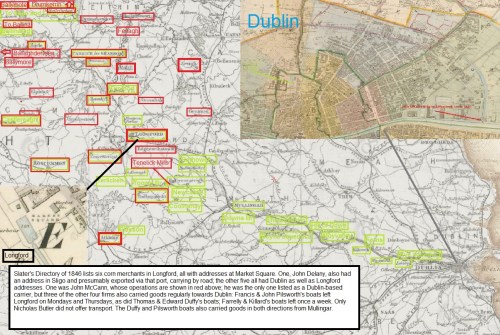
I thought it might be interesting to show these destinations on a map. Note that the map is from the 25″ Ordnance Survey map of around 1900 rather than the 6″ of around 1840: I used it because it was clearer, but it shows features (eg railway lines) that were not present in 1846.

Click on the map to get a slightly larger version.

Royal Canal carriers M'Cann and RCC 1846 (OSI)

Royal Canal carriers M’Cann and RCC 1846 (OSI)

I can’t stand over every location marked on the map (as it were). Spellings of place-names were sometimes not those in use today; some place-names (Ballinamore, Ballymore, Newcastle) are used of two or more places that might have been those intended; I could not identify two places, Dunmore and Junction, although I suspect the latter may be the junction between the main line and the Longford Branch of the canal.

What is interesting, though, is the different emphases in the two firms’ marketing. The Royal Canal Company lists almost every location along its canal; M’Cann offers a wide range of destinations beyond the canal, presumably linked by cars on the roads, into Counties Longford, Cavan, Roscommon, Westmeath, Mayo and Sligo. The RCC serves some such destinations, but a smaller number of them.

Some of the locations listed are small places; my presumption — which I have not yet checked, but for which I have found some supporting examples — is that such places have mills, quarries or other industries that provide cargoes for the canal.

The Shannon and the roads

Both operators offer to serve destinations on the River Shannon, to which the Royal Canal is joined at Clondra/Richmond Harbour:

  • RCC: Athlone, Carrick on Shannon, Dromod, Drumsna, Glasson, Lanesborough, Ruskey
  • M’Cann: Athlone, Carrick on Shannon, Dromod, Drumshambo, Drumsna, Lanesborough, Ruskey.

It is possible that goods to those places were carried by water, although (if steam tugs were not available) that would have been slow and uncertain; given that there were good roads leading from the west to the Shannon and throughout the region, it is, I think, likely that these destinations were served by road. I have no evidence on the matter save that the directory entries for Carrick-on-Shannon, Drumsna and Jamestown do not mention the availability of water transport.

Some of those destinations were served by direct road services from Dublin:

  • Athlone, Ballina, Castlerea, Dunmore, Longford, Roscommon, Sligo, Thomastown.

Competition presumably kept charges down.

Other carriers

Slater’s Directory lists six corn merchants in Longford, all with addresses at Market Square. One, John Delany, also had an address in Sligo and presumably exported via that port, carrying by road; the other five all had Dublin as well as Longford addresses.

One was John McCann, whose operations are shown in red on the map; he was the only one listed as a Dublin-based carrier, but three of the other four firms also carried goods regularly towards Dublin: Francis & John Pilsworth’s boats left Longford on Mondays and Thursdays, as did Thomas & Edward Duffy’s boats; Farrelly & Killard’s boats left once a week. Only Nicholas Butler did not offer transport. The Duffy and Pilsworth boats also carried goods in both directions from Mullingar. My guess is that carrying goods from others helped these merchants to cover the costs of their own fleets.

Peter Clarke’s Appendix C suggests that M’Cann’s fleet was the smallest of those based in Longford. The list is of “Boat Owners operating on the Royal Canal 1826 to 1847” but I am not entirely clear what the list shows. It seems unlikely, for instance, that the Midland Great Western Railway owned four boats throughout the period, as the company did not exist for most of it. Is the number of boats the largest that an owner had, or used, in a peak year, or an average over several years?

I don’t, therefore, know how to interpret the list but, assuming that the same methods were applied to all owners, it seems that the fleet sizes were these:

  • Duffy Bros 12
  • Pilsworths 9
  • M’Cann 5
  • Royal Canal Company 4.

Neither Farrelly nor Killard is listed, but there are many others: Dunne 8, Kelly 6, Murtagh 6, Murphy 5, MGWR 4, Williamson 4, and many others with 1, 2 or 3 boats each. Again, it is not clear in which years those owners had those numbers of boats.

More

As far as I know, little has been written about the carrying companies, especially those of the nineteenth century. I would be glad to hear from anyone who can correct, supplement or comment on this information.


[i] I Slater’s National Commercial Directory of Ireland: including, in addition to the trades’ lists, alphabetical directories of Dublin, Belfast, Cork and Limerick. To which are added, classified directories of the important English towns of Manchester, Liverpool, Birmingham, Sheffield, Leeds and Bristol; and, in Scotland, those of Glasgow and Paisley. Embellished with a large new map of Ireland, faithfully depicting the lines of railways in operation or in progress, engraved on steel. I Slater, Manchester, 1846

[ii] Peter Clarke The Royal Canal: the complete story ELO Publications, Dublin 1992

My OSI logo and permit number for website

Locomotion

Dialogue between an unidentified member of the committee and Colonel John Fox Burgoyne at a hearing of the Select Committee appointed to inquire into the amount of advances made by the Commissioners of Public Works in Ireland on 1 June 1835:

1899 Are you aware that locomotive engines have gone at a speed of from 15 to 20 miles an hour on common roads? — I think I have gone at one at the rate of 20 miles an hour myself on a common road.

1900 Suppose those carriages were used upon a curb-stone and granite road, and not subject to the interruption of carts and carriages, which occur upon common roads, what speed do you suppose they might fairly be worked at? — Very nearly the speed they go on rail-roads.

1901 If it could be proved that granite or curb-stone roads could be constructed at the rate of from £2000 to £3000 a mile, would you, in the present state of the country, recommend an expense of a sum of six and seven times that amount for a railway? — I do not imagine there would be that difference of expense; the levels would be the same, and the stone-work would be the same; the only difference would be the application or not of the iron railway bars.

Locomotives on common roads? It’ll never work.

Rail

In evidence to the Select Committee appointed to inquire into the amount of advances made by the Commissioners of Public Works in Ireland on 22 May 1835 James Pim, Treasurer to the Dublin and Kingstown Railway, said:

1431. Can you tell the average length of time which the [horse-drawn] cars took in going [between Dublin and Kingstown/Dun Laoghaire], and the distance? — I should think the average length of time taken by the cars after they got in motion, was probably 45 or 50 minutes, from Dublin to Kingstown.

1432. Are you not able to do it in 11 minutes? — Easily.

I’ve just had a look at the DART website. As far as I can see, the DART takes 19 minutes to travel from Dublin Pearse [Westland Row] to Dun Laoghaire [Kingstown]. Is the difference attributable to the number of stops?

A picnic on the Barrow in 1896

[…] I recall a little arbitration case in which I was engaged. It was during the summer, in July I think. The Grand Canal (not the canal which belongs to the Midland and is called the Royal) is a waterway which traverses 340 miles of country. Not that it is all canal proper, some of it being canalised river and loughs; but 154 miles are canal pure and simple, the undisputed property of the Grand Canal Company. On a part of the river Barrow which is canalised, an accident happened, and a trader’s barge was sunk and goods seriously damaged. Dispute arose as to liability, and I was called on to arbitrate. To view the scene of the disaster was a pleasant necessity, and the then manager of the company (Mr Kirkland) suggested making a sort of picnic of the occasion; so one morning we left the train at Carlow, from whence a good stout horse towed, at a steady trot, a comfortable boat for twenty miles or so to the locus of the accident. We were a party of four, not to mention the hamper. It was delightfully wooded scenery through which we passed, and a snug little spot where we lunched. After lunch and the arbitration proceedings had been dispatches, our pegasus towed us back.

Joseph Tatlow Fifty Years of Railway Life in England, Scotland and Ireland The Railway Gazette, London 1920

The Shannon River in 1902

Last week I gave the dimensions of the Shannon River:

Length: 770 feet

Breadth: 3 feet 6 inches

Depth: 1 foot 3 inches

Longest straight stretch: 90 feet

Tunnels: 6, totalling 356 feet, the longest 100 feet.

I added that it had a monorail link.

And so it did, in Bombay in 1902, at Lady Northcote’s Fancy Fete and Shannon River Show, with boats, a mono-rail, frocks, shamrocks and Art. Irresistible.

Royal Canal, Dublin

Some superb pics here, by Conor Nolan, of converted working boats on the final descent into Dublin on the recently reopened Royal Canal.


The Shannon River

Length: 770 feet

Breadth: 3 feet 6 inches

Depth: 1 foot 3 inches

Longest straight stretch: 90 feet

Tunnels: 6, totalling 356 feet, the longest 100 feet

Transport links: monorail

More details later.