Category Archives: Rail

Steam, the Shannon and the Great British Breakfast

That is the title of the Railway and Canal Historical Society‘s 2014 Clinker Memorial Lecture, to be held at the Birmingham and Midland Institute, Margaret Street, Birmingham B3 3BS, at 1415 on Saturday 18 October 2014.

The lecture will concentrate on the period before 1850 with such interesting topics as

  • Shannon steamers
  • the Grand and Royal Canals
  • the first Irish turf (peat) to reach the USA (possibly)
  • port developments in Dublin, Limerick and Kingstonw
  • the Dublin and Kingstown Ship Canal
  • the Midland Great Western Railway
  • what “cattle class” really means
  • bacon and eggs.

Admission is free and booking is not required. However, if you plan to attend, it would be helpful if you could e-mail […] to this effect.

The Clinker Memorial Lecture is named for Charles R Clinker, an eminent railway authoe and one-time historian of the Great Western Railway, who died in 1983.

If you would like the contact email address, leave a Comment below and I’ll get in touch with you direct.


The future of railways

None, or at least very little. A sensible government would regard the current union activity as a suicide note, but I suppose support for a technology of the nineteenth century is at least marginally better than suppord for one of the eighteenth. Brian Lucey has the right idea, although I’m puzzled by his proposed route from Dublin to Cork.

Archives workshop: a reminder

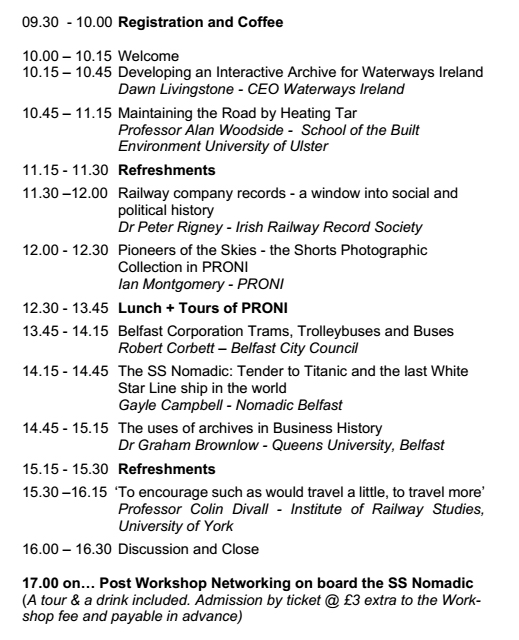
I mentioned, back in April, that an interesting-looking workshop is scheduled for Belfast on 8 September 2014. It’s being held in the Public Record Office of Northern Ireland [PRONI] in the Titanic Quarter and there’s an optional extra tour and reception on the SS Nomadic afterwards. This post is a reminder.

The programme covers waterways, roads, railways and flight. For this site, the opening session is of great interest: Dawn Livingstone, CEO of Waterways Ireland, is to talk about an interactive archive for Waterways Ireland.

By air, sea and land

By air, sea and land

The workshop is being organised for PRONI by A²SN, the Archives and Artefacts Study Network, supported by the Historical Model Railway Society, the Business Archives Council and the Postal History Society.

The [two-page PDF] brochure is downloadable here PRONI transport archives workshop. The workshop fee is £20/€25 with an extra £3/€3.50 for the SS Nomadic visit. Sterling cheques are accepted; there is provision for paying in euro by online banking.


Effin mensuration

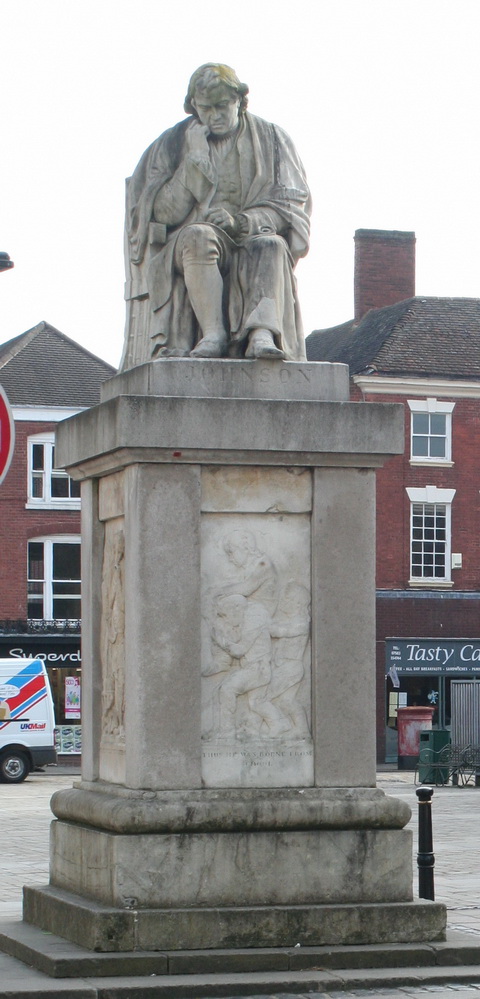
Statue of Dr Johnson near his birthplace in Lichfield

Statue of Dr Johnson near his birthplace in Lichfield

The learned readers of this site will not need to be reminded of the sapient advice of the late Dr Samuel Johnson:

[…] no man should travel unprovided with instruments for taking heights and distances.

There is yet another cause of errour not always easily surmounted, though more dangerous to the veracity of itinerary narratives, than imperfect mensuration. An observer deeply impressed by any remarkable spectacle, does not suppose, that the traces will soon vanish from his mind, and having commonly no great convenience for writing, defers the description to a time of more leisure, and better accommodation. […]

To this dilatory notation must be imputed the false relations of travellers, where there is no imaginable motive to deceive.

Samuel Johnson A Journey to the Western Islands of Scotland W Strahan and T Cadell 1775

The good doctor would, I think, have welcomed the invention of the digital camera with inbuild chronometer. Equipped with just such a device I arrived yesterday at the first lock on the Royal Canal to witness the lifting of the railway bridge and the passage thereunder of fleets of boats. I thought it would be interesting to record how long each stage took.

I have written before about this bridge: reporting a question by Maureen O’Sullivan TD in October 2013 and another in November 2013 and providing statistics on usage a few days later:

  • only 58 boats went through in 2013
  • the bridge was lifted on seven dates
  • two other scheduled lifts were cancelled as no boats wanted to travel
  • Irish Rail charged Waterways Ireland €1200 per weekday lift and €2000 per weekend lift.

The first 45 minutes

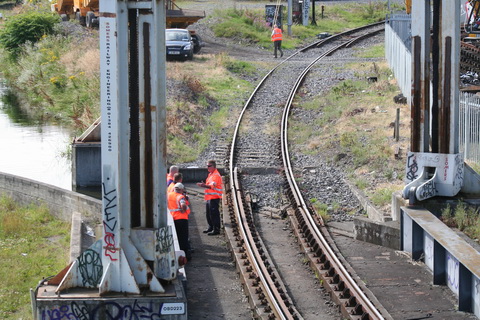
A lift scheduled for early July 2014 was cancelled; yesterday’s lift catered for just two boats, whose passage was assisted or monitored by eight Irish Rail staff and four from Waterways Ireland. Four of the Irish Rail people may have been in training as others seemed to be demonstrating things to them, but that’s only a guess. Three of the WI staff travelled together in WI’s stealth van and operated the first lock; the other, who travelled separately in a 4WD vehicle, visited from time to time. As far as I could see there was no contact between the Irish Rail and WI teams.

The bridge was scheduled to be lifted by 1100.
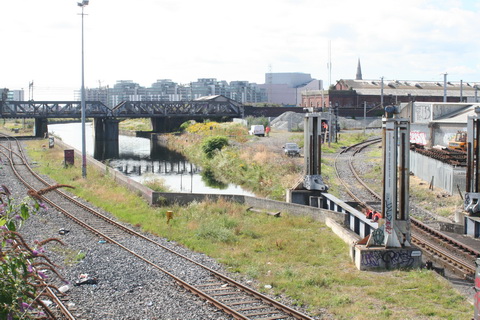
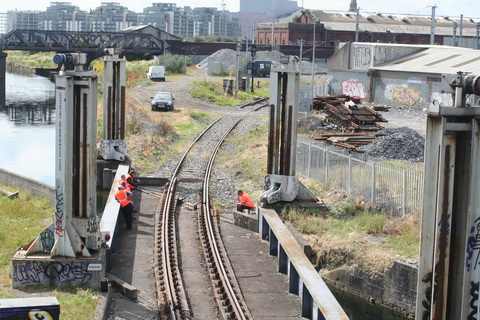
Before the lift 0945

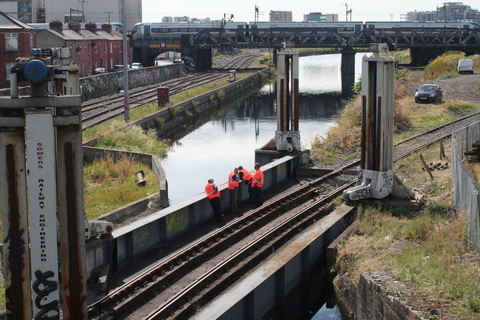
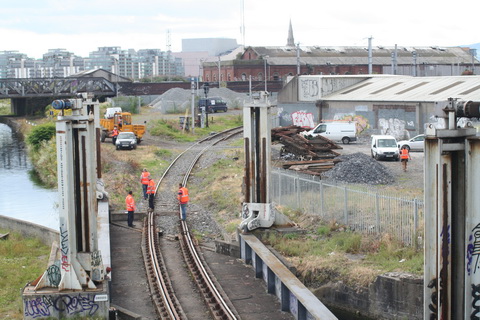
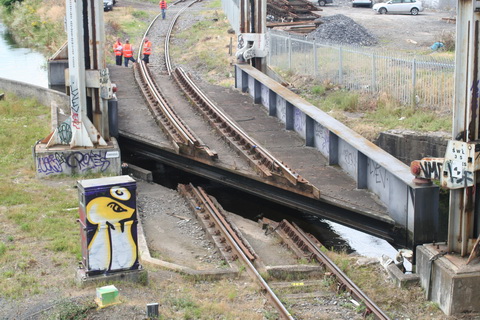
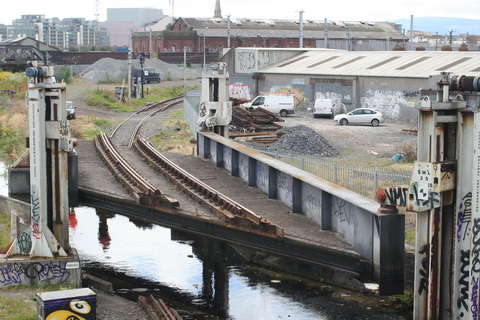
Before the lift: 0945. The lifting bridge is on the right of the photo
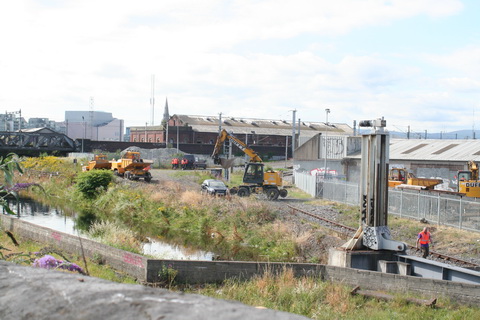
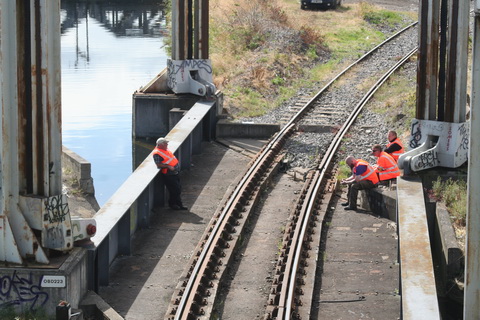
Before the lift 0946

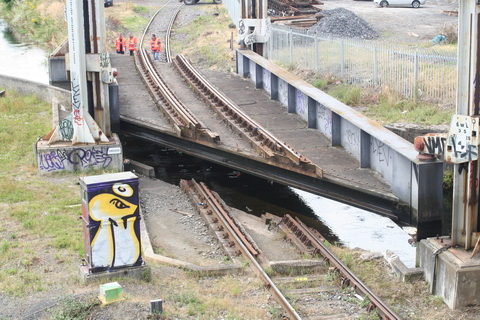
One minute later: 0946. A separate group of workers, perhaps contractors, is going down the west side of Spencer Dock with equipment
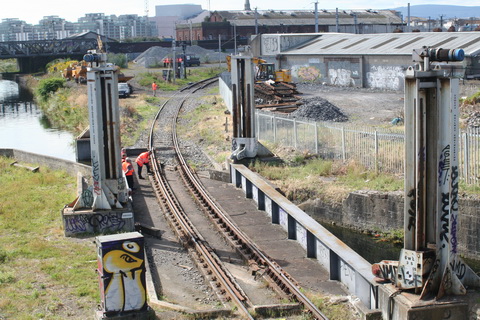
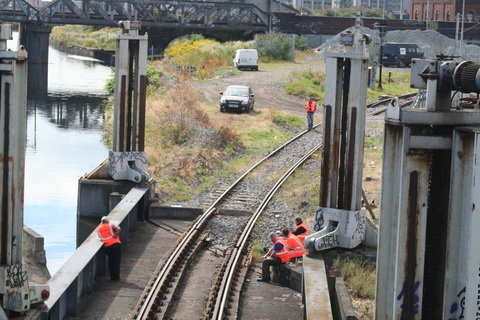
Before the lift 0949

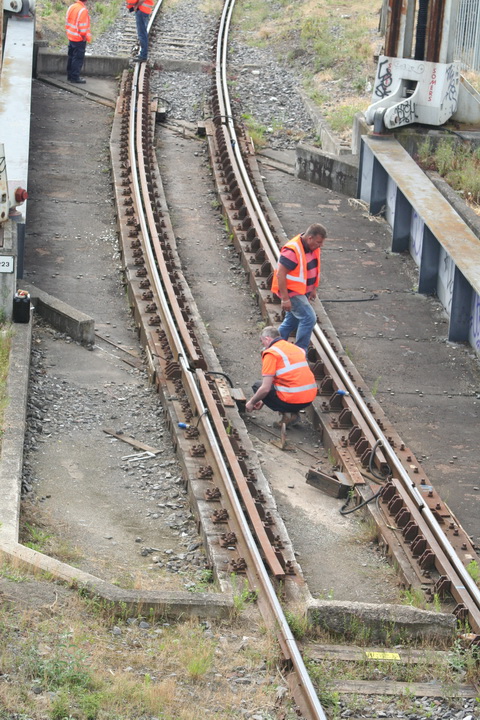
Four men still on the bridge 0949

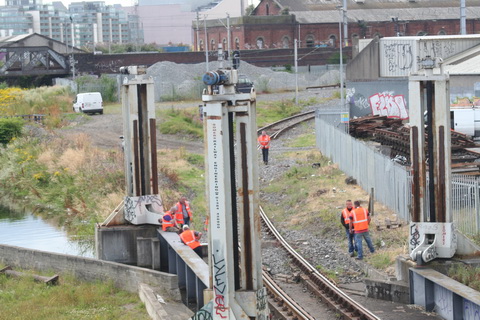
Before the lift 0951

Two minutes later

Before the lift 0956

On the bridge 0956

Before the lift 0958

Still there 0958

Before the lift 0959

One minute later

Before the lift 1006

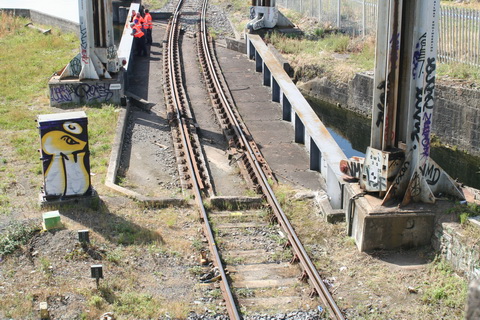
The bridge 1006

Before the lift 1012

The bridge 1012

Before the lift 1015

The bridge 1015: another person approaches
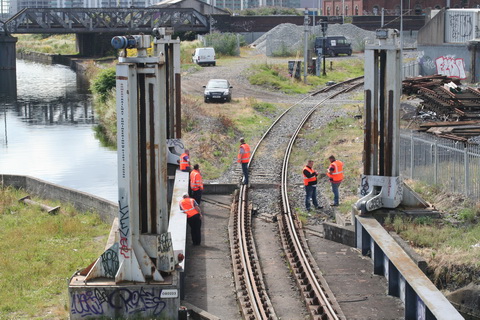
Before the lift 1020

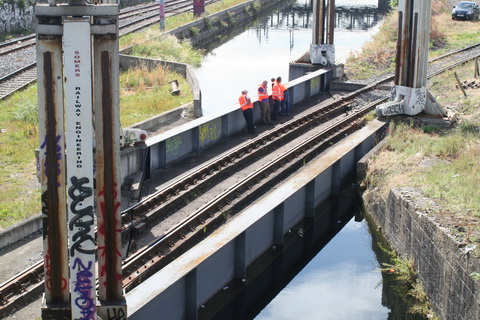
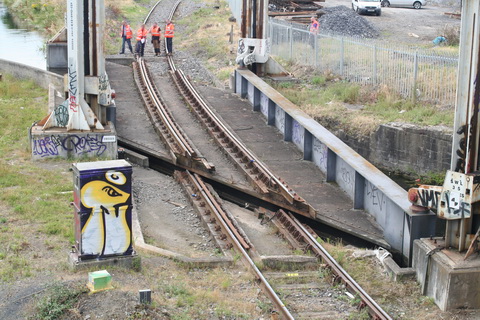
Six men at the bridge at 1020

Before the lift 1028

A seventh man approaches at 1028

Preparing to lift

The preparation stage, presumably involving the unlocking of some mechanism, took about five minutes altogether.
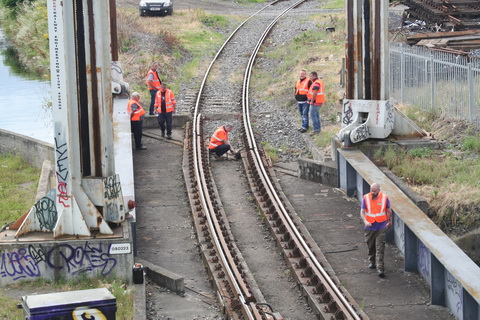
Preparing the bridge 5 mins 03_resize

One man worked on the far end while another walked to do the same at the near end
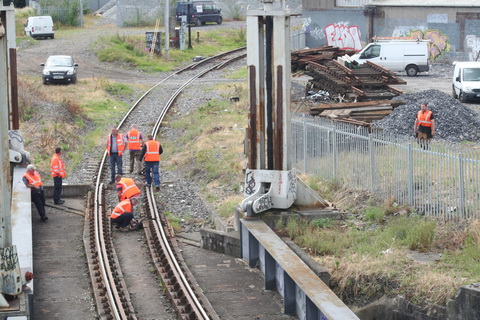
Preparing the bridge 5 mins 06_resize

An eighth man, behind the fence on the right, seemed to summon two of the men on the bridge
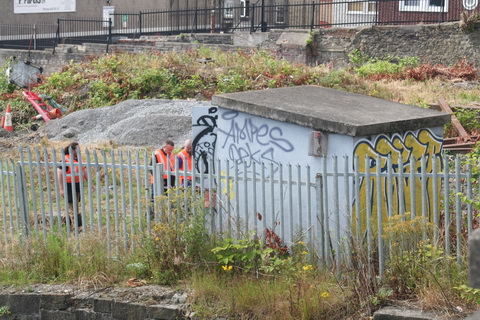
Preparing the bridge 5 mins 14_resize

They went to this building, which I guess houses the controls for the bridge
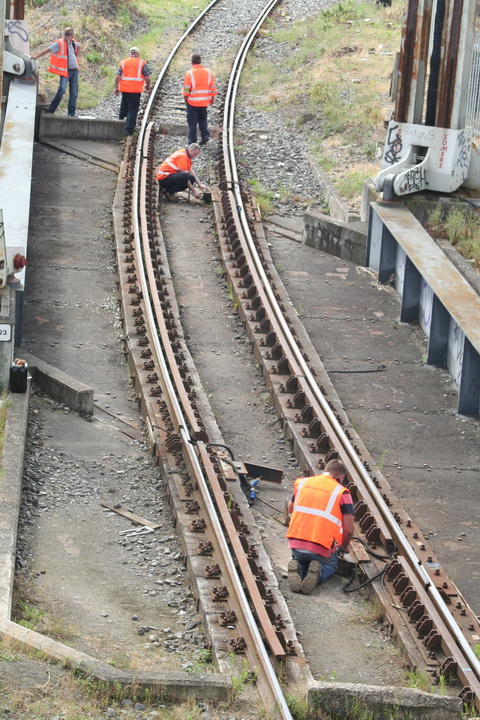
Preparing the bridge 5 mins 15_resize

Meanwhile work continued on the bridge itself
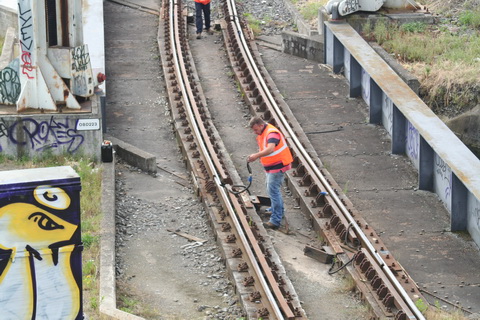
Preparing the bridge 5 mins 19_resize

Almost done

Preparing the bridge 5 mins 22_resize

A final check

Preparing the bridge 5 mins 25_resize

Everybody was off the bridge by 1033

Lifting

The lift itself took just over nine minutes; the bridge was up before 1044, in good time for the arrival of the boats.
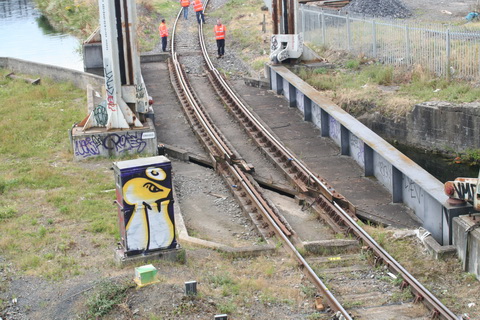
The lift 9 mins 02_resize

After about one minute

The lift 9 mins 08_resize

Another minute later

The lift 9 mins 11_resize

Another minute (or so)

The lift 9 mins 15_resize

About four minutes have elapsed

The lift 9 mins 18_resize

After five minutes. The sides are clear of the water in which they usually rest; they are dripping on to the canal below
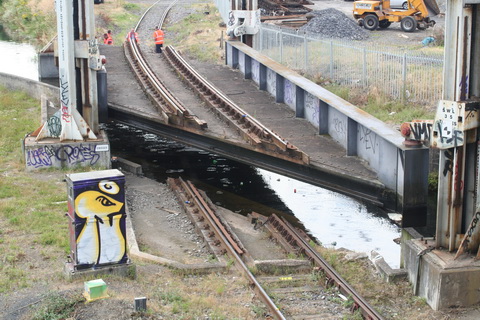
The lift 9 mins 20_resize

Six minutes in

The lift 9 mins 23_resize

Seven minutes

The lift 9 mins 24_resize

The men behind the fence may be controlling the lift
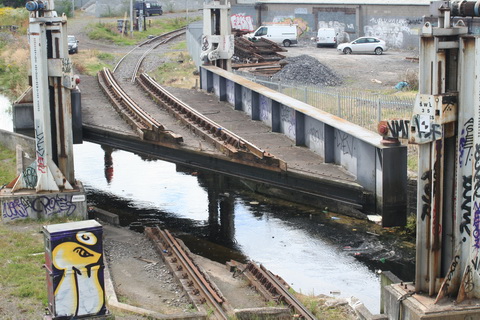
The lift 9 mins 28_resize

Not much further to go

The lift 9 mins 32_resize

Eight minutes

The lift 9 mins 40_resize

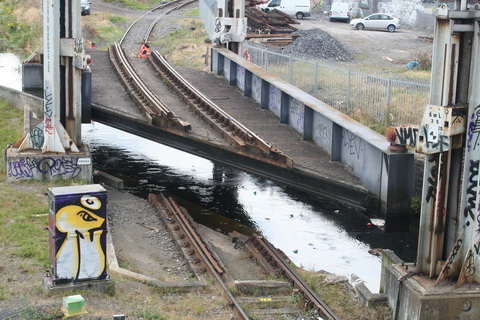
It’s up

The bridge up 16_resize

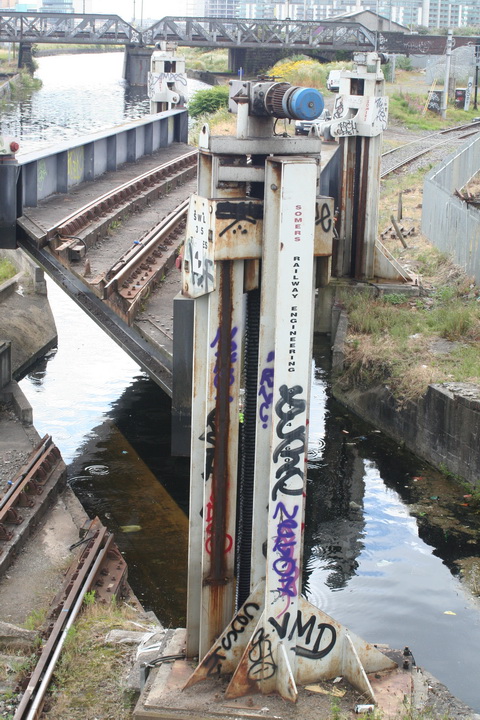
One of the jacks

After the boats passed_resize

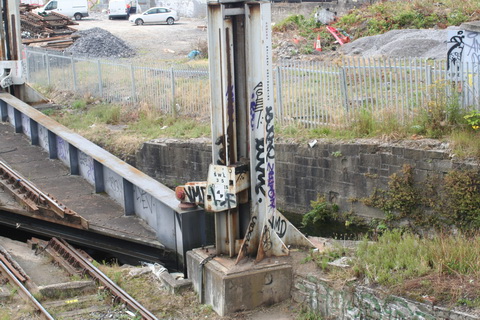
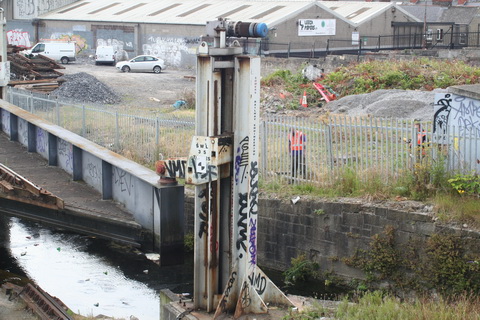
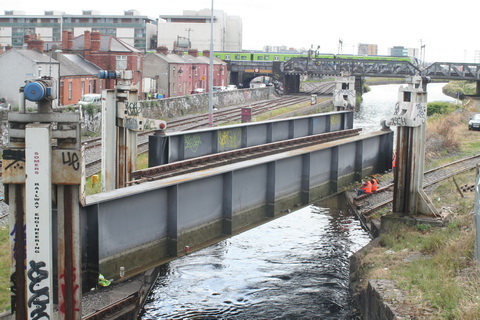
Side view (taken after the boats had gone through)
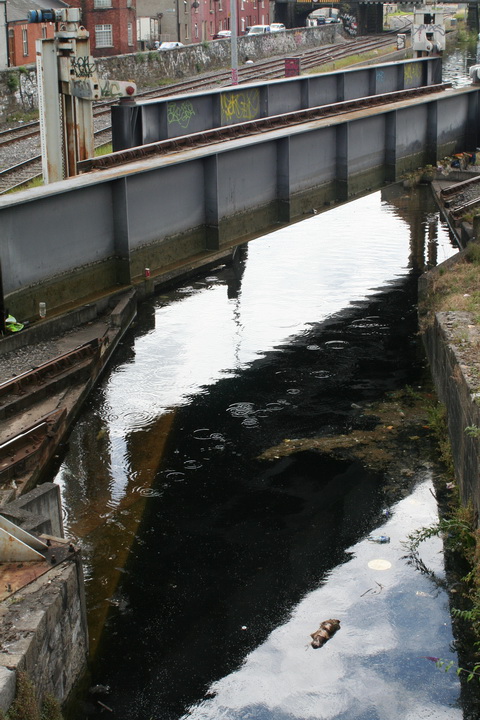
The bridge up 13_resize

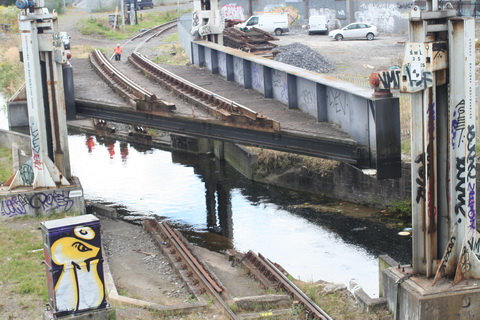
Water under the bridge

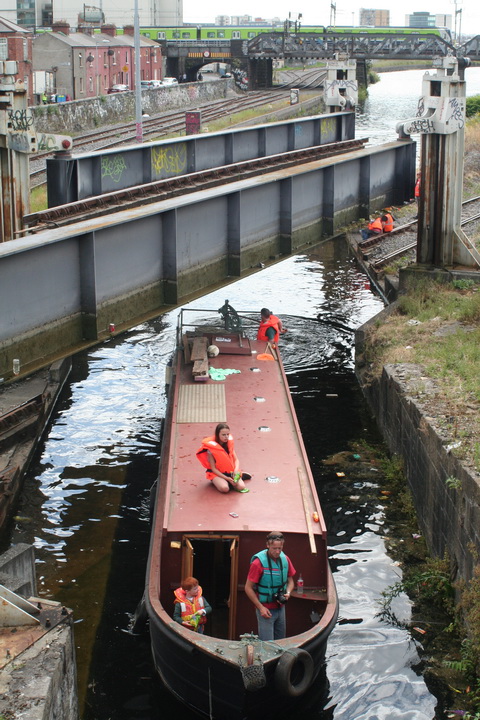
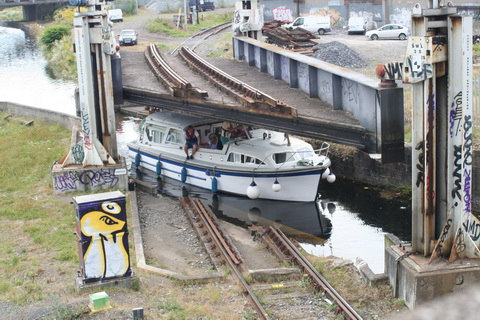
Boats go through

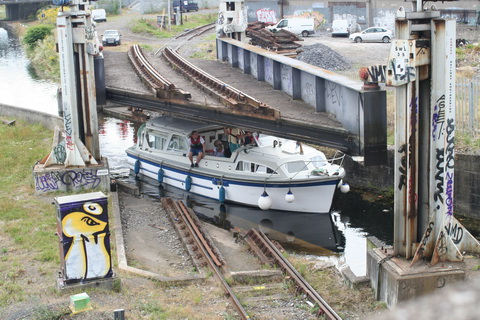
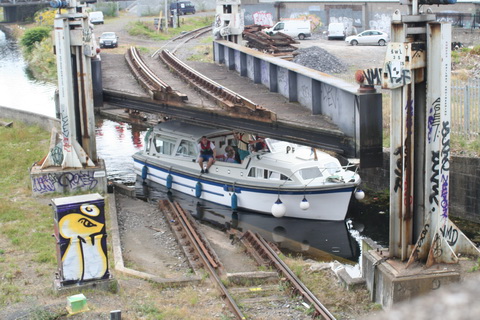
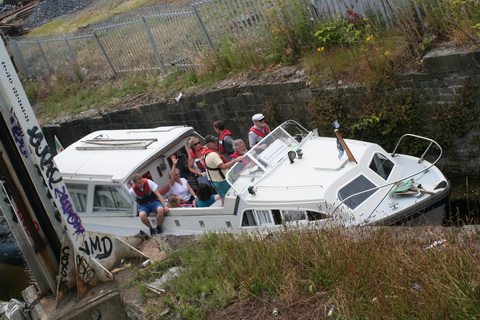
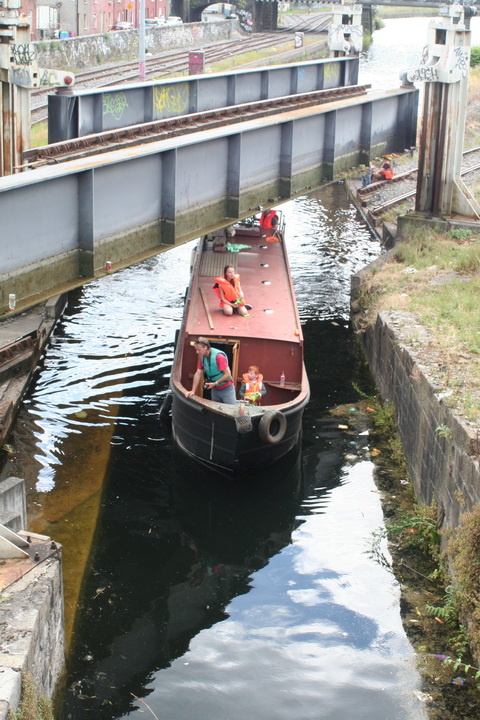
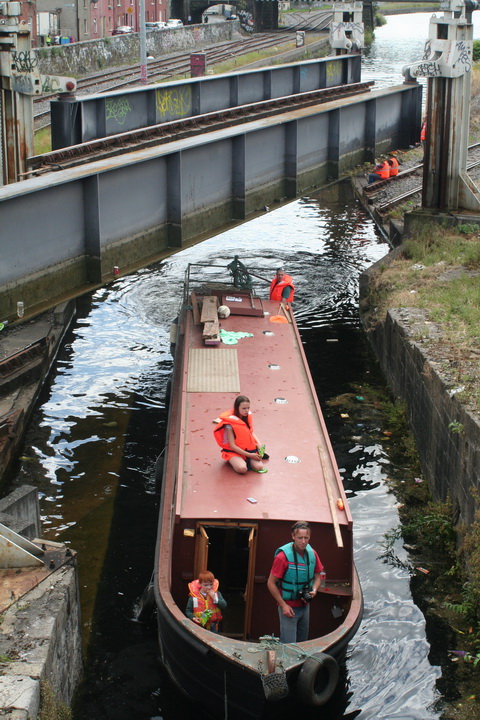
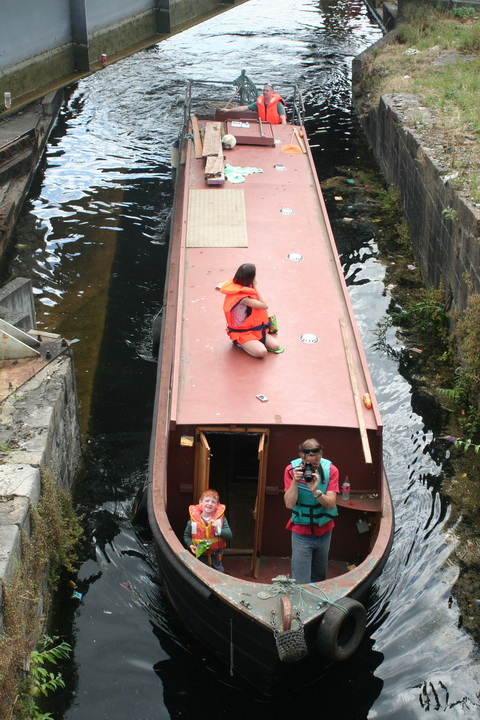
It took just over three minutes for the two boats to go under the bridge.
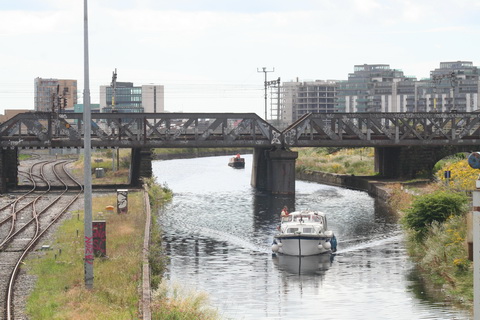
Boats approach 12_resize

Cruiser approaches; steel boat visible through the bridge
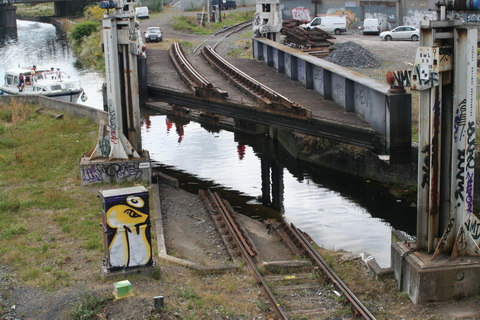
Cruiser goes through 03_resize

Cruiser about to enter

Cruiser goes through 04_resize

Heads down

Cruiser goes through 06_resize

Half way through

Cruiser goes through 07_resize

Leaving

Cruiser goes through 08_resize

Out

Steel boat goes through 12_resize

Steel boat entering

Steel boat goes through 20_resize

Almost through

Steel boat goes through 22_resize

Looking ahead to the lock

Steel boat goes through 25_resize

Done


I did not record the lowering of the bridge, which I presume took much the same time as the raising.

Preparation 5 minutes, lifting 9 minutes, passage 3 minutes, lowering and locking say another 14 minutes: say 45 minutes altogether, allowing some margin. But a large number of boats would take much longer as the rate at which they could move on from the bridge would be limited by the time taken to work through the lock.



Carrick-on-Shannon in 1949

T W Freeman “The town and district of Carrick-on-Shannon, Co Leitrim” in Irish Geography (Bulletin of the Geographical Society of Ireland) Vol II No 1 1949:

There is no mill in use now, though flour is sent from Rank’s in Limerick by barge to Carrick, but no farther. Before the 1939–1945 war general cargo was also brought to the town by barges which could convey 50 tons of coal; other goods included timber and galvanised iron for builders. At present, stout is the only commodity brought by barge to the solidly-built stone warehouse of the early nineteenth century, whence it is distributed for some twenty miles in every direction.
 

Things not to do on a boat …

… at least if you’re close to an airport.

If the boat had rammed an aeroplane it might have become as famous as the schooner Cymric.

h/t Kids Prefer Cheese

Thon sheughery business

It will be recalled that Her Majesty’s Loyal Home Rule Government in Belfast is considering investing in the Clones Sheugh [aka Ulster Canal] and that I asked DCAL, the department responsible, for a copy of the Business Case. To my surprise, it said:

Your request is being treated as a Access to Information request and will be handled under either Freedom of Information Act 2000 or the Environmental Information Regulations 2004.

Either way, DCAL has now told me that I can’t see it. The Business Case, which is apparently an addendum to the 2007 Business Case (which was rotten: see here passim), won’t be complete until November. I have made a note to remind myself to ask for it then.

I quite sympathise with the DCAL folks: it can’t be easy thinking of any good reason to spend taxpayers’ [British or Irish] money on the Clones Sheugh. But perhaps DCAL can spin it out until the Shinners have taken over the Free State, at which point the economics of Grattan’s Parliament will be in vogue and we can all take up growing flax, spinning and weaving, giving grants for canals and making money out of the slave plantations.

Speaking of Shinners, there’s one called Cathal Ó hOisín, a member of HM Loyal Home Rule Government in Belfast representing East Londonderry, who said there recently:

The possibility of the reopening of the Ulster canal would open up limitless opportunities in tourism. The idea that, once again, we could travel from Coleraine to Limerick, Dublin and Galway by boat would be absolutely wonderful.

Well, you can do that: by sea. There was never an inland navigation from Coleraine, Limerick or Dublin to Galway, despite the urgings of Lord Cloncurry and the nitwitted ideas of Sir Edward Watkin.

As for a connection between Limerick or Dublin and Coleraine, I suspect that Mr Ó hOisín is perpetuating the error into which Her late Majesty Victoria, by the Grace of God of the United Kingdom of Great Britain and Ireland Queen, etc, seems to have fallen when she appointed

Commissioners to inquire respecting the System of Navigation which connects Coleraine, Belfast, and Limerick

which Commissioners reported in 1882. There was no such system and, if Mr Ó hOisín can provide evidence that any vessel ever travelled by inland navigation between Coleraine and Limerick, I would be glad to hear of it. I prefer to think of the Commissioners’ conclusion that

As an investment for capital the whole canal system in Ireland has been a complete failure.

I see no reason why politicians of the twenty-first century should repeat the errors of their predecessors in the eighteenth, nineteenth and twentieth centuries.

You expect the Parnellite members to have a bit more sense, but one John Dallat said in the same debate:

[…] when the Ulster canal is open, tourists will come in their thousands and that will benefit the Lower Bann, the Foyle as well, and right over to Scotland.

Er, John? There are actually canals in other countries. Even in Scotland. Folk are familiar with canals. They’ve seen them before. And a short sheugh to Clones is not going to attract tourists (apart from the relatively small number of canal twitchers, who will need to tick it off on their lists) unless the town of Clones is particularly attractive. Which … well, let me put it this way: why not look it up on TripAdvisor?

Of course I’m all in favour of Clones myself: I am quite interested in concrete engine-sheds and former canal stores.


Not the end of the Tralee Ship Canal [updated]

I am grateful to Holger Lorenz of Tralee for alerting me to the removal of one of the gates of the Tralee Ship Canal. Holger’s photos of the lock and gate are here:

Photo 1    Photo 2    Photo 3    Photo 4    Photo 5    Photo 6

According to a Radio Kerry story, the gate had to be removed for maintenance and Tralee Town Council had “no time frame” for replacing it.

It seems to me, from Holger’s photos, that only one gate of the upper pair was removed. If the lower gates were working properly, surely they should be able to keep the canal in water.

It is some years since I visited Tralee. At the time, there was a largeish barge moored on the canal at the bridge. If it hasn’t been moved, I presume that its occupants are now unhappy.

I do not know what Tralee Town Council, or whoever it was, hoped to achieve by restoring the canal (or, for that matter, why whoever it was built the Jeanie Johnston, which was a huge waste of money). But whatever they hoped to achieve, I suspect that the canal failed to meet expectations. I do not know whether there has ever been a formal review of the project but I cannot imagine that it provided a reasonable return on investment.

The best thing to do with it now would be to seal up the seaward end with a fixed wall, forget about opening the bridge, maintain some flow through the canal to keep the water from becoming overly offensive and let the rowers take over the canal.

Addendum February 2015

This story from The Kerryman in November 2014 escaped my notice; it says that the damaged gates were replaced. It also says that the gates “now have a new motorised opening system that replaces the old crank mechanism”, which may reflect some confusion on the Kerryman‘s part as the gates were hydraulically operated.

I still don’t understand why the lower gates, or stop planks, could not have been used to maintain the level in the canal.

Addendum March 2015

Kerry County Council confirms that the lock has been restored and that the canal is fully operational.

See also comments below.

And I’m like wow …

… as the young folk say nowadays. Searching the National Library catalogue for prints and drawings of the Royal Canal before 1900 brought up the usual suspects but also a very interesting map and this stunning view of Dublin in 1853. Viaducts! Railways! Steamers! Barges being propelled by sweeps!

I couldn’t find the Royal Canal, though.

Shannon history in Birmingham

According to the Railway & Canal Historical Society’s Events page, its annual Clinker Memorial Lecture, to be held in Birmingham in October 2014, will be about River Shannon steamers in the second quarter of the nineteenth century:

The 2014 Clinker Memorial Lecture will be held in Birmingham on the afternoon of Saturday 18th October 2014. The speaker will be Brian Goggin, BA (Mod), MA.

Brian graduated from Trinity College, Dublin in Economics and Politics, and spent some years as honorary Editor of the quarterly magazine of the Inland Waterways Association of Ireland. He and his wife Anne have been boating on Irish inland waterways since the late 1970s. He is currently working on a book on the Shannon steamers of the 1830s and 1840s, and the Clinker Lecture will draw on his research.

Before lunch (and independent of the Lecture) there will be a walking tour of central Birmingham, focusing on sites of waterway and railway interest.