Category Archives: Rail

Effin Bridge: a modest proposal

Effin Bridge, the railway lift-bridge over the Royal Canal on the seaward side of Newcomen Bridge in Dublin, has caused some little annoyance to boating folk. It is raised on a small number of days each year to allow boats through; many staff must attend and Waterways Ireland must pay Iarnród Éireann, the railway company, for each lift, as well as paying its own staff for attending.

Perhaps a more modest structure might work. Something like this.

Description of a new Lift Bridge for the Midland Great Western Railway, over the Royal Canal at Newcomen Bridge, Dublin. By Bindon B Stoney, MA, MInstCE

This bridge carries a short branch of the Midland Great Western Railway of Ireland across the Royal Canal immediately below Newcomen Bridge, at the very oblique angle of 25 degrees and, though the canal is only 15 feet wide, the bridge carrying the railway requires to be nearly 40 feet long on the skew.

The trains run over this bridge at about two feet above ordinary water level, and whenever a boat is passing along the canal the bridge is lifted from 8 to 13 feet, according to the height of the deck load, so as to permit the boat to pass beneath. The bridge is formed of two strong single-plate girders of the usual type, which lie underneath the rails, with cross girders and side brackets over which the platform is laid. This bridge is lifted by means of a lever 40 feet long, formed of two plate girders braced together horizontally, and attached rigidly at right angles to the centre of the bridge, and this lever is itself balanced at its centre on blunt steel knife edges like the beam of a pair of scales. The weight of the bridge at one end of the lever is counterpoised by an equal weight of metal attached to the other end, so that the whole structure turns freely on the knife edges, which work in steel pillow blocks on the top of metal standards, one on either side of the lever. The opening and closing motions are regulated by a small crab-winch and chain worked by hand; the ends of this chain are attached to the lever at several feet on either side of the knife edges, and its centre is wound on or off from the barrel of the winch, which is itself bolted down to a mass of concrete extending beneath the metal standards.

The man in charge works this arrangement with the greatest ease, and it is so regulated that the bridge is opened or closed in about one minute. It might be moved much faster than this, as the friction is reduced to a mere trifle by the knife edges, but it is not convenient to put so large a mass in rapid motion when there is nothing to be gained by so doing. It was essential that the bridge should be erected speedily and so as to interrupt the traffic as little as possible, and the first engine passed over it in about twelve weeks after the contractors, Messrs Courtney, Stephens and Bailey, of Dublin, got instructions to proceed with the work and the traffic was interrupted for only about one week during erection. The lever sloping upwards has a somewhat singular appearance when the bridge is in position for trains to pass over and, on the other hand, the bridge itself has a singular effect when it is tilted up into the air for canal boats to pass beneath; but the author has successfully obtained what he aimed at — namely, simplicity of design, strength, ease of working, little aptitude to go out of order and last, but not least, very moderate cost.

Report of the Forty-eighth Meeting of the British Association for the Advancement of Science; held at Dublin in August 1878 John Murray, London 1879
 

Waterways [and other] archives

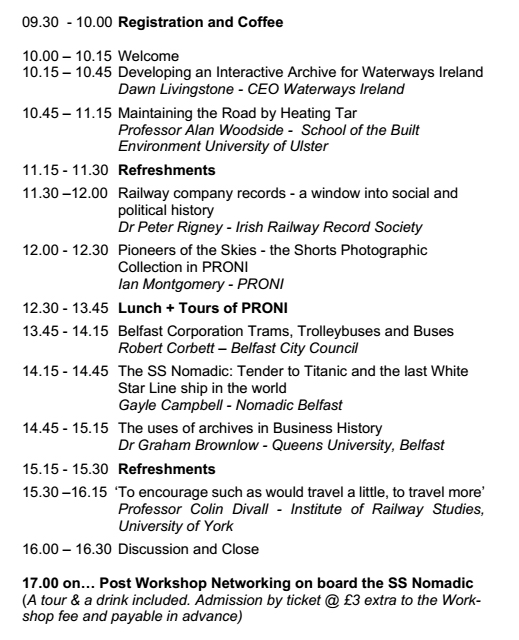
For anyone interested in transport history, there is an interesting-looking workshop scheduled for Belfast on 8 September 2014. It’s being held in the Public Record Office of Northern Ireland [PRONI] in the Titanic Quarter and there’s an optional extra tour and reception on the SS Nomadic afterwards.

The programme covers waterways, roads, railways and flight. For this site, the opening session is of great interest: Dawn Livingstone, CEO of Waterways Ireland, is to talk about an interactive archive for Waterways Ireland.

By air, sea and land

By air, sea and land

The workshop is being organised for PRONI by A²SN, the Archives and Artefacts Study Network, supported by the Historical Model Railway Society, the Business Archives Council and the Postal History Society.

The [two-page PDF] brochure is downloadable here PRONI transport archives workshop. The workshop fee is £20/€25 with an extra £3/€3.50 for the SS Nomadic visit. Sterling cheques are accepted; there is provision for paying in euro by online banking.

While on the subject of archives, I might mention again the Archives & Records Association, Ireland branch, whose [freely downloadable PDF] newsletters often cover topics of interest, and their Learn About Archives site here.

Important topics in Ireland 1845–1850

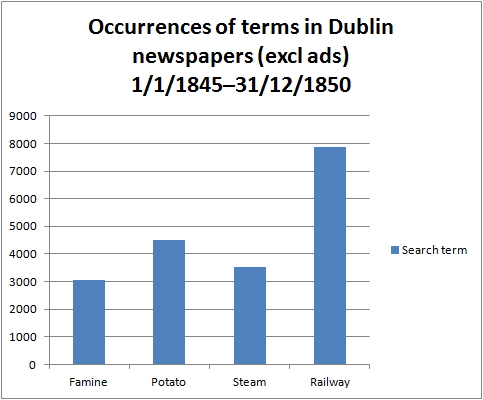
I thought it would be interesting to ask the British Newspaper Archive what people were reading about in newspapers published in Dublin between 1 January 1845 and 31 December 1850. The BNA has scans of two Dublin newspapers for that period, the Freeman’s Journal and the Dublin Evening Mail. I used the archive to search for four different words in those newspapers in that period; I then counted the numbers of results.

On the first round, I included ads and family notices.

Newspaper terms incl ads 1845–1850

Terms in Dublin newspapers (incl ads) 1845–1850

I guessed that the numbers for steam and railway might be exaggerated by their inclusion in ads so, on the second round, I excluded both ads and family notices. The result was as expected.

Newspaper terms excl ads 1845–1850

Terms in Dublin newspapers (excl ads) 1845–1850

I then asked Google’s Ngram machine to count the numbers of occurrences of four pairs of words between 1845 and 1850. I asked it to do a case-insentitive search, but it can’t do that for “compositions” (combinations of words), so it counted:

Ireland+potato
Ireland+steam
Ireland+famine
Ireland+railway.

Here is what it came up with, but whence I know not, other than that it searched the corpus English. The embedding process doesn’t seem to be working, so I’ve left the code here but also cut and pasted the output.

Google Ngram

Google Ngram

I suspect that, in recent times, the amount written about steam and railways of the period 1845–1850 in Ireland has been rather less than that about potatoes and the famine.


The (re)invention of heritage

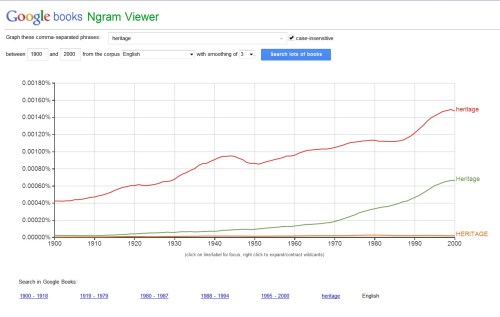
From Google’s Ngram viewer (more here):

ngram[Sorry, Google: couldn’t get the embedding to work properly. WordPress’s whitelist omits Google, though maps seem to work OK. Here’s the original.]

The growth in the use of “Heritage” with an initial capital is particularly interesting. I can think of three possible reasons:

  • that more organisations, eg The Heritage Council, use the word in their titles
  • that the word is increasingly used as an abstract noun at the start of sentences like “Heritage is important”
  • that the word is increasingly used as an attributive adjective at the start of sentences like “Heritage apples should be preserved”.

Traditional, personal uses (like “My heritage from my ancestors …”) are, I think, less likely to require initial capital letters. That in turn might suggest that Google’s Ngram viewer is reflecting a new(ish) set of meanings for the word and might lead us to ask what that new(ish) usage is (or was) intended to achieve.

It might also lead us to ask whether an even newer concept might now be more useful: one that would dissuade well-meaning folk from preserving and displaying context-free old tat and persuade them to find and record information instead.

The Gillogue railroad

Gillogue, in Co Clare, is the site of a former Burlington factory and of a Clare entrance to the University of Limerick. It is also the site of a lock on the Plassey–Errina Canal, a section of the old Limerick Navigation, and of quarries, gravel pits and lime kilns.

And, according to the 6″ Ordnance Survey map, of around 1840, Gillogue also had a railroad.

The Gillogue rail road

The Gillogue rail road (click to enlarge)

The railroad was almost certainly not for carrying passengers; it may have been a light railway, with small wagons pushed by men or pulled by horses, and designed to be taken up and moved elsewhere fairly easily. However, I have no hard information about who owned it, who built it or what it was for. I can make guesses, based on its closeness to the canal and to the quarries, but it would be nice to have evidence.

If, Gentle Reader, you know anything about it, do please leave a Comment below.

My OSI logo and permit number for website

M’Gauley’s mysterious mechanism

In 1851 Alex Thom, Printer and Publisher of Dublin, produced the third edition of Lectures on Natural Philosophy by the Rev James William M’Gauley, Canon &c, Professor of Natural Philosophy and one of the Heads of the Training Department to the National Board of Education in Ireland. [The Morning Post of 9 October 1840 suggests that the first edition seems to have been in 1840: Longman, Orme & Co in London, W Curry, jun & Co in Dublin and Fraser and Crawford in Edinburgh.]

You can read the third edition of the Lectures here, paying special attention to any electro-magnetic apparatus, given that the Rev James read papers on the subject to the meetings of the British Association for the Advancement of Science in Dublin in 1835 and in Liverpool in 1837.

But I can find nothing, there or elsewhere, about his contributions to steam propulsion on canals. Several British newspapers copied this story from the Dublin Pilot in 1837:

We understand that the Rev Mr M’Gauley, of Marlborough-street, in this city, has completed a series of experiments upon a subject which for some time has occupied his attention — the application of steam to canal boats, with perfect success.

Our readers are aware that the great obstacle to the application of steam to packet boats on canals is caused by the great injury which would arise to the banks from the wave created by the paddles. He has, it seems, adopted a paddle on an altogether new principle; one of great simplicity and of such a nature that the injury to the banks shall not be greater than what is produced by the ordinary boat.

He gets rid entirely of backwater, his paddles work without noise, and require for their application a steam engine of the simplest construction.

It is said that Mr M’Gauley contemplates a velocity which to seem possible would require his working model to be understood. We hope and indeed believe, that Mr M’Gauley will not have to contend with apathy and want of enterprise in the introduction of so important an application of steam in Ireland, one which would render our canals incalculably more profitable and more useful than at present, and to give us an opportunity of consuming to advantage the turf with which so large a portion of the country is covered.

And in its issue of 29 December 1838 [No 803] the Mechanics’ Magazine, Museum, Register, Journal, & Gazette carried this story from the Dublin Post:

Steam-boats on Canals. — The Rev J W M’Gauley, Professor of Natural Philosophy to the Board of Education, we understand, has at length succeeded in fabricating a machine for propelling boats on canals without raising a surge, which has been very detrimental to the banks, causing a considerable annual outlay to keep them in repair.

The power will be derived from a steam-engine; but instead of the usual paddle-wheels, there will be a machine immerged in the water underneath the centre of the boat, the working of which will not cause the least ripple on the surface of the water. There will be a public test of the invention on the Grand Canal about a fortnight hence, with a boat fitted up under the immediate inspection of the Rev gentleman.

But I have found nothing after that: no report of the success or otherwise of the machine. I would be grateful for information from anyone who knows anything about it.

By 1840 the Rev M’Gauley’s attention had returned to electro-magnetic apparatus with a practical application. In November and December of that year several British newspapers reproduced this report from the Dublin Monitor [I take this from the Leicester Chronicle, which was so excited that it reported the news twice, on 21 November and 12 December 1840]:

Important improvement. — The Rev Professor M’Gauley, whose scientific experiments in electro-magnetism excited so much interest in the philosophic world some time ago, has communicated to some of the principal Railway Companies in England a valuable invention, which will be attended with most important results in the preservation of life and property from almost all the casualties to which they are at present subjected in railway travelling.

His object is to render the stoppage of the train entirely independent of the engine conductors; so that, should they, as was lately the case, fall asleep, get drunk, or otherwise become incapacitated for the discharge of their responsible duties, the steam can be turned off, and the train stopped, totally independent of them. The simple announcement of the object of Mr M’Gauley’s invention is sufficient to render its vast importance obvious to every man who has bestowed one moment’s thought upon the subject. We have been favoured with an examination of the invention, and consider it at once simple, ingenious, and admirably adapted to effect the desired end; its cost is trifling.

This important improvement has been submitted to the directors of some of the first lines of railway in England, to the Dublin and Kingstown and Ulster Railway Companies who are giving it their best consideration, and, we presume, will test its utility by experiment.

Addendum April 2017:  could this be relevant?

More on M’Gauley (lots of variant spellings) in Wikipedia and here in a short notice at the bottom right of page 376 of The Engineer for 1 November 1867 [PDF courtesy of Grace’s Guide]. Who knew that folk left the priesthood and got married in the nineteenth century?

A further brief mention here [January 2019].

A missed opportunity for railways

The Leeds Intelligencer of Saturday 16 September 1837 reported on the seventh annual meeting of the British Association for the Advancement of Science, which had begun at Liverpool on the previous Monday. The Mechanical Science section met, appropriately, at the Mechanics’ Institution with Professor Robinson of Armagh, President, in the chair.

It heard papers from Mr Williams on the Treffos Pump, Mr Kingsley on the Perspective Drawing Board, Mr Henwood on the Expansive Action of Steam in Cornish Mine Engines and Mr Russell on the Motion of Steamers in Shallow Waters. But the first and greatest paper was not delivered by its author, Mr G Remington [presumably George Remington, railway engineer], who was absent, but by Dr Lardner. Its subject was

… the Railway Balance Lock. The object of this was to do that upon Railways which is accomplished on Canals by means of Locks, namely, to raise the trains to any given height, according to the inequality of that surface.

You can read more about it here; interweb search engines will find more references. Perhaps it is not too late to have this innovation adopted.

More Pathé

A train ferry, claimed to be in service on the Liffey

Fishing at Ringsend the hard way

Turf by canal

Launching the Irish Elm in Cork

A Boyne regatta

Making and using a Boyne currach in 1921 (you can learn the art yourself here)

A non-watery film: Irish Aviation Day 1936


Lartigue in motion

I’ve just noticed a 3½-minute video of the original Lartigue on the British Pathé website. Here is my page about the modern recreation, which is well worth a visit. The other monorail by the Shannon River is covered here.

Drawbacks of canals

There was a proposal in the 1830s for a ship canal along the coast, outside the railway embankment, from Dublin to the asylum harbour at Kingstown. A preliminary report was provided by William Cubitt after the House of Commons Select Committee on the Dublin and Kingstown Ship Canal had reported in July 1833.

Henry E Flynn was opposed to the idea and, in his A Glance at the Question of a Ship Canal connecting the asylum harbour at Kingstown with the river Anne Liffey at Dublin &c &c &c [George Folds, Dublin 1834], dedicated to Daniel O’Connell, he wrote eloquently of the drawbacks of the proposal, which included this:

Be it remembered, that the whole coast from Ringsend to Merrion is the bathing ground for the less affluent classes of the Citizens; and hundreds get their bread by attending on and bathing the females who frequent it.

And are the patriotic Would-be’s who support a Ship Canal equally reckless of the health, the morality, and the existence of those persons? Would they have no objection to expose their mothers, wives, sisters and daughters to the immediate wanton gaze, the scoffs, the jeers, the immodest jest, the filthy exposure and indecent exhibitions which the most abandoned race of men [ie sailors] could find in their dissolute minds to perpetrate in their view, and within their hearing? And yet, all this must be the consequence of a Ship Canal in the immediate vicinity of the female baths and bathing ground along the line.

Happily, the canal was never built.