Category Archives: Scenery

Another tour-Limerick-by-water idea …

… but this one, unlike the rest, might actually make financial sense: it uses existing infrastructure, it probably has a low capital requirement (as the firm presumably already owns the kayaks) and it seems to offer the prospect of extra income, without much extra cost, in the off-season, with low fixed costs. Furthermore, it covers the more scenic parts of the city: the Park Canal is not, alas, one of them when seen from water level, because the banks are so high you can see nothing else.

The Limerick Post covered the venture here.

SEUPBer

SEUPB, the Special European Union Programmes Body, has withdrawn its offer of funding for the Narrowwater bridge about which I wrote here and here.

Perhaps the scheme’s proponents might now consider a Newry Southern Relief Road instead. It might not be iconic, but it would be considerably more useful.

And I really don’t think it needs an opening span to cater for a couple of yachts going up the Newry Ship Canal.

It seems that the SEUPB wants to reallocate the money to a project that could be completed by December 2015. A cross-border sheugh, maybe?

Levels

On 9 October 2013 minister Brian Hayes spoke in the Dáil about Shannon water levels, saying:

A meeting between the ESB, Waterways Ireland and the Office of Public Works to review the interim operating regime is due to take place shortly.

On 17 and 18 October 2013, in correspondence with Waterways Ireland, I learned that the meeting had not then taken place and that no date had been set. I have now sent WI another note asking whether the meeting has been held and, if it has, requesting a report on the proceedings and outcome.

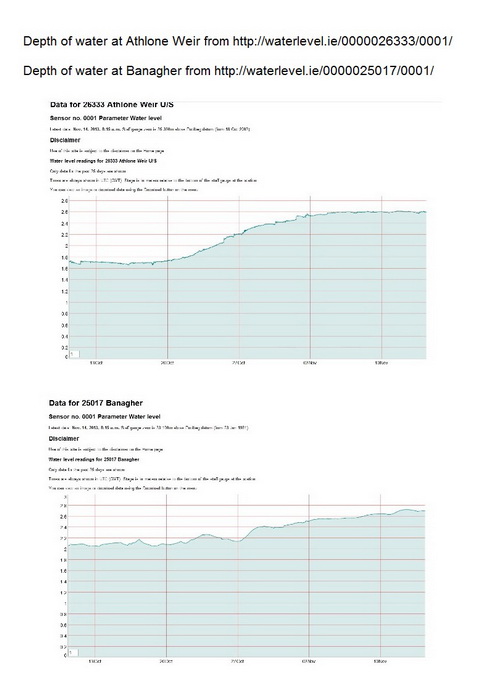
In the meantime, I have put together two charts nicked from waterlevel.ie for Banagher and Athlone:

Athlone and Banagher water levels

Athlone and Banagher water levels

Both of them show the levels for the last 35 days. I’m sure that more data and much more sophisticated analysis would be required to reach any reliable conclusion, but my untutored impression is that, in what has been a fairly dry autumn, keeping Lough Ree low didn’t do much to keep Banagher low. If that is so, and if I’m right in thinking that this autumn was dry (see below), the outcome would not show whether lowering Lough Ree would help in a very wet season; it may be necessary to repeat the experiment next year while performing rain dances. I would be glad, though, to have comments from more erudite folk and, if I get any information from TPTB, I’ll publish it here. In the meantime, this CFRAM PDF provides background reading.

On the dryness: Met Éireann’s monthly report for September 2013 is headed “Dry everywhere; warm and dull in most places” while that for October says “Rainfall was above average except in parts of the West, Northwest and North”. Its report doesn’t, AFAIK, specify any stations in the Shannon catchment (apart from Shannon Airport), but those to the west were generally below average while whose to the east were above; it may be that the Shannon rainfall was moderate.

Ticking all the boxes

Sometimes an idea comes along that is just so good, so right, so advantageous on all counts that it is simply irresistible. This idea comes from the Americas, from the US Coast Guard. Adapted to the Irish inland waterways, and specifically to the Shannon, it could:

  • help to promote industry in recession-hit rural areas
  • create direct employment
  • help to stimulate indirect employment
  • promote Irish energy independence by reducing reliance on imported hydrocarbons
  • counter pollution of water-courses
  • reduce the number of heavy trucks using remote rural roads
  • use environmentally-friendly water transport, by barge along the Shannon
  • honour and promote the industrial heritage of Co Leitrim and the transport heritage of the Shannon
  • help to defray the costs of maintaining the Shannon Navigation
  • solve Dublin’s water supply problem, at least for non-potable water.

How could anybody resist?

The US Coast Guard has proposed that wastewater from fracking [PDF] should be transported by barge, rather than by truck or railway train, from the fracking sites to remote storage or treatment facilities. So, when fracking begins around Lough Allen, the wastewater could be carried down the Shannon by barge and, if necessary, pumped to Dublin.

It sounds like a winner to me.

No queue for the quay …

… at Querrin on the Shannon Estuary. The page discusses its building and the early years of its operation.

More on Major Rowland Raven-Hart

A recent comment by Horacio A Nigro of Montevideo, Uruguay, may have solved the mystery of the birthplace of Major Rowland Raven-Hart, whose Canoeing in Ireland covered several inland navigations in the 1930s. You can see Horacio’s comments, and the subsequent discussion, on my page here.

But, on his own site, Horacio has cast light on Rowland-Hart’s career in radio, working in South America between the Kaiser’s War and Hitler’s War, and he has also very kindly provided an English-language version here as a PDF.


Up with this sort of thing

Folk interested in the history of the Shannon before 1850 may like to know of a talk …

The smart green technology of the 1830s: the Shannon steamers and the definition of Ireland

… to be delivered to the Thomond Archaeological and Historical Society on Monday 4 November 2013. It’s in Room T.1.17, TARA Building, Mary Immaculate College, Limerick, at 8pm.

A related topic …

Charles Wye Williams and the Anglo-Irish Trade

… will be discussed in one of the papers at the Eighth [British] Waterways History Conference on Saturday 26 October 2013 at the University of Birmingham. Leave a Comment below if you would like contact information for the conference.

Water levels in Athlone

At time of writing, the depth of water at Athlone Weir is 1.7m. “Staff gauge zero is 35.360m above Poolbeg datum”, which means the water level is 37.06m OD (Poolbeg). According to Bob Cullen’s 2002 article for Inland Waterways News [PDF], “The minimum navigation level in Lough Ree is 36.88m OD”, so if the level drops another 0.18m, about 7 inches, there may be a WI Marine Notice.

It seems that the dropping of the level of Lough Ree is intended to provide a buffer against flooding in the area from Athlone downstream to Meelick. According to Brian Hayes “A meeting between the ESB, Waterways Ireland and the Office of Public Works to review the interim operating regime is due to take place shortly.” [I have asked Waterways Ireland for a report on the meeting.]

But, if we are to believe the Dublin Evening Mail, the Shannon Commissioners took a rather more robust attitude to flooding downstream of Athlone: steamers [and PR] came first.

Waterways minister keen on waterways

An exchange from the Northern Ireland Assembly on 7 October 2013, thanks to theyworkforyou.com.

Pam Brown (DUP) asked the Minister of Culture, Arts and Leisure whether inland waterways could be developed to provide a major leisure and recreational activity resource.

Carál Ní Chuilín (Sinn Féin; Minister for Culture, Arts and Leisure): Waterways Ireland is one of the all-Ireland bodies that my Department has responsibility for. You can see the value of the work that it does, particularly in rural areas. I am also working with some councils to improve some of the waterways within their control. I agree with the Member that inland waterways provide brilliant opportunities not just for tourism but for local leisure. They are the economic driver in some towns and villages.

Pam Brown (DUP): I thank the Minister for her answer. She has touched on my supplementary question. Does the Minister agree that the development of inland waterways, while a great source of leisure and recreational activities, can also act as a catalyst for urban and rural regeneration?

Carál Ní Chuilín (Sinn Féin): I agree. I made a statement to the House in July, I think, about some of the events that take place at inland waterways across the island. Those events include festivals and family fun days. Huge numbers attend those events, and they act as economic drivers. Not only are those responsible keen to make sure that they are further developed, but people from other areas visit those festivals in towns and villages to see how they can extract that product for their area. They see the potential and outcome of those events.

That’s good: nice cheap family fun days, not expensive and unnecessary waterway restorations.

Newry and Narrow Water

I wrote a few days ago about the proposed bridge across Carlingford Lough at Narrowwater (or Narrow Water). I was reminded of that today on reading a debate, held in the Northern Ireland Assembly on 30 September 2013, about a proposed Newry Southern Relief Road [thanks to theyworkforyou.com].

Apart from an admittedly minor mistake made by a Sinn Féin MLA about the Newry Canal (first summit-level canal, not “oldest inland waterway” in These Islands), the debate was remarkable for its demonstration of cross-party agreement: not so much on the desirability of public works (a desideratum of Irish politicians since the eighteenth century) as on the irrelevance of the Narrowwater bridge. Jim Wells [DUP] said:

There has also been some progress on the Narrow Water bridge project, although we do not know exactly where we stand. First, that bridge is far from certain, and, secondly, even if it were built, it would not relieve much of the traffic that we are dealing with. It would certainly not relieve the large number of juggernauts coming through from Warrenpoint harbour.

Sean Rogers [SDLP] said:

Narrow Water bridge is merely a tourist bridge, but the relief road would take heavy goods vehicles off the streets of Newry, reduce traffic congestion and attract even more shoppers to the city. Heavy goods vehicles would also have a direct route to Warrenpoint port, increasing trade in the port area.

And the other contributors to the debate did not mention it, which suggests to me that it is seen as irrelevant to the traffic problems of Warrenpoint and of Newry.

The Minister for Regional Development, Danny Kennedy [UUP], gave a lengthy response to the debate, including this point:

A more detailed technical investigation of the specific options for crossing the Newry canal was also recommended, given the sensitive nature of this important heritage feature. It is expected to require at least the provision of a bascule, or lifting bridge, to allow the passage of tall ships on the canal. The width of the Victoria lock already limits the size of ship that can enter the canal and it is expected that any bridge would maintain a navigation channel that matches the width of the sea lock. My Department will continue to consult with NIEA on how the impact of the proposal on the canal might be mitigated and an appropriate design developed.

And it seems that one of the areas being considered for the road is Fathom, which is where the Victoria Lock is. It is a short distance north (and upstream) of the border.

It must surely be unlikely that there will be two crossings of Carlingford or the Newry River [and canal] within a few miles of each other. But if one option, the Newry Southern Relief Road, helps to relieve Newry and Warrenpoint traffic and the other, the Narrowwater bridge, doesn’t do so, then the first option would seem to be the rational choice.

Although I wouldn’t bother providing for “tall ships”.