Category Archives: Sources

Are the Sheughers …

seeing sense?

A cynic (not that there are any of them around here) might say that DAHG feels that it has done as much as it’s going to do (admittedly at Waterways Ireland’s expense) by dredging the River Finn and that it has told Monaghan Council that, if it wants any more Sheughery for Clones, it will have to pay for it itself. The Council might like a canal, but only if someone else pays for it, so it will have to be content with a greenway.

And rightly so.


Good news for Sheughers

I noted recently that, according to the Department of Arts Heritage and the Gaeltacht, Waterways Ireland’s budget for the Clones Sheugh assumed a cost of land [including legal costs] of just over €52,500 per acre, when “the majority of [the land] is poor quality agricultural land”. I have asked Waterways Ireland for more information about this.

But today [as I am sure all regular readers will be aware] the Irish Farmers Journal Agricultural Land Price report 2014 has been published. It says that the average price of Co Monaghan land (based on 25 completed transactions) was only €9384 per acre, with a range from €1049 (for a 43-acre lot of which 12 acres were bog) to €40000 for land with development potential near Carrickmacross. A 25-acre “holding of prime agricultural land overlooking the lake at Emyvale” went for €14800 per acre and the county’s weighted average was €8103 per acre.

In Fermanagh, in Northern Ireland, the average price was £7493 (€10126) per acre, but “Lots of poor, rocky and heather land sold for around £1700/acre”.


Mr Roberts and his basin

To complement my page on the Eglinton Canal in Galway, here is one about the Claddagh Basin.

Crossing the Barrow

The trackway [towing-path] on the River Barrow changes from the east {left) bank to the west at Leighlinbridge and back again at Graiguecullen/Carlow.

It seems to me that there may have been some difficulties in getting horse-drawn boats from one side of the river to the other and I have found no evidence on how it was done, so here is some speculation instead.

Sort it yourself, Heather

No, that’s not me saying it: that’s the message from Enda Kenny to Heather Humphreys about Saunderson’s Sheugh. Recall that Ms Humphreys’s Northern Ireland counterpart has been pressing her to do something about the Ulster Canal:

Moving to implementation would have a positive impact on wider North/South relations. It would provide delivery on a commitment given by the North South Ministerial Council in 2007 in the context of the restoration of the Northern Ireland Assembly and Executive following a five year hiatus. It had not been possible to make visible progress up to now in the absence of planning permission. However, now that the necessary preparatory work has been completed and the required planning permissions are in place, failure to proceed to implementation could be viewed as tantamount to retracting the commitment given in 2007 and reported on regularly at North South Ministerial Council meetings since then.

Strange words to find in a business case, but that’s where they are: in the Department of Arts, Heritage and the Gaeltacht’s Restoring the Ulster Canal from Lough Erne to Clones: Updated Business Case February 2015. They read to me as if they might have been written by Carál Ní Chuilín’s Department of Culture, Arts and Leisure in the draft they sent to DAHG; it might have been tactful to remove them, as they smack of the message I envisaged here:

[…] I suspect that Sinn Féin put a gun to someone’s head: “We’re fed up waiting for our sheugh. Start digging or the baby gets it.”

Presumably, then, Ms Humphreys went to her government colleagues and asked for money to buy a few shovels. It is clear that the government took a decision on the matter:

The Government also remains committed to the Narrow Water bridge project and to developing the Ulster Canal. The Government made a decision in regard to an element of that project today.

That was Enda Kenny in the Dáil on 24 February 2015. Later in the same discussion, he said:

This morning, on a recommendation from the Minister for Arts, Heritage and the Gaeltacht, the Government approved a recommendation from Waterways Ireland to allocate €2 million from its resources to address a 2.5 km section of the Ulster Canal. It is a stand-alone project which will demonstrate further evidence of great co-operation. I understand a further 11 km are due for assessment after that.

Now, I am quite ready to believe Mr Kenny’s assertion that Waterways Ireland volunteered to have its already tattered budget cut by another €2 million to pay for dredging the River Finn; I also believe Mr Kenny’s assertions about economic recovery and about the existence of unicorns. I’m less certain that having the southern state pay the entire cost can be called “evidence of great co-operation”. But I am happy to note that no decision has been taken to dig a further 11 km of sheugh to Clones.

It seems, though, that — despite its commitment to sheughery — Mr Kenny’s government does not intend (at least until that economic recovery is further advanced and the unicorn mating season is over) to pay an extra penny or cent to cover the costs. That is very wise, but I suspect that it left Ms Humphreys swinging in the wind: forced to do something to satisfy DCAL and Sinn Féin but unable to extract any extra money from the government. Waterways Ireland then — without, I am sure, any prompting — nobly volunteered to reduce the spending levels agreed in its business plan just two months before, and to sell some unidentified property, to come up with €2 million to save its southern minister.

I have asked DAHG for a list of those government departments to which the business case was sent; I’ll then ask them what they said about it. As it stands, it seems that DAHG’s work of imaginative literature failed to convince the Irish government.


Shannon–Erne Waterway traffic

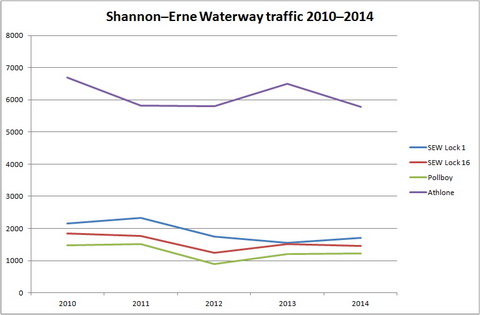
I have reported regularly on Shannon traffic figures [most recently here] but I have paid relatively little attention to the Shannon–Erne Waterway [SEW]. I am therefore grateful to Waterways Ireland for supplying me with the last five years’ monthly traffic figures for Locks 1 and 16 on the SEW. I had some queries about the figures for certain months and I have put them to Waterways Ireland, but I presume that the annual figures are OK.

Shannon–Erne Waterway traffic 2010–2014

Shannon–Erne Waterway traffic 2010–2014

Clearly, not all boats go all the way through: if they did, the figures for Locks 1 and 16 might be the same. The hire bases for Locaboat, Riversdale and Corraquill were all on the Erne side of the summit level; does Lock 1’s excess of traffic over Lock 16 suggest that hirers, perhaps wishing to minimise the number of locks they passed through, headed for the Erne rather than the Shannon? The figures, which I presume are gathered automatically, do not distinguish between private and hired boats.

The other point that strikes me is that the level of traffic is actually quite low. I put in the figures for Pollboy and Athlone locks to allow comparison. SEW traffic is greater than that on the Lough Allen Canal, but it is not much greater than that on the River Suck to Ballinasloe. In that case, WI is [according to its Business Plan 2015] considering automating Pollboy Lock to reduce costs.

Pollboy lock passages 2005–2014

Pollboy lock passages 2005–2014

The SEW locks are already automated, but the costs and benefits may have to be re-examined, especially now that Locaboat has moved from Ballinamore to Quigleys Marina at Killinure on Lough Ree: I presume that that will result in less traffic on the SEW.

Pollboy and the CLones Sheugh

In 2006 Pollboy traffic was used as the basis for estimating likely traffic to Clones on the Ulster Canal’s “SW section”:

The total number of boat parties/groups for the SW section is assumed to be 600. This is based on a comparison with another “offshoot” like the Suck Navigation which had around 1,250 boat parties/groups in 2005 (obtained by dividing the passages through Pollboy Lock by 2) in a much busier section of the whole system. So, for the SW section, a level of around 50% (ie. 600) is regarded as a reasonable assumption.

Waterways Ireland Socio economic Summary Report for the NE and SW Sections of the Ulster Canal Final Report February 2006

Now that Pollboy’s traffic is half what it was in 2005, no doubt the estimate for the number of boats that would visit Clones, if a canal ever reached it, has likewise been halved, which would give an average of about ten boats a week over a seven-month season: four boats every Saturday and one a day for the rest of the week. Folk intending to build restaurants to cater for the cruiser traffic might be wise to reassess their investment plans:

In overall terms, the benefits of waterway restoration derive from the fact that these can facilitate a variety of leisure and recreational activity, that the users will benefit from this activity, and that there will also be wider spin-off benefits in the areas, e.g. facilities such as restaurants etc built to service canal traffic.

Department of Arts, Heritage and the Gaeltacht Restoring the Ulster Canal from Lough Erne to Clones Updated Business Case February 2015

There’s not enough business there for a burger van, never mind a restaurant.

The magic of the Shannon–Erne Waterway

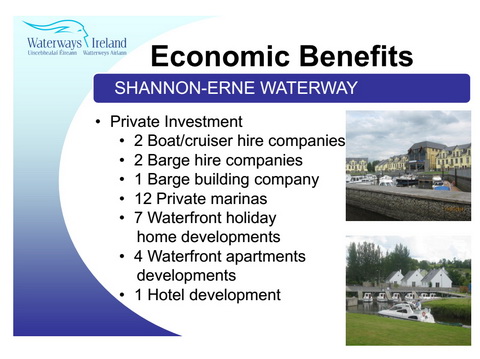
But if Pollboy, the River Suck and Ballinasloe are no longer cited as support for the construction of a Clones Sheugh, the Shannon–Erne Waterway is still used as an example, in that and in other contexts. Take, for example, this:
Shannon–Erne Waterway magic

Shannon–Erne Waterway magic

I’ve nicked that from a slide show called Economic, Recreational and Social Benefits of Rural Waterways in Ireland, which was to be delivered [PDF] by Garret McGrath of Waterways Ireland at the World Canals Conference [PDF] in Milan in 2014.

Now, if the Shannon–Erne Waterway had caused all that construction activity, we’d have to drag Waterways Ireland before the Irish banking enquiry. Skipping lightly over the question of the ghost estates, and the departure of Locaboat from Ballinamore, we come to the real problem with this sort of stuff: the post hoc fallacy. We are invited to believe that

  • a waterway was built
  • prosperity followed
  • so the waterway must have caused the prosperity.

Well, maybe it did and maybe it didn’t, but the argument presented in the slide show isn’t sufficient to prove it. You would have to check to see whether there were any other possible explanations: any other changes that might have resulted in all that construction.

Along the Shannon–Erne Waterway, I can think of two other possible factors: Sean Quinn’s business empire and the Upper Shannon Rural Renewal Scheme, a tax dodge that applied in Leitrim, Longford, Roscommon, Cavan and Sligo, five of the six counties that had the highest rates of vacant housing (excluding holiday houses). So there are two problems here:

  • much of that construction activity may have been driven by tax breaks rather than by the existence of a nearby waterway
  • the construction itself may not have had beneficial effects.

You can read more about that here, noting in particular, on the map, the areas around the upper Shannon and the SEW with vacancy rates of over 25%; you might wonder whether Waterways Ireland is wise to claim credit for housing over-development.

But my main concern here is a different one: that, if you want to claim credit for economic benefits that followed waterways development, you have to measure the benefits and subtract those attributable to other factors, such as Sean Quinn and the Rural Renewal Scheme. Then it would be useful if you compared the remaining benefits with the cost of constructing your waterway: it might then be possible to say that waterways development is a good investment.

It may be that such a study has been done on the SEW, but if it has I don’t know where it is; I would like to see it if it exists. Until then, I regard this sort of thing, from DAHG’s Business Case, as drivel:

The broad existence and nature of the potential socio-economic benefits of canals and restored waterways are therefore well established and not really at issue.

Sorry, minister: that’s rubbish. As far as I know no proper evaluation has ever been carried out on the costs and benefits of any restored or new-built Irish waterway. So you’re not getting away with that one.

 

Shannon history

Folk interested in the history of the Shannon Navigation, and in particular in the work of the Shannon Commissioners in the 1840s, may like to get hold of an article “Steam, the Shannon and the Great British breakfast”, published in the Journal of the Railway & Canal Historical Society Vol 38 Part 4 No 222 March 2015.

They’re taking the [bodily fluid]

Of the cost of land to be acquired for a canal to Clones:

We understand that the costs of land acquisition are based on the purchase of 46 hectares of land (equivalent to approx. 114 acres), the majority of which is poor quality agricultural land for a total estimated cost of €6m. This is equivalent to an average price for acquisition of just over €52,500 per acre, although the total acquisition costs would also include legal costs associated with the process.

Nevertheless, an average price of €52,500 would appear to be very high compared with the average price at which agricultural land is currently sold in the area. If an average price of €25,000 per acre (including legal costs) was applied, then total land acquisition costs would be reduced to €2.85m. This is still a generous assumption. The average RoI price of agricultural land in 2014 was less than €10,000. [Irish Farmers’ Journal Agricultural Land Price Report 2013 January 2014]

That’s from Department of Arts, Heritage and the Gaeltacht Restoring the Ulster Canal from Lough Erne to Clones: Updated Business Case February 2015. Hats off to Fitzpatrick Associates for checking and for leaving the information in the final report. I have written to Waterways Ireland to ask for more information:

I would be grateful if you could let me have a list of

  • the names and addresses of the owners of the land you propose to buy to build a canal to Clones

  • map references or maps showing the location of that land

  • the size and nature of each plot of land you propose to acquire

  • the amount you propose to pay for each plot

  • the justification for each such amount.

Actually, I have the list of landowners in Co Monaghan, because it’s in the planning application. I can’t find the equivalent on the NI Planning Service’s website because I can’t work out how to search by applicant.

The stony grey soil of Monaghan must be worth more than one might think. Either that or this proposal is a steaming dunghill.

DAHG and the unicorns

In purely quantifiable monetary terms, it is clear from these estimates that the project has a very significant capital cost of circa €46m and that the quantified annual net economic benefits are at most €323.5k per annum. The latter thus covers the annual revenue costs of €308.8k per annum only. Applying any cost benefit analysis, whether payback period or net present cost, will result in a large negative for the project.

The justification of the project therefore relies largely on the unquantifiable benefits associated with the project and the disadvantaged area in which these will occur.

Department of Arts, Heritage and the Gaeltacht Restoring the Ulster Canal from Lough Erne to Clones: Updated Business Case February 2015

The project will give this border region, which has suffered greatly from economic deprivation, a much needed boost in terms of job creation and tourism. There is significant potential for growth in the waterways based tourism market and I have no doubt that the reopening of this section of the canal will help to attract significant numbers of visitors to the area.

Heather Humphreys quoted in Department of Arts, Heritage and the Gaeltacht press release Minister Humphreys secures Government approval to restore Ulster Canal from Upper Lough Erne to Castle Saunderson 24 February 2015

If “quantified annual net economic benefits are at most €323.5k per annum” for a sheugh running all the way to Clones, it is hard to see how a shorter sheugh to Castle Saunderson is going to result in “a much needed boost in terms of job creation and tourism”.

But that’s where the unicorns come in: it will all happen by magic.

What DAHG knows about waterways history

Commercial traffic on all waterways in Ireland ended during the first half of the 20th century.

For certain values of “half”.