Category Archives: Sources

The River Shannon and its Shrines

One of the Shannon books that are listed on the IWAI website but that I’d never seen is J B Cullen’s The River Shannon and its Shrines, which the IWAI list says is

Dublin. C.T.S. of Ireland. 1909. p.p.107. Green boards. Prof. illus.

IWAI also lists J E McKenna Lough Erne and its Shrines published by the Catholic Truth Society of Ireland in 1909, and it provides a link to a downloadable copy of what is a short work of 32 pages.

How many pages?

In 2004 that learnéd bibliophile Michael Slevin also provided a list of books being sold by Healy Rare Books, which included

J.B. Cullen. The River Shannon and its Shrines. Dublin. Browne & Nolan. n.d. Disbound. p.p.28. Illustrated.

I mention this because I have recently acquired a copy matching that description (though, I suspect, not at Healy prices). The number of pages is indeed 28 rather than the 107 mentioned on the IWAI listing. So were there two books with the same title by J B Cullen? My copy concludes with the words

At Killaloe may end the notice of the Upper Shannon and its Shrines.

That is followed by

[The Story of Saint Senanus, which is to follow, will introduce the remaining Sanctuaries of the hallowed and majestic River.]

It seems possible, therefore, that Cullen wrote more than one piece on the Shannon; perhaps they were originally published in the Catholic Truth Society magazine and then assembled to provide a 107-page book. The National Library suggests that there may have been four pieces.

I would be glad to hear from anyone who knows more about this — and to get copies of any other sections that may exist.

Athlone

Here is an extract from Cullen about Athlone.

To-day Athlone presents a picture of greater interest than many of our Irish cities or towns. Its normal population is some ten thousand inhabitants, but its importance as a military station often swells this aggregate. This latter circumstance gives a very distinct feature to Athlone. The town is generally bright and gay with the parade of military, and joyous with the strains of martial music, while ever and anon the practice of artillery keeps the echoes of the Shannon busy recalling — in our peaceful days — the stirring memories of the warring past.

The book was published in 1909: the army is that of His late Majesty King Edward VII.

Shannon -v- Erne

McKenna’s Erne book has a practical tone: it mentions the “finely-equipped paddle-steamer Lady of the Lake” but says

We prefer a modest little steam launch for the purpose of our present excursion.

Assuming we have a few quid to spare, of course. But Cullen says nothing about how the traveller is to get around. He has clearly been on the water (he visited several islands — and even Lough Forbes, which is not easy to see by road) but also travelled by land to Kilronan, Edgeworthstown and Roscommon. It would be interesting to know how and when he made his journeys.

Despite its title, his book[let?] displays an interest in military as well as in religious sites and history, but there is nothing about contemporary waterways usage or traffic.

J B Cullen

From searching tinterweb, I conclude that John Bernard Cullen may have attended Mungret College in Limerick [PDF; mostly irrelevant] and had a brother called James who was a Jesuit, co-founded the Rosbercon Choir, lived at Bawnjames House near New Ross, was a founding committee member of the Catholic Truth Society of Ireland, contributed to the Parnell National Tribute and wrote lots of light historical articles. In 1886 two of his daughters, aged 3 and 13, drowned in an ornamental pond in his gardens.

I would welcome more information.

As far as I can tell he was dead before 1933 and his work is therefore out of copyright; accordingly I provide a PDF [5.3 MB] below.

The River Shannon and its Shrines

DUKWs? Fiat lux

I have written here about a series of misfortunes suffered by DUKWs in Liverpool and London. On 16 June 2013 I put up some photos of DUKWs in Dublin and Liverpool; I pointed to what seemed to me to be two differences between practices in the two cities:

First, before they enter the water at Grand Canal Dock, Ringsend, the DUKWs are fitted with extra buoyancy in cylinders that slide into racks along their sides. I saw the VikingSplash crew removing the cylinders from the yellow DUKW; it took only a couple of minutes, and I presume that it didn’t take much longer to put the cylinders on.

Second, the Dublin passengers are issued with buoyancy aids before they take to the water. I can’t see any buoyancy aids on the Liverpool passengers, although it’s possible that they are out of camera shot.

There are links on that page to photos, news reports and a seriously scary video of the sinking of a DUKW in Liverpool. Then, in September 2013, a DUKW went on fire on the Thames; my brief report and links here. In October 2013 the UK Marine Accident Investigation Branch issued a safety bulletin (my report here, with links) pointing to foam buoyancy as a common factor. The Liverpool DUKWs did not have enough buoyancy to keep them afloat if they started taking water and MAIB thought it would be impossible to get enough into them. On the London vessel,

… the most likely cause of fire was the action of the rotating drive shaft (or other moving parts) on the oil contaminated surfaces of the buoyancy foam blocks.

In November 2013 I noted that the wearing of lifejackets had been discussed in London and I commented on the policy of the Dublin operator, VikingSplash:

The point that strikes me is that, in both UK accidents, passengers had little time to don lifejackets and would have been trying to put them on in a confined space and under less than ideal conditions. It seems to me that Viking Splash’s policy [having passengers don lifejackets before taking to the water] is the right one.

In December 2014 the MAIB published its report into the two accidents. There’s a Guardian news report here [h/t gjb] and you can download the MAIB’s full report and annexes from this page. The London and Liverpool accidents are covered in the same report.

It’s well worth reading and pulls (as far as I could tell) no punches, even tearing strips off the Maritime and Coastguard Agency and the Vehicle and Operator Services Agency, both within the UK Department for Transport and both involved because the DUKW is an amphibian.

I took three main points from the report.

The Irish approach

First, the Irish authorities seem to have thought seriously about the safety problems. My understanding of the buoyancy requirements was mistaken: the UK DUKWs had added buoyancy (although not enough, and adding more foam caused fire) and the Irish buoyancy cylinders are not designed to keep the vessel afloat. Here’s what MAIB says:

In Ireland, APV operators have been permitted to operate vintage DUKWs without having to provide any residual buoyancy. To mitigate the consequences of serious flooding, the Irish regulator required the operators to:

  • Fit external buoyancy tubes designed to slow the sinking process and make the vehicle sink bodily [my emphasis].
  • Retract the canopy roof and open the side curtains prior to entering the water.
  • Require passengers and crew to wear PFDs while on the water.
  • Provide a fast rescue craft, rescue crew and an inflatable liferaft at the slipway.
  • Limit operations to a non-tidal area.

This approach focused on passenger survivability by reducing the risk of entrapment and drowning, rather than vehicle survivability, and introduced several of the interim measures recommended by the NTSB following the sinking of Miss Majestic.

The Irish model demonstrates that open topped APVs can be operated successfully in similar weather conditions to those experienced in the UK, and that passengers are willing to wear PFDs.

So big it up for the Irish Maritime Administration.

The speed of the sinking

Second, if you’ve seen the video of the Liverpool sinking you may have been struck by its speed. In both Liverpool and London passengers had very little time to get out and the report’s synopsis says

In both instances, the crew had little time to co-ordinate the evacuation process and the confined nature of passenger spaces made it almost impossible for them to control or assist the passengers.

And in 4.3 Common safety issues:

8.  It was extremely fortunate that all on board WQ1 and Cleopatra were able to evacuate into the water unharmed. In both cases the passengers were forced to act on instinct and exit the vehicles under their own initiative.

Any of several issues could have cut the time available and “the risk of entrapment and the likelihood of loss of life would have been considerably higher”.

So Figure 63 of a Dublin DUKW doesn’t just show the external buoyancy cylinders: the passengers are wearing buoyancy aids, there is a crewman already stationed at the stern and the side and roof canopies are open, all giving more chance of escape.

I’m not in any position to assess the overall safety of the Irish DUKW operation. What interests me here is a more general point about the evacuation of passengers from trip vessels: getting a large number of people out of a small space in a short time is not easy. And the recent problem of getting people off the Norman Atlantic didn’t make me feel any better.

Photo

Third, I am delighted that my photo of a DUKW in Liverpool was useful to the  UK Marine Accident Investigation Branch (see the report’s Figure 16) but they really should have asked for permission to use it.


Matricide

A young woman, named Anne Macdonald, threw her mother into the Grand Canal, Dublin, last week, where the unfortunate woman was drowned. The daughter was excited to the unnatural act by a sudden fit of passion, on being called an opprobrious name by her mother.

Liverpool Mercury 1 January 1830

Nenagh Canal

Canal between Nenagh and the River Shannon

At a numerous and highly respectable Meeting of the Gentry, Merchants, Traders, and Freeholders of the Baronies of Upper Ormond, Lower Ormond, and Owney and Arra, held at Nenagh, County of Tipperary, on Wednesday, the 30th day of January, 1839.

PETER HOLMES, Esq, JP, and DL, in the Chair.

Moved by John Bayly, Esq; seconded by the Rev J H Poe, Rector of Nenagh:

Resolved — That we consider a Canal communication between Nenagh and the River Shannon, of vital importance to the prosperity of the town and neighbourhood, as increasing commerce, lessening the cost of fuel, facilitating intercourse with the sea ports of the country, and giving employment to the poor.

Moved by John Bouchier, Esq; seconded by the Reverend Ambrose O’Connor, PP of Nenagh:

Resolved — That we have heard with interest the Report of Mr Henry Buck, Engineer, on the proposed line of Canal; and recommend the adoption of the line he has surveyed.

Moved by John M’Keogh Dwyer, Esq; seconded by Thomas Maguire, Esq:

Resolved — That we recommend the adoption of the Prospectus that we have heard read.

Moved by Hastings Atkins, Esq; seconded by J J Poe, Esq:

Resolved — That we appoint Peter Holmes, Esq, a Commissioner, who is to name a second, the second a third, and so on, until the whole are appointed.

Moved by O’Brien Dillon, Esq; seconded by John Bayley, Esq:

Resolved — That the names of Lords Dunally, and Orkney be added to the list of Commissioners.

Moved by Doctor Quin; seconded by Doctor Dempster:

Resolved — That we recommend the proceedings of the Meeting to be published in the Nenagh Guardian, Limerick Chronicle, and other Papers, and that the Secretary be instructed to get printed 300 copies of the Prospectus.

Moved by John M’Keogh Dwyer, Esq; seconded by Thos Maguire, Esq:

Resolved — That we now enter into a Subscription list for Shares, according to the provisions of the Prospectus read at this Meeting.

PETER HOLMES, Chairman.
O’BRIEN DILLON, Secretary.

Mr Holmes having left the Chair, and Mr Bayley having been called thereto —

Resolved — That the thanks of the Meeting are due, and hereby given, to Peter Holmes, Esq, for his impartial conduct in the Chair, and for the spirited example he has set in being the first to subscribe for Fifty Shares.

JOHN BAYLEY, Chairman.
O’BRIEN DILLON, Secretary.

Dublin Monitor 7 February 1839

Inland waterways transport

I mentioned back in October 2014 that the Joint Oireachtas Committee on Jobs, Enterprise and Innovation (whom god preserve, although I don’t know whether they have any connection with Utrecht) had applied its collective mind to COM (2014) 452. And I’m sure we were all very relieved at the news.

Regular readers, a well-informed lot, will not of course need to be told what  COM (2014) 452 is all about. However, in case you’re new here, perhaps I should explain that COM (2014) 452 is a proposal for a European Council directive implementing the European agreement concluded by the European Barge Union, EBU, the European Skippers Organisation, ESO, and the European Transport Workers Federation, ETF, concerning certain aspects of the organisation of working time in inland waterway transport.

And rightly so, I hear you say. But the Joint Oireachtas Committee on Jobs, Enterprise and Innovation “agreed that this proposal warrants further scrutiny”, which is slightly odd given that (a) Ireland has no inland waterways transport and (b) the members of the Joint Oireachtas Committee on Jobs, Enterprise and Innovation presumably have other things they could be doing with their time. However, I thought (after wading through the gobbledegook) that the proposal might affect hours of work on the half dozen or so trip-boats on Irish inland waterways.

Well, the Joint Oireachtas Committee on Jobs, Enterprise and Innovation has been giving the proposal more scrutiny. It — or at least its chair, one Marcella Corcoran Kennedy, a Fine Gael TD for Banagher (where there is a trip-boat) and some other places — recommended that

[…] the committee consider the merit of the submission of a political contribution on this proposal. The political contribution would focus on the following: the committee’s concern regarding the lack of clarity in the scope of the agreement from a sufficiently early stage; the fact that an exemption was not carved out for Ireland and other member states, as had been done previously; the issue of proportionality; and that the committee recommends in future proposals which relate to sector policy areas within which certain member states have traditionally been exempted should indicate clearly from the beginning the intended scope of application, and this would allow member states the full opportunity to scrutinise the proposal and submit a reasoned opinion within the allowed 56 day timeframe.

That seems to mean “we didn’t read the stuff properly when it came out”. But the other members agreed to the recommendation: in fact their combined contributions spent more time on wishing each other happy xmases than on debating the proposal. I hesitate to suggest that they hadn’t actually read it, but the report of proceedings provides no evidence that they had done so. Any members of the JOC who wish to prove their mastery of the issues are invited to leave Comments below.

The upshot is that Ireland, which has no inland waterways transport, is to submit an objection, on procedural but not on substantive grounds, to a proposal that seems to have emanated from countries where there are real inland waterways transport industries. It seems that Ireland is following the lead of Her Majesty’s Government across the water, which is always nice.

Of course, the United Kingdom has no serious inland waterways transport either. And, as far as I can see, neither Cyprus nor Malta, the other driving-on-the-left imperial remnants that joined the resistance movement, has any inland waterways, never mind any transport thereon. Checking on waterways in the Czech Republic, Estonia, Greece and Hungary, the other heroes of the people’s revolution, is left as an exercise for the reader.

So we have countries with no serious inland waterways transport objecting to arrangements made by and for those who have real waterways. That should make the remnants of empire popular.

No doubt the members of the Joint Oireachtas Committee on Jobs, Enterprise and Innovation reached their decision on opposing the proposed EU directive after appropriate analysis and consideration. They have not, alas, revealed the results of either of those processes. It would be nice to know who in Ireland would be affected by the proposed directive and what representations such persons have made to the Joint Oireachtas Committee on Jobs, Enterprise and Innovation.


Royal water

An interesting piece of information from Waterways Ireland’s feasibility study on the restoration of the Longford Branch of the Royal Canal. We learn on page 44 that the Royal Canal needs, on average, 10 million gallons of water per day to cope with “lockages, leakage, seepage and evaporation” and that the current supply arrangements, with much pumping, are costing €300,000 a year.


Sorry, Longford

Waterways Ireland’s Feasibility Study into the Restoration of the Longford Branch of the Royal Canal is available for download [7 PDFs: main report + 6 appendices]. Skip straight to page 59:

6.5 Recommendation

Given the current financial climate and because of the associated costs, environmental issues and uincertainty regarding planning approval it is not recommended to pursue this project any further at this time.

The recent work undertaken in regard to the shared walkway/cycleway has protected the asset as a publicly owned recreational amenity and it is recommended that any outstanding property issues be resolved and finalised in order to complete the protection of the asset.

I hope that admirable recommendation survives the pre-election period.

By the way, there’s a snail ….

Saunderson’s Sheugh

The Minister for  Arts, Heritage and the Gaeltacht [who is also a Fine Gael TD for Cavan–Monaghan] spoke at the meeeting of the Joint Oireachtas Committee on Environment, Culture and the Gaeltacht on 25 November 2014. She said:

In addition to progressing North-South co-operation, my key priority is progressing the first stage of the Ulster Canal project from upper Lough Erne to Castle Saunderson, near Belturbet, County Cavan. I am working on this with the Government and other key partners, including the North-South Ministerial Council and Waterways Ireland. […]

It sounds, then, as if the minister intends to get work started on the Clones Sheugh, but only as far as Castle Saunderson, where there is a scouting establishment. The route from Quivvy Lough (location of the Quivvy Marina) is along the Finn River; the first 5.5 km of the route would be in the river and the last 8.5 km to Clones in a canal. The route to Castle Saunderson would, I imagine, require dredging and the removal of rocks as well as work on [or replacement of] Derrykerrib Bridge [I have not read all the details].

It would, of course, be faster to get there by road, but no doubt lots of people will travel from Foreign Parts for the excitement of seeing Castle Saunderson from the water and paying tribute to the memory of a stout Orangeman and founder of the Irish Unionist Alliance.

No mention of the treasure-hunting group who are to find the money, but there’s an election in the offing so money won’t be a problem. Until afterwards.

Quivvy to Castle Saunderson [OSI ~1840]

Quivvy to Castle Saunderson [OSI ~1840]

The minister also said:

Regarding the Ulster Canal, which stretches from upper Lough Erne to Castle Saunderson, we hope to get the project started on that section because that is the one part of the inland waterway system that has not been developed. If we get that done, the Ulster Canal will connect into Lough Neagh. That means we will have a complete network of waterways in Ireland, which is very important. It is also a cross-Border project, and there is a peace dividend in terms of that project. It is very important in terms of cross-Border relationships. It is one shovel-ready project that can be progressed.

The minister said that “a complete network of waterways in Ireland […] is very important”. She did not say why and I can think of no possible economic justification for the creation of such a “network”. Nor is it clear what the “peace dividend” is. But the phrase that evoked most terror is “shovel-ready project”, which I take to mean something that might buy votes in the next election.

The minister’s predecessor, Éamon Ó Cuív, a Fianna Fáil TD for Galway West, said:

I welcome the Minister’s continuation of the work on the Ulster canals. There was quite a bit of work done on that in my time and I was very anxious to see it progress on a step-by-step basis. I was going to bring it to Clones, I am not sure whether the place the Minister mentioned is further or nearer than that.

The minister interjected:

It is not as far as Clones. We will start it anyway and we will get it there.

And Mr Ó Cuív continued:

I take the view that even if she were to get it half a mile, we should just nibble away at it until we get it finished. It is of strategic national importance and if we could connect Coleraine, where I was the other day and where my poor car is getting mended, all the way down the coast through Lough Neagh down to Shannon and back up the canals, it would be a fantastic facility for the island. I will not be heard complaining in any way that it is in the Minister’s constituency – that just happens to be a happy coincidence in this case.

Actually, although both Quivvy Marina and Castle Saunderson are in the Free State, most of the River Finn route is in the United Kingdom of Great Britain and Northern Ireland.

It seems that I must cease to speak of the Clones Sheugh: it’s Saunderson’s Sheugh. I suppose that, if reaching Castle Saunderson were enough to shut up the Shinners, who seem to be madly keen on Sheughery for some reason that is hidden from me, that might be a bargain: it would certainly be better than going all the way to Clones.

My OSI logo and permit number for website


Down to the sea in steps

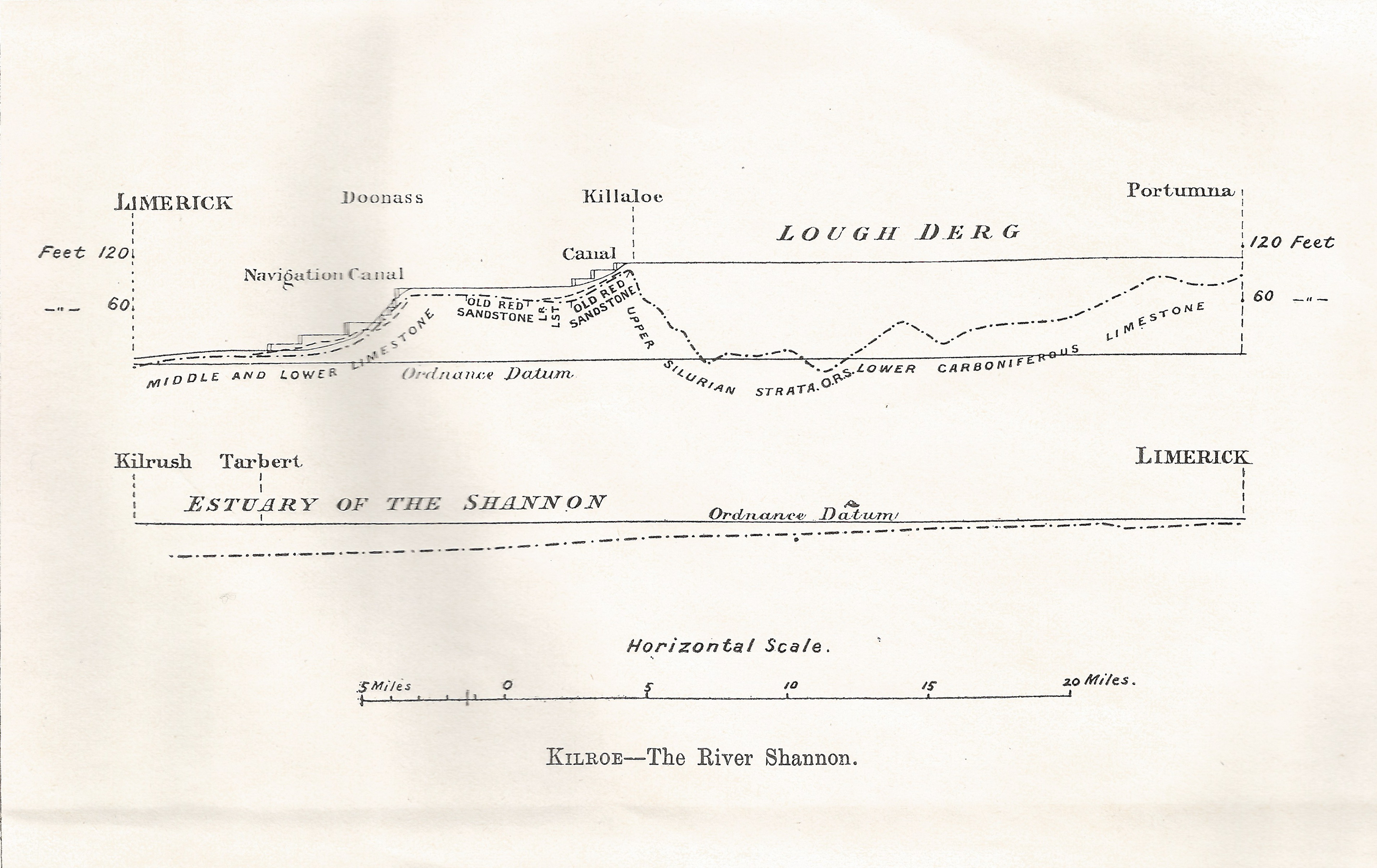
On 28 January 1907 James Robinson Kilroe [near the bottom of the page] of H M Geological Survey read to the Royal Irish Academy a paper on “The River Shannon: its present course and geological history” [Proceedings of the Royal Irish Academy Vol XXVI Section B No 8 Hodges, Figgis & Co Ltd, Dublin; Williams & Norgate, London 1907]. I thought that Plate V was interesting.

Shannon Derg to sea

Plate V

Kilroe wrote:

It will be perceived that instead of the river being shallow over the unyielding Silurian slate-rock, set almost vertically, and striking across the river-course, it is deeper than over the limestone of Lough Derg, and much deeper than over the comparatively easily eroded Old Red Sandstone at Killaloe. The river-bed actually drops below the datum line above the town, while at the town it is 100 feet above datum.

Old Red Sandstone strata are here to be seen in the river-bank, and Silurian rocks in situ in its bed. A barrier is thus formed, partly of Silurian, and partly of Old Red Sandstone rocks, which without the artificial impounding weir would retain the waters of Lough Derg to a depth of some 104 feet opposite Derrycastle — two miles above Killaloe.

One might have expected to find a fairly level shallow bed from Killaloe northward, a sudden drop from slate-rock to the sandstone floor, and  a pronounced wide, well-formed valley in the limestone district southward to Limerick.

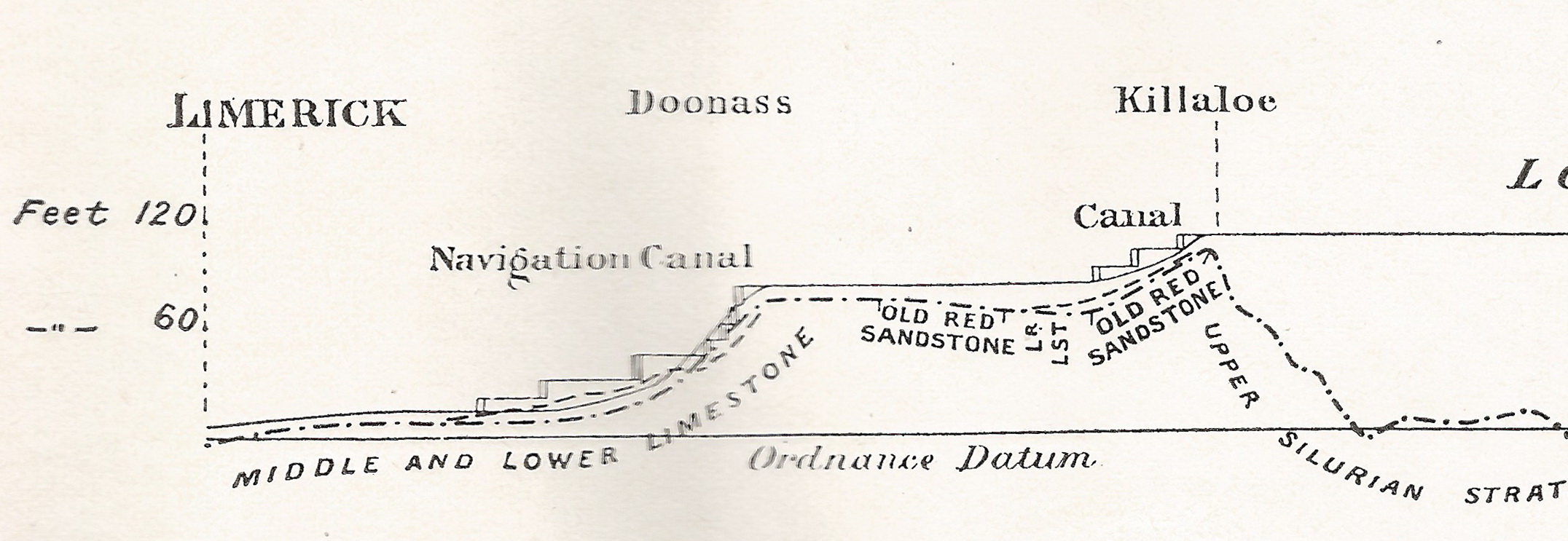
None of these elements exist; instead, we have the formidable barrier at Killaloe, naturally damming up a considerable depth of water in Lough Derg, and the river falling away southward by a series of rapids which correspond with drops in the canal, south of O’Briensbridge […], along an alternative course, possibly one used by a branch of the Shannon.

Here is an extract from the Plate V map, showing the steps of the (pre-Ardnacrusha) Limerick Navigation between Lough Derg and the sea.

Shannon Killaloe to Limerick

The steps of the canal (click to enlarge)

Upstream

Kilroe wrote of Lough Ree:

The waters of Lough Ree stood some 10 feet higher within recent times than they now do, as proved by evidence of solution, with under-cutting of limestone blocks, to be seen about five miles north-west of Athlone, close to the railway, in the townland of Cornaseer.

Under these conditions the lake must have been, perhaps, twice its width, and for a considerable period. Its ancient surface-level is clearly indicated by the caps of the mushroom-shaped blocks.

And of the Shannon between Lough Ree and Lough Derg:

The extreme flatness of the river between Athlone and Meelick is such that, consequent upon the completion of the Suck Drainage-works in 1892, it was found that the callows along the Shannon above the confluence of the Suck at Shannonbridge were much more liable to sudden and frequent floodings than they previously had been.

The more rapid discharge of the Suck waters into the Shannon, before ordinary extra water had time to pass away, had the effect of modifying the regimen of the main stream to an extent which resulted in an action at law [La Touche -v- The Suck Drainage Board].

I have found only one account of that case, in the Freeman’s Journal of 1 July 1893. The plaintiffs, Messrs Harrison and La Touche, owned land at Cappaleitrim, on the west bank of the Shannon above Shannonbridge. They said that the actions of the Suck Drainage Board had caused their lands to be flooded:

[…] that the defendants brought water from the Suck into the Shannon, containing a drainage of 40 miles, with such velocity and such volume that the Shannon was penned back, and that the back water caused the damage to the lands complained of.

[…] The jury disagreed and were discharged.

I don’t know whether the matter ever again came before a judge.

Royal Canal drawbridge

According to the Freeman’s Journal of 5 April 1837, Henry Garnett was

superintendent or agent to the èxtensive and highly respectable firm of Purcell and Jameson, coach proprietors.

Their offices were in Sackville Street. On Sunday 2 April 1837 Mr Garnett had been on his way home to [Royal] Canal Terrace when

as he ascended the hill at the bend of Upper Dominick-street he met a man habited in a dark cloak, and having a cap on his head, who, after looking him steadfastly in the face, opened the cloak, and fired at him.

The man was not more than a yard away, so close that the powder scorched Garnett’s hand, but the bullet struck a suspender button, wounding but not killing the victim.

The scene of the crime

The scene of the crime [OSI ~1840]

William Cagburn heard the shot and also heard Garnett calling out

I am shot — stop the murderer, he has run in the direction of the aqueduct.

Cagburn gave chase:

He instantly pursued, crossed the draw-bridge, and came under the aqueduct, when he saw the prisoner running along the Phibsborough road.

Cagburn and the watchman seized the man; the watchman took two pistols from him and another witness found a third, discharged, pistol nearby on the pathway.

The prisoner, Christopher Clanchy, had been a road maker for eight years. The Freeman’s Journal said:

While a contractor for repairing part of the Ashbourne road, in the employment of Messrs Bourne, he [Clanchy] was allowed to travel free by Mr Purcell’s coaches, and Mr Garnett in the discharge of his duty having occasion to withdraw this privilege, hence proceeding his desire to be revenged. […] We are happy to state Mr Garnett is not likely to suffer any inconvenience from the injury.

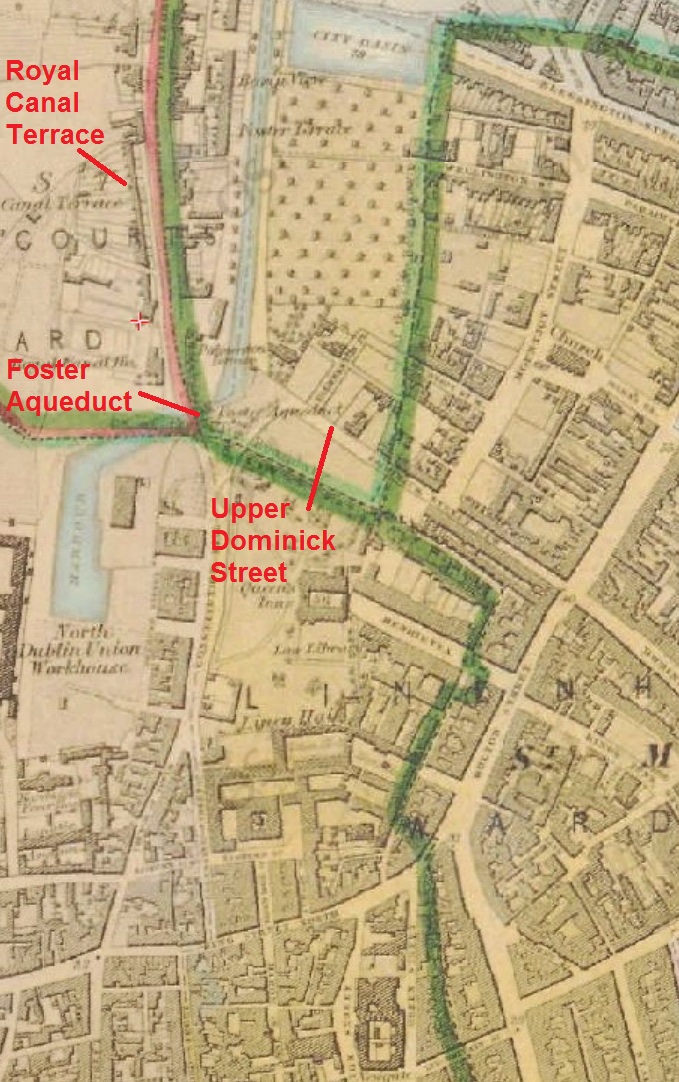
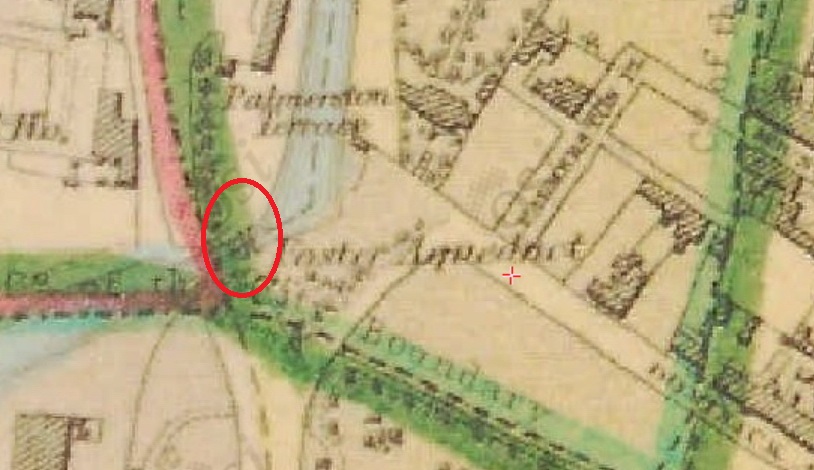
But of more interest for this site is the route taken by William Cagburn. What or where was the drawbridge he crossed?

Foster Aqueduct

Upper Dominick Street and the Foster Aqueduct [OSI ~1840]

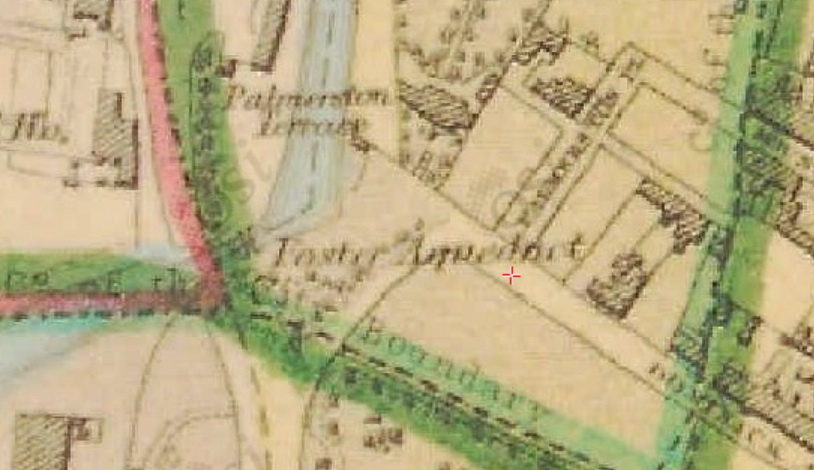
I haven’t come across [or at least I haven’t noticed] any previous mention of a drawbridge in this area. I presume that it was across the canal. And, looking closely at the map extract above …

Possible site of drawbridge

Possible drawbridge [OSI ~1840]

… I see what might be a bridge just to the left of the F of Foster. It shows up more clearly on the black and white OSI map. At Clanchy’s trial before the Commission of Oyer and Terminer, reported in the Freeman’s Journal of Monday 26 June 1837, the bridge was said to be a wooden bridge; George Cayburn [probably the William Cagburn named in the earlier report] described it as “the swinging bridge”.

Perhaps Mallet’s Insistent Pontoon merely replaced an old nuisance with a new.

Clanchy, incidentally, was found guilty: there were suggestions that he was insane, but the jury rejected them. Baron Richards said [Freeman’s Journal 1 July 1837]

The court had no discretion but to pass the extreme sentence of the law, that he should be hanged by the neck […].

Purcell, Garnett’s employer, had requested a commutation of his sentence; Richards said that it was open to Clanchy to memorial for a commutation, and the court would put no obstacle in his way; indeed it hoped he would meet the mercy “which he would have denied his intended victim”. I do not know what happened to Clanchy.

Update December 2016

The Warder and Dublin Weekly Mail of 26 September 1835 mentions the bridge:

Monday night a respectable looking elderly man fell into the Royal Canal Basin, at the Broadstone, on the Dominick-street side, within a few yards of the draw bridge.

A canal employee called Keybourne hauled Mr White out within a few minutes, but he was DOA at the Richmond Hospital.

This seems to confirm that the bridge was moveable and was where the OSI map suggests.

From the BNA

My OSI logo and permit number for website