Category Archives: Sources

Survey problems

Back in the dark ages, some unfortunate folk tried to teach me about Statistics, which included how statistical surveys should be conducted. Some snippets of information, perhaps misremembered or misunderstood, came back to me as I read Waterways Ireland’s press release about its research into the contribution of boating to the economy and as I attempted to complete its online questionnaire.

WI commissioned a similar survey in November 2005 (with the results being published in 2006). That survey was carried out on WI’s behalf by the Tourism Research Centre at Dublin Institute of Technology [about whose current status I can find little information]. The TRC folk posted questionnaires to the 6682 boat-owners registered with WI; 54 respondents said that the questionnaire was no longer relevant to them so the population was reduced to 6628. Owners returned 718 questionnaires; 14 were excluded as being incomplete so the 704 were analysed, a valid response rate of 11%.

Participation

The current survey is online. It is said to be “open to all boat owners on Ireland’s inland waterways” but there is no way of restricting participation. Question 1 is “Are you a Boat Owner?” It does not specify that the boat has to be on Irish inland waterways run by Waterways Ireland. However, answering No brings up a page stating, inter alia, “This survey is solely for owners of craft on the inland navigational waterways.”

There is nothing to stop truthful people who own boats on other waterways from participating. There is nothing to stop liars who don’t own boats from participating. There is nothing to stop people from participating twice, or even more often, as long as they delete cookies after each session; that makes the survey open to manipulation by evil-minded interest groups.

And, most significantly, there is no way of assessing whether the average expenditures to be reported by the survey are in any way representative of the amounts actually spent by the body of boat-owners on Irish inland waterways. All that can be said is that the reported results will represent what some people, who may or may not be owners of boats on WI’s inland waterways, said about their spending.

Initial Questions

According to the press release

The survey should take 10-12 minutes to complete.

That may be so if you happen to have all your financial records to hand and if your classification happens to coincide with that used by Waterways Ireland. It took me considerably longer than that, even though my records are all in an Excel spreadsheet. There is no provision for saving your answers and returning to complete them later.

Furthermore, I cheated: the survey asks about spending “between August 2013 to August 2014”; I had figures for y/e 31 December 2013 so I used those.

Q2 asks about gangs whereof you might be a member and Q3 about your three favourite waterways activities; I think you can get away with listing only two, but not only one. Q4 asks “Do you own your own craft outright or shared?” but does not distinguish between sharing with a spouse (or other close family member), sharing with friends and sharing via a commercial syndicate (if there are any: it would be interesting to know).

The next page has five questions: whether you bought your boat new or secondhand (Q5), when you bought it (Q6), how long (in months) you expect to keep it before buying another (Q7), the cost in euro (Q8: I don’t know whether, if you log in from NI, you can answer in sterling) and the number of days each year you spend boating (Q9).

I had difficulty with QQ6 and 7. Q6, for some reason, insists on your entering the day, month and year in which you bought the boat. I know the year, I’m pretty sure of the month but I have no idea of the day. Q7 assumes that you are going to sell your boat: there is no provision for saying “I don’t intend to [or have no plans to] sell it”. I thought I’d get around the problem by saying “ten years”, which meant entering 120, but the survey rejected that, whereas it accepted 99 (and, on later trials, accepted 100). My answer to Q7 is thus inaccurate because the question is badly designed.

That lot is more or less equivalent to QQ 1, 2, 3, 4, 9 and 10 on the 2005 survey.

One other feature of the survey is that error messaages appear in red between two questions; at first you have to guess which answer the system dislikes. And the message I got for entering too large a number for Q7 …

The comment you entered is in an invalid format.

… is not at all helpful: you have to guess what you are to do in response.

Expenditure questions

The next page has the detailed questions on expenditure; they are almost, but not quite, the same as those used in 2005. While that might allow comparison (were it not that the two surveys might be completed by non-comparable groups), some of the initial questions were so idiotic that they should have been dropped. I can’t imagine that anyone other than Ebenezer Scrooge would record a year’s spending on “Sweets/snacks” bought while on board. But there is no provision for showing that you have no records for a particular category: all you can do is record expenditure of 0.

The authors of the report on the 2005 survey said:

Another limitation is that respondents were asked to recall expenditure over a  twelve-month period, which is difficult to do accurately unless precise records are kept during the reference period and this leads to figures based on estimates. One way to address this issue in future studies and to ensure more detailed record keeping in future studies is to introduce an ‘Expenditure Diary’ for Waterways Ireland registered boat owners to track their expenditure.

I suspect that would not have been welcomed but the problem has not, as far as I can see, been addressed in any other way, apart from this instruction at the top of the page:

Please detail all expenditure for the last 12 months only, please ensure all expenditure, including credit card and cash payments.Where the exact value is not known,please give as close an estimate as possible and state clearly that it is just an estimate.

However, if you try to enter anything other than a numeric value (eg “Estimate”) in any of the fields for QQ10 and 12, you get this:

Please enter a positive number.

The questions are grouped in two major categories: Regular Expenditure and Irregular Expenditure. The latter provides for the purchase of a boat but it does not provide for improvements more significant than maintenance (which is under Regular). For instance, if you happen to have added three and a half tons of ballast, there is no suitable category for recording the expenditure.

Here, in flagrant breach of WI’s copyright, but in the interests of allowing folk to prepare their answers, are the expenditure questions.

10. Regular Expenditure (August 2013- August 2014)

Regular Expenditure (August 2013- August 2014)
Mooring Rental (per annum)
Insurance
Fuel
Winter Moorings
Maintenance (to include parts,repairs,servicing,paint.etc)
Equipment (Life Saving Appliances, Fire Extinguishers, Mooring lines etc)
Annual membership fees
Smart Cards
Permits
Lock Passes
Other

11. Please specify equipment purchased/or other expenses
12. Irregular Expenditure (August 2013- August 2014)

Purchase of craft/boat ( within the last 12 months)
Training
Navigational publications – charts, guide, GPS
Hire of boat (if applicable)
Internal transport cost associated with boating
Accommodation while using the waterways
Food in bars and restaurants while using the waterways
Drink in bars and restaurants while using the waterways
Shopping(food) – on board
Shopping(drink)- on board
Newspapers/magazines
Clothing associated with boating
Sweets/snacks
Souvenirs/crafts
Other purchases associated with boating (please detail below)

13. Please specify other expenses

There is some upper limit to the values you can enter in the fields for QQ10 and 12, but I haven’t discovered what it is.

Trips

If you survive that lot, you get asked about your trips.

14. How many boating trips do you take each year?
15. Average number of days spent on each boating trip?
16. Last Boating Trip

What waterway was visited:
How much did you spend on your last boating trip on Ireland’s Inland Waterways(euro):
Number of nights spent on your last boating trip:
Number of people in your party:
Adults:
Children:

17. 2nd most recent boating trip

[same questions][

18. 3rd most recent boating trip

[same questions]

19. Which of the above 3 boating trips was most typical/most accurately reflect your spending patterns?

There is a minor difficulty in that it is assumed that the same number of people was on board throughout. What I see as a more significant problem is that, for those who take their annual holidays “on Ireland’s Inland Waterways”, at this time of year the three most recent boating trips might include (say) a fortnight’s holiday, a weekend and a bank holiday weekend. Only the non-bank-holiday weekend is likely to be typical of trips within the year, but all three might be regular annual events. It is difficult to get that across in answer to Q19.

There seems to be no data validation on that page: ridiculous numbers are accepted, as are waterways that are not run by WI.

The rest

On the next page, QQ20, 21 and 22 ask about age, gender and personal status. Then, on the last, you can (but are not forced to) give your name and email address if you want a copy of the survey results or to get WI mailings.

The value of the survey

I am all in favour of gathering and publishing information. And I appreciate both the difficulty of doing so at low cost and the desirability of maintaining some sort of comparability with the earlier survey. But it seems to me that this survey is seriously flawed: the design of the questionnaire, the restrictions on the answers and the impossibility of drawing any reliable conclusions about the body of inland boat-owners are weaknesses that undermine the value of the exercise.

Having been one of the victims interviewees for WI’s other information-gathering exercise, the Survey of Waterways Users 2010 [PDF], I had reservations about that too, but the method might offer more control and, with better questionnaire design [tested on actual owners], might be applied to the “Economic Contribution” survey as well as to the user survey.
 

Sliabh Aughty Furnace Festival

I don’t know how many people are aware that there were once extensive ironworks [which used water transport] along the lower western shore of Lough Derg and in the foothills of Sliabh Aughty. The existence of a townland called Furnace, near Whitegate, might be a clue, I suppose. Ger Madden had an article on “The Iron Works of Sliabh Aughty” in Sliabh Aughty: East Clare Heritage Journal No 7 [1997]; he told me the other day that the works burned an acre of oak every day during the season. That bears out what J H Andrews said in “Notes on the Historical Geography of the Irish Iron Industry” [Irish Geography: bulletin of the Geographical Society of Ireland Vol III No 3 1956]:
[…] the Irish woods were exploited [for charcoal] with an extravagant disregard for the future supply position, although at first the conversion of woodland to permanent pasture could have been justified in many cases as a rational long-term economic decision. […] [Cpppicing was] never adopted in Ireland, even by such enlightened land owners as Sir William Petty, so that even a small forge or furnace could despoil its woods at an alarming rate.

Ger and others in Mountshannon have now organised the Sliabh Aughty Furnace Festival, to be held in Mountshannon on 20 and 21 September 2013. The leaflet says:

In the 17th and 18th century, the western shores of Lough Derg were the setting for an intensive iron industry. Although little known, it has left many traces in the landscape and various archives.

The Sliabh Aughty Furnace Project is hoping to safeguard these monuments for the future, research the history and develop the story as a touristic attraction. […]

The festival caters both for those with a deep interest in the subject and for those who might like a lighter approach. For the first group, there is a series of talks in the Mountshannon Hotel, running from 1030 to 1630 (with an hour for lunch):

1030 Paul Rondelez “Iron production in the Sliabh Aughty mountains”
1100 Mary Sleeman “Heritage and the law”
1200 Gerard Madden “The Emmerton Papers” [an archive with valuable
information about the Clare ironworks]
1230 Professor Audrey Horning “Archaeology and early industry in Ireland and
the Americas” [yes, there is a direct link]
1400 Dr Colin Rynne “Industry on the Shannon”
1430 Dr Christy Cuniffe “An elusive foundry in the Slieve Aughty foothills: the
work of T Clarke”
1530 Sean Spellissy “Expanding on Slieve Aughty”
1600 Ewelina Rondelez “The Sliabh Aughty Furnace Project”

The Aistear Iniscealtra Park [the maze] will have events including blacksmithing, charcoal production, a living history tent, sword-fighting demonstrations, 17th century games, a knitting demonstration, an exhibition on the ironworks, stalls with local produce and a barbecue.

All of that for €10 (adult rate; under-16s €5, toddlers free).

On the Sunday there is a guided tour of the remaining furnaces, leaving the harbour at 10.30am: free if you use your own transport, €20 by bus.

There is a website here with full details including information about accommodation in the area.


Luddite loons

I have commented from time to time on the reluctance of some Irish folk to move beyond the technologies of the eighteenth century. Thus we find Shinners wanting canals all over the place and folk in Leitrim determined that, if Ireland has oil and gas, they must never be used. [That’s the Leitrim that had both a coal and an iron industry, by the way, as well as hydroelectricity, railways, a brickworks and a dockyard, to name but a few industries that come to mind.]

The latest target of the ire of the Luddites is that newfangled invention, the bicycle. Waterways Ireland might like to provide for folk to cycle along the trackway on the Barrow Navigation; some folk want to keep the dreaded bicycle, and presumably its Lycra-clad users, away from the trackway along which they like to walk.

Happily, some sane folk have written letters to the blatts and IndustrialHeritageIreland has a sensible comment.

I presume that the Luddites insist that the grass be cut using scythes, thus creating much local employment.

Where do correct ideas come from?

Where do correct ideas come from? Do they drop from the skies? No. Are they innate in the mind? No. They come from social practice, and from it alone; they come from three kinds of social practice, the struggle for production, the class struggle and scientific experiment.

Readers will not, I am sure, need to be reminded that those are the words of the late Comrade Mao Tse-tung [or Mao Zedong, as the younger comrades say] in the Draft Decision of the Central Committee of the Chinese Communist Party on Certain Problems in Our Present Rural Work of May 1963.

Maurice Semple, in By the Corribside [self-published, 1981], lists writers who, from 1868 onwards, agreed with the view of the Cong Canal expressed by Sir William Wilde:

[…] for it was discovered, that like many other undertakings, the great canal at Cong “would not hold water.”

Those writers’ view is echoed by local people, and even by engineers, to the present day. Their case is, in effect, that the Board of Works engineers did not know what they were doing or did not properly survey the ground and were therefore surprised to find, on admitting water to the bed of the canal, that it vanished into sinkholes or swallow-holes in the karst.

One oddity about that belief is that the Cong Canal does actually hold water: it is full in winter, as the photos on this page, taken in February 2013, clearly show. It is empty in summer, but that is because water is unable to get in at the upper end, not (I suggest) because it flows out through the bottom.

What interests me at the moment is that I can find no evidence to support Wilde’s contention. Samuel Roberts, the engineer in charge of the work, knew that the work would be difficult but there is no hint in any of his annual reports that he feared that the difficulties might be insuperable. Furthermore, it is clear from his own reports and from other evidence that he was ordered to cease work on the navigation aspects of the canal before it was finished: there was never a moment when water was admitted to a completed navigation canal.

I have not been able to find any report from the 1850s in the Freeman’s Journal, the Cork Examiner, the Dublin Evening Mail or the Belfast News-Letter, or in any British newspaper, that supports William Wilde’s account of events. What, then, is its basis?

Of course my inability to find evidence does not mean that it doesn’t exist, but I would be grateful if anyone could point me towards it. I should say that I do not regard later accounts, like Wilde’s, as valid unless they include some evidence from 1854, the year of which Roberts wrote

The masonry in the Cong lock was commenced in March, and was progressing rapidly when I received instructions from the Board, in April, to suspend the execution of all navigation works in this division of the district, and complete only such as were necessary for the regulation of the waters of Lough Mask, for drainage purposes.

What I am looking for is an eyewitness, an official or some other reliable account, from 1854, that says “the canal was completed; water was let in; it vanished, to the surprise of the engineers”. If no such account exists, I may be forced to conclude that Wilde’s style of work is opposed to the fundamental spirit of Marxism-Leninism. As the Great Helmsman put it in the Little Red Book:

To behave like “a blindfolded man catching sparrows”, or “a blind man groping for fish”, to be crude and careless, to indulge in verbiage, to rest content with a smattering of knowledge — such is the extremely bad style of work that still exists among many comrades in our Party, a style utterly opposed to the fundamental spirit of Marxism-Leninism. Marx, Engels, Lenin and Stalin have taught us that it is necessary to study conditions conscientiously and to proceed from objective reality and not from subjective wishes; but many of our comrades act in direct violation of this truth.


Archives workshop: a reminder

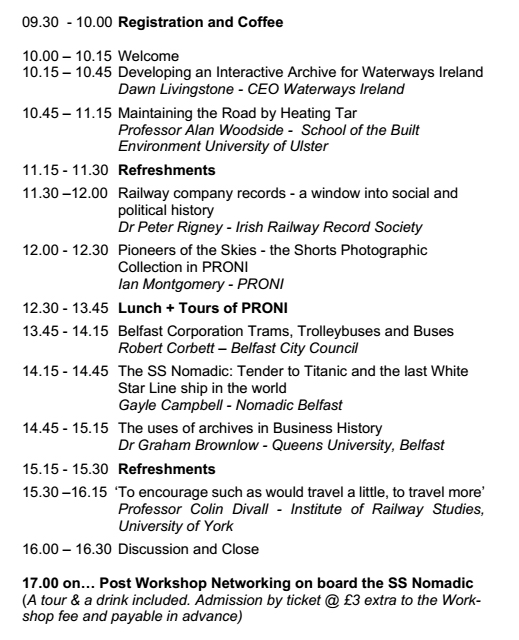
I mentioned, back in April, that an interesting-looking workshop is scheduled for Belfast on 8 September 2014. It’s being held in the Public Record Office of Northern Ireland [PRONI] in the Titanic Quarter and there’s an optional extra tour and reception on the SS Nomadic afterwards. This post is a reminder.

The programme covers waterways, roads, railways and flight. For this site, the opening session is of great interest: Dawn Livingstone, CEO of Waterways Ireland, is to talk about an interactive archive for Waterways Ireland.

By air, sea and land

By air, sea and land

The workshop is being organised for PRONI by A²SN, the Archives and Artefacts Study Network, supported by the Historical Model Railway Society, the Business Archives Council and the Postal History Society.

The [two-page PDF] brochure is downloadable here PRONI transport archives workshop. The workshop fee is £20/€25 with an extra £3/€3.50 for the SS Nomadic visit. Sterling cheques are accepted; there is provision for paying in euro by online banking.


The abandonment of the Cong Canal

I am speaking tomorrow, 23 August 2014, at Lough Mask School House’s Heritage Day about the history of the Cong Canal.

Apart from an overview of the initial proposal, the construction and the current state of the canal, I intend to present what I think is an entirely new explanation for its abandonment before completion. At least, it’s an explanation that I have not seen published elsewhere.

Ballinasloe footbridge

Here is a new page with a brief account of the Ballinasloe Line of the Grand Canal and some photos of a footbridge that seems to have been built across it in the twentieth century.

Salmon

In my youth, I tried angling once or twice, but with no success: the only time I ever caught fish was with mackerel feathers. So, despite having read Isaak Walton (several times), angling doesn’t really interest me. But it’s hard to read this without accepting that Something Must Be Done, whatever it is. Note, in particular, Dudley Mallett’s comment.

Effin mensuration

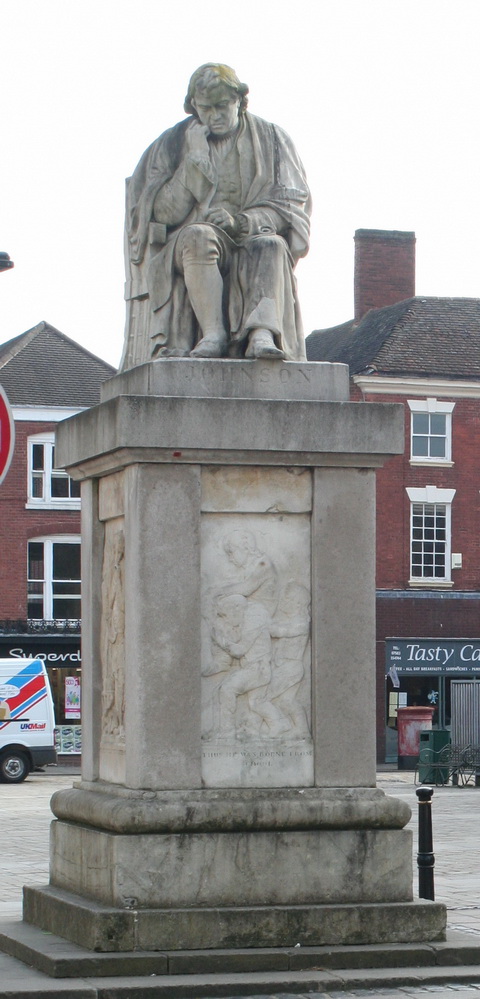
Statue of Dr Johnson near his birthplace in Lichfield

Statue of Dr Johnson near his birthplace in Lichfield

The learned readers of this site will not need to be reminded of the sapient advice of the late Dr Samuel Johnson:

[…] no man should travel unprovided with instruments for taking heights and distances.

There is yet another cause of errour not always easily surmounted, though more dangerous to the veracity of itinerary narratives, than imperfect mensuration. An observer deeply impressed by any remarkable spectacle, does not suppose, that the traces will soon vanish from his mind, and having commonly no great convenience for writing, defers the description to a time of more leisure, and better accommodation. […]

To this dilatory notation must be imputed the false relations of travellers, where there is no imaginable motive to deceive.

Samuel Johnson A Journey to the Western Islands of Scotland W Strahan and T Cadell 1775

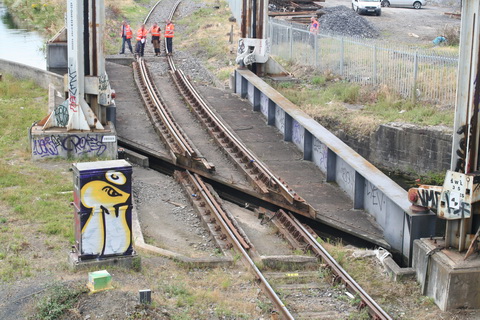
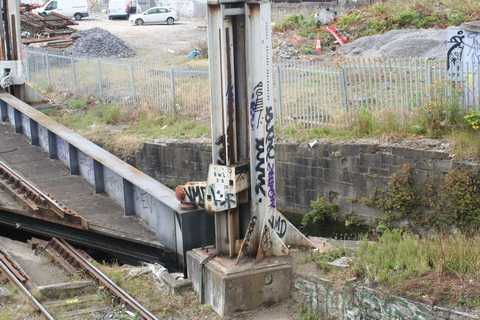
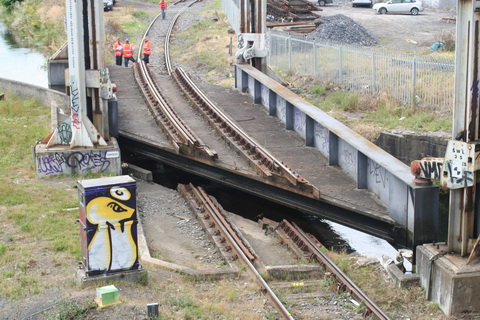
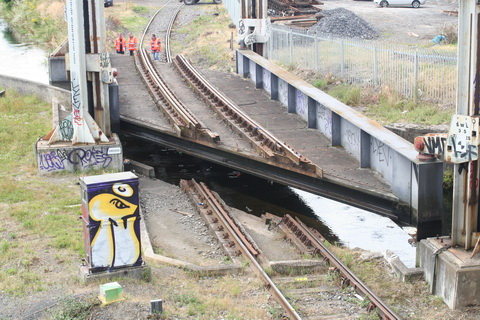
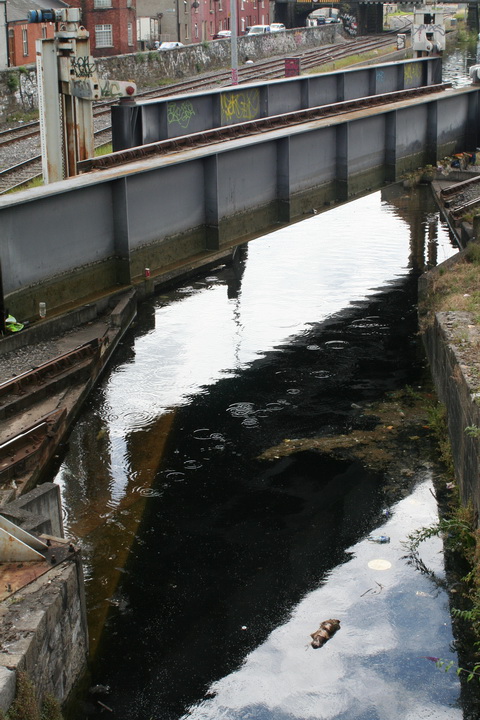
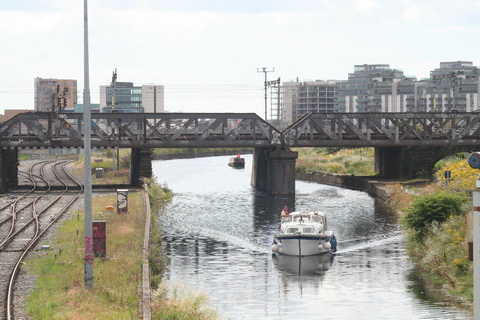
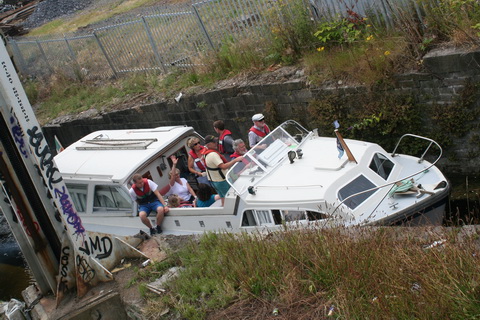
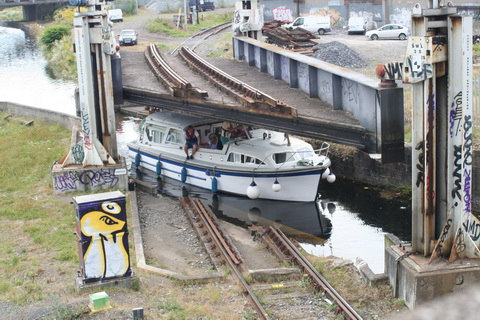
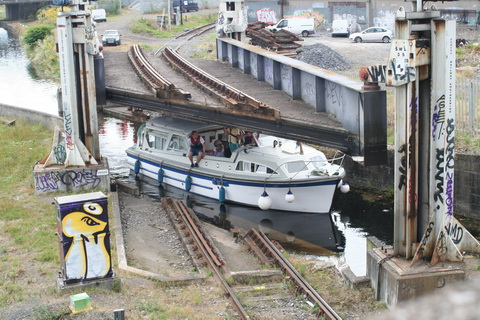
The good doctor would, I think, have welcomed the invention of the digital camera with inbuild chronometer. Equipped with just such a device I arrived yesterday at the first lock on the Royal Canal to witness the lifting of the railway bridge and the passage thereunder of fleets of boats. I thought it would be interesting to record how long each stage took.

I have written before about this bridge: reporting a question by Maureen O’Sullivan TD in October 2013 and another in November 2013 and providing statistics on usage a few days later:

  • only 58 boats went through in 2013
  • the bridge was lifted on seven dates
  • two other scheduled lifts were cancelled as no boats wanted to travel
  • Irish Rail charged Waterways Ireland €1200 per weekday lift and €2000 per weekend lift.

The first 45 minutes

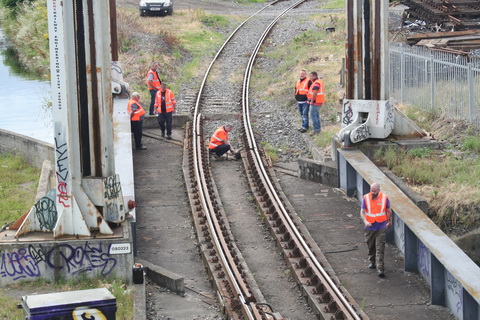
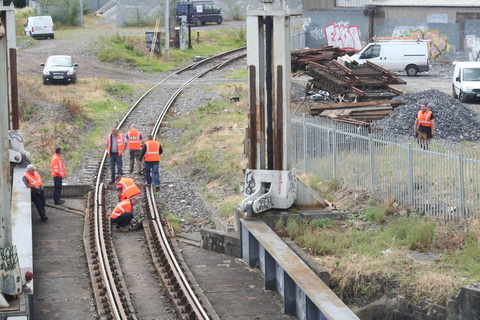
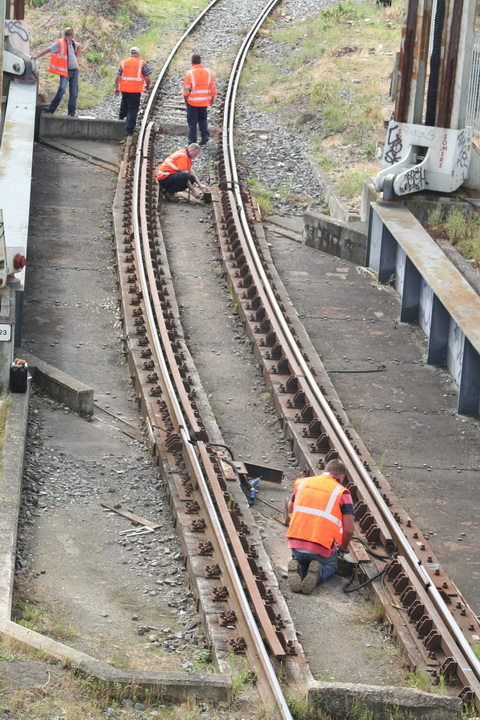
A lift scheduled for early July 2014 was cancelled; yesterday’s lift catered for just two boats, whose passage was assisted or monitored by eight Irish Rail staff and four from Waterways Ireland. Four of the Irish Rail people may have been in training as others seemed to be demonstrating things to them, but that’s only a guess. Three of the WI staff travelled together in WI’s stealth van and operated the first lock; the other, who travelled separately in a 4WD vehicle, visited from time to time. As far as I could see there was no contact between the Irish Rail and WI teams.

The bridge was scheduled to be lifted by 1100.

Before the lift 0945

Before the lift: 0945. The lifting bridge is on the right of the photo

Before the lift 0946

One minute later: 0946. A separate group of workers, perhaps contractors, is going down the west side of Spencer Dock with equipment

Before the lift 0949

Four men still on the bridge 0949

Before the lift 0951

Two minutes later

Before the lift 0956

On the bridge 0956

Before the lift 0958

Still there 0958

Before the lift 0959

One minute later

Before the lift 1006

The bridge 1006

Before the lift 1012

The bridge 1012

Before the lift 1015

The bridge 1015: another person approaches

Before the lift 1020

Six men at the bridge at 1020

Before the lift 1028

A seventh man approaches at 1028

Preparing to lift

The preparation stage, presumably involving the unlocking of some mechanism, took about five minutes altogether.

Preparing the bridge 5 mins 03_resize

One man worked on the far end while another walked to do the same at the near end

Preparing the bridge 5 mins 06_resize

An eighth man, behind the fence on the right, seemed to summon two of the men on the bridge

Preparing the bridge 5 mins 14_resize

They went to this building, which I guess houses the controls for the bridge

Preparing the bridge 5 mins 15_resize

Meanwhile work continued on the bridge itself

Preparing the bridge 5 mins 19_resize

Almost done

Preparing the bridge 5 mins 22_resize

A final check

Preparing the bridge 5 mins 25_resize

Everybody was off the bridge by 1033

Lifting

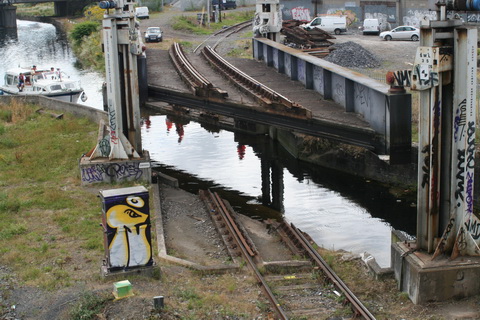
The lift itself took just over nine minutes; the bridge was up before 1044, in good time for the arrival of the boats.

The lift 9 mins 02_resize

After about one minute

The lift 9 mins 08_resize

Another minute later

The lift 9 mins 11_resize

Another minute (or so)

The lift 9 mins 15_resize

About four minutes have elapsed

The lift 9 mins 18_resize

After five minutes. The sides are clear of the water in which they usually rest; they are dripping on to the canal below

The lift 9 mins 20_resize

Six minutes in

The lift 9 mins 23_resize

Seven minutes

The lift 9 mins 24_resize

The men behind the fence may be controlling the lift

The lift 9 mins 28_resize

Not much further to go

The lift 9 mins 32_resize

Eight minutes

The lift 9 mins 40_resize

It’s up

The bridge up 16_resize

One of the jacks

After the boats passed_resize

Side view (taken after the boats had gone through)

The bridge up 13_resize

Water under the bridge

Boats go through

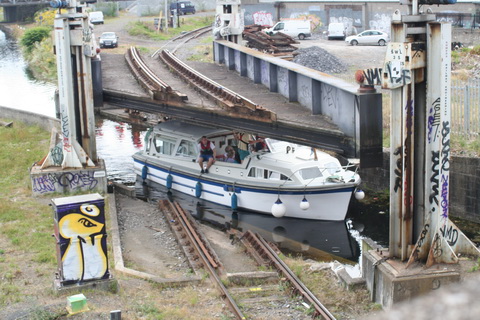
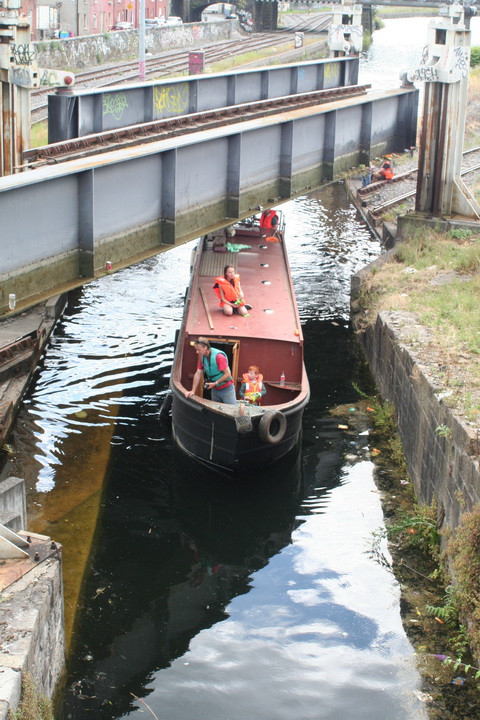
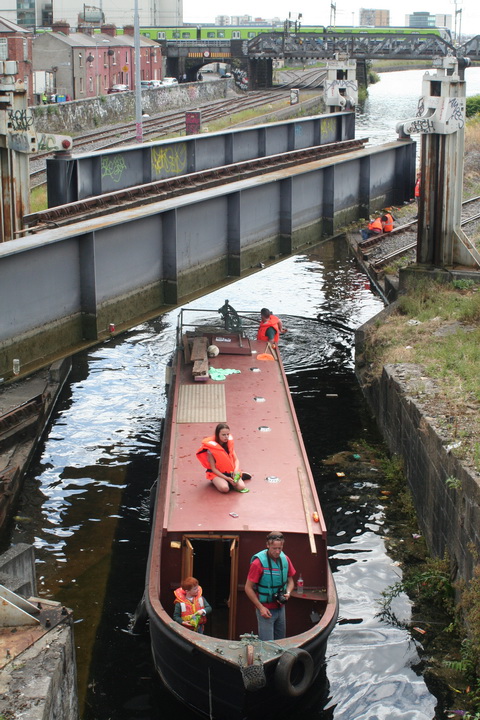
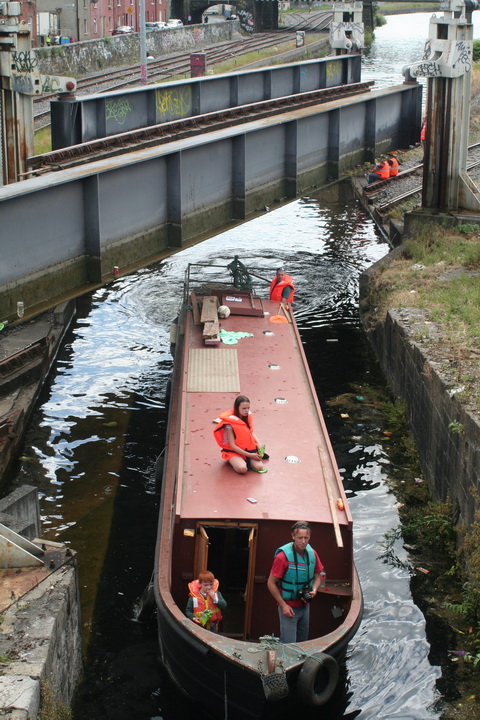
It took just over three minutes for the two boats to go under the bridge.

Boats approach 12_resize

Cruiser approaches; steel boat visible through the bridge

Cruiser goes through 03_resize

Cruiser about to enter

Cruiser goes through 04_resize

Heads down

Cruiser goes through 06_resize

Half way through

Cruiser goes through 07_resize

Leaving

Cruiser goes through 08_resize

Out

Steel boat goes through 12_resize

Steel boat entering

Steel boat goes through 20_resize

Almost through

Steel boat goes through 22_resize

Looking ahead to the lock

Steel boat goes through 25_resize

Done


I did not record the lowering of the bridge, which I presume took much the same time as the raising.

Preparation 5 minutes, lifting 9 minutes, passage 3 minutes, lowering and locking say another 14 minutes: say 45 minutes altogether, allowing some margin. But a large number of boats would take much longer as the rate at which they could move on from the bridge would be limited by the time taken to work through the lock.


The buoys of the lough

Waterways Ireland’s proposed new moorings on Lough Erne. Note that the links at the bottom of the page [which do not include this or this] are to PDFs.

The “heaviest cruisers”, eh? Hmph. And “egress” is not the mot juste. But let us not carp: perhaps the idea will, in time, be applied on some southron waterways too.