Category Archives: Tourism

Waterways Ireland and Erne Bye-laws

Waterways Ireland gets slightly tougher. Basil McCrea will be disappointed.
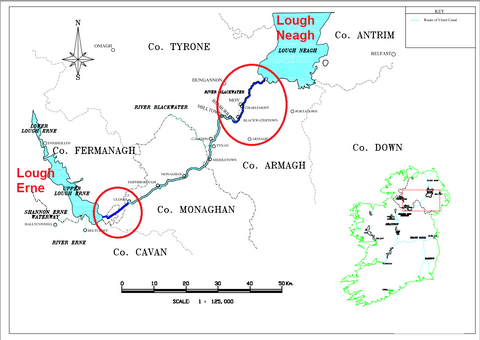
Shagging the Shannon to shovel the sheugh

On 24 February 2015, the Irish Times published an article headed

First stage of Ulster Canal restoration due to begin in April
Some €2m will be spent on a section of the Shannon-Erne waterway

It ended with these sentences:

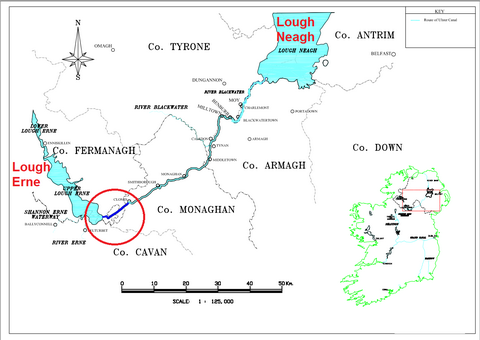
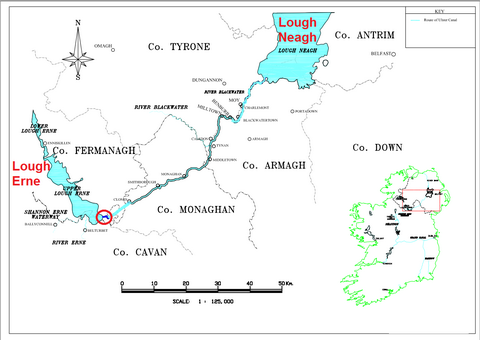
The €2 million will be drawn from the funds of Waterways Ireland, a north-south implementation body. It will carry out the dredging of a 2km section of the Erne river and the construction of a new navigation arch at Derrykerrib Bridge to accommodate boat traffic, with a target completion date of April 2016.

It may be that the Irish Times doesn’t know very much about waterways. If it did, it might have been aware that, on 18 December 2014, the North South Ministerial Council approved Waterways Ireland’s Business Plan 2015, which included this Action:

3.6 Progress the restoration of the Ulster Canal on an incremental basis. €1,000

So on 18 December 2014 the North South Ministerial Council — which for all practical waterways purposes consists of Heather Humphreys, the southern minister for waterways and other stuff, and Carál Ní Chuilín, her northern counterpart — approved the allocation of €1,000 to the Ulster Canal in Waterways Ireland’s 2015 plan. Yet, just over two months later, they expect Waterways Ireland to spend about €2 million on the blasted thing, about €1.5 million of it in 2015.

The southern government’s party of treasure-seekers seems to have disappeared entirely: at any rate it doesn’t seem to have found any money. And the two ministers’ departments have presided over successive years of cuts in Waterways Ireland’s current and capital budgets, cuts whose effect has been worsened by the woefully inadequate provision for an ever-increasing pensions bill. Waterways Ireland’s Corporate Plan 2014–2016 shows a cumulative increase of €984,000 in pension costs over the period of the plan, which wipes out a lot of savings in other areas.

I suppose that curiosity is a weakness in journalism. Were it not so, two questions might have struck the Irish Times:

  • how is Waterways Ireland to come up with €2 million out of an ever-decreasing budget?
  • why has Waterways Ireland’s Business Plan been so violently disrupted only two months after it was approved? The €2 million is half WI’s total capital budget spending in for the republic in 2015; it will be recalled that the republic, in a fit of more than usually nitwitted arrogance, undertook to pay for a canal to Clones, which is what the powers-that-be are pretending Saunderson’s Sheugh is.

I can answer the first question, at least for 2015, during which WI expects to spend €1,416,000:

  • €166,000 will come from Heather Humphreys’s department
  • €900,000 will (WI hopes) come from the sale of property assets
  • €150,000 will come from the postponement of an IT programme
  • €220,000 will come from the postponement of non-navigation works on the Shannon
  • €90,000 will come from postponing development of the Barrow Blueway.

I don’t know what property assets WI can sell to bring in the requsite amount. It seems that damage to everyday navigation has been avoided, but the Shannon and the Barrow are to suffer to pay for dredging a river that merely provides a small extension of the Erne navigation.

As for the second question, I suspect that Sinn Féin put a gun to someone’s head: “We’re fed up waiting for our sheugh. Start digging or the baby gets it.” The baby might have been Heather Humphreys’s Dáil seat or it might have been something more important. And the gun was, I suspect, a message accompanying the “business case” prepared by the northern department and sent to the southern. [I have asked both departments for copies and other information.]

Arthur Aughey, then lecturer in politics at the University of Ulster, wrote in Magill magazine in February 2001:

Puritanical republicans grieve at the thought that the hunger strikers [of 1981] died to achieve the Waterways Ireland Implementation Board.

I suspect that the less puritanical republicans, those who operate in the devolved institutions of Northern Ireland, are now demanding that the southern government deliver, through the “Waterways Ireland Implementation Board”, what nitwitted previous governments promised. It’s a pity that Sinn Féin and those previous governments couldn’t have come up with a more sensible list of waterways and other infrastructural projects.


Minister talks through her hat

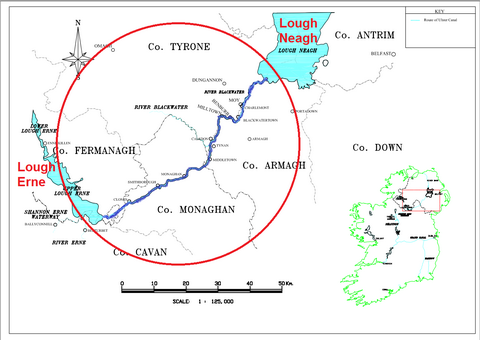
I originally had a rather more rude heading …. The Minister for Waterways and Other Stuff has decided to have the River Finn dredged to aid her reelection campaign shut up the Shinners promote peace and prosperity. The “shutting up the Shinners” bit means pretending that this is a restoration of the Ulster Canal, whereas it avoids the canal altogether in favour of dredging the river as far as Castle Saunderson, in Co Cavan, instead of going to Clones, in Co Monaghan. According to NorthernSound

Minister Heather Humphreys says the project will provide a wonderful recreational facility for local communities and will act as a significant draw for tourists.

That, minister, is a load of old bollocks: the locals have plenty of waterway already and the tourists are not going to be drawn by another bit of river. Still, Saunderson’s Sheugh is better than the Clones Sheugh, but it is worrying that

The project is expected to cost in the region of €2 million euro and will be funded by Waterways Ireland.

According to its Business Plan 2015, approved by the North South Ministerial Council on 18 December 2014, Waterways Ireland’s budget for sheughery in 2015 is €1000. So, if it is to spend €2 million on Saunderson’s Sheugh, and if the Treasure-Seekers have failed to find any money, will this mean that WI’s budget for maintaining and repairing the existing navigations will be cut?

I see that

The Minister says construction should begin in the final quarter of 2015.

I wonder when the next election is.

Boater’s handbook

The Canal & River Trust have a useful PDF Boater’s handbook available for download, free of charge, from this page; there is also a video thingie.

The handbook naturally concentrates on British inland waterways, with narrowboats on canals and rivers but not on lakes, but there is nonetheless much useful material. Even experienced boaters might find it of interest, if only for briefing any non-boaty friends they’ve invited along for a trip.


What has happened to Harbour Flights?

The successful air transport company Harbour Flights, which had a base at Mountshannon, announced some time ago that its level of success was such that it was suspending operations but that it would be back early in 2014, “fully operational again” with a fleet of aircraft “operating from [sic] destinations nationwide”.

Alas, my request for reports of sightings of the fleet produced neither information nor photographs and my own visits to Mountshannon in 2014 did not coincide with any aircraft movements. And now the website at http://www.harbourflights.com/landing.php has disappeared.

Surely nothing can have happened to the firm.


Ulster Canal restoration: a history

Ulster Canal 01 whole_resize

Studies 1994–2000

Ulster Canal 02 whole_resize

Socio-economic summary report and feasibility study 2006

Ulster Canal 03 whole_resize

North/South Ministerial Council agreement 2007, with the Irish government to pay the full cost

Ulster Canal 04 whole_resize

DCAL business case to DAHG 2015

Exhaustive coverage begins here but use the search facility for updates. More to come.

Shannon traffic figures to December 2014

I am grateful to Waterways Ireland for sending me the Shannon traffic figures for the last three months of 2014. They sent them last month but I didn’t have time to deal with them until now.

Regular readers may wish to skip this section

All the usual caveats apply:

  • the underlying figures do not record total waterways usage (even for the Shannon) as, for instance, sailing, fishing or waterskiing on lakes or river stretches, which did not involve a passage through a lock or Portumna Bridge, would not be recorded
  • the passage records would not show, for instance, a change in the balance of types of activities from those in larger cruising boats to those in smaller (sailing, fishing, waterskiing) boats
  • figures like these will not necessarily be representative of those for the year as a whole. The winter months, January to March, see little traffic in any year; for April, May and June, the weather can have a large influence on the amount of activity especially, I suspect, in private boats.

On the other hand, the figures do include the Shannon’s most significant tourism activity, the cruiser hire business. And they are our only consistent long-term indicator of usage of the inland waterways.

All boats

Shannon 2003-2014 01-12 all boats_resize

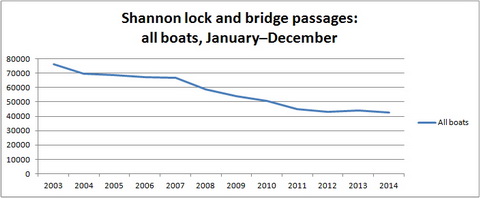
Total (private + hired) traffic for the full year

As we saw in September, traffic is down on 2013, but there has been little change over the last three years.

Private boats

Shannon 2003-2014 01-12 private boats_resize

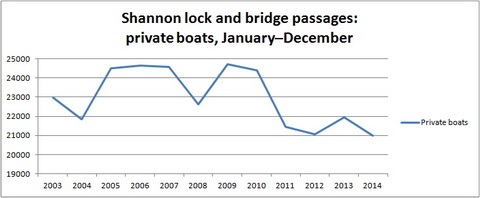
Private-boat traffic for the full years 2003 to 2014

The vertical scale on this chart is different from that for hired boats so the changes in private boating from one year to another are exaggerated (by comparison). The good weather did not prevent a fall in activity.

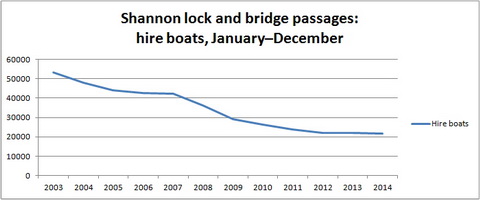
Hire boats

Shannon 2003-2014 01-12 hired boats_resize

Hire-boat traffic for the full years 2003 to 2014

Again, the lowest figure in my records, but the drop was small; perhaps the hire trade is bouncing along the bottom (as it were). I wonder whether anyone has a Grand Plan for recovery or rejuvenation.

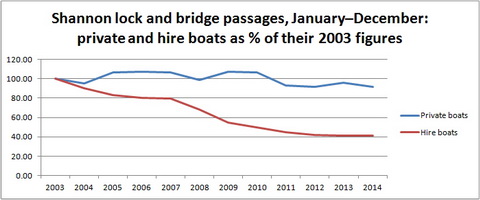
Percentages of 2003 levels

Shannon 2003-2014 01-12 compared with 2003_resize

Percentages of 2003 levels

Private traffic at just over 90% of 2003 levels, hire traffic at just over 40%.

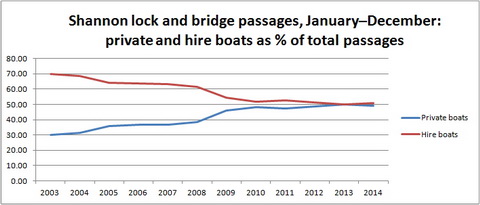
Private -v- hired

Shannon 2003-2014 01-12 private -v- hired_resize

Still roughly 50:50

Seasons

In the five months January, February, March, November and December, there were 385 passages altogether, less than 1% of total boat movements for the year. If money can be saved by ceasing to operate the locks and bridge during the winter, they should be closed except, perhaps, for one Saturday per month, to be arranged for a non-flood day.

Regions

Here is the order of popularity.

ALBERT LOCK 7205
ATHLONE LOCK  5775
CLARENDON LOCK 5650
ROOSKY LOCK 5565
PORTUMNA BRIDGE 5395
VICTORIA LOCK 4934
TARMONBARRY LOCK 3885
POLLBOY LOCK 1222
CLONDRA LOCK 1020
BATTLEBRIDGE 835
DRUMLEAGUE 797
DRUMSHANBO LOCK 387
SARSFIELD LOCK 97

Lough Allen is a delightful place but it is not popular.

Saunderson’s Shack

Some links to info about the Castle Saunderson estate, to which DCAL is trying to persuade DAHG to construct a sheugh.

Cavan County Council owns it, I think.

There is an International Scout Centre, although I’m not clear whether the scouts occupy the entire site or just part of it. For instance, do they control the church where services take place, at least occasionally?

There was an Orange parade to the site last year.

It is close to Belturbet, where the County Council has a River Project. Was that completed?

Belleek to Tralee in 10 hours by inland waterway

Learned Readers are undoubtedly familiar with Design-Driven Innovation, but I’m afraid I hadn’t come across it until I read a conference paper: S McCartan, P Murphy, R Starkel, A Sánchez González and M López Cabeceira “Design-Driven Innovation: Sustainable Transport Opportunities for the Inland Waterways of Ireland”, read at the fifth annual conference of the Irish Transportation Research Network at the University of Limerick from 3 to 5 September 2014.

The paper [PDF] can be downloaded free from Sean McCartan’s page on the academia.edu site, though you have to be registered with the site; the paper is also available, I think, from researchgate.net, but I’m not registered there so I haven’t tried the download.

As I understand it — and I am a Bear of Very Little Brain, and Long Words Bother me — Design-Driven Innovation means that a lot of clever chaps and chapesses come up with new and brilliant ideas and then ask people what they think of them:

The process of Design-Driven Innovation is an exploratory research project, which aims to create an entirely new market sector for a given product through changing the design meaning the user has for the product.

It seems that, in Ireland, 99.1% of freight travels by road, leaving just 0.9% for rail; 82.8% of passenger traffic is by car and 14.4% by bus and coach, leaving just 2.8% by rail. Waterways transport could use existing ports and canals; once the canals had the right bridges and automatic locks, running costs would be low. West coast ports could be used by a “coastal cruiser service”; people could travel by fast boat from Donegal right around the west and south coasts to Rosslare. All of this would reduce the carbon dioxide footprint (assuming, of course, that folk on the west coast wanted to travel, or needed to send goods, to anywhere else on the west coast rather than to Dublin).

On the inland waterways, 139 catamaran CLF vessels (Cruise Logistics Ferries) could run from Belleek to Tralee. Travelling at 22 knots, and ignoring lock times, they would complete the journey in only 10 hours; they could carry freight but also carry passengers in green luxury. These CLFs would be 81 metres long and 25 metres wide; each could carry 20 TEUs. At sea, 26 high-speed (40-knot) CLFs could each transport 12 TEUs from Cork to Dublin in just under four hours. And solar-powered catamarans on the Shannon and Erne could carry 64 passengers at 12 knots.

Meanwhile, the Grand, Barrow and Royal would not be forgotten. They would have a fleet of 1549 unmanned canal catamarans, with autonomous control systems, powered either by batteries or by fuel cells, ultimately fed from wind farms. They would each carry two TEUs but could also be converted for tourist cruising.

The overall aim, with those numbers of boats, is to replace half of the amount carried by road.

The paper concludes:

This is a first step in the analysis of the potential of the coastal and inland waterways of Ireland, to meet the EU targets for transport. State aid has been identified as a potential funding mechanism to support the realisation of these proposals.

Sometimes I wonder.


Northern Ireland spending on waterways

Sammy Wilson [DUP]: Looking through the list of capital projects, I see lock gates on the Shannon, bridge repairs on the Grand canal, enhancements of the Grand canal towpath, the Shannon Blueway and the multi-activity trail at Carrick-on-Shannon. Nearly every one of these projects is in the Irish Republic. Does the Minister see her role as fighting for projects in Northern Ireland or simply sitting there, handing over our money for projects in the Irish Republic?

Mr Wilson might not have noticed, during his terms in ministerial office, that waterways capital projects in each jurisdiction are paid for by the government of that jurisdiction. So NI money is not spent on capital projects in the republic; if NI politicians want more money spent on waterways improvements [as opposed to running costs] in Northern Ireland, it will have to come from the NI budget.

Unfortunately Mr Wilson’s party colleague, and successor as Minister of Finance and Personnel, Simon Hamilton, does not share Mr Wilson’s enthusiasm for erecting lock gates or towing-paths on the Erne [or whatever it was he wanted], for he has cut DCAL’s Budget [157-page NI budget and 28-page statement, both PDFs] and, in consequence, the amounts to be allocated to Waterways Ireland.

DCAL is wondering how to apply the chopper and is seeking views; a 190-page consultation document can be downloaded here [MS Word *.doc]. Neither DFP nor DCAL makes it easy to find the change from last year’s allocations, but DCAL says that the “savings” to be made by Waterways Ireland will be £468,000. As of today, that’s €630,727.

The Word document points out that

The budgets for the North/South Bodies are agreed by the North South Ministerial Council and are dealt with under different arrangements.  They are therefore outside the scope of this exercise.

So the document can’t say what the “front-line impact” of the cuts to Waterways Ireland’s allocation will be.

15% of WI’s current budget is paid by Northern Ireland and 85% by the republic. If the savings shown above are all to the current budget [which is not clear, though WI’s NI capital budget was pretty small anyway], then the total cut in WI’s current spending will be €5,204,847.

Note again that, without spending a lot more time on this than I currently have available, I cannot say from what base figure the cuts or savings are to be made.

Respondents to DCAL’s November 2014 consultation on the draft budget included only one who discussed waterways:

There was one response who stated that other sectors should be cut and funding to Waterways Ireland should be increased.

That was from an individual; it appears that no organisations commented on waterways issues and I cannot see any inland waterways-related voluntary body listed amongst those who submitted their views. As in the republic, arts folk seem to have been well organised.

The DCAL page contains a link to a surveymonkey page seeking responses.