Category Archives: Weather

Levels

Folk who have boats tied to fixed jetties on Lough Derg might like to check their ropes: the water level has risen quite a bit and some ropes are bar-taut.
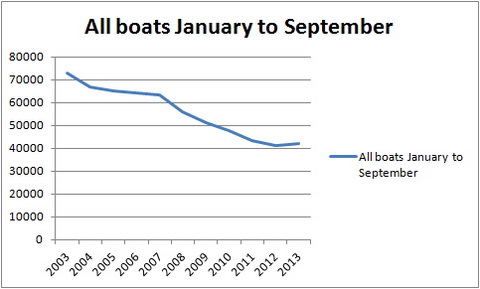
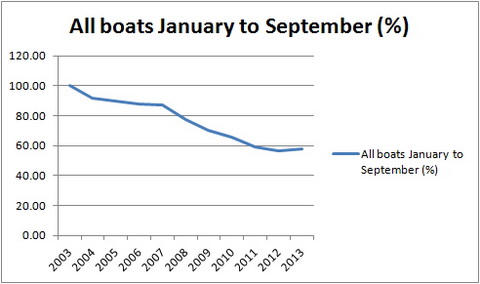
Shannon traffic figures to September 2013

The current (November 2013) issue of the British magazine Waterways World (available online only to subscribers) has an interview with Dawn Livingstone, new CEO of Waterways Ireland. There was a question about visitor numbers:

How are boating visitor numbers holding up in the recession?

The type of boating is changing — more sports boats for example, and numbers, after an initial decline, have held steady in the cruiser hire and private boat fleets. But more customers are investing in active recreation — canoeing, sailing, rowing, and these clubs and holiday types are growing rapidly.

My sense of the types of boating is the same, but I do not know of any source of reliable data. I think it would be useful if Waterways Ireland were (somehow) to collect and then to publish data on these activities and their economic costs and benefits.

But I was amused by the statement that …

[…] numbers, after an initial decline, have held steady in the cruiser hire and private boat fleets.

I’m not sure what useful data there are for the Lower Bann, Shannon–Erne Waterway, Grand, Royal and Barrow, though perhaps enhanced enforcement of the regulations will improve the data for the last three of those waterways. For the Shannon and Erne, the numbers in the fleets are, I presume, derived from the numbers of registered vessels, but there is no annual re-registration and I am not clear how many boats that are removed from the navigation are removed from the registers.

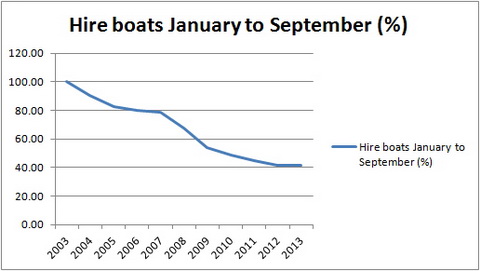
The other, indirect, measure, which applies only to the Shannon, is of passages through locks and moveable bridges. And, for hire boats, the “initial decline” has been 60% since 2003. If the numbers are now holding steady, it is at a very much lower level than ten years ago.

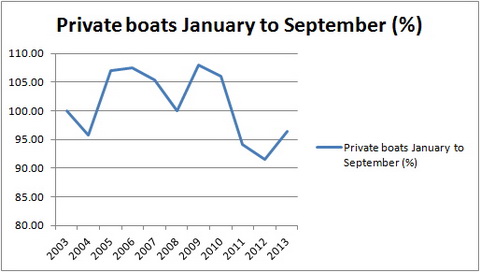
I was able to report in August that the better weather in July seemed to have led to an increase in the number of passages by private boats [the usual caveats apply]. Furthermore, for the first time that I knew of, the number of passages by private boats in the first seven months of the year exceeded the number of passages by hire boats in the same period.

I now have the figures for two more months, August and September, kindly supplied by Waterways Ireland, who are not to blame for my delay in getting the information up here.

All boats JanSept nos_resize

Look! An increase!

All boats JanSept percent_resize

Total passages are now almost back up to 60% of the levels of ten years ago

Hire boats JanSept percent_resize

Hire boat numbers are down by only a tiny amount

Private boats JanSept percent_resize

Private boat numbers are up

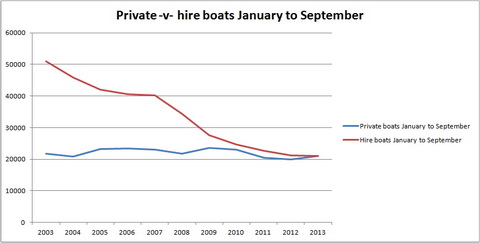
Private -v- hire JanSept nos_resize

Hire boat numbers are slightly above private boat numbers

Private boat numbers are ahead of hire in the three main summer holiday months of June, July and August and, although the numbers are tiny, in the winter months as well; hirers are ahead in spring and autumn.


Levels

On 9 October 2013 minister Brian Hayes spoke in the Dáil about Shannon water levels, saying:

A meeting between the ESB, Waterways Ireland and the Office of Public Works to review the interim operating regime is due to take place shortly.

On 17 and 18 October 2013, in correspondence with Waterways Ireland, I learned that the meeting had not then taken place and that no date had been set. I have now sent WI another note asking whether the meeting has been held and, if it has, requesting a report on the proceedings and outcome.

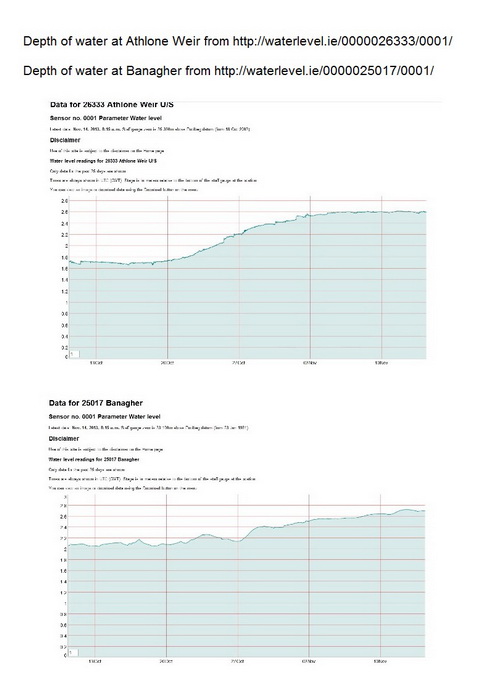
In the meantime, I have put together two charts nicked from waterlevel.ie for Banagher and Athlone:

Athlone and Banagher water levels

Athlone and Banagher water levels

Both of them show the levels for the last 35 days. I’m sure that more data and much more sophisticated analysis would be required to reach any reliable conclusion, but my untutored impression is that, in what has been a fairly dry autumn, keeping Lough Ree low didn’t do much to keep Banagher low. If that is so, and if I’m right in thinking that this autumn was dry (see below), the outcome would not show whether lowering Lough Ree would help in a very wet season; it may be necessary to repeat the experiment next year while performing rain dances. I would be glad, though, to have comments from more erudite folk and, if I get any information from TPTB, I’ll publish it here. In the meantime, this CFRAM PDF provides background reading.

On the dryness: Met Éireann’s monthly report for September 2013 is headed “Dry everywhere; warm and dull in most places” while that for October says “Rainfall was above average except in parts of the West, Northwest and North”. Its report doesn’t, AFAIK, specify any stations in the Shannon catchment (apart from Shannon Airport), but those to the west were generally below average while whose to the east were above; it may be that the Shannon rainfall was moderate.

No queue for the quay …

… at Querrin on the Shannon Estuary. The page discusses its building and the early years of its operation.

London Docklands

Big it up for the Museum of London Docklands, near Canary Wharf. You can go there on the DLR, always a bonus, which will counteract the queasiness you feel at proximity to a large number of bankers, accountants and lawyers.

Apart from any temporary exhibitions, the Museum offers a chronological account of the ports of London from Roman times to the present day; you start on the third floor and work downwards. The timeline anchors the narrative, but there is no attempt to pretend that there is a single uncontested history: conflicts over slavery, dock labour schemes and modern redevelopment are all presented, using a mixture of text, displays of artefacts large and small, models, paintings, audio and video. Easy to spend several hours there; the Docklands at War section was particularly interesting.

And if you have time afterwards, nip around to The Grapes for bangers and mash (£6.50) [or whatever you like] and a pint of Timothy Taylor’s Landlord, which (weather permitting) you may be able to consume on the balcony overlooking the Thames, with the shingle below on which the mudlarks worked, while you remember all those Conrad novels and sing “Sweet Thames flow softly” .

Like the Mary Ellen Carter …

rise againJust a few weeks ago the depth was around 1.7m at Athlone weir, about 7″ above the navigational minimum. But today the depth is over 2.4m and, with staff gauge zero at 35.360m above Poolbeg datum, the water level is 37.760 m above Poolbeg datum.

Water levels in Athlone

At time of writing, the depth of water at Athlone Weir is 1.7m. “Staff gauge zero is 35.360m above Poolbeg datum”, which means the water level is 37.06m OD (Poolbeg). According to Bob Cullen’s 2002 article for Inland Waterways News [PDF], “The minimum navigation level in Lough Ree is 36.88m OD”, so if the level drops another 0.18m, about 7 inches, there may be a WI Marine Notice.

It seems that the dropping of the level of Lough Ree is intended to provide a buffer against flooding in the area from Athlone downstream to Meelick. According to Brian Hayes “A meeting between the ESB, Waterways Ireland and the Office of Public Works to review the interim operating regime is due to take place shortly.” [I have asked Waterways Ireland for a report on the meeting.]

But, if we are to believe the Dublin Evening Mail, the Shannon Commissioners took a rather more robust attitude to flooding downstream of Athlone: steamers [and PR] came first.

The whistling postman of Inishturk

When Hugh Malet[1] visited Lough Erne, he met a whistling postman, William Rooney, who lived on Inishturk. Rooney delivered post to the islanders on three days a week and to the mainland farms and houses on the other three. His father had had the job before him, and had used a sailing boat, but he himself had a little outboard motor on his pillarbox-red skiff.

Two years later, staying in Gibraltar over Christmas, Malet read of William Rooney’s death. He had finished his delivery round for Friday 29 December 1961 and was on his way home to his wife and family when his boat got caught in the ice.

His sixty-year-old brother James went to his assistance, but he too got caught. The two brothers were found next day, frozen to death, only a short distance apart[2].


[1] Malet, Hugh In the Wake of the Gods: On the waterways of Ireland Chatto & Windus 1970.

[2] Malet, op cit; Rogers, Mary, Prospect of Erne Watergate Press 2nd ed 1971; Irish Times 2 January 1962; British Postal Museum Archive.

Lough Derg Regatta 1849

The Dublin Evening Mail of 19 September 1849 has come to hand.

LOUGH DERG REGATTA

The Regatta on the above-named beautiful lake came off last week. Monday, the 10th of September commenced the annual aquatic sports: the day was tolerably fine, and at two o’clock, PM, the Commodore, the Right Hon Lord Viscount Avonmore, started four yachts for a 30 Guinea Challenge Cup, with £12 added. After a drifting match (for it fell flat calm shortly after three o’clock), they came in as under:—

Gem, 12 tons, James Spaight, Esq
Hero, 8 tons, Dash Gainor, Esq
Iris, 19 tons, Wills C Gason, Esq
Foam, 24 tons, Lord Avonmore.

This was a time race.

While the yachts were absent several cot races came off.

On Tuesday, the 11th, the yachts sailed down in fleet to Killaloe, but the following day it blew a whole gale of wind, and the match that was to have been sailed for on that day was put off till the next; however, in the evening there were some well contested cot races.

The course was as usual — start from the Jetty, over the diagonal wall (built by the Shannon Commissioners to keep the water to a proper level in summer), under the bridge, round Friar’s Island, and back: to a stranger, it is astonishing to see a boat go down an incline nearly four feet high, which they are obliged to do in the race, and what is more extraordinary, any cot that is not rowed at it pretty fast, is almost certain of being upset.

Thursday, the 12th, at the Commodore’s signal, all the yachts got under weigh, and came to anchor off Derry, and at two o’clock, PM, five yachts started for a Silver Cup, valued at £15, witn £5 added. This was a time race for yachts under twelve tons. The wind was WNW, and blew a fine gaff-topsail breeze; at half-past four o’clock the yachts came in as under:—

Hero, 8 tons, Dash Gainor, Esq
Gem, 12 tons, James Spaight, Esq
Willy Wa, 9 tons, Captain Hon F Yelverton
Vampire, 9 tons, Arthur Vincent, Esq
Midge, 7 tons, Bassett W Holmes, Esq.

This was a beautiful race, all the yachts coming in almost together: the Hero only winning by 27 seconds — indeed she may thank the Midge for winning the prize, as going free the first round she got the Gem under her lee, and kept her back some minutes. Shortly after the signal was given to weigh anchor, and start for Portumna, where the fleet arrived at a late hour. In passing Scilly Island the Foam carried away her rudder head, and was near going ashore.

Next day, Friday the 14th, the yachts assembled off Portumna Castle, and at three o’clock, PM, the Commodore started the following boats for a 40 Guinea Challenge Cup, with a purse of Sovereigns added, for all yachts. A handicap race.

Novice, 4 tons, Dash Ryan, Esq
Midge, 7 tons, Bassett W Holmes, Esq
Vampire, 9 tons, Arthur Vincent, Esq
Gem, 12 tons, James Spaight, Esq
Foam, 24 tons, Lord Avonmore
Iris, 18 tons, Wills C Gason, Esq.

This was a most exciting race, and during the first hour it was difficult to tell which would be the winner. Before rounding the second flag boat the Novice put about and gave up the race, and off Church Island, the Midge carried away the jaws of her gaff, and was obliged to give up the race, which she was almost sure of winning — having gained two minutes the first round. The course was a long one, and the race was not over till after eight o’clock, when the four boats came in as follows:—

Iris
Foam
Gem
Vampire.

During each day of the Regatta, the City of Dublin Steam Company placed one of their fine steamers at the disposal of the Sailing Committee, who took out all their friends, and accompanied the yachts each day during the race.

In the evening, after several cot races and other amusements too numerous to relate. The ladies and gentlemen present were entertained at Belle Isle, the beautiful seat and hospitable mansion of Lord Avonmore; and at a later hour assembled some 120 of the elite of Tipperary, Galway, and King’s County, at the Clanricarde Arms, Portumna, where dancing was kept up with spirit until morning.

The population of the Portumna DED declined by 30.46% between 1841 and 1851.

A wet winter?

Today’s Irish Times reports on yesterday’s launch of a report called Ireland’s climate: the road ahead [92.9 Mb 103 page PDF here]. The report predicts:

  • Daytime summer temperatures to rise by up to 2°C
  • Lowest winter night-time temperatures to rise by 2-3°C
  • Milder winters to reduce cold-related mortality rates
  • Wetter winters and drier summers
  • Increase in frequency of heavy precipitation event.

Chapter 10 “Climate change and catchment hydrology” covers river flows.

Met Éireann’s report on summer 2013 [2 page PDF] is available here; rainfall was down [on the 1981–2010 average] at all stations except Valentia; temperature was up everywhere and so was sunshine. So perhaps we’ll have a wet winter to look forward to.