Questions, questions

I reproduce below the text of an email I have sent to the press office at the Department of Arts, Heritage and the Gaeltacht, which is responsible for waterways in RoI. Though you wouldn’t think it; DAHG’s home page has this list of activities on the left-hand side:

Arts
About Us
Culture
Heritage
20-Year Strategy for the Irish Language 2010–2030
Irish
Islands
An Ghaeltacht
Aran LIFE+ Posts
Ministers
Public Service Reform
National Famine Commemoration 2013
National Ploughing Championships
EU Presidency
Censorship of Publications
Press Releases
Publications
Speeches
Consultations
Links
Contact Details

Nothing about either waterways or northsouthery (which is the category into which waterways fall).

Anyway, here are the questions I asked.

1. On 19 November 2013, in a written answer to Gerry Adams, Jimmy Deenihan said:

My Department’s REV provision for Waterways Ireland for 2013 is €25.463m, a 6% efficiency saving on 2012. My Department’s Estimates provision for 2014 is €24.183m, a 5% efficiency saving on 2013.

I would be grateful if you could tell me what a REV provision is.

2. Your minister also said:

The 2013 and 2014 Budget allocations to the Bodies are subject to ongoing discussion by the two Sponsor Departments and will require, of course, formal approval by the NSMC.

I would be grateful if you could tell me (a) why Waterways Ireland’s budget had not been finalised when 88% of the year had passed and (b) how that affected budgetary management in the Body.

3. I would be grateful if you could tell me when Waterways Ireland’s report and accounts for 2012 will be published.

4. I would be grateful if you could tell me when Waterways Ireland’s plan for 2014 and subsequent years is to be published and what public consultation there has been on it.

5. On 16 October 2013 Jimmy Deenihan said in the Dáil that WI’s

core activities and targets

include

keeping the waterways open for navigation during the main boating season.

I would be grateful if you could tell me whether that formulation represents any forthcoming change in WI’s practices in keeping waterways open outside the main boating season.
 

Setback for Sheugh

The likelihood that limitless wealth will result from the construction of the Clones Sheugh was reduced recently with the closure of the cruiser-hire base closest to the Ulster Canal: the Emerald Star (Le Boat) operation at Belturbet.

Perhaps, though, it reflects a wider decline in the hire business rather than disappointment at the delay in the canal’s reconstruction.

Sallins delay?

Waterways Ireland has readvertised for a contractor to build a houseboat facility at Sallins on the Grand Canal:

Waterways Ireland seeks tenders from experienced and competent contractors for the construction of a House Boat Mooring Facility in Sallins, Co Kildare.

Shannon traffic figures to September 2013

The current (November 2013) issue of the British magazine Waterways World (available online only to subscribers) has an interview with Dawn Livingstone, new CEO of Waterways Ireland. There was a question about visitor numbers:

How are boating visitor numbers holding up in the recession?

The type of boating is changing — more sports boats for example, and numbers, after an initial decline, have held steady in the cruiser hire and private boat fleets. But more customers are investing in active recreation — canoeing, sailing, rowing, and these clubs and holiday types are growing rapidly.

My sense of the types of boating is the same, but I do not know of any source of reliable data. I think it would be useful if Waterways Ireland were (somehow) to collect and then to publish data on these activities and their economic costs and benefits.

But I was amused by the statement that …

[…] numbers, after an initial decline, have held steady in the cruiser hire and private boat fleets.

I’m not sure what useful data there are for the Lower Bann, Shannon–Erne Waterway, Grand, Royal and Barrow, though perhaps enhanced enforcement of the regulations will improve the data for the last three of those waterways. For the Shannon and Erne, the numbers in the fleets are, I presume, derived from the numbers of registered vessels, but there is no annual re-registration and I am not clear how many boats that are removed from the navigation are removed from the registers.

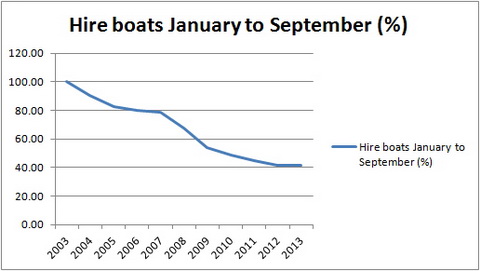
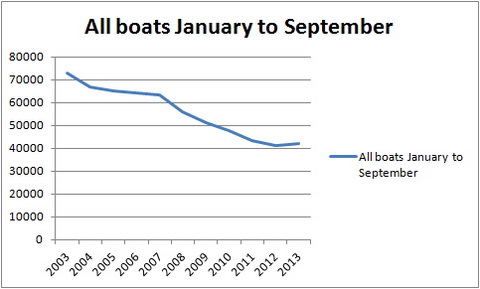
The other, indirect, measure, which applies only to the Shannon, is of passages through locks and moveable bridges. And, for hire boats, the “initial decline” has been 60% since 2003. If the numbers are now holding steady, it is at a very much lower level than ten years ago.

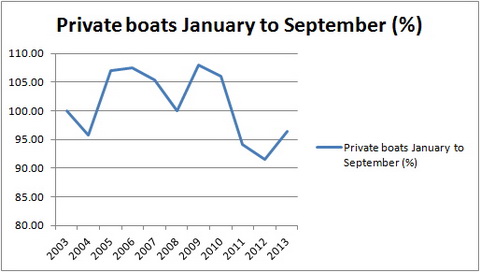
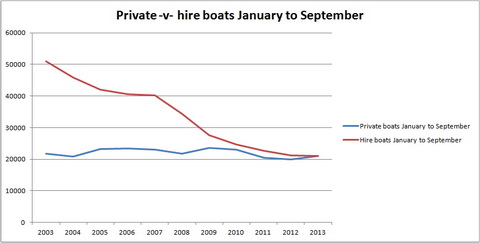
I was able to report in August that the better weather in July seemed to have led to an increase in the number of passages by private boats [the usual caveats apply]. Furthermore, for the first time that I knew of, the number of passages by private boats in the first seven months of the year exceeded the number of passages by hire boats in the same period.

I now have the figures for two more months, August and September, kindly supplied by Waterways Ireland, who are not to blame for my delay in getting the information up here.

All boats JanSept nos_resize

Look! An increase!

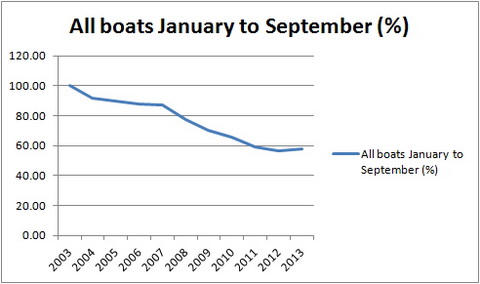
All boats JanSept percent_resize

Total passages are now almost back up to 60% of the levels of ten years ago

Hire boats JanSept percent_resize

Hire boat numbers are down by only a tiny amount

Private boats JanSept percent_resize

Private boat numbers are up

Private -v- hire JanSept nos_resize

Hire boat numbers are slightly above private boat numbers

Private boat numbers are ahead of hire in the three main summer holiday months of June, July and August and, although the numbers are tiny, in the winter months as well; hirers are ahead in spring and autumn.


Effin stats

I wrote here about Maureen O’Sullivan’s questioning of ministers about Effin Bridge, the lifting railway bridge below Newcomen Bridge on the Royal Canal in Dublin. It seems that she would like a drop-lock to replace the bridge, thus enabling boats to pass under the railway at any time without interfering with the operation of the trains. Which would be very nice, but that it would cost over €5 million and cause significant disruption to the railway during construction.

I was distressed by Ms O’Sullivan’s failure to make any sort of economic case for the drop-lock or for any other measure that might allow for free movement of boats on that section of the Royal Canal. I said:

As the expenditure on reopening the Royal Canal is a sunk cost, I am all in favour of making its use easier — provided that it can be demonstrated that (a) there is a demand for increased use, (b) such increased use will have benefits that outweigh the costs of any improvements and (c) no alternative investment offers better returns. As far as I can see, Ms O’Sullivan has demonstrated none of the three: indeed I see no evidence that she has even considered them.

Ms O’Sullivan’s position might be described as favouring an increase in the supply of possible passages along that section of the canal, but I thought it might be interesting to know what the demand for such passages was, so I asked Waterways Ireland how many boats had passed under Effin Bridge in 2013.

I was wrong about the number of days on which the bridge was lifted: nine lifts were available altogether. Six were on Tuesdays, two on Saturdays and one on a Sunday (to facilitate the Dublin boat rally):

Tuesday 16 April 2013:           0 boats
Tuesday 30 April 2013:         10 boats
Sunday 5 May 2013:            24 boats
Tuesday 21 May 2013:           0 boats
Saturday 1 June 2013:           8 boats
Tuesday 18 June 2013:           2 boats
Saturday 20 July 2013:          3 boats
Tuesday 13 August 2013:       7 boats
Tuesday 17 September 2013:  4 boats

So that’s 58 boats in a year.

I asked what the cost was: I was told that Irish Rail charges €1200 per weekday lift and €2000 per weekend lift. I presume that Waterways Ireland itself incurs other costs, perhaps overtime at weekends, but I don’t know what they are. The cost per boat for each lift was:

Tuesday 16 April 2013:           0 boats: lift cancelled as no boats wanted it
Tuesday 30 April 2013:         10 boats: €120.00 per boat
Sunday 5 May 2013:            24 boats: €83.33 per boat
Tuesday 21 May 2013:           0 boats: lift cancelled as no boats wanted it
Saturday 1 June 2013:           8 boats: €250.00 per boat
Tuesday 18 June 2013:           2 boats: €600.00 per boat
Saturday 20 July 2013:          3 boats: €666.67 per boat
Tuesday 13 August 2013:       7 boats: €171.43 per boat
Tuesday 17 September 2013:  4 boats: €300.00 per boat

The total charged to Waterways Ireland (not to the boaters) by Irish Rail was €10800.00.

Suppose that a drop-lock had been built for €5000000. Would it be worth investing that amount to save an annual expenditure of €10800? I suspect not, although I am open to correction by anyone capable of calculating NPVs or other relevant measures.

It seems to me, though, that the case for any capital expenditure is weak while demand for passages is lower than supply. Perhaps Royal Canal enthusiasts might work on attracting more boats to the Dublin end, whether from the Shannon end or from the Grand and Liffey.


SEUPBer

SEUPB, the Special European Union Programmes Body, has withdrawn its offer of funding for the Narrowwater bridge about which I wrote here and here.

Perhaps the scheme’s proponents might now consider a Newry Southern Relief Road instead. It might not be iconic, but it would be considerably more useful.

And I really don’t think it needs an opening span to cater for a couple of yachts going up the Newry Ship Canal.

It seems that the SEUPB wants to reallocate the money to a project that could be completed by December 2015. A cross-border sheugh, maybe?

Levels

On 9 October 2013 minister Brian Hayes spoke in the Dáil about Shannon water levels, saying:

A meeting between the ESB, Waterways Ireland and the Office of Public Works to review the interim operating regime is due to take place shortly.

On 17 and 18 October 2013, in correspondence with Waterways Ireland, I learned that the meeting had not then taken place and that no date had been set. I have now sent WI another note asking whether the meeting has been held and, if it has, requesting a report on the proceedings and outcome.

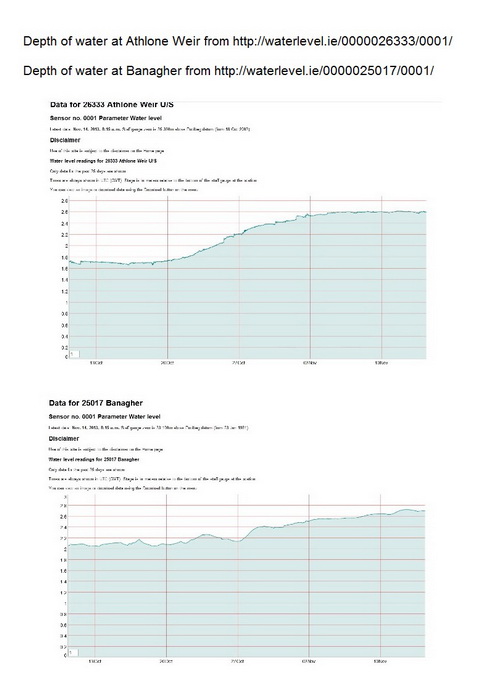
In the meantime, I have put together two charts nicked from waterlevel.ie for Banagher and Athlone:

Athlone and Banagher water levels

Athlone and Banagher water levels

Both of them show the levels for the last 35 days. I’m sure that more data and much more sophisticated analysis would be required to reach any reliable conclusion, but my untutored impression is that, in what has been a fairly dry autumn, keeping Lough Ree low didn’t do much to keep Banagher low. If that is so, and if I’m right in thinking that this autumn was dry (see below), the outcome would not show whether lowering Lough Ree would help in a very wet season; it may be necessary to repeat the experiment next year while performing rain dances. I would be glad, though, to have comments from more erudite folk and, if I get any information from TPTB, I’ll publish it here. In the meantime, this CFRAM PDF provides background reading.

On the dryness: Met Éireann’s monthly report for September 2013 is headed “Dry everywhere; warm and dull in most places” while that for October says “Rainfall was above average except in parts of the West, Northwest and North”. Its report doesn’t, AFAIK, specify any stations in the Shannon catchment (apart from Shannon Airport), but those to the west were generally below average while whose to the east were above; it may be that the Shannon rainfall was moderate.

Meath River Rescue

I have no idea what this Dáil written question and answer, from 12 November 2013, are about:

Peadar Tóibín [SF, Meath West]: To ask the Minister for Environment, Community and Local Government if his Department will provide direction for a safety procedure (details supplied) to be enforced; if this procedure been enforced in any other region or with any other community organisation; if he will reverse this decision and allow for Meath River Rescue to operate in a fully integrated and efficient manner.

Phil Hogan [FG, Carlow-Kilkenny; Minister for the Environment, Community and Local Government]: My colleague, the Minister for Transport, Tourism and Sport is the Minister with responsibility for receiving calls for assistance for inland waterways and mobilisation of appropriate response services. I have no function in the matter referred to in this question.

Googling suggests that Meath River Rescue got €278,358 for a boathouse and training room in Navan, with two FG TDs announcing the grant a year apart [or is one of those dates a typo?]. The service is known to Irish Water Safety but is not one of its Community Rescue Boats Ireland so it’s not a Coast Guard declared resource [which doesn’t mean there’s anything wrong with it]. Meath River Rescue’s own website and facebook page don’t seem to have been updated since April 2012 [although I am unfamiliar with facebook and may not be interpreting the dates correctly] but the service has been in action as recently as September 2013.

Unfortunately “details supplied” means supplied to the minister, not to readers of Dáil proceedings, so I have no idea what problem was being raised.


Ticking all the boxes

Sometimes an idea comes along that is just so good, so right, so advantageous on all counts that it is simply irresistible. This idea comes from the Americas, from the US Coast Guard. Adapted to the Irish inland waterways, and specifically to the Shannon, it could:

  • help to promote industry in recession-hit rural areas
  • create direct employment
  • help to stimulate indirect employment
  • promote Irish energy independence by reducing reliance on imported hydrocarbons
  • counter pollution of water-courses
  • reduce the number of heavy trucks using remote rural roads
  • use environmentally-friendly water transport, by barge along the Shannon
  • honour and promote the industrial heritage of Co Leitrim and the transport heritage of the Shannon
  • help to defray the costs of maintaining the Shannon Navigation
  • solve Dublin’s water supply problem, at least for non-potable water.

How could anybody resist?

The US Coast Guard has proposed that wastewater from fracking [PDF] should be transported by barge, rather than by truck or railway train, from the fracking sites to remote storage or treatment facilities. So, when fracking begins around Lough Allen, the wastewater could be carried down the Shannon by barge and, if necessary, pumped to Dublin.

It sounds like a winner to me.

No Newry is bad news

In October I wrote about a Northern Ireland Assembly debate on a proposed Newry Southern Relief Road. I said:

… the debate was remarkable for its demonstration of cross-party agreement: not so much on the desirability of public works (a desideratum of Irish politicians since the eighteenth century) as on the irrelevance of the Narrowwater bridge.

[…]

It must surely be unlikely that there will be two crossings of Carlingford or the Newry River [and canal] within a few miles of each other. But if one option, the Newry Southern Relief Road, helps to relieve Newry and Warrenpoint traffic and the other, the Narrowwater bridge, doesn’t do so, then the first option would seem to be the rational choice.

Yesterday, 12 November 2013, Martin McGuinness [SF, Mid Ulster] reported to the Northern Ireland Assembly on the recent plenary meeting of the North/South Ministerial Council. He and others expressed support for the Narrowwater project. This question is revealing:

Caitriona Ruane [SF, South Down]: Go raibh maith agat agus go raibh maith agat don LeasChéad-Aire as an ráiteas sin. I welcome the statement from the deputy First Minister. Does he agree that the Narrow Water bridge project is a very good project for everyone in the Louth/Down area, that the chambers of commerce are representing every single community — Kilkeel, Warrenpoint and Rostrevor — and that the project went through a very rigorous process in relation to the SEUPB and came out at the top of the competitive process?

She made no mention of Newry; nor did any other contributor to the debate.