Tag Archives: ESB

An eels update, updated

Pat Rabbitte’s reply to Michael Colreavy; thanks to KildareStreet.

Update 6 February 2014: Fergus O’Dowd [FG, Louth] responded to the Dáil’s most famous canoeist, Ming Flanagan [Ind, Roscommon/South Leitrim], the Rockville navigator, with some more information about eels.

Lowering Lough Ree

I reported in October and in November on the lowering of the level of Lough Ree, in advance of heavy rain, to see whether that would help to manage flooding on the Shannon Callows further downstream.

The interim data from the experiment is available on the OPW website here [seven-page PDF]. The conclusion is:

Conclusion
From the water level records, it is apparent that the closing of the gates at Athlone weir in anticipation of a rise in water levels on Lough Ree led to a temporary lowering of the Shannon water levels immediately downstream of Athlone. This possibly delayed inundation of the Shannon callows downstream of Athlone by a number of days. To determine whether the extent or depth of eventual inundation was in any way reduced by the experiment will require more detailed analysis by the CFRAM consultants. Data is available on request from Hydrometric Section if required.

It should be stressed that this is an interim report. This CFRAM background document [PDF] is still useful.

It is not clear to me why the state should spend any money improving the value of privately owned riverside land that is of marginal benefit to the economy.


Cutting and pasting

One of the problems with all this newfangled technology is that some things — like, for instance, copying a block of text from one document into another – are so easy that folk may forget to check their work afterwards.

Consider, for instance, the Office of Public Works, which seems to have a block of boilerplate text ready for answering written boilerplate questions from midlands TDs who have discovered that things get wet when it rains.

On 22 January 2014 Denis Naughten [Ind, Roscommon/South Leitrim, which — let it be admitted — The Lord intended to be rather boggy and sad] had this question:

To ask the Minister for Public Expenditure and Reform the steps being taken to address flood risks within the Shannon basin; and if he will make a statement on the matter.

The answer tells Mr Naughten about CFRAM — nothing he didn’t know before he asked, I imagine — but it included this sentence:

On foot of discussions between my colleague, Minister of State Hayes and the IFA, and with the cooperation of both the ESB and Waterways Ireland, a water level monitoring exercise is being carried out as part of the CFRAM process which will allow for analysis of water flows and levels at key points around the Lough Ree and Callows areas.

The highlighting is mine: it seemed a bit odd because this written answer was allegedly being given by Mr Hayes.

Mr Naughten had another Q&A here, but it’s not very interesting.


A new concept in electricity transmission

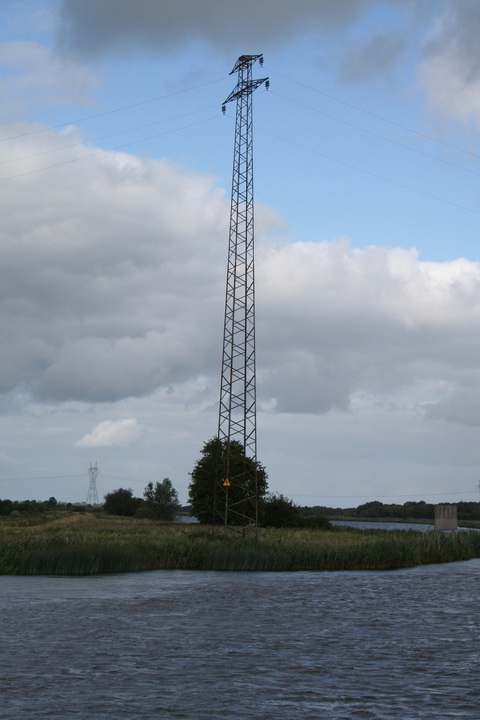
Lower pylons 2_resize

We read on the Clare FM website:

The Government says it is not realistic or financially feasible to run new electricity pylons underground.

Well, yes, I’d imagine there’s something in that. Although I don’t quite see why anyone would want underground pylons. I knew some folk wanted underground electric cables, but hadn’t realised they wanted the pylons buried too.

Personally, I’m all in favour of pylons: I like them, and would like to see more of them. I don’t understand why a row of nice pylons should be thought to make scenery less, er, scenic. It might make scenery less like a pre-industrial idea of scenery, but that’s a good thing; big it up for Stephen Spender.

And think of the industrial heritage value in the future: as well as old canals and railways, folk will come to photograph pylons; indeed some people already do so.


Draining Lough Derg

The ESB is currently letting more water down the old course of the Shannon, from Parteen Villa Weir through O’Briensbridge, Castleconnell and the Falls of Doonass. This channel gets the first 10 cubic metres per second from the Shannon; the next 400 go through Ardnacrusha and anything left over is sent down the old course.

The result is to help to reduce the water level on Lough Derg while raising it on the old course.

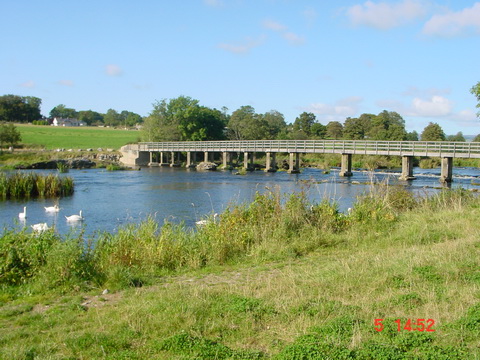
The footbridge in Castleconnell at normal summer level in 2002

The footbridge in Castleconnell at normal summer level in 2002

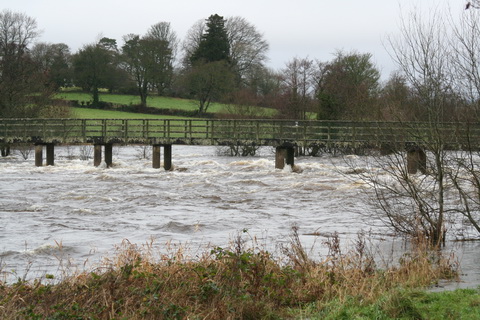
The footbridge on 1 January 2014

The footbridge on 1 January 2014

Before Ardnacrusha was built, the old channel took the entire flow of the Shannon, so it can take more than it has now.

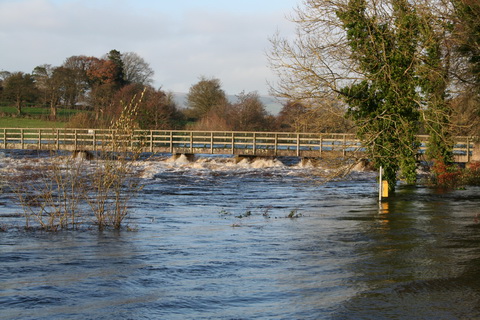
The footbridge in the floods of November 2009

The footbridge in the floods of November 2009

The level is still below that of 2009, when the land around the old channel flooded in several places. But much land is waterlogged: I saw yesterday that the upper reaches of the Nore, the Barrow and other rivers were in flood. And more rain is forecast.

Wouldn’t it be nice if some of that could be sent to Dublin instead? I see that some folk claim (on what looks like a website that hasn’t been updated for a while) that the evil Dublin folk want to extract 350 million litres of water from the Shannon every day; the original idea was to take it from Lough Ree but now it seems that Lough Derg is the preferred source.

Now 350 million litres sounds like a lot, but it’s 350 000 cubic metres per day, 14 583.3 per hour, 243.05 per minute, 4.05 per second, which is less than 1% of normal flow through the two channels draining Lough Derg. There’s a lot more at the moment, and the good citizens of Dublin are welcome to come down and fill their buckets. I suspect that Clare TD Michael McNamara has got things out of proportion.

Addendum: 350 million litres per day, over a lake whose area is 130 square kilometres, would lower the level of the lake (if my calculations are correct) by 2.69 millimetres. If no water entered the lake, the level would be down 983 mm after a year, ignoring evaporation and other abstractions and assuming that the Shannon and other tributaries no longer flowed in and that there was no rain.

Ballylongford (and Inishmurray/Cahircon)

SHANNON-RIVER. This is by far the most considerable river in Ireland, or perhaps in any known island, not only on account of its rolling 200 miles, but also of its great depth in most places, and the gentleness of its current, by which it might be made exceedingly serviceable to the improvement of the country, the communication of its inhabitants, and consequently the promoting inland trade, through the greater part of its long course, being navigable to a considerable distance, with a few interruptions only of rocks and shallows, to avoid which there are in general small canals cut, to preserve and continue the navigation.

Thus Wm Wenman Seward, Esq [correspondent of Thomas Jefferson], in his Topographica Hibernica; or the topography of Ireland, antient and modern. Giving a complete view of the civil and ecclesiastical state of that kingdom, with its antiquities, natural curiosities, trade, manufactures, extent and population. Its counties, baronies, cities, boroughs, parliamentary representation and patronage; antient districts and their original proprietors. Post, market, and fair towns; bishopricks, ecclesiastical benefices, abbies, monasteries, castles, ruins, private-seats, and remarkable buildings. Mountains, rivers, lakes, mineral-springs, bays and harbours, with the latitude and longitude of the principal places, and their distances from the metropolis, and from each other. Historical anecdotes, and remarkable events. The whole alphabetically arranged and carefully collected. With an appendix, containing some additional places and remarks, and several useful tables printed by Alex Stewart, Dublin, 1795. [Google it if you want a copy.]

Seward was one of many people who saw the Shannon as a valuable resource, even if they were vague on how it was to yield a return. I was reminded of that on reading the Strategic Integrated Framework Plan for the Shannon Estuary 2013–2020: an inter-jurisdictional land and marine based framework to guide the future development and management of the Shannon Estuary. The Introduction includes this:

The Shannon Estuary is an immensely important asset and one of the most valuable natural resources in Ireland and the Mid-West Region in particular — the fringe lands and the marine area both provide space and location for development, activities and opportunities to progress economic, social and environmental growth within the Region.

This report is an attempt to show how the estuary could deliver a return. The core point seems to be that a small number of areas are designated as “Strategic Development Locations for marine related industry and large scale industrial development”, thus protecting them from the attentions of the environmentalists: the whole of the estuary is a Special Area of Conservation and a Special Protection Area.

Almost all the Strategic Development Locations are already industrialied in some way:

  • Limerick Docks (in Limerick city)
  • Ballylongford (of which more below)
  • Tarbert (power station)
  • Aughinish Island (alumina)
  • Askeaton (Nestlé)
  • Foynes Island and land to the rear of Foynes (main port on the estuary)
  • Moneypoint (power station).

There is one more, Inishmurry/Cahircon (which is not boring), which is even more interesting because there is no industry there at present. It was used as a resting place for certain vessels, but it was also proposed as the site for an explosives factory. Perhaps the designation as a Strategic Development Location suggests that that proposal is not dead but merely sleeping.

Ballylongford is equally lacking in industry, despite activity at Saleen in the early nineteenth century. However, Shannon Development assembled a large landbank nearby; the report’s Executive Summary says:

The Ballylongford Landbank benefits from a significant deepwater asset and extant permission for a major LNG bank.

Here is the area in question. Note that the red oval is just to indicate the rough location; it does not show the boundaries of the landbank.

Ballylongford (OSI ~1840)

Ballylongford (OSI ~1840)

You can see a proper map and a marked-up aerial photo in Volume 1 of the report [PDF] on page 73 (77/174).

Shannon Development agreed to give a purchase option on a little uder half of the site to Shannon LNG Ltd, which proposed to build a liquefied natural gas terminal there, to be supplied by ship; much information is available here.

The Commission for Energy Regulation decided to introduce charges that would have increased Shannon LNG’s costs; the company took the matter to court but, yesterday, lost its case. The Irish Times report here will probably disappear behind a paywall at some stage; the Irish Independent report is here and the Limerick Leader‘s here (its photo shows Tarbert and Moneypoint; the Ballylongford site is off to the left).

If the Ballylongford development does not proceed, plans for economic growth on the Shannon estuary may prove to be for the birds.

My OSI logo and permit number for website

Levels

On 9 October 2013 minister Brian Hayes spoke in the Dáil about Shannon water levels, saying:

A meeting between the ESB, Waterways Ireland and the Office of Public Works to review the interim operating regime is due to take place shortly.

On 17 and 18 October 2013, in correspondence with Waterways Ireland, I learned that the meeting had not then taken place and that no date had been set. I have now sent WI another note asking whether the meeting has been held and, if it has, requesting a report on the proceedings and outcome.

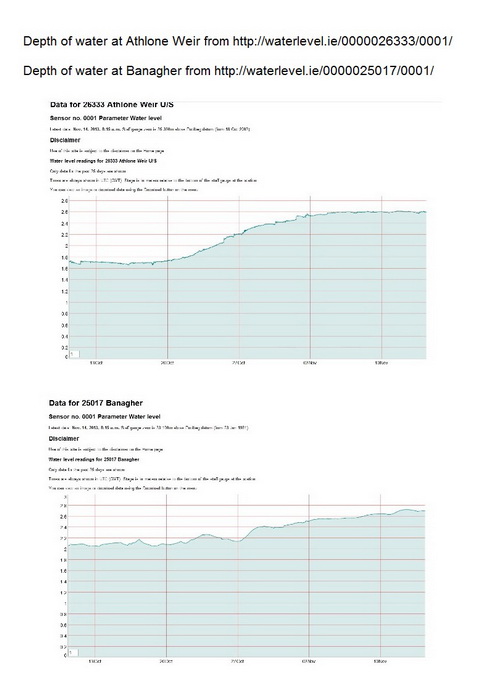
In the meantime, I have put together two charts nicked from waterlevel.ie for Banagher and Athlone:

Athlone and Banagher water levels

Athlone and Banagher water levels

Both of them show the levels for the last 35 days. I’m sure that more data and much more sophisticated analysis would be required to reach any reliable conclusion, but my untutored impression is that, in what has been a fairly dry autumn, keeping Lough Ree low didn’t do much to keep Banagher low. If that is so, and if I’m right in thinking that this autumn was dry (see below), the outcome would not show whether lowering Lough Ree would help in a very wet season; it may be necessary to repeat the experiment next year while performing rain dances. I would be glad, though, to have comments from more erudite folk and, if I get any information from TPTB, I’ll publish it here. In the meantime, this CFRAM PDF provides background reading.

On the dryness: Met Éireann’s monthly report for September 2013 is headed “Dry everywhere; warm and dull in most places” while that for October says “Rainfall was above average except in parts of the West, Northwest and North”. Its report doesn’t, AFAIK, specify any stations in the Shannon catchment (apart from Shannon Airport), but those to the west were generally below average while whose to the east were above; it may be that the Shannon rainfall was moderate.

Like the Mary Ellen Carter …

rise againJust a few weeks ago the depth was around 1.7m at Athlone weir, about 7″ above the navigational minimum. But today the depth is over 2.4m and, with staff gauge zero at 35.360m above Poolbeg datum, the water level is 37.760 m above Poolbeg datum.

Ardnacrusha

A press release just in from Waterways Ireland:

Waterways Ireland Change Advice on Travel into Limerick

Waterways Ireland is changing the advice on travel from Ardnascrusha into the Limerick Navigation due to a new service available from the ESB which provides real time information on the output from the turbines.

Boaters are advised not to travel on the Ardnacrusha to Limerick Navigation if the output from Ardnacrusha is above 20 Megawatts. The previous advice advised boaters not to travel if one turbine was operating; 1 turbine is equivalent to 20 megawatts.

The new service offers real time information on the megawatt output of Ardnacrusha by phone (tel 087-6477229) and is available 24hrs a day. Boaters are advised to contact the ESB phoneline for information on the output when making travel plans. In the event of a line failure in the real time information number, boaters can call the main Ardnacrusha number 087-9970131 for the megawatt information as well as any other information required for travel through Ardnacrusha.

This new information service is an improvement in safety for mariners who travel on the Ardnacrusha to Limerick Navigation.

Update 2018: that was in 2013. Much better information is now available here.

Water levels in Athlone

At time of writing, the depth of water at Athlone Weir is 1.7m. “Staff gauge zero is 35.360m above Poolbeg datum”, which means the water level is 37.06m OD (Poolbeg). According to Bob Cullen’s 2002 article for Inland Waterways News [PDF], “The minimum navigation level in Lough Ree is 36.88m OD”, so if the level drops another 0.18m, about 7 inches, there may be a WI Marine Notice.

It seems that the dropping of the level of Lough Ree is intended to provide a buffer against flooding in the area from Athlone downstream to Meelick. According to Brian Hayes “A meeting between the ESB, Waterways Ireland and the Office of Public Works to review the interim operating regime is due to take place shortly.” [I have asked Waterways Ireland for a report on the meeting.]

But, if we are to believe the Dublin Evening Mail, the Shannon Commissioners took a rather more robust attitude to flooding downstream of Athlone: steamers [and PR] came first.