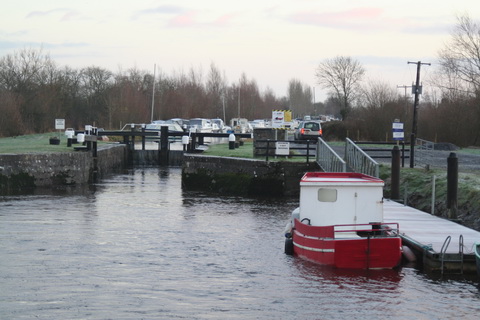
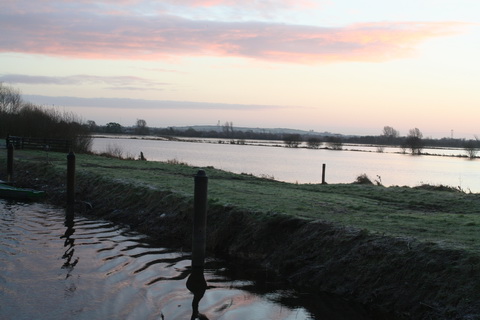
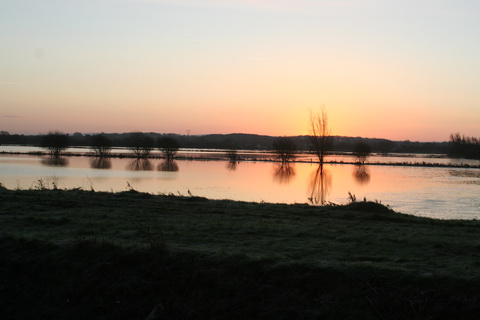
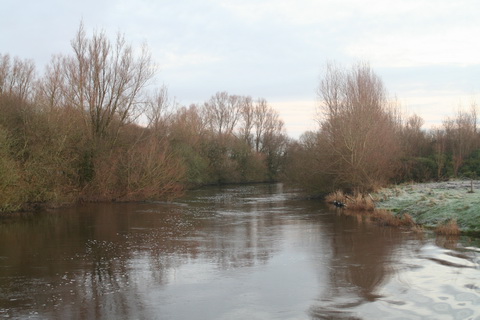
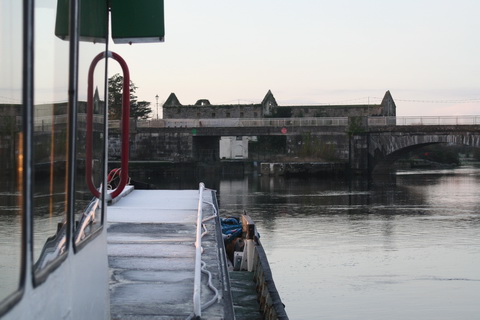
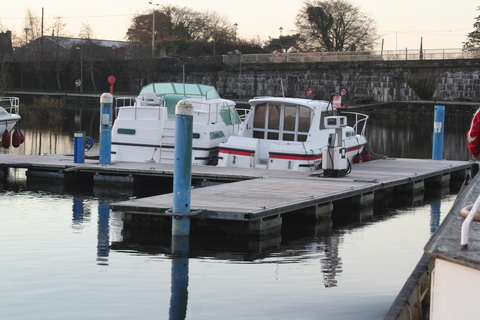
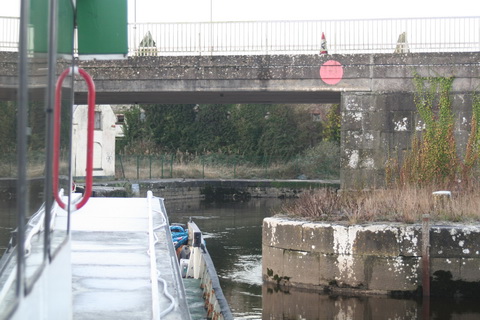
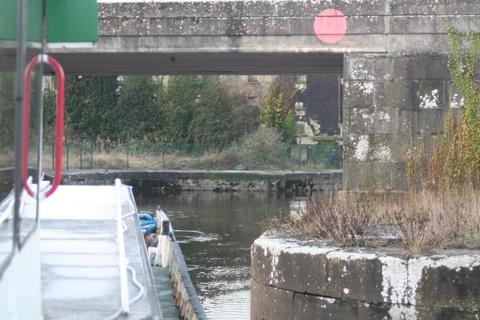
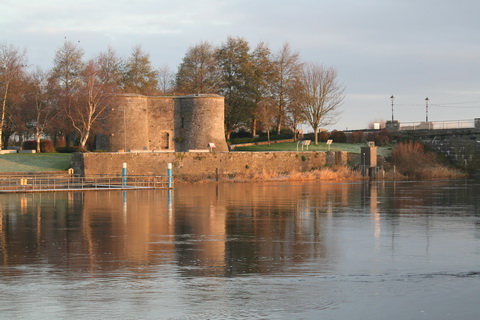
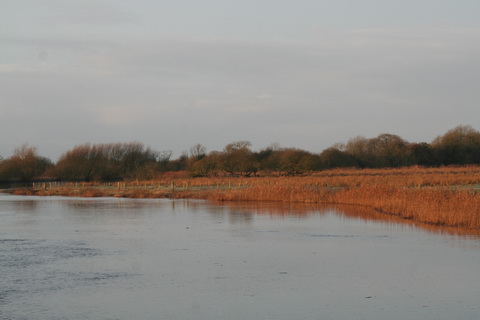
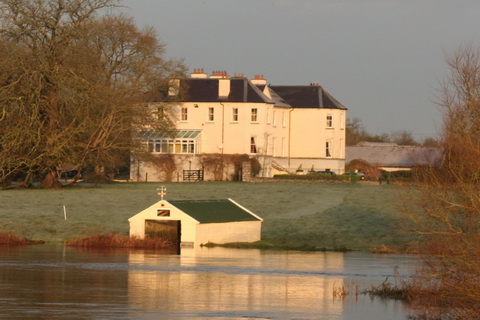
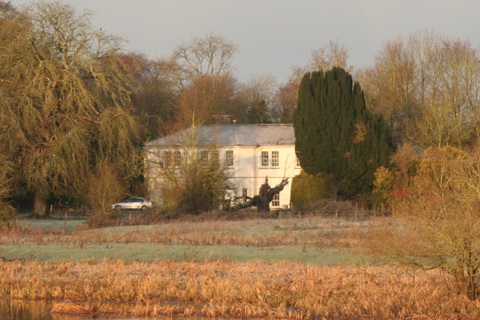
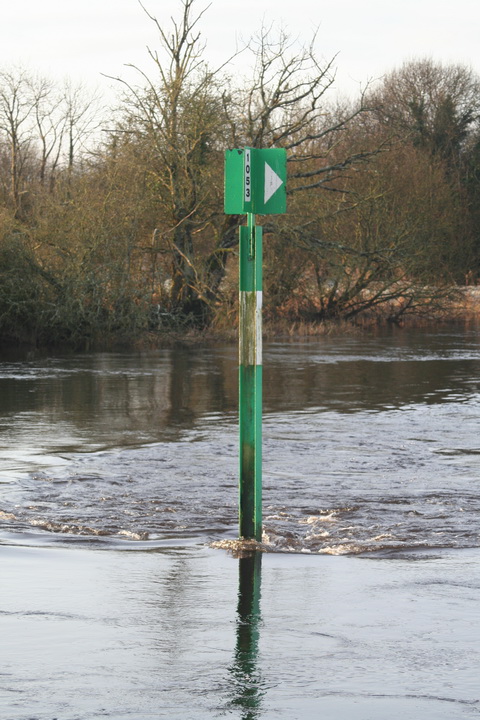
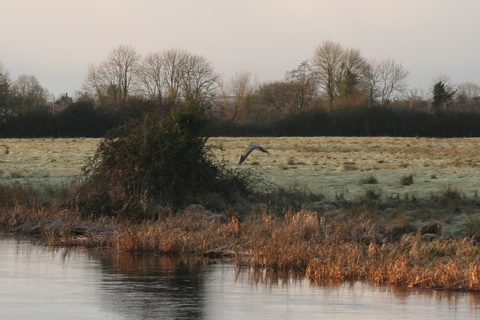
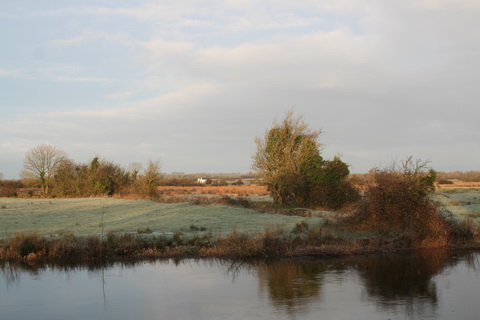
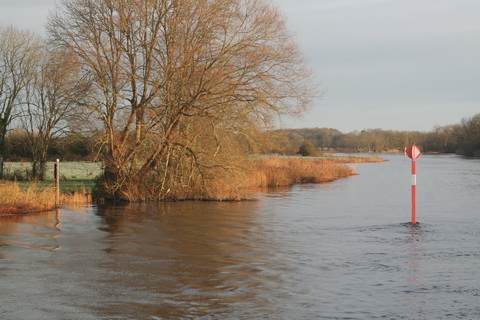
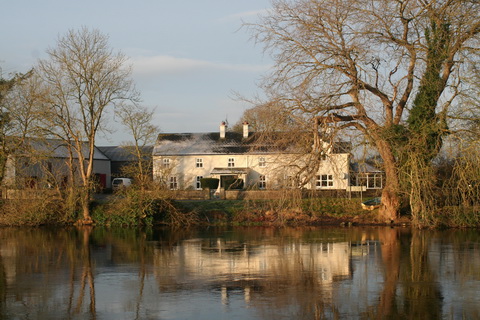
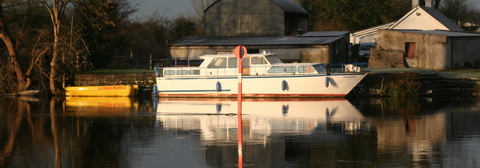
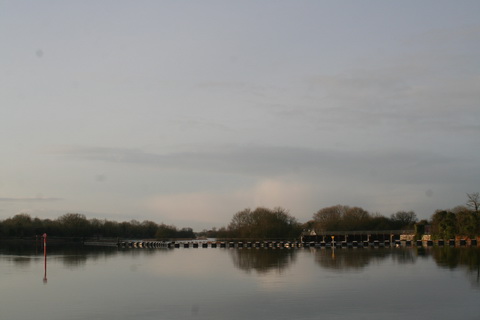
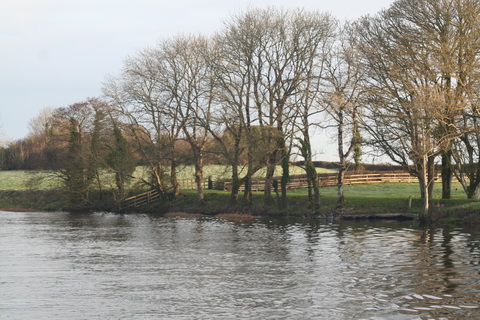
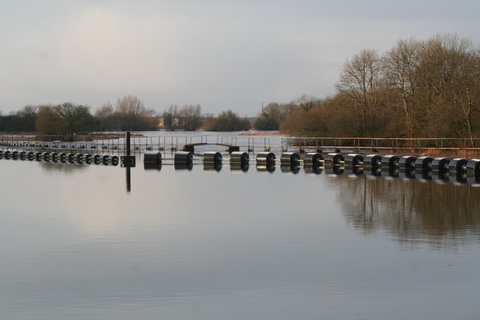
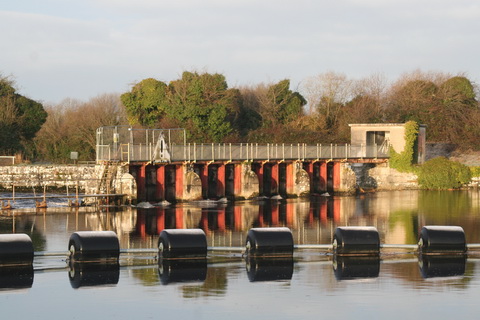
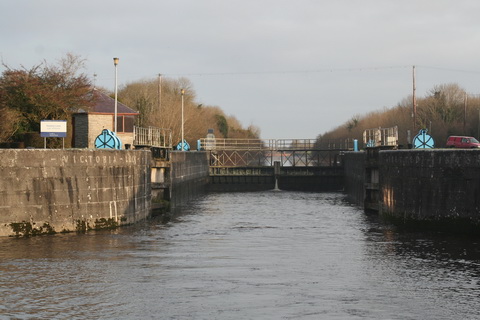
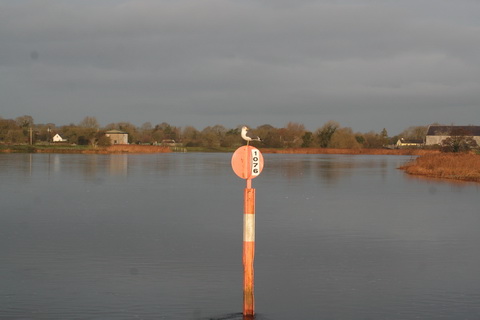
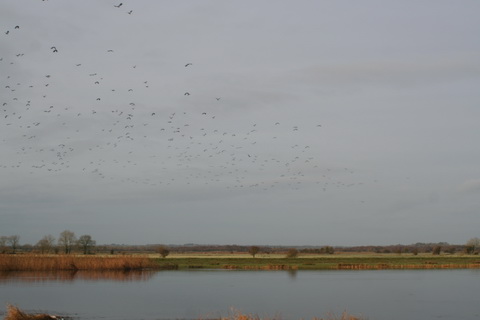
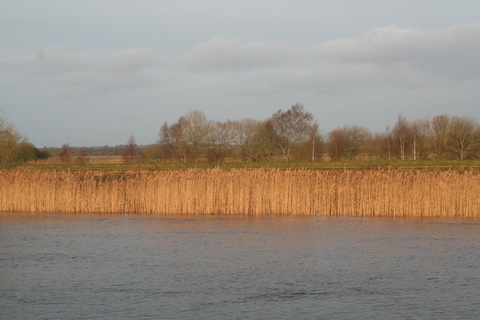
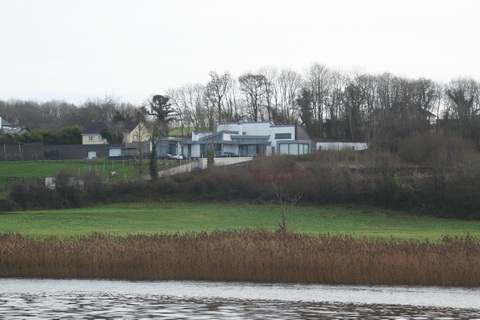
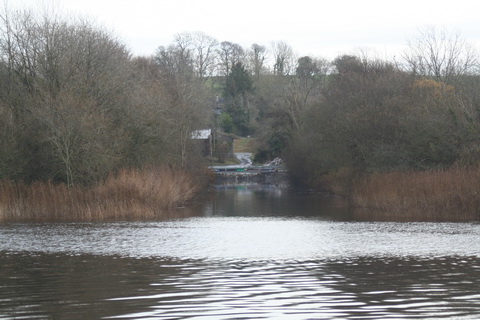
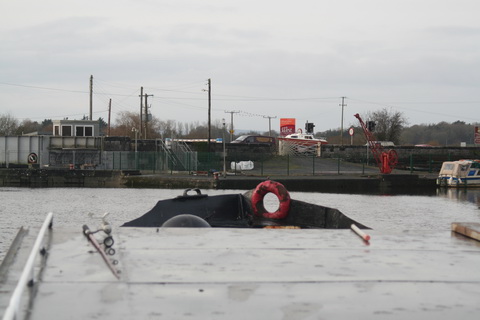
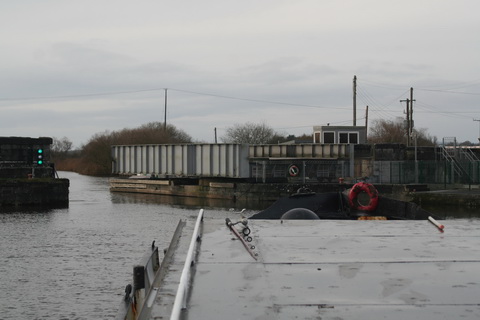
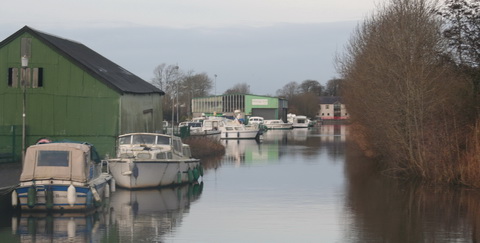
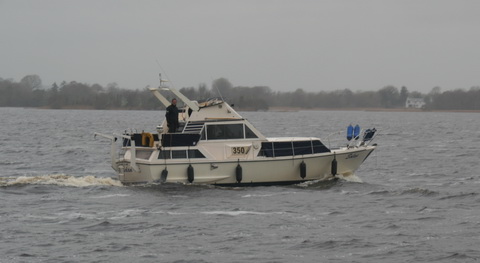
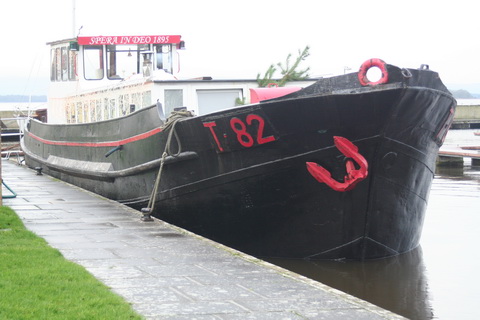
Downriver from Shannon Harbour to Dromineer in December 2014. It began as a bright, cold morning.
There is a YouTube video of the shooting of the bridge here. It seems to start automatically, including sound; I don’t know how to avoid that.
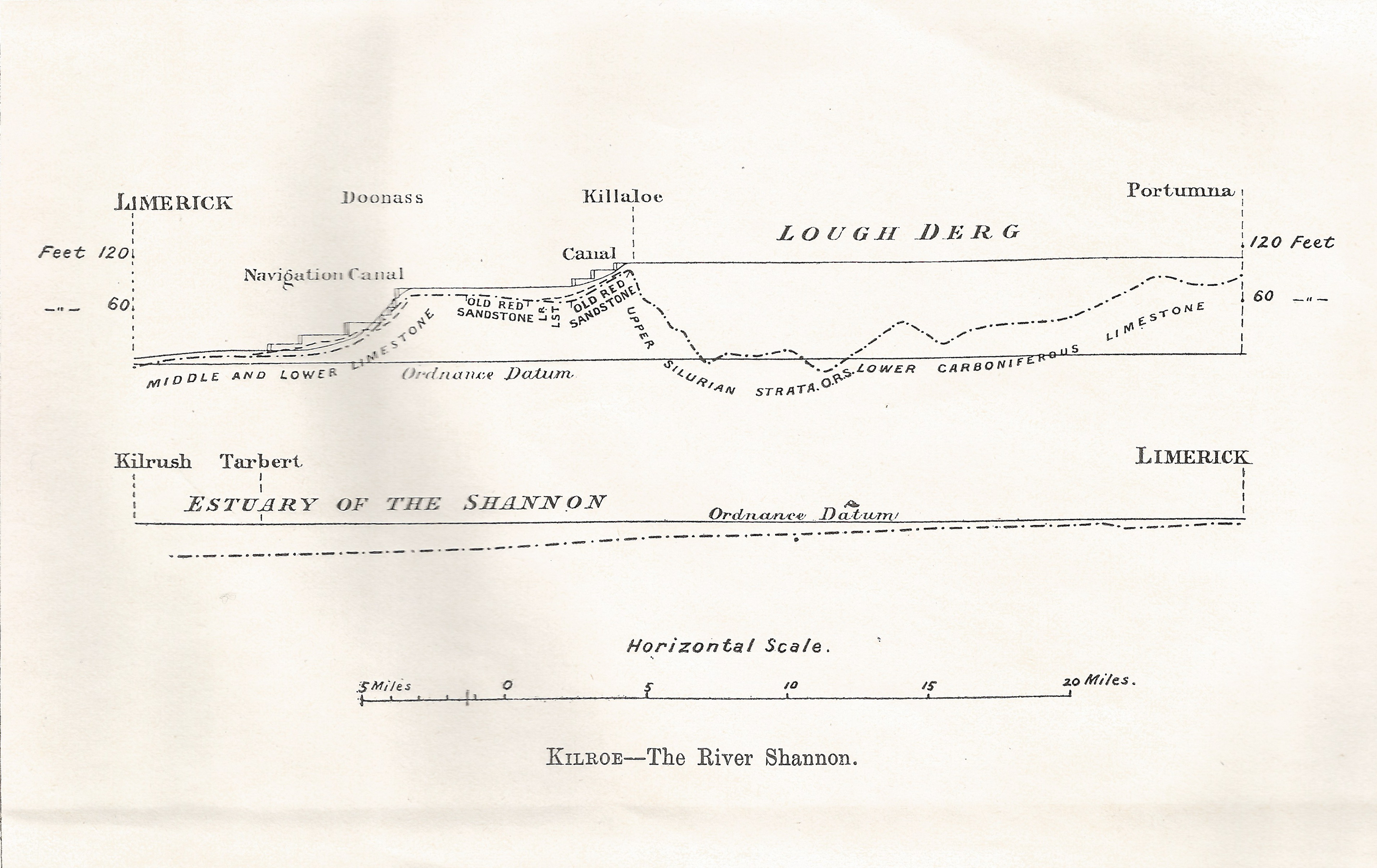
On 28 January 1907 James Robinson Kilroe [near the bottom of the page] of H M Geological Survey read to the Royal Irish Academy a paper on “The River Shannon: its present course and geological history” [Proceedings of the Royal Irish Academy Vol XXVI Section B No 8 Hodges, Figgis & Co Ltd, Dublin; Williams & Norgate, London 1907]. I thought that Plate V was interesting.
Kilroe wrote:
It will be perceived that instead of the river being shallow over the unyielding Silurian slate-rock, set almost vertically, and striking across the river-course, it is deeper than over the limestone of Lough Derg, and much deeper than over the comparatively easily eroded Old Red Sandstone at Killaloe. The river-bed actually drops below the datum line above the town, while at the town it is 100 feet above datum.
Old Red Sandstone strata are here to be seen in the river-bank, and Silurian rocks in situ in its bed. A barrier is thus formed, partly of Silurian, and partly of Old Red Sandstone rocks, which without the artificial impounding weir would retain the waters of Lough Derg to a depth of some 104 feet opposite Derrycastle — two miles above Killaloe.
One might have expected to find a fairly level shallow bed from Killaloe northward, a sudden drop from slate-rock to the sandstone floor, and a pronounced wide, well-formed valley in the limestone district southward to Limerick.
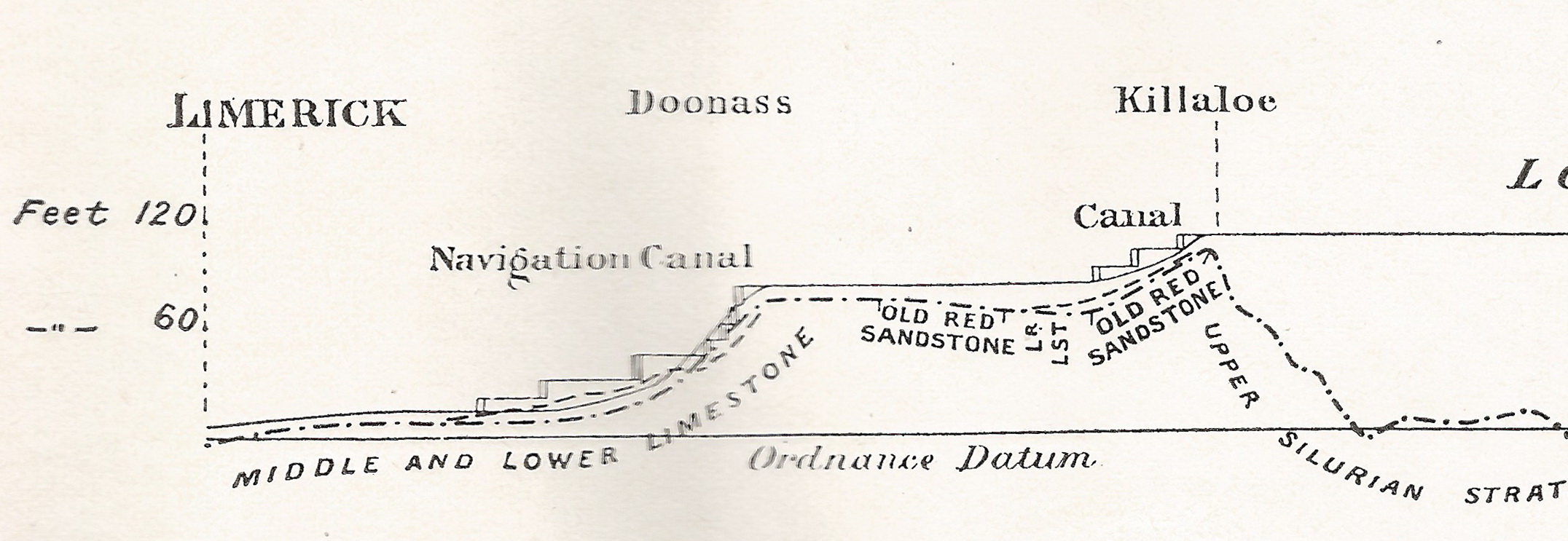
None of these elements exist; instead, we have the formidable barrier at Killaloe, naturally damming up a considerable depth of water in Lough Derg, and the river falling away southward by a series of rapids which correspond with drops in the canal, south of O’Briensbridge […], along an alternative course, possibly one used by a branch of the Shannon.
Here is an extract from the Plate V map, showing the steps of the (pre-Ardnacrusha) Limerick Navigation between Lough Derg and the sea.
Kilroe wrote of Lough Ree:
The waters of Lough Ree stood some 10 feet higher within recent times than they now do, as proved by evidence of solution, with under-cutting of limestone blocks, to be seen about five miles north-west of Athlone, close to the railway, in the townland of Cornaseer.
Under these conditions the lake must have been, perhaps, twice its width, and for a considerable period. Its ancient surface-level is clearly indicated by the caps of the mushroom-shaped blocks.
And of the Shannon between Lough Ree and Lough Derg:
The extreme flatness of the river between Athlone and Meelick is such that, consequent upon the completion of the Suck Drainage-works in 1892, it was found that the callows along the Shannon above the confluence of the Suck at Shannonbridge were much more liable to sudden and frequent floodings than they previously had been.
The more rapid discharge of the Suck waters into the Shannon, before ordinary extra water had time to pass away, had the effect of modifying the regimen of the main stream to an extent which resulted in an action at law [La Touche -v- The Suck Drainage Board].
I have found only one account of that case, in the Freeman’s Journal of 1 July 1893. The plaintiffs, Messrs Harrison and La Touche, owned land at Cappaleitrim, on the west bank of the Shannon above Shannonbridge. They said that the actions of the Suck Drainage Board had caused their lands to be flooded:
[…] that the defendants brought water from the Suck into the Shannon, containing a drainage of 40 miles, with such velocity and such volume that the Shannon was penned back, and that the back water caused the damage to the lands complained of.
[…] The jury disagreed and were discharged.
I don’t know whether the matter ever again came before a judge.
Posted in Ashore, Built heritage, Canals, Drainage, Economic activities, Engineering and construction, Extant waterways, Industrial heritage, Ireland, Irish waterways general, Natural heritage, Operations, People, Safety, Shannon, Sources, The cattle trade, waterways, Waterways management, Weather
Tagged bridge, canal, Cappaleitrim, Cornaseer, Doonass, drainage, estuary, floods, flow, Ireland, Killaloe, Kilroe, Limerick, lock, Lough Derg, Lough Ree, O'Briensbridge, Operations, RIA, Shannon, Shannonbridge, Suck, water level, waterways
On 26 November 2012 I noted that
The Royal Canal water supply applications have been approved by An Bord Pleanala. There were two separate applications […] but they were in effect treated as one.
There were conditions attached, but I concluded that
If I remember correctly, the amount of water available from Lough Ennell will not always provide enough (eg in a dry season) to keep the canal full. Still, this is a significant advance for Waterways Ireland and for Royal Canal enthusiasts.
So here we are, almost two years later, and the work of providing a supply from Lough Ennell to the Royal Canal, reckoned to be about a five-month job, has doubtless been long completed, no?
No.
The work has not yet started and Waterways Ireland will be lucky if it gets done within the next year.
As I understand it — and if, Gentle Reader, you have more information, do please leave a Comment below (your name can be kept out of public view if you like) — there are three sources of delay:
Irish Water has published its proposed Capital Investment Programme [PDF] but Appendix 1, the Investment Plan Project Summary, is in a separate file [PDF]. Category B is headed Review Scope and Commence Construction and it includes
Mullingar Regional Water Supply Scheme (G) … Lough Ennell Abstraction.
I can’t work out what “(G)” means. A few items are so marked; a few others are marked “(H)”; most items have neither.
The Capital Investment Programme [CIP] document says:
The CIP is dominated by contractual commitments entered into previously by Local Authorities, and which have now transitioned to Irish Water. In the 2014-2016 period, Irish Water will fund these contracts to completion and bring forward programmes and prioritised projects to commence. At the same time, it will progress a large portfolio of projects that are at the planning and design stage, reviewing their scope, budgets and, where appropriate, timing to favour maximising the performance of the existing assets through intensified capital maintenance that might allow deferral of major capital investment.
Emphasis mine. So that raises the possibility that Irish Water will decide not to fund the abstraction scheme but will rather opt to pay for continued pumping.
It is, of course, quite possible that I have misunderstood these difficult matters, so I will be glad to hear from anyone with better information.
Incidentally, reviewing Irish Water’s documents suggests to me that there are people there who know what they are doing and who have the expertise to manage large and complex operations. That differentiates them from the politicians in government and opposition, few of whom (as far as I can see) have any experience of running anything more complex than a parish social.
Posted in Built heritage, Canals, Drainage, Economic activities, Engineering and construction, Extant waterways, Industrial heritage, Ireland, Natural heritage, Non-waterway, Operations, People, Politics, Restoration and rebuilding, Sources, Tourism, waterways, Waterways management, Weather
Tagged bridge, Brosna, canal, Clonsingle, county council, department of arts heritage and the gaeltacht, floods, flow, Ireland, irish water, lock, Lough Ennell, Lough Owel, Mullingar, Operations, Royal Canal, water level, water supply, waterways, Waterways Ireland, weir, Westmeath
If you’re anywhere near Athlone, hie thee to the Lough Ree Yacht Club at 8.00pm on Wednesday 22 October 2014 for the Old Athlone Society meeting. It features Paul Clements, who has just written a biography of Richard Hayward, author (amongst many other roles) of (amongst many other books) Where the River Shannon Flows, a book that should be in every Irish waterways person’s library.
The evening includes a showing of the film of the same name, which (though short) is highly evocative. WW2 was declared as the filming team reached Portumna. There is some very good footage of the Foynes flying-boats.
h/t gjb
Posted in Ashore, Economic activities, Engineering and construction, Extant waterways, Ireland, Irish inland waterways vessels, Non-waterway, Operations, People, Sea, Shannon, shannon estuary, Sources, Tourism, Water sports activities, waterways, Waterways management
Tagged flow, Ireland, LRYC, Old Athlone Society, Paul Clements, Richard Hayward, Shannon, Where the River Shannon Flows
… perhaps. The water depth at Banagher has stayed at around 2.1 metres but that at Athlone has gone down to about 2.0 metres. Are TPTB lowering Lough Ree so that it can store the water from the autumnal rains? Information welcome.
Posted in Ashore, Built heritage, Drainage, Economic activities, Engineering and construction, Extant waterways, Ireland, Operations, People, Politics, Safety, Shannon, Sources, waterways, Waterways management, Weather
Tagged Athlone, Banagher, CFRAM, floods, flow, Ireland, Lough Ree, Operations, OPW, Shannon, waterways, weir
The government’s new election manifesto construction strategy has just been published and can be downloaded here. I wouldn’t bother, though: there’s nothing in it about the Clones Sheugh and it’s written in the sort of turgid prose that won’t fry your brain: it will instead submerge your brain in a slurry pit and hold it under, providing a slow, choking, unpleasant death.
Anyway, the doughty Rob Kitchin has waded through it on our behalf and gives his conclusions here. I don’t share his enthusiasm for National Spatial Strategies and National Development Plans, but I have some sympathy for him when he says
I would have preferred something a bit more holistic, rather than trying to frame a whole bunch of stuff as a coordinated plan.
Michael Hennigan uses the B word.
Posted in Ashore, Built heritage, Canals, Drainage, Economic activities, Engineering and construction, Extant waterways, Ireland, Non-waterway, Operations, People, Politics, Restoration and rebuilding, Safety, Shannon, Sources, Ulster Canal, waterways, Weather
Tagged canal, department of arts heritage and the gaeltacht, floods, flow, Ireland, Operations, Shannon, Ulster Canal, water level, waterways
Patrick O’Donovan [FG, Limerick] wants to drain the Shannon. Or wants farmers to do it. He doesn’t want the “multiplicity of agencies [which] have made it virtually impossible for anything to be done with the river and the rivers and streams draining into it”; he wants a non-multiplicity of agencies — “the OPW, the Department of the Environment, Community and Local Government, Inland Fisheries Ireland or whoever” — to dig sheughs and stop flood plains flooding. He says
The one group of people who seem to have no say are those who live on the banks of the rivers or who have watched thousands of gallons of water coming in their front door and out their back door.
But he is wrong. That is the one group of people who can stop flood waters coursing through their houses and who can do it most quickly, most easily and without the permission of a single state agency.
The solution is simple: they should move house, away from the flood plains to higher ground.
Posted in Ashore, Canals, Drainage, Economic activities, Engineering and construction, Extant waterways, Ireland, Natural heritage, Non-waterway, Operations, People, Politics, Safety, waterways, Waterways management, Weather
Tagged flood plains, floods, flow, Ireland, Operations, Shannon, water level, waterways, Waterways Ireland