Tag Archives: Killaloe

Two brief notes about eels

Fr Oliver Kennedy, of the Lough Neagh Fishermen’s Cooperative Society, which ran the eel fishery [PDF], has died at the age of 83.

The ESB eel-catching apparatus at Killaloe Bridge is being renewed (and not, as I feared, removed). Eels are caught now only to be transported around Ardnacrusha. Read about the fishery here and, at greater length, here.

Canal carrying 1846: the Grand Canal

Isaac Slater’s Directory[i] of 1846 lists those carrying goods on inland waterways. Most of the carriers on the Grand Canal, which runs from Dublin to the River Shannon with various branches, claim to serve a modest number of places, but Thomas Berry & Co have a very lengthy list. So long is their list that it will require two maps to show all the places they served, with a third map for the rest of the carriers.

Note that the maps are from the 25″ Ordnance Survey map of around 1900 rather than the 6″ of around 1840: I used it because it was clearer, but it shows features (eg railway lines) that were not present in 1846.

There may be some cases where I have misidentified a destination; I would be grateful to have my attention drawn to such cases.

Click on a map to get a slightly larger version.

Thomas Berry & Co

Thomas Berry & Co midland and south routes

Thomas Berry & Co midland and southern destinations (OSI)

The canal runs from Dublin, at the top right, left (roughly west) through Tullamore to Shannon Harbour, where it meets the river; there was an extension to Ballinasloe on the far side of the Shannon. Berrys served places along the canal and several others fairly close to it, but it looks to me as if there were three routes by road beyond that:

  • via Banagher (which has a bridge across the Shannon) to Eyrecourt and Killimor
  • from Ballinasloe to Loughrea and district and then south-west to Ennis in Co Clare
  • perhaps from Tullamore to Birr [Parsonstown], Roscrea (including Shinrone, Cloughjordan and Borrisokane) and Templemore.

There are also two outliers for which I can think of no plausible explanation: Baltinglass and Wexford. Perhaps their inclusion was a mistake. Certainly Berrys, like John M’Cann & Sons on the Royal Canal, seem to have had extensive road networks (perhaps using car-owning subcontractors?) to supplement their water-borne routes, but I don’t see why they would take on a route no part of which could sensibly have been conducted by inland navigation.

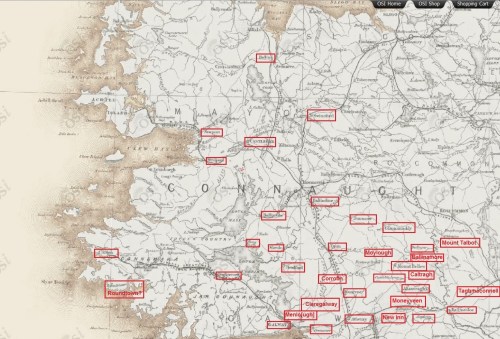
The next map shows the north-western destinations served by Berrys.

Thomas Berry & Co western routes

Thomas Berry & Co north-western destinations (OSI)

You can see that their network covered much of County Roscommon and went almost as far west into County Galway as it was possible to go; it also extended northwards into County Mayo.

I have not attempted to check what industries might have made these towns and villages worth serving. Berrys certainly seemed keen to take as much as possible of the traffic from west of the Shannon towards Dublin — excluding such of it as went by the Royal Canal: it is interesting to compare these maps with that for M’Cann on the Royal.

Finally, note that along the canal itself Berrys listed only destinations towards the western (Shannon Harbour) end: it seems likely that the roads took the valuable traffic from the eastern end into Dublin. There were no doubt turf boats taking fuel in from closer to Dublin, but they were not general carriers.

Other carriers

Now for the rest of the carriers.

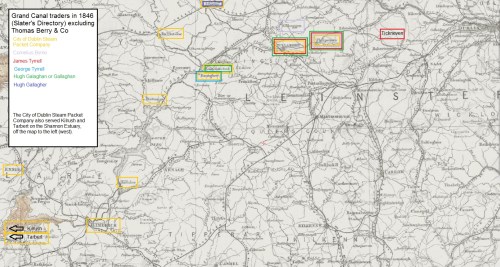
Grand Canal carriers 1846 excl Thomas Berry

Grand Canal carriers 1846 excluding Thomas Berry (OSI)

I have included the Shannon here as well as the Grand Canal; however I have covered the Barrow Line of the Grand Canal, as well as the navigable rivers Barrow, Nore and Suir, in a separate post. Of the carriers listed here, only the City of Dublin Steam Packet Company [CoDSPCo] (which employed horses to pull its boats on canals) ventured on to the Barrow Line, serving Portarlington and Mountmellick.

Berrys and the CoDSPCo were by far the largest firms on the Grand. I don’t know the size of the Berrys fleet, but the CoDSPCo had 52 barges in addition to its Shannon (and Irish Sea) steamers. Note that only on the middle Shannon, around the junction with the Grand Canal, and at Ennis did the two firms serve the same destinations: the CoDSPCo seems to have had the lower Shannon trade to itself.

With one exception, all the carriers, including Berrys, had Dublin depots at Grand Canal Harbour, James St; the Grand Canal Docks at Ringsend, joined to the Liffey, were not mentioned.

The exception is Hugh Gallagher, whose only listed destination was Athlone. It would be interesting to know how he served Athlone: whether by road or by water and, in the latter case, whether he used a steamer. I do wonder whether Hugh Gallagher might be the same person as the Hugh Galaghan (also Gallaghan) who served Philipstown [now Daingean], Tullamore and Shannon Harbour.

George Tyrrell is another who is listed with but a single destination, Banagher, whereas James Tyrrell is listed as serving Tickneven, Philipstown, Tullamore — and Edgeworthstown, which must be a mistake as it is closer to the Royal Canal.

Finally, Cornelius Byrne is shown as serving two destinations: Philipstown and Kilbeggan (which has its own branch off the main line of the canal).

Other information

A little extra information is available from the entries for towns other than Dublin in the Directory:

  • Naas has its own branch from the main line of the canal, but the directory says that “TO DUBLIN, there are Boats, as occasion require, but they have no fixed periods of departure.”
  • Edenderry also has its own branch, short and lock-free, but there is no mention of its being served by trade boats
  • Kilbeggan, with a longer, leakier, lock-free branch, was served by the CoDSPCo’s and Thomas Byrne’s boats travelling to Dublin three times a week. Is this Thomas Byrne related to the Cornelius Byrne mentioned above? It seems that Byrne went only eastward for only the CoDSPCo’s boats went westward (to Shannon Harbour, Ballinasloe and Limerick) two or three times a week
  • at Banagher, Fleetwood Thomas Faulkner of Main Street was the CoDSPCo agent; a downstream steamer left Shannon Harbour after the [passenger] boat from Dublin arrived and called at Banagher’s Bridge Wharf; an upstream steamer from Limerick called every afternoon at 3.00pm and met the night boat travelling to Dublin by the Grand Canal. I presume that this happened on every day except Sunday.

More

As far as I know, little has been written about the carrying companies, especially those of the nineteenth century. I would be glad to hear from anyone who can correct, supplement or comment on this information.

My OSI logo and permit number for website


[i] I Slater’s National Commercial Directory of Ireland: including, in addition to the trades’ lists, alphabetical directories of Dublin, Belfast, Cork and Limerick. To which are added, classified directories of the important English towns of Manchester, Liverpool, Birmingham, Sheffield, Leeds and Bristol; and, in Scotland, those of Glasgow and Paisley. Embellished with a large new map of Ireland, faithfully depicting the lines of railways in operation or in progress, engraved on steel. I Slater, Manchester, 1846

Shannon traffic to June 2013

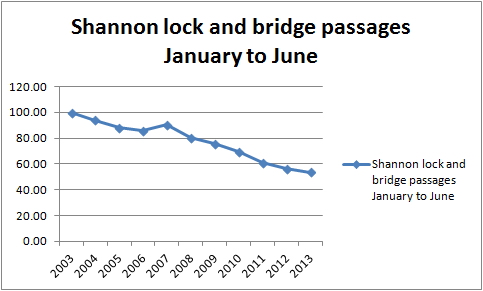
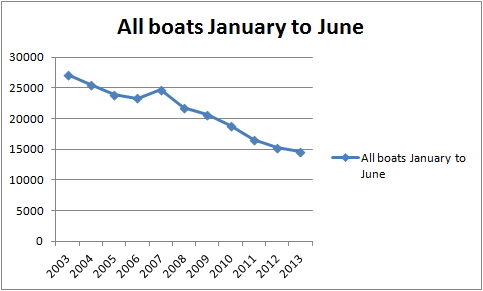
The figures for Shannon lock passages to the end of June 2013 are now available. The decline continues, though perhaps more slowly.

Shannon traffic Jan to June percent

Shannon lock and bridge passages January to June as percentages of the 2003 number

The usual caveats apply: the underlying figures (kindly supplied by Waterways Ireland) do not record total waterways usage because, for instance, sailing, fishing or waterskiing on lakes or river stretches, which did not involve a passage through a lock or Portumna Bridge, would not be recorded. The passage records are our only consistent long-term indicator of usage of the Shannon but they would not show, for instance, a change in the balance of types of activities from those in larger cruising boats to those in smaller (sailing, fishing, waterskiing) boats. It is quite possible, therefore, that overall usage might be increasing while long-distance cruising was declining.

Shannon traffic Jan to June private

Shannon lock and bridge passages by private boats January to June

As it happens, the figures show a small increase over 2012 in passages by private boats. I suspect that July’s warm weather will spur a further increase.

Folk living in Ireland, whether owners or prospective hirers, are likely to be able to react quickly to better (or worse) weather by doing more (or less) boating; folk living abroad may be less able to change their holiday plans. Accordingly, July’s weather might (I’m speculating here) mean an increase in passages by private boats and by boats hired by Irish residents; it might not lead to an increase in hiring from abroad.

Traffic in hired boats continued to decline in June.

Shannon traffic Jan to June hire

Shannon lock and bridge passages by hired boats January to June

That decline outweighed the small increase in private traffic, leading to an overall decline in the first six months as compared with the same period in 2012, which itself continued the pattern set in 2007.

Shannon traffic Jan to June all

Shannon lock and bridge passages by all boats January to June

I wondered whether the figures might show any change in the geographical distribution of activity. WI’s reports don’t show separate figures for private and hired boats for the individual locks, but it seems to me that the hire business is becoming more concentrated on northern waters, from Lough Ree upwards. If that is so, then there might be an increase in the proportion of passages through the northern locks, from Tarmonbarry upwards, and a decrease in the proportion passing through Portumna Bridge and Meelick (Victoria) Lock.

I put the WI reporting stations in four groups:

  • Portumna + Meelick
  • Athlone
  • Tarmonbarry, Clondra, Roosky, Jamestown (Albert), Knockvicar (Clarendon)
  • the also-rans: the three locks leading to Lough Allen, Pollboy leading to Ballinasloe, the Limerick sea-lock (Sarsfield).

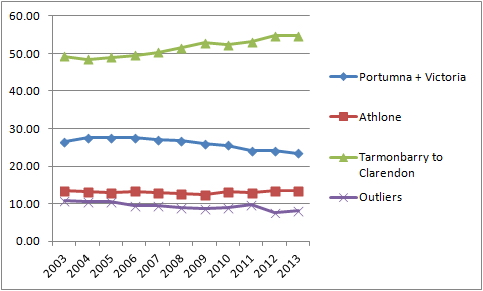
The figures suggest that the distribution is indeed changing, but gradually rather than dramatically. Athlone’s figures are pretty steady, the outliers are declining slightly and Portumna + Meelick are declining a bit more; the northern locks (Tarmonbarry to Knockvicar) are taking the gains. Comments or alternative interpretations welcome.

Change by region

Lock passages by group

The figures for 2013 are for the six months January to June; those for other years are for twelve months.

The locks could of course be grouped in other ways, and I may try some of them in future months.

Ardnacrusha drowning

Killaloe Coast Guard report.

Lough Derg search: addenda

Some additional information from the Clare Champion and the Limerick Post. The Irish Mirror has one of the few accounts that includes discussions with participants.

More to come.

Searching Lough Derg

Last Friday evening, 21 June 2013, was not a good time to be out on Lough Derg. We were heading north, with the waves behind us, and had little difficulty until entering port, but we could hear on the VHF what must have been one of the biggest search and rescue operations on the Shannon in recent years.

We had switched on at what seemed like a fairly early point in the proceedings, and kept listening until the Coast Guard were assured that everybody was accounted for. We weren’t able to attend to the whole thing, as manoeuvres during and after berthing occupied our attention for some time, but we got a pretty clear picture. The Irish Times report (which will probably disappear behind a paywall at some stage) is here; I think it has some minor details wrong but the gist of it is correct; its later report is here. The Clare Herald has a very detailed account here, the Clare Champion account is here and the Limerick Post adds some information here.

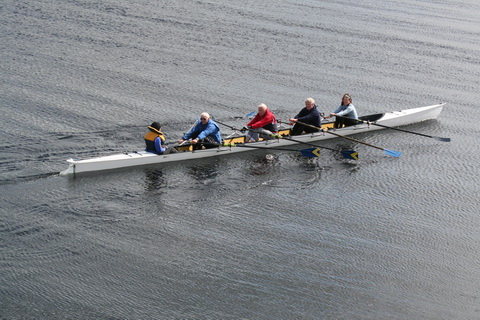
The event was said by the Irish Times to be “hosted for FISA in Ireland by St Michael’s Rowing Club of Limerick” but I can’t see anything about it on either organisation’s website. I presume that the boats were something like this one.

Quad at Clonlara in 2011

It’s a quad, with each rower using two oars; it carries a cox and it’s used for touring rowing, so it’s not as slim as a standard racing shell.

By the way, just to be clear, none of the photos on this page were taken during last Friday’s operation.

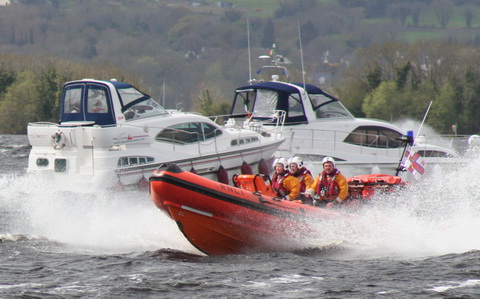
RNLI Lough Derg lifeboat

From what we could hear, the operation involved volunteers from Killaloe Coast Guard, the RNLI at Dromineer, the Community Rescue Boats from Mountshannon and Limerick and at least one yacht, which (I think) took one of the rowing boats in tow; that yacht’s participation and careful provision of information to the Coast Guard was admirable.

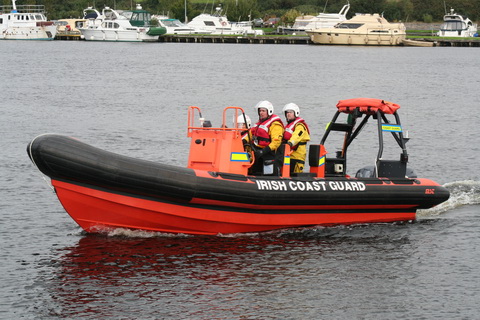
Killaloe Coast Guard RIB

Killaloe Coast Guard RIB

We heard discussion of proposals to ask the Civil Defence to participate as well, and the Clare Herald confirms they did turn out. It seems that the University of Limerick Activity Centre boat was out too, as was Peter Hooker of RNLI in his own boat.

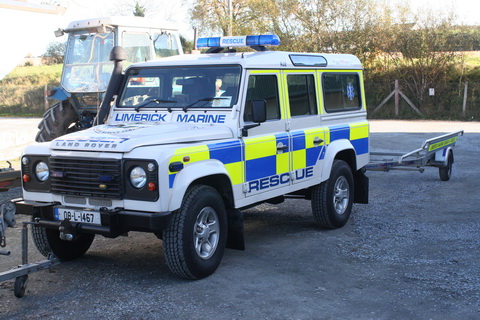
Limerick Marine SAR Land Rover

Limerick Marine SAR Land Rover

That’s just the volunteers, and if I’ve left anybody out I’m sorry; let me know and I’ll amend this.

Then there were the professionals: the Coast Guard staff on VHF, the Gardaí on shore, the helicopter crew. And, again, the Clare Herald makes it clear that lots of other people were involved too: fire brigade and ambulance units, paramedics and a hospital consultant.

All in all, this was a major operation and a lot of people put in a lot of effort that night, in bloody awful weather.

Communications

I formed the impression that communication amongst the members of the rowing fleet, and between them and the rescue services, was poor. It was difficult to establish what rowers were where and how many were unaccounted for. The Clare Herald story seems to support that conclusion: it says that Gardaí had to travel to the rowers’ hotel to make sure that everybody had turned up and that the search was not formally stood down until 11.30pm.

I don’t know what communications equipment and what sort of organisation and safety procedures the rowing group had, so I’m not going to comment on them. Instead, I want to go off at a tangent. It struck me that life would have been easier for everybody if each boat had had a handheld VHF and someone able to operate it. Such sets can be bought for as little as £50 in the UK or €75 in Ireland.

So the technology is now very cheap and, for short range work as on Lough Derg, a handheld VHF should be adequate. But if you want to be legally entitled to use a VHF set, matters are much more complicated. I’ll discuss that in another post.

Not Grand

Limerick’s SmarterTravel initiative aims to promote cycling, walking, car sharing and public transport. It has a little leaflet (I can’t find a downloadable version) describing five walking and cycling routes and including information on bus routes, a cycle to work scheme and car sharing.

One of the cycling and walking routes is along the towing path of the Limerick Navigation from Limerick to Plassey. It is described thus:

The Tow Path was part of the Grand Canal system stretching to Dublin and was used by the Guinness brewery to bring stout to Limerick.

The towing-path was not part of “the Grand Canal system”, although I suppose it might be described as a facility used by the Grand Canal Company. The Park Canal in Limerick, and the towing-path on the river navigation to Plassey, were not built or owned by the Grand Canal Company; they were part of the independent Limerick Navigation until subsumed into the Shannon Navigation in the 1840s. The Grand Canal Company was permitted to use its vessels on the navigation when it began carrying cargoes, which it did for, amongst others, Guinness; Guinness itself did not own or operate boats on the Shannon Navigation or the Limerick Navigation.


FF -v- SF on C18 economic development

More from the splendid KildareStreet.com, this time an actual Dáil debate, with real people speaking, on 30 May 2013. The debate was initiated by Micheál Martin [head honcho in FF, Cork South Central], who asked the minister …

… his plans for capital investment in Waterways Ireland in the coming year; and if he will make a statement on the matter.

There are three odd aspects to that question.

The first is that Micheál Martin should already know that the capital expenditure allocation for WI within RoI for 2013 is €4 071 000: I can understand that he wouldn’t have wanted to plough through the vast wodges of budgetary bumpf, but I’m sure he would have read the highlights on this site.

The second oddity is that Micheál Martin must have known that the minister would not himself have any plans for capital expenditure: they would be WI’s plans.

The third oddity is that FF didn’t seem to have any particular reason for asking this question: the rest of the debate (see below) seems rather desultory. Could it be that it’s trying to reclaim the waterways limelight from the Shinners, who’ve been keeping an eye on WI dredging as well as on thon sheugh?

To be honest, it all seems a bit pointless: waterways may be interesting to me, and presumably to readers of this site, but they’re hardly of great national importance. A serious debate, by informed participants, might be useful, but (with all due respect to the contributors) there was little sign of that here.

Jimmy Deenihan did actually give some interesting, albeit minor, details about WI’s plans for this year. I omit the first two paras and the last, which are boring boilerplate bumpf that will be familiar to regular readers.

Jimmy Deenihan [FG, Kerry North/West Limerick]: While the Waterways Ireland 2013 business plan and budget is the subject of ongoing discussions with the co-sponsoring Department of Culture, Arts and Leisure in Northern Ireland and will require formal approval by the North-South Ministerial Council, I have provided an indicative funding allocation of €4.071 million to Waterways Ireland for capital projects in this jurisdiction in the coming year. This will facilitate capital works by Waterways Ireland in developing, restoring and improving infrastructure for water based and activity recreation and tourism, consolidating facilitates and improving access to the waterways across the navigations.

I am advised that the Waterways Ireland draft 2013 business plan has a development schedule providing for 1354 m of additional moorings across the navigations. Works planned within this jurisdiction include a range of major projects such as upgrading Bagenalstown Lock on the Barrow; provision of a slipway and stabilisation of the dock walls at Grand Canal Dock, dredging the Grand Canal; development of houseboat facilities at Lowtown and Sallins; lifting the bridge at Tullamore depot; bridge upgrades, works on weirs and locks on the Shannon; and commencement of work on the Belturbet Service Block on the Shannon Erne and purchase of plant and machinery.

I said that I would welcome information about what “lifting the bridge at Tullamore depot” means. The answer was provided in the Comments below; here is a photo of the bridge in question.
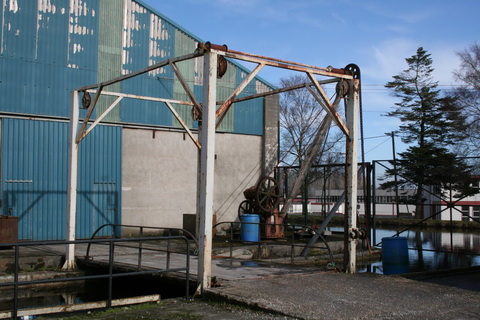
The (currently non-lifting) lifting bridge at Tullamore

The (currently non-lifting) lifting bridge at Tullamore


Most of the rest is unsurprising.

The FF follow-up came from Seán Ó Fearghaíl [FF, Kildare South], who said:

I welcome the many positive developments to which the Minister referred but one of our concerns is that since 2011 the funding available for Waterways Ireland has been cut from €35 million to approximately €32 million.

Studies over the years have shown that waterways tourism is one of the activities that is most likely to generate return visits. As a regular user of places like the Shannon Navigation, one never ceases to be amazed at the number of non-nationals one meets on that waterway who have been coming back to Ireland year in, year out. I wonder to what extent the funding the Minister has available to him should be augmented by the Department of Transport, Tourism and Sport. These waterways are of immense value to the local populations privileged to live in the catchment area of each amenity, along with their huge tourism importance. What sort of interaction does the Minister have with tourism bodies north of the Border and the Department of Transport, Tourism and Sport? Is anything planned for the waterways under the auspices of The Gathering?

What has happened in Kildare this week? We had Bernard Durkan [FG, Kildare North] the other day and Clare Daly [Socialist Party, Dublin North, but originally from Newbridge, Co Kildare] a moment ago; now we have a new chap from Kildare South.

Anyway, it can’t have come as any surprise to Mr Ó Fearghaíl that WI’s budget has been cut: so has everybody else’s, and the budgets were announced last December. I note that he didn’t ask how the Clones Sheugh was to be funded, never mind the Cavan Sheugh to Lough Oughter. But his question is the sort that a journalist might ask: vague, unfocused, couched in generalities, lacking in evidence of research into the subject. I would like to know more about his “Studies over the years”, with particular reference to the balance between and the allocation of the costs and benefits of investment in waterways; generating return visits is not in itself terribly useful (I really do not want Great Aunt Maud here again).

Not that the minister offered many hard facts in his reply:

I have seen for myself the provision of moorings at Killaloe and Ballina. Those have made a major difference to both towns in different counties on either side of the Shannon. The result of that investment is obvious and local people would accept that.

As regards involvement from Fáilte Ireland, Waterways Ireland is augmenting Fáilte Ireland’s promotion of the waterways. Waterways Ireland is providing funding on an annual basis for the promotion of tourism on its waterways. It is a North-South body, which is also very important, because Tourism Ireland promotes the entire island and the waterways network of more than 1,000 navigable kilometres can really be pushed on an all-island basis and we are doing that. I have tried to minimise the reduction in funding for Waterways Ireland because of its North-South significance and its potential and considerable work has been done. We have improved facilities for tourists so we are now ready to proactively promote this great facility.

Any, like, figures? Statistics? References to analyses? How much of WI’s budget is being diverted to the tourism bods and what is the benefit?

Next (and last) up was Peadar Tóibín [SF, Meath West], with “now for something completely different“:

A number of groups are actively trying to create a green way along the Boyne from the estuary to its source. The Boyne is littered with internationally recognised heritage monuments and would be a fantastic tourist attraction that would bring people into the region. People who holiday in the region visit Trim Castle and Newgrange on coach trips and as ar result Meath does not get the full value of their tourism. The Boyne Canal runs from Navan to Drogheda. It is not covered by the Waterways Ireland network. Would the Minister agree that such a canal should be brought within the ambit of Waterways Ireland, along with other canals, and would he consider the funds that might be available to help with the development of such a green way along the River Boyne?

The minister’s reply is interesting:

We have no plans to extend the present 1,000 kilometres of navigable waterways. The focus of our investment in capital development will be from Clones to Lough Erne to the value of €35 million.

What? No Cavan Sheugh? No Kilbeggan, Longford or Mountmellick Branch?

Oh, and note that the figure of €35 million is being quoted for the Clones Sheugh, although the last estimate I had form WI was higher than that.

The minister continued:

As regards the green way, I do not have direct responsibility but any way I can help through Waterways Ireland, I will do so. As a keen cyclist and walker, I am all for encouraging green ways wherever possible. If the Deputy has a proposal I can forward to Waterways Ireland for discussion, I will gladly take it.

Well, well. A Monaghan greenway is being developed; why not a Clones greenway too, instead of an expensive canal?

Courtesy flag

Proper order

Proper order

The Marquis survives

I reported last October that an unused London pub, named after Henry Petty-Fitzmaurice, 3rd Marquess of Lansdowne, KG, PC, FRS, was threatened with demolition in favour of a museum extension.

I pointed out that the late Marquis had two claims on the attention of Irish waterways enthusiasts. First, the best-known of the early River Shannon steamers, the Lady Lansdowne, was named after his wife. Second, he was Lord President of the Council [the current holder of the post is Nick Clegg] when the government of Her Late Majesty Queen Victoria decided, in 1839, to spend about half a million pounds improving the Shannon Navigation.

The Indie reports today that Hackney Council’s planning committee has voted against the demolition, so the Marquis survives, at least for now.