Tag Archives: lock

Closing the Shannon in winter

I pointed out some time ago that, in the Dáil on 16 October 2013, Jimmy Deenihan said:

The [budgetary] provision will enable Waterways Ireland to deliver on its core activities and targets, which include keeping the waterways open for navigation during the main boating season and promoting increased use of the waterways resource for recreational purposes.

That was the first time I noticed the suggestion that, in effect, boating in winter might be de-emphasised, as it were; the idea is followed up in the current draft of the Waterways Ireland Corporate Plan 2014–6. The proposal receives some support from the figures for Shannon traffic in the first three months of 2014.

I realise that, as the numbers are small, they can be affected by the high water levels, bad weather or the date of Easter, but those for 2014 are remarkably low. The totals for the first three months [Jan–Mar] since 2003 are:

2003  689
2004  536
2005 2229
2006  683
2007  825
2008 1449
2009  687
2010  567
2011  626
2012  736
2013  753
2014  260

All the usual caveats apply, notably that the figures do not capture boating that is confined to the lakes. Still, the 2014 figure is less than half the next lowest, and it’s the first time since 2003 that the figure has been below 500, 400 or 300.


A sheugh would solve it …

… not.

If you’re feeling the need of something to depress you, troll on over to the website of the Northern Ireland Community Relations Council and download the six PDF sections of the third Peace Monitoring Report. Written by Dr Paul Nolan, it is an extremely impressive piece of work — and a welcome counter to the witterings of the peaceprocess feelgoodistas who are so prominent on 2RN these days.

If you would prefer a summary, here is Liam Clarke’s account in the Belfast Telegraph, and here is his commentary; Tomboktu and others pointed to some problems with the headline on the first piece, but I’m more concerned that the focus on education in the headline on Clarke’s account may distort perceptions of what the report and, indeed, the rest of Clarke’s article are really about.

The report uses indicators grouped into four domains:

  • the sense of safety
  • equality
  • cohesion and sharing
  • political progress.

I didn’t find much that was cheering in any of them. Nolan lists ten key points:

  1. The moral basis of the 1998 peace accord has evaporated
  2. The absence of trust has resulted in an absence of progress
  3. There has been some increase in polarisation
  4. A culture war is being talked into existence
  5. The City of Culture year presented a different understanding of culture
  6. Failure lies in wait for young working-class Protestant males
  7. Front line police have been the human shock absorbers for failures elsewhere
  8. The rebalancing of inequalities unbalances unionism
  9. At grassroots level the reconciliation impulse remains strong
  10. No one picks up the tab.

Only the fifth and ninth offer any good news. But, from a waterways perspective, I was struck by the complete irrelevance of the proposed reconstruction of the Ulster Canal, the Clones Sheugh, to solving any of these problems. Yet Waterways Ireland, around whose neck this dead albatross has been hung, is the largest of the cross-border bodies and the sheugh is the largest capital project proposed to be undertaken by any of them. If the Irish government wants to do something to solve the real and continuing problems of Northern Ireland, as outlined in the Peace Monitoring Report, couldn’t it find something more useful to do?

Incidentally, I have not been able to find coverage of the report on the websites of the Irish Times, Irish Independent or Irish Examiner, although that may reflect poor searching on my part rather than any lack of interest on theirs.

The Mahmoudié Canal

There is a possible link between the Mahmoudié Canal, which ran from Alexandria to the Nile, and Irish waterways. I have not managed to establish a definite link to this Irish canal-boat but it is not ruled out either, and a few other Irish connections came up along the way: Oscar Wilde’s father, for instance, who wrote about the Boyne and the Corrib, and sent his most famous son to school on the Erne, travelled on the Mahmoudié Canal.

And did you know that, in the early 1840s, you could buy bottled Guinness and Bass in Cairo? Or that, to transport 50 people (including 12 ladies and 3 female servants) and 3 bags and 62 chests of mail across 84 miles of desert, you would have needed, in 1841,

  • 130 camel men, donkey men and servants
  • an escort of 17 Arab horsemen
  • 145 camels
  • 60 donkeys
  • 12 saddle horses
  • 12 carriage horses
  • 7 carriage camels
  • 12 donkey chairs: “for invalids, or ladies, the donkey-chair forms as easy a conveyance as a palanquin or sedan”
  • 3 two-wheeled carriages
  • 1 four-wheeled carriage?

Or that, to reduce the number of rats and insects on a cangia (sailing boat) on the Nile, you should sink it for two or three days before boarding?

You can read about all of that and more in this PDF. However, it’s not for the faint-hearted: it’s 51 pages, with over 300 endnotes (which you don’t have to read) and lots of links for those who are really interested. There are illustrations in some of the linked materials.

The Mahmoudié mystery v04 iwh [PDF]

Bernard Durkan TD

I have sent this email to Bernard Durkan, a Fine Gael TD for Kildare North:

Greetings.

It is reported that, in the Dáil on 6 March 2014, you said:

“The canal restoration that has taken place over the past 50 years was largely done through voluntary effort. While Waterways Ireland has an involvement in upgrading the canals, and it has a responsibility that we all respect, cognisance should be taken of the huge voluntary effort in the restoration of the canals.”

I would be grateful if you could tell me the evidence for your assertion. How did you measure restoration and the respective contributions of volunteers and of Waterways Ireland and its predecessor bodies?

Best wishes
bjg

I may confess that I think he’s talking through his hat, but I will read his evidence with interest.

Rural nitwits and retirement communities

I’ve just been writing elsewhere to the effect that national politicians are a pack of nitwits. I was cheered therefore, in a sense, to note that local politicians, at least in Co Mayo, are (if possible) even more thick-headed than their national counterparts.

However, I am happy to be able to offer a solution, one that kills two birds with one stone. There are, it seems, many English pensioners living in poverty on boats on the canals and unable (or at least unwilling) to pay for the privilege. I had intended to suggest that Waterways Ireland should provide them with moorings away from the honeypot areas.

WI could then charge more for berths at, say, Hazelhatch, Sallins, Blanchardstown and Lowtown, catering for those in work who could afford a couple of thousand a year, while the pensioners, who don’t need to be within commuting distance of Dublin, could be accommodated in rural areas where their small additional spending would make a difference. That would help to increase those community and economic benefits to which the subsidy-seeking boat-owners draw our attention, bringing spending to deprived rural areas.

I was thinking of Pollagh, for instance: it has a pub, a shop, a church and a visiting burger van, and easy access to supplies of turf.

But the Mayo problem reminds me that Mayo too has lakes. So why not ship the boats to Mayo? As the canals byelaws provide that boats should not discharge any water other than from engine-cooling, these boats must be fitted with holding tanks or other non-discharging loos, so there would be no pollution problem. In fact Mayo could advertise itself to the world as offering floating retirement communities at modest cost, thus renewing its own population while solving a problem for boat-owners. I thnk this is a winner.

Shannon traffic 2013

Some weeks ago Waterways Ireland kindly supplied me with the Shannon traffic figures for the final three months of 2013 and I have just now had a chance to add them to my spreadsheets and produce some graphs.

The usual caveats apply: the underlying figures do not record total waterways usage (even for the Shannon) as, for instance, sailing, fishing or waterskiing on lakes or river stretches, which did not involve a passage through a lock or Portumna Bridge, would not be recorded. The passage records are our only consistent long-term indicator of usage of the Shannon but they would not show, for instance, a change in the balance of types of activities from those in larger cruising boats to those in smaller (sailing, fishing, waterskiing) boats. On the other hand, they do include the Shannon’s most significant tourism activity, the cruiser hire business.

It is good to note, incidentally, that, in its draft Corporate Plan 2014–2016, Waterways Ireland says that it intends to

Develop and implement a research programme to measure waterway usage and inform planning and development.

It won’t be easy to do, but we need much better measures of all types of activities on all seven of the waterways managed by WI.

The final outcome for 2013 won’t greatly surprise anyone who has read earlier bulletins on this subject, like this covering the figures to end-September 2013. All the illustrations are based on information supplied by Waterways Ireland, with some minor adjustments by me to eliminate anomalies, but the interpretation and comments are mine own.

All boats full year

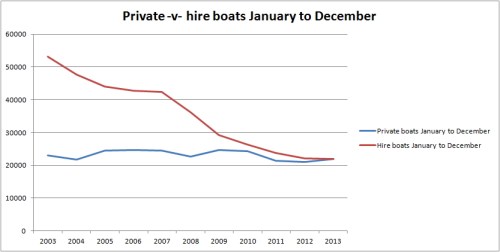
Total Shannon traffic 2003–2013, private and hired

The decline in traffic since 2003 seems to have been halted …

All boats full year %

Total Shannon traffic as a percentage of 2003 traffic

… but it is 40% below what it was in 2003.
Private boats full year %

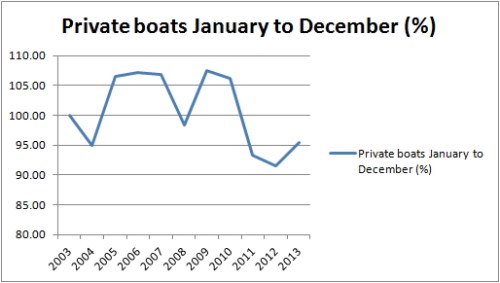
Private-boat traffic 2003–2013 as a percentage of 2003 traffic

Traffic in private boats seems to be recovering, but what is perhaps more significant is that it never went more than 10% above or below the 2003 figure. It has been remarkably stable over the period, despite the economic crash and despite the anecdotal evidence of boats being sold to overseas owners and trucked out of the country. Perhaps larger boats were replaced by smaller? Perhaps only boats bought in the boom were sold in the bust? Unfortunately the deficiencies of the registration system make it very difficult to determine what has been happening.

Hire boats full year %

Hire-boat traffic 2003–2013 as a percentage of 2003 traffic

But if private-boat traffic has been remarkably stable since 2003, the same cannot be said of hire-boat traffic. The best that can be said of 2013 is that the figures didn’t get [much] worse, but a 60% decline since 2003 is really, really dreadful.

WI’s draft Corporate Plan, which does not explicitly mention the hire industry, talks of

… unlocking opportunities to achieve recreational growth, and economic and social development.

I don’t know whether that omission means that WI sees little prospect of a rejuvenated hire-boat industry. And I note that, other than in the titles of organisations, the draft plan rarely mentions tourism or tourists. Are the waterways only for natives? If so, is that a deliberate policy decision? Or is there something that could be done, cheaply, to help to revive waterways tourism?

Emma Kennedy, writing in the Sunday Business Post on 23 February 2014, wrote about Fáilte Ireland’s latest brainwave, which is to “target” three groups:

  • social energisers, which are gangs of young people interested in “new and vibrant destinations”, which I take to mean Temple Bar
  • culturally curious folk aged 50 or over, with money, who are interested in “exploring new landscapes, history and culture”
  • great escapers, who like energetic rural holidays with their partners.

No families with kids, I see, although “Families & Loved Ones” (the latter term, by the way, nowadays seems to mean either dead people or their relicts) were one of the two “primary target customer segments” identified in Fáilte Ireland’s Inland Cruising Market Development Strategy. (Fat lot of good that strategy did, but we mustn’t be bitter.)

Anyway, without having done any market studies (though WI has funded lots of them), it seems to me that there is scope for more tourism on the waterways, but it might not be on traditional cruisers. It might involve outdoor activities like cycling and walking along the canals and Barrow: WI’s plan discusses them, but without adverting to an overseas market. And it might involve small-boat activities — canoeing, touring rowing, small-boat sailing, camping — on Shannon, Erne and SEW: WI says it will support micro-enterprises, and those providing outdoor activity holidays may need expertise and assistance rather than hard cash.

I admit to having little evidence on this, but it seems to me to be too early to give up on the tourism potential of the waterways. And the decline of the cruiser hire business does not necessarily mean that all waterway tourism is doomed.
Private -v- hire full year

Private boats overtake hire boats

That said, 2013 was the year when, for the first time since Noah was an Able Seaman, the number of passages by private boats exceeded that by hire boats.
Checkpoints 2013

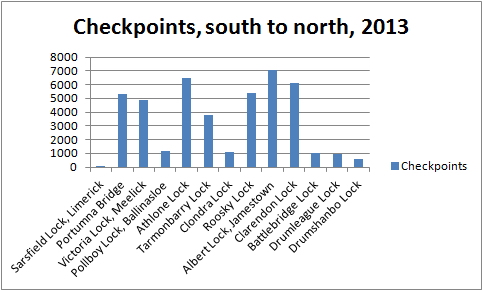
The points at which numbers were recorded

Finally, this chart suggests that any structures that were not built by the Shannon Commissioners in the 1840s will not attract many visitors. The extensions off the main stem of the Shannon — south to Limerick, west to Ballinasloe, east through Clondra, north to Lough Allen — are much less used than the main line from Lough Derg to Lough Key. It seems unlikely that any further extensions, especially to small towns that it would take three hours (at canal speed) to get to, are likely to be any more successful in attracting traffic.

Another turf canal system

Here is a short page about a canal system I had not heard of before today. It was a network of turf canals, with a sea lock, on the estate of Scotts of Willsborough, near Eglinton, on Lough Foyle; the Scotts supplied [London]Derry with turf and, like James Macnab at Portcrusha, reclaimed the land from the bog.

“Lock keepers face uncertain future” …

it says here.

The Dublin to Lough Neagh Canal

Here’s another lunatic canal proposal: one I hadn’t come across before.

Proposal for making a line of navigation from Dublin to Lough Neagh

It is proposed by several noblemen and gentlemen of the county of Meath, and of the manufacturing counties of the north of Ireland, the river Boyne company, with several merchants of the city of Dublin and of the commercial towns of the north, to complete, by private subscription, together with such aid as parliament may be pleased to grant, a navigable canal, from the royal canal at Blanchardstown, near Castleknock, in the county of Dublin, to Navan, Kells, Balieborough, Monaghan, Armagh, and Lough Neagh.

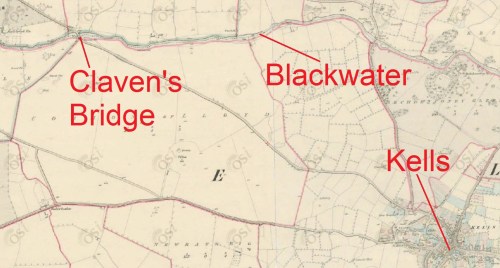
The object of this undertaking is to open a direct intercourse between the metropolis and the manufacturing towns of the north; and it is conceived, by the proposers for this undertaking, that a canal, large enough to navigate twenty-five ton boats on, would answer the trade; and in consequence of many locks being already made, rising from the city of Dublin to Castleknock, they think such a canal could be carried on very cheaply from thence to Navan, where another ascent takes place, through the locks of the Boyne navigation to the level of the town of Kells, and the river Blackwater, at Glevin’s bridge, three miles north of that town.

Claven's Bridge over the Blackwater near Kells

Claven’s Bridge over the Blackwater near Kells

My OSI logo and permit number for website

The country northward appears so fit for inland navigation, that no doubt can be entertained of being able to cut cheap canals through it. It is therefore most humbly hoped, if a line for a canal in this direction should be found to answer the expectation, that parliament will be pleased to allow the undertaking to become a part of the intended system of inland navigation of Ireland, and to a share of whatever bounty parliament may grant to accomplish the same.

The advantages that would arise to the nation from this undertaking, are too obvious to take up the time of this honourable house with any comment upon them.

A Atkinson Esq (late of Dublin) Ireland exhibited to England, in a political and moral survey of her population, and in a statistical and scenographic tour of certain districts; comprehending specimens of her colonisation, natural history and antiquities, arts, sciences, and commerce, customs, character, and manners, seats, scenes and sea views. Violent inequalities in her political and social system, the true source of her disorders. Plan for softening down those inequalities, and for uniting all classes of the people in one civil association for the improvement of their country. With a letter to the members of His Majesty’s Government on the state of Ireland Vol II Baldwin, Cradock, and Joy, London 1823

The (re)invention of heritage

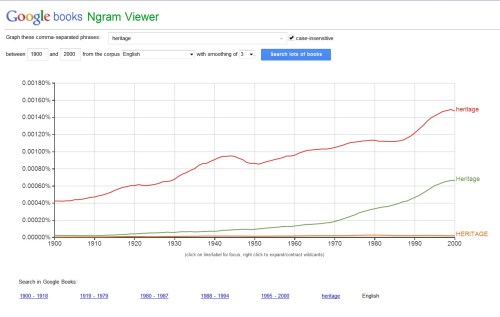
From Google’s Ngram viewer (more here):

ngram[Sorry, Google: couldn’t get the embedding to work properly. WordPress’s whitelist omits Google, though maps seem to work OK. Here’s the original.]

The growth in the use of “Heritage” with an initial capital is particularly interesting. I can think of three possible reasons:

  • that more organisations, eg The Heritage Council, use the word in their titles
  • that the word is increasingly used as an abstract noun at the start of sentences like “Heritage is important”
  • that the word is increasingly used as an attributive adjective at the start of sentences like “Heritage apples should be preserved”.

Traditional, personal uses (like “My heritage from my ancestors …”) are, I think, less likely to require initial capital letters. That in turn might suggest that Google’s Ngram viewer is reflecting a new(ish) set of meanings for the word and might lead us to ask what that new(ish) usage is (or was) intended to achieve.

It might also lead us to ask whether an even newer concept might now be more useful: one that would dissuade well-meaning folk from preserving and displaying context-free old tat and persuade them to find and record information instead.