Tag Archives: Operations

Are we there yet?

Some folk get bored by the Shannon between Athlone and Portumna. I don’t share that feeling, but those who do might like to be able to make a guess at how far they are from the next major feature.

Waterways Ireland’s numbering of its assets, including navigation markers, provides one possible way of assessing progress. The numbering of the markers is not quite sequential but it’s pretty good. I think that WI has GPS locations for all its assets, but GPS takes all the fun out of things; wouldn’t it be much better to try to photograph and tick off all the markers on paper? Far more exciting than train-spotting!

As a start, here are some rough locations. These are not the nearest markers to the places mentioned but they’re in the right general area:

  • 827 above Shannonbridge
  • 848 just above the Shannonbridge speed limit signs
  • 1014 above Shannon Harbour
  • 1029 above Banagher Bridge
  • 1036 below Banagher
  • 1065 green above Meelick cut
  • 1101 green just below high-level power cables
  • 1110 above Portumna Bridge
  • 1122 below Hayes’s Island
  • 1128 goalposts lower green.

Isn’t this exciting? Any more numbers for locations?

Canal carrying 1846: Dublin to Waterford

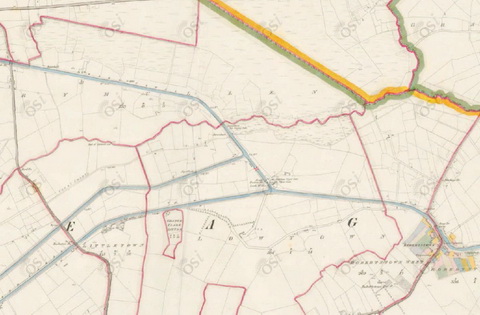
Lowtown is at the western end of the summit level of the Grand Canal; it thus has some claim to be the highest point on the canal. It is close to the village of Robertstown in County Kildare.

Lowtown is also the site of the junction between the main (Dublin to Shannon) line of the Grand Canal and its most important branch, the Barrow Line.
Lowtown (OSI ~1840)

Lowtown (OSI ~1840)

The main line from Dublin comes in from near the bottom right and exits near the top left. The two cuts leaving near the bottom left are the Old and New Barrow Lines, which join together just off the map. The Barrow Line runs to Athy, in south County Kildare, from which the Barrow [river] Navigation runs to the tidal lock at St Mullins, downstream of Graiguenamanagh.

The River Nore joins the Barrow a litle further downstream; the Nore is navigable on the tide upstream to Inistiogue. The combined rivers flow south through the port of New Ross and eventually join the estuary of the River Suir. Turning right at that point takes you up the Suir to Waterford, Carrick-on-Suir and Clonmel. Thus the Barrow Line, from Lowtown, forms an inland waterway link between Dublin and some towns along the Barrow, Nore and Suir.

Isaac Slater’s Directory[i] of 1846 lists those carrying goods on inland waterways. There is a long list for Dublin; entries for other towns list those providing local services. There are some conflicts between the lists (see below).

The map below shows those carrying on the Barrow Line of the Grand Canal and on the rivers Barrow, Nore and Suir. Each carrier is assigned a colour, which is used to frame the name of each place served by that carrier. Some towns (Mountmellick, Carrick-on-Suir, Clonmel) are off the map, further to the west. Note that the map is from the 25″ Ordnance Survey map of around 1900 rather than the 6″ of around 1840: I used it because it was clearer, but it shows features (eg railway lines) that were not present in 1846.

Click on the map to get a slightly larger version.
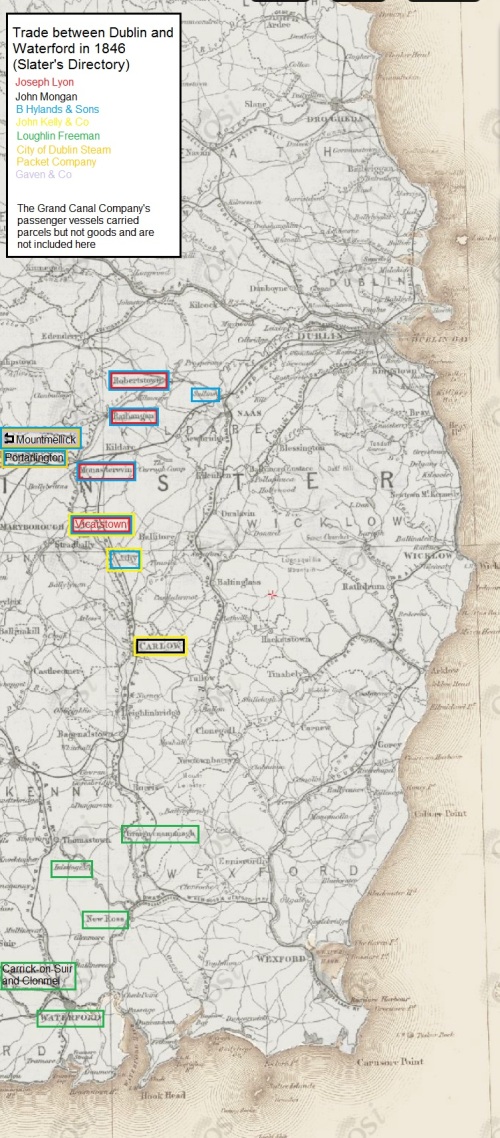
Dublin to Waterford: inland waterway traders 1846 (OSI)

Dublin to Waterford: inland waterway carriers 1846 (OSI)

Notes

All but one of the carriers are shown as having Dublin premises at Grand Canal Harbour, James Street. The exception is Gaven & Co, which is mentioned only in the Mountmellick entry.

I have not included the Grand Canal Company’s passenger-carrying boats, which carried parcels but not goods.

The City of Dublin Steam Packet Company entry for Dublin does not include Portarlington and Mountmellick amongst the towns served but the entry for Mountmellick says that the company’s boats leave for Dublin every Tuesday and Friday (its agent being John White) while that for Portarlington says they leave weekly. Boats from Mountmellick had to pass through Portarlington as well as Monastereven and other towns en route to Dublin.

Similarly, the entry for Mountmellick says that the Hylands boats leave there every other day while that for Portarlington says that they pass through weekly.

There is a page missing from the electronic copy of the directory that I consulted so the entry for Monastereven is incomplete.

The entry for Carlow says

To DUBLIN, and also to [New] ROSS, Boats depart, at uncertain periods, from the Wharfs of Lawrence and James Kelly, the Quay.

It does not say whether Lawrence and James Kelly owned any boats. They may have had boats but used them only for their own goods.

The entry for Mountmellick says “Bryan Hyland” rather than “B Hylands”.

The entry for Mountmellick includes the only mention I have found of Gaven & Co’s boats (James Waldron, agent).

The entry for Rathangan says

There are Boats for the conveyance of Goods, but no fixed period of departure.

Thomas Berry & Co, the most important carrier on the Grand Canal, did not venture south of Lowtown.

More

As far as I know, little has been written about the carrying companies, especially those of the nineteenth century. I would be glad to hear from anyone who can correct, supplement or comment on this information.


[i] I Slater’s National Commercial Directory of Ireland: including, in addition to the trades’ lists, alphabetical directories of Dublin, Belfast, Cork and Limerick. To which are added, classified directories of the important English towns of Manchester, Liverpool, Birmingham, Sheffield, Leeds and Bristol; and, in Scotland, those of Glasgow and Paisley. Embellished with a large new map of Ireland, faithfully depicting the lines of railways in operation or in progress, engraved on steel. I Slater, Manchester, 1846


My OSI logo and permit number for website

Sinn Féin sheughs again

Sinn Féin demonstrates its continuing commitment to the unification of Ireland reconstruction of the Clones Sheugh. KildareStreet tells us that Sandra McLellan, TD for Cork East, no doubt motivated by the wealth of waterways in her own area, asked a written question on 18 July 2013:

To ask the Minister for Arts, Heritage and the Gaeltacht the position regarding the Ulster Canal restoration project; the remaining steps that must be taken to complete the project; if he will provide an indicative timeline for the completion of the project; and if he will make a statement on the matter.

She got a more or less standard answer from the minister, Jimmy Deenihan [FG, Kerry North/West Limerick]:

As the Deputy will be aware, in July 2007, the North/South Ministerial Council (NSMC) agreed to proceed with the restoration of the section of the Ulster Canal between Clones and Upper Lough Erne. The then Government agreed to cover the full capital costs of the project, which were estimated at that time to be of the order of €35m.

It was always the intention that the Ulster Canal project would be funded from the Waterways Ireland annual allocations, as agreed through the annual estimates processes in this jurisdiction, as well as the deliberations of NSMC in relation to annual budgets. It was a key consideration throughout the process that the Ulster Canal project would be supported by a significant level of projected income from the commercialisation of certain Waterways Ireland assets. However, as the Deputy will be aware, the economic downturn has had a negative impact on those plans.

In the meantime, the Ulster Canal project is progressing on an incremental basis. Planning approvals have recently been secured for the project in both jurisdictions. I welcome these developments, which, I am sure the Deputy will agree, are a significant milestone for the project.

I am continuing to explore all possible options to advance this project within the current fiscal constraints. In this regard, an Inter-Agency Group on the Ulster Canal has been established to explore and examine ways to advance the project and to examine possible funding options for it, including existing funding streams and the leveraging of funding from other sources, including EU funding options.

Isn’t it funny? Every so often the shinners ask a question to remind the minister that they, er, haven’t gone away, you know. They don’t get really aggressive about it and they don’t seem to be organising mass rallies in Clones to demand a sheugh. And the minister is equally polite, saying in effect “we haven’t shot your horse”.

This project is not very important: it’s a waste of money and will be of no benefit to the national economy, and a government seeking savings could easily kill it off. Yet it has refused, over several years, to take that obvious step. Instead, it’s devoting departmental time, and that of other public servants, to (admittedly low-cost) measures that seem to be intended to show that the project will be maintained on life support, even if it never rises from its bed.

Is there something in the St Andrew’s Agreement, or some other bit of northsouthery, that promises a sheugh to Sinn Féin, to enable them to claim credit for some high-profile but non-threatening all-Irelandism? Is the Clones Sheugh the price of SF support for the Police Service of Northern Ireland? I don’t know, but there must be some explanation for the failure to kill off the sheugh.


Watering Dublin

Someone asked me recently about the progress of the scheme to supply Dublin with water from the Shannon. I had to confess that I haven’t been keeping up with the matter, because I don’t think it’s very important, but happily KildareStreet.com has provided an update. On Tuesday 16 July 2013 one of the Sinn Féin chappies, Brian Stanley of Laois-Offaly, asked a priority question:

54. To ask the Minister for Environment, Community and Local Government the progress being made on the Dublin, Garryhinch, Shannon water supply project; and the timeframe for planning, construction and completion phases of this project.

I suspect that most folk think of the scheme as one involving Dublin and the Shannon, so that the inclusion of Garryhinch may have been puzzling. It seems that Garryhinch is on the road from Portarlington to Mountmellick, just after that nasty bend where folk go to commit golf.

And Mr Stanley is interested not because he wants Garryhinch, Portarlington Golf Club, or indeed Portarlington and Mountmellick to be flooded but because he wants his constituents to be employed digging a hole in the ground there (a bit like the Clones Sheugh, really) and working in a water-based ecopark that will include a reservoir where the Shannon’s water will be stored.

Anyway, Fergus O’Dowd [FG, Louth], who is a Minister of State for something, replied:

The Dublin water supply scheme long-term water source is listed as a scheme at planning stage in my Department’s water services investment programme 2010 to 2013. Dublin City Council is the lead authority for this scheme, on behalf of all of the water services authorities in the greater Dublin area.

Studies carried out for the city council and a strategic environmental assessment have identified a preferred option which involves abstraction of raw water from Lough Derg and pumping the abstracted water through a new pipeline to a proposed storage reservoir at Garryhinch cut-away bog in County Offaly, forming part of a proposed midlands water-based eco-park. After treatment, water would then be conveyed to the west of Dublin where the new supply would be integrated with the existing storage and trunk distribution system.

In December 2012, the Department approved a brief for the engagement of consultants for the planning and statutory approval phase of the scheme. Dublin City Council has carried out a procurement process and I understand it will shortly be in a position to appoint a consultant to advance the further planning of this scheme.

The programme for project implementation has been developed based on the planning and statutory approval phase taking approximately two years. The detailed design and procurement phase should take a further two years, while the construction and commissioning phase should be completed in three years.

Following their appointment by Dublin City Council, the consultants will undertake the environmental impact statement and other statutory requirements in preparation for a submission to An Bord Pleanála which will adjudicate on the matter.

He forgot to mention “best practice”, so he’s lost some brownie points. Mr Stanley wanted it all to happen much faster, to be completed before 2021, but the discussion provided no more useful information. Bord na Móna has some more information about the eco-park here. All good stuff, much as I suggested for Lough Oughter, but I’d lose the eco title: eco stuff is so last millennium.

Shannon traffic to June 2013

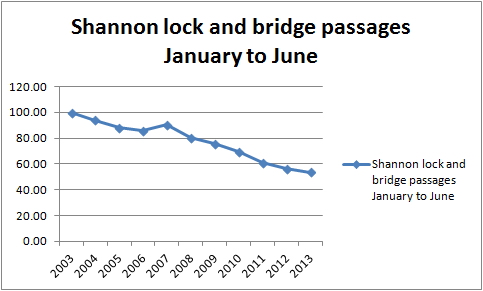
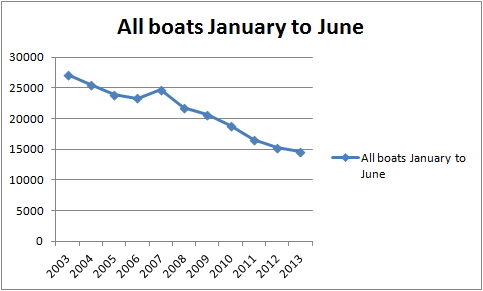
The figures for Shannon lock passages to the end of June 2013 are now available. The decline continues, though perhaps more slowly.

Shannon traffic Jan to June percent

Shannon lock and bridge passages January to June as percentages of the 2003 number

The usual caveats apply: the underlying figures (kindly supplied by Waterways Ireland) do not record total waterways usage because, for instance, sailing, fishing or waterskiing on lakes or river stretches, which did not involve a passage through a lock or Portumna Bridge, would not be recorded. The passage records are our only consistent long-term indicator of usage of the Shannon but they would not show, for instance, a change in the balance of types of activities from those in larger cruising boats to those in smaller (sailing, fishing, waterskiing) boats. It is quite possible, therefore, that overall usage might be increasing while long-distance cruising was declining.

Shannon traffic Jan to June private

Shannon lock and bridge passages by private boats January to June

As it happens, the figures show a small increase over 2012 in passages by private boats. I suspect that July’s warm weather will spur a further increase.

Folk living in Ireland, whether owners or prospective hirers, are likely to be able to react quickly to better (or worse) weather by doing more (or less) boating; folk living abroad may be less able to change their holiday plans. Accordingly, July’s weather might (I’m speculating here) mean an increase in passages by private boats and by boats hired by Irish residents; it might not lead to an increase in hiring from abroad.

Traffic in hired boats continued to decline in June.

Shannon traffic Jan to June hire

Shannon lock and bridge passages by hired boats January to June

That decline outweighed the small increase in private traffic, leading to an overall decline in the first six months as compared with the same period in 2012, which itself continued the pattern set in 2007.

Shannon traffic Jan to June all

Shannon lock and bridge passages by all boats January to June

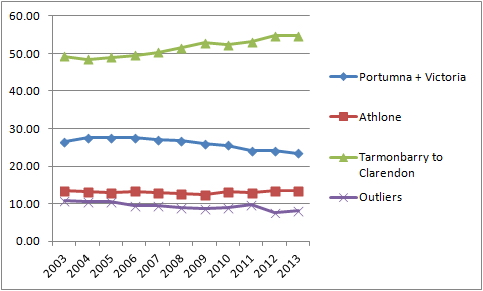
I wondered whether the figures might show any change in the geographical distribution of activity. WI’s reports don’t show separate figures for private and hired boats for the individual locks, but it seems to me that the hire business is becoming more concentrated on northern waters, from Lough Ree upwards. If that is so, then there might be an increase in the proportion of passages through the northern locks, from Tarmonbarry upwards, and a decrease in the proportion passing through Portumna Bridge and Meelick (Victoria) Lock.

I put the WI reporting stations in four groups:

  • Portumna + Meelick
  • Athlone
  • Tarmonbarry, Clondra, Roosky, Jamestown (Albert), Knockvicar (Clarendon)
  • the also-rans: the three locks leading to Lough Allen, Pollboy leading to Ballinasloe, the Limerick sea-lock (Sarsfield).

The figures suggest that the distribution is indeed changing, but gradually rather than dramatically. Athlone’s figures are pretty steady, the outliers are declining slightly and Portumna + Meelick are declining a bit more; the northern locks (Tarmonbarry to Knockvicar) are taking the gains. Comments or alternative interpretations welcome.

Change by region

Lock passages by group

The figures for 2013 are for the six months January to June; those for other years are for twelve months.

The locks could of course be grouped in other ways, and I may try some of them in future months.

Dialogue

Some time ago I noted that Waterways Ireland was now down wid da kidz in da hood, doing groovy things like social meeja with a Youtube thingie. It features (inter alia) a flight in a helicopter gunship along a restored Clones Sheugh. At least, that’s what I presume was going on, although I couldn’t work out how to fire the rockets at the suspiciously large number of narrowboats found along the way. The scenic highlight of the journey was Clones.

There’s also a Facebook page, from which I learned that there is now a skippered boat available for hire on the Barrow. And there is a Twitter whatsit, which does two interesting things.

First, it has summaries of marine notices, which will be useful to those cruising on the waterways without internet access.

Second, it shows signs of WI’s engaging in public dialogue with users, even when their comments might be critical. This is very welcome; it will be interesting to see the extent to which such public dialogue is permitted to develop.


Ardnacrusha drowning

Killaloe Coast Guard report.

Domestic travel

The current appalling weather, with temperatures over 18C, seems to have increased the number of folk going boating on the inland waterways; it will be interesting to see how it affects the Shannon lock passage figures for July when they appear in August. But Constantin Gurdgiev says, of the data for the first quarter of 2013, that …

Data shows sustained declines in domestic trips undertaken for holiday purposes by Irish residents. Weather effects are of course a factor, but it is worth noting that holiday travel abroad by irish residents also contracted y/y in Q1 2013. In other words, it looks like even disregarding weather conditions, things are grim.

But in Q2 we may have to take “seasonal factors” literally.

Living on boats in Dublin

Clare Daly [Socialist, Dublin North] elicited some information via written answers on 10 July 2013; h/t KildareStreet.

Clare Daly: To ask the Minister for Arts, Heritage and the Gaeltacht the recommendations of the Waterways Ireland consultation process on utilising Dublin’s waterways and the reason recommendations for the development for spaces for houseboats were not implemented; and his plans for same.

Jimmy Deenihan [FG; Kerry North/West Limerick]: I wish to advise the Deputy that Waterways Ireland is committed to utilising Ireland’s waterways to the greatest extent possible. In relation to the Deputy’s query regarding utilising Dublin’s waterways for the development for spaces for houseboats, I am informed that Waterways Ireland has plans to develop provision for houseboats in the Dublin City area on the existing floating moorings at Grand Canal Dock in Ringsend.

The Deputy should be aware that when Waterways Ireland applied to the Dublin Docklands Development Authority for permission to install floating moorings around the Waterways Ireland Visitor Centre to provide approximately 55 berths for boats/vessels back in 2003, the Authority issued a Certificate of approval under Section 25 of the Dublin Docklands Development Authority Act, 1997 which included the condition that ‘This Certificate permits the use of the 55 berths for boats/vessels used solely for amenity on the waterways and not as permanent residential or commercial units’. Waterways Ireland is currently in discussion with the Dublin Docklands Development Authority with the aim of having 25 berths designated for permanent residential or commercial use at Grand Canal Dock.

Second h/t to Clare Daly. I trust that Waterways Ireland will auction the residential berths to maximise the revenue from these prime city-centre locations.

The decreasing importance of cruising

I wrote here about the continuing decline in the numbers of boats recorded as passing through locks (and moveable bridges) on the Shannon. For the first five months of the year, the total number of recorded passages was jusst over half what it was in 2003. Maybe the current hot weather will increase the numbers, but the long-term trend has been downward for ten years, despite a Celtic-Tiger-inspired spike in usage by private boats.

I don’t know to what extent that decline affects Waterways Ireland’s policy-making. Are the hundreds of economists, marketing gurus, MBAs and other high-powered bods in WI’s marketing department engaged in a major search for new and profitable markets? Certainly its sponsorship programme [can’t find info on the WI website], its lists of events and its descriptions of activities are much broader in scope than mere boating, and even within that category small-boat activities are prominent.

WI is cooperating with other official bodies in developing walking [h/t Industrial Heritage Ireland] and cycling routes [h/t KildareStreet] and. with the Irish Sports Council and Irish Leisure Consultants, it has recently published A Guide to Planning and Developing Small Vessel Water Trails in Ireland [PDF]. WI does not, as far as I know, have a strategy for promoting increasing use of its waterways by cruising boats (private or hired), although I’d be happy to be corrected about that if I’m wrong.

All of this is good stuff, and I’m all in favour of widening the, er, user base (apart from those events for which people dress in fluorescent underwear and run around the streets: I share the late Mrs Patrick Campbell’s concern for the horses).

But three points strike me. The first is that the older waterways businesses — hotel boats, hire firms, marinas — involved capital investment and created reasonable numbers of jobs. I do not know whether Waterways Ireland measures employment, or other economic benefits, as an output of its sponsorship, marketing and organisational activities but it seems to me that it would be nice if it were able to show that the benefits outweigh the costs. It would also be interesting to know to what extent the newer activities can profitably attract tourists from overseas: with the water trails, for instance, is it possible for anyone to make a profitable business out of overseas visitors, given the costs of marketing and selling, or are these trails purely for the domestic market?

The second point is that one sector, that of professional event organisers, may indeed be benefiting from WI’s support. But if that disempowers local or voluntary groups, renders them unable to run events without professional assistance or makes the cost of doing so too high, it may not be an unmixed blessing.

The third is that there is a representative body for owners of inland cruising boats, but these new activities do not have inland-waterway-specific user bodies (if they have user bodies at all). That, I think, must make for a different type of relationship between the service provider, Waterways Ireland, and the users: most inland cruiser owners have nowhere else to go, but canoeists or anglers or walkers can easily switch to the sea or to non-WI inland waters, so WI has to compete for their custom.

This piece is written not to provide answers but to ask some questions.