Tag Archives: Operations

They’re taking the [bodily fluid]

Of the cost of land to be acquired for a canal to Clones:

We understand that the costs of land acquisition are based on the purchase of 46 hectares of land (equivalent to approx. 114 acres), the majority of which is poor quality agricultural land for a total estimated cost of €6m. This is equivalent to an average price for acquisition of just over €52,500 per acre, although the total acquisition costs would also include legal costs associated with the process.

Nevertheless, an average price of €52,500 would appear to be very high compared with the average price at which agricultural land is currently sold in the area. If an average price of €25,000 per acre (including legal costs) was applied, then total land acquisition costs would be reduced to €2.85m. This is still a generous assumption. The average RoI price of agricultural land in 2014 was less than €10,000. [Irish Farmers’ Journal Agricultural Land Price Report 2013 January 2014]

That’s from Department of Arts, Heritage and the Gaeltacht Restoring the Ulster Canal from Lough Erne to Clones: Updated Business Case February 2015. Hats off to Fitzpatrick Associates for checking and for leaving the information in the final report. I have written to Waterways Ireland to ask for more information:

I would be grateful if you could let me have a list of

  • the names and addresses of the owners of the land you propose to buy to build a canal to Clones

  • map references or maps showing the location of that land

  • the size and nature of each plot of land you propose to acquire

  • the amount you propose to pay for each plot

  • the justification for each such amount.

Actually, I have the list of landowners in Co Monaghan, because it’s in the planning application. I can’t find the equivalent on the NI Planning Service’s website because I can’t work out how to search by applicant.

The stony grey soil of Monaghan must be worth more than one might think. Either that or this proposal is a steaming dunghill.
DAHG and the unicorns

In purely quantifiable monetary terms, it is clear from these estimates that the project has a very significant capital cost of circa €46m and that the quantified annual net economic benefits are at most €323.5k per annum. The latter thus covers the annual revenue costs of €308.8k per annum only. Applying any cost benefit analysis, whether payback period or net present cost, will result in a large negative for the project.

The justification of the project therefore relies largely on the unquantifiable benefits associated with the project and the disadvantaged area in which these will occur.

Department of Arts, Heritage and the Gaeltacht Restoring the Ulster Canal from Lough Erne to Clones: Updated Business Case February 2015

The project will give this border region, which has suffered greatly from economic deprivation, a much needed boost in terms of job creation and tourism. There is significant potential for growth in the waterways based tourism market and I have no doubt that the reopening of this section of the canal will help to attract significant numbers of visitors to the area.

Heather Humphreys quoted in Department of Arts, Heritage and the Gaeltacht press release Minister Humphreys secures Government approval to restore Ulster Canal from Upper Lough Erne to Castle Saunderson 24 February 2015

If “quantified annual net economic benefits are at most €323.5k per annum” for a sheugh running all the way to Clones, it is hard to see how a shorter sheugh to Castle Saunderson is going to result in “a much needed boost in terms of job creation and tourism”.

But that’s where the unicorns come in: it will all happen by magic.

What DAHG knows about waterways history

Commercial traffic on all waterways in Ireland ended during the first half of the 20th century.

For certain values of “half”.

Waterways Ireland and Erne Bye-laws

Waterways Ireland gets slightly tougher. Basil McCrea will be disappointed.

Boater’s handbook

The Canal & River Trust have a useful PDF Boater’s handbook available for download, free of charge, from this page; there is also a video thingie.

The handbook naturally concentrates on British inland waterways, with narrowboats on canals and rivers but not on lakes, but there is nonetheless much useful material. Even experienced boaters might find it of interest, if only for briefing any non-boaty friends they’ve invited along for a trip.


What has happened to Harbour Flights?

The successful air transport company Harbour Flights, which had a base at Mountshannon, announced some time ago that its level of success was such that it was suspending operations but that it would be back early in 2014, “fully operational again” with a fleet of aircraft “operating from [sic] destinations nationwide”.

Alas, my request for reports of sightings of the fleet produced neither information nor photographs and my own visits to Mountshannon in 2014 did not coincide with any aircraft movements. And now the website at http://www.harbourflights.com/landing.php has disappeared.

Surely nothing can have happened to the firm.


Shannon traffic figures to December 2014

I am grateful to Waterways Ireland for sending me the Shannon traffic figures for the last three months of 2014. They sent them last month but I didn’t have time to deal with them until now.

Regular readers may wish to skip this section

All the usual caveats apply:

  • the underlying figures do not record total waterways usage (even for the Shannon) as, for instance, sailing, fishing or waterskiing on lakes or river stretches, which did not involve a passage through a lock or Portumna Bridge, would not be recorded
  • the passage records would not show, for instance, a change in the balance of types of activities from those in larger cruising boats to those in smaller (sailing, fishing, waterskiing) boats
  • figures like these will not necessarily be representative of those for the year as a whole. The winter months, January to March, see little traffic in any year; for April, May and June, the weather can have a large influence on the amount of activity especially, I suspect, in private boats.

On the other hand, the figures do include the Shannon’s most significant tourism activity, the cruiser hire business. And they are our only consistent long-term indicator of usage of the inland waterways.

All boats

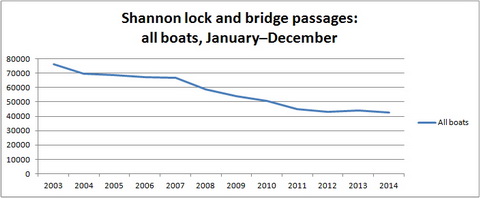
Shannon 2003-2014 01-12 all boats_resize

Total (private + hired) traffic for the full year

As we saw in September, traffic is down on 2013, but there has been little change over the last three years.

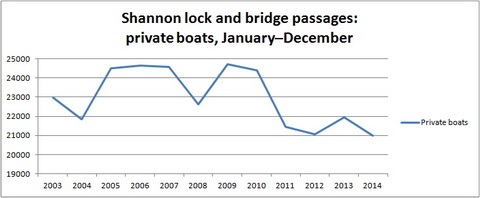
Private boats

Shannon 2003-2014 01-12 private boats_resize

Private-boat traffic for the full years 2003 to 2014

The vertical scale on this chart is different from that for hired boats so the changes in private boating from one year to another are exaggerated (by comparison). The good weather did not prevent a fall in activity.

Hire boats

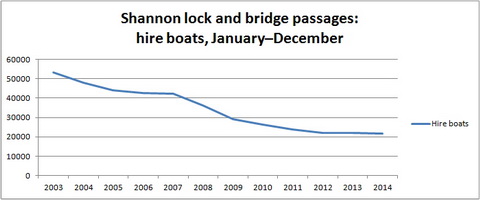
Shannon 2003-2014 01-12 hired boats_resize

Hire-boat traffic for the full years 2003 to 2014

Again, the lowest figure in my records, but the drop was small; perhaps the hire trade is bouncing along the bottom (as it were). I wonder whether anyone has a Grand Plan for recovery or rejuvenation.

Percentages of 2003 levels

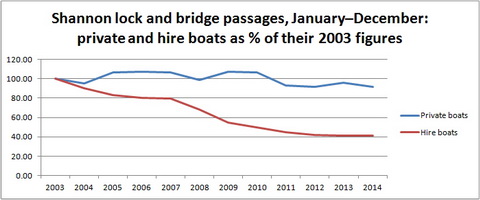
Shannon 2003-2014 01-12 compared with 2003_resize

Percentages of 2003 levels

Private traffic at just over 90% of 2003 levels, hire traffic at just over 40%.

Private -v- hired

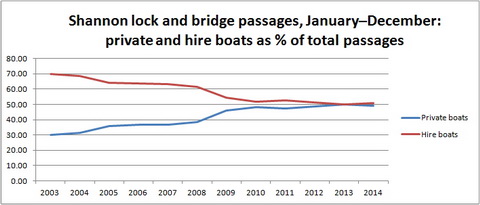
Shannon 2003-2014 01-12 private -v- hired_resize

Still roughly 50:50

Seasons

In the five months January, February, March, November and December, there were 385 passages altogether, less than 1% of total boat movements for the year. If money can be saved by ceasing to operate the locks and bridge during the winter, they should be closed except, perhaps, for one Saturday per month, to be arranged for a non-flood day.

Regions

Here is the order of popularity.

ALBERT LOCK 7205
ATHLONE LOCK  5775
CLARENDON LOCK 5650
ROOSKY LOCK 5565
PORTUMNA BRIDGE 5395
VICTORIA LOCK 4934
TARMONBARRY LOCK 3885
POLLBOY LOCK 1222
CLONDRA LOCK 1020
BATTLEBRIDGE 835
DRUMLEAGUE 797
DRUMSHANBO LOCK 387
SARSFIELD LOCK 97

Lough Allen is a delightful place but it is not popular.

A quick bit of sheughery

Here, read this. I haven’t time to take it all in at the moment, but the minister’s “An updated business case was recently completed for my Department” is, as far as I know, misleading: that business case was completed by DCAL in Northern Ireland and sent to Dublin. Thus, as the SF TD Mr Ó Snodaigh probably knows, the “business case” (which is not a cost-benefit analysis) came from a Sinn Féin minister’s department.

It seems our designation of “Saunderson’s Sheugh” was spot on.

Northern Ireland spending on waterways

Sammy Wilson [DUP]: Looking through the list of capital projects, I see lock gates on the Shannon, bridge repairs on the Grand canal, enhancements of the Grand canal towpath, the Shannon Blueway and the multi-activity trail at Carrick-on-Shannon. Nearly every one of these projects is in the Irish Republic. Does the Minister see her role as fighting for projects in Northern Ireland or simply sitting there, handing over our money for projects in the Irish Republic?

Mr Wilson might not have noticed, during his terms in ministerial office, that waterways capital projects in each jurisdiction are paid for by the government of that jurisdiction. So NI money is not spent on capital projects in the republic; if NI politicians want more money spent on waterways improvements [as opposed to running costs] in Northern Ireland, it will have to come from the NI budget.

Unfortunately Mr Wilson’s party colleague, and successor as Minister of Finance and Personnel, Simon Hamilton, does not share Mr Wilson’s enthusiasm for erecting lock gates or towing-paths on the Erne [or whatever it was he wanted], for he has cut DCAL’s Budget [157-page NI budget and 28-page statement, both PDFs] and, in consequence, the amounts to be allocated to Waterways Ireland.

DCAL is wondering how to apply the chopper and is seeking views; a 190-page consultation document can be downloaded here [MS Word *.doc]. Neither DFP nor DCAL makes it easy to find the change from last year’s allocations, but DCAL says that the “savings” to be made by Waterways Ireland will be £468,000. As of today, that’s €630,727.

The Word document points out that

The budgets for the North/South Bodies are agreed by the North South Ministerial Council and are dealt with under different arrangements.  They are therefore outside the scope of this exercise.

So the document can’t say what the “front-line impact” of the cuts to Waterways Ireland’s allocation will be.

15% of WI’s current budget is paid by Northern Ireland and 85% by the republic. If the savings shown above are all to the current budget [which is not clear, though WI’s NI capital budget was pretty small anyway], then the total cut in WI’s current spending will be €5,204,847.

Note again that, without spending a lot more time on this than I currently have available, I cannot say from what base figure the cuts or savings are to be made.

Respondents to DCAL’s November 2014 consultation on the draft budget included only one who discussed waterways:

There was one response who stated that other sectors should be cut and funding to Waterways Ireland should be increased.

That was from an individual; it appears that no organisations commented on waterways issues and I cannot see any inland waterways-related voluntary body listed amongst those who submitted their views. As in the republic, arts folk seem to have been well organised.

The DCAL page contains a link to a surveymonkey page seeking responses.


Outbreak of sanity in Co Westmeath

Our big thing is to link the Galway Dublin cycleway into Kilbeggan and along the stretch of the old canal to Ballycommon. That’s around a million euro project and the biggest thing in our Vision for Kilbeggan plan.

Thus Dan Scally of Renew Kilbeggan in the Westmeath Examiner.