Tag Archives: Waterways Ireland

Watering Dublin

Someone asked me recently about the progress of the scheme to supply Dublin with water from the Shannon. I had to confess that I haven’t been keeping up with the matter, because I don’t think it’s very important, but happily KildareStreet.com has provided an update. On Tuesday 16 July 2013 one of the Sinn Féin chappies, Brian Stanley of Laois-Offaly, asked a priority question:

54. To ask the Minister for Environment, Community and Local Government the progress being made on the Dublin, Garryhinch, Shannon water supply project; and the timeframe for planning, construction and completion phases of this project.

I suspect that most folk think of the scheme as one involving Dublin and the Shannon, so that the inclusion of Garryhinch may have been puzzling. It seems that Garryhinch is on the road from Portarlington to Mountmellick, just after that nasty bend where folk go to commit golf.

And Mr Stanley is interested not because he wants Garryhinch, Portarlington Golf Club, or indeed Portarlington and Mountmellick to be flooded but because he wants his constituents to be employed digging a hole in the ground there (a bit like the Clones Sheugh, really) and working in a water-based ecopark that will include a reservoir where the Shannon’s water will be stored.

Anyway, Fergus O’Dowd [FG, Louth], who is a Minister of State for something, replied:

The Dublin water supply scheme long-term water source is listed as a scheme at planning stage in my Department’s water services investment programme 2010 to 2013. Dublin City Council is the lead authority for this scheme, on behalf of all of the water services authorities in the greater Dublin area.

Studies carried out for the city council and a strategic environmental assessment have identified a preferred option which involves abstraction of raw water from Lough Derg and pumping the abstracted water through a new pipeline to a proposed storage reservoir at Garryhinch cut-away bog in County Offaly, forming part of a proposed midlands water-based eco-park. After treatment, water would then be conveyed to the west of Dublin where the new supply would be integrated with the existing storage and trunk distribution system.

In December 2012, the Department approved a brief for the engagement of consultants for the planning and statutory approval phase of the scheme. Dublin City Council has carried out a procurement process and I understand it will shortly be in a position to appoint a consultant to advance the further planning of this scheme.

The programme for project implementation has been developed based on the planning and statutory approval phase taking approximately two years. The detailed design and procurement phase should take a further two years, while the construction and commissioning phase should be completed in three years.

Following their appointment by Dublin City Council, the consultants will undertake the environmental impact statement and other statutory requirements in preparation for a submission to An Bord Pleanála which will adjudicate on the matter.

He forgot to mention “best practice”, so he’s lost some brownie points. Mr Stanley wanted it all to happen much faster, to be completed before 2021, but the discussion provided no more useful information. Bord na Móna has some more information about the eco-park here. All good stuff, much as I suggested for Lough Oughter, but I’d lose the eco title: eco stuff is so last millennium.
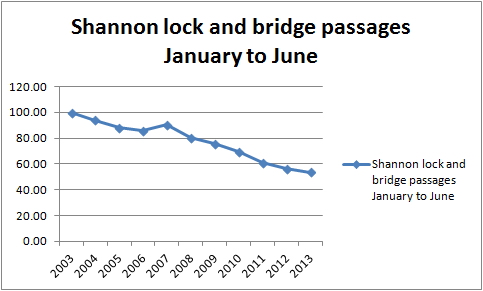
Shannon traffic to June 2013

The figures for Shannon lock passages to the end of June 2013 are now available. The decline continues, though perhaps more slowly.

Shannon traffic Jan to June percent

Shannon lock and bridge passages January to June as percentages of the 2003 number

The usual caveats apply: the underlying figures (kindly supplied by Waterways Ireland) do not record total waterways usage because, for instance, sailing, fishing or waterskiing on lakes or river stretches, which did not involve a passage through a lock or Portumna Bridge, would not be recorded. The passage records are our only consistent long-term indicator of usage of the Shannon but they would not show, for instance, a change in the balance of types of activities from those in larger cruising boats to those in smaller (sailing, fishing, waterskiing) boats. It is quite possible, therefore, that overall usage might be increasing while long-distance cruising was declining.

Shannon traffic Jan to June private

Shannon lock and bridge passages by private boats January to June

As it happens, the figures show a small increase over 2012 in passages by private boats. I suspect that July’s warm weather will spur a further increase.

Folk living in Ireland, whether owners or prospective hirers, are likely to be able to react quickly to better (or worse) weather by doing more (or less) boating; folk living abroad may be less able to change their holiday plans. Accordingly, July’s weather might (I’m speculating here) mean an increase in passages by private boats and by boats hired by Irish residents; it might not lead to an increase in hiring from abroad.

Traffic in hired boats continued to decline in June.

Shannon traffic Jan to June hire

Shannon lock and bridge passages by hired boats January to June

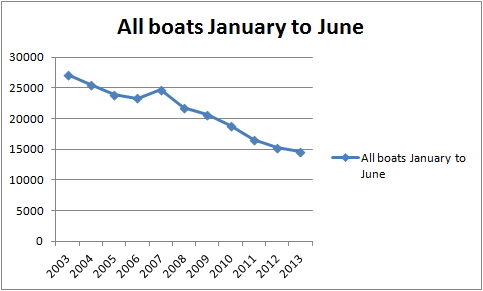
That decline outweighed the small increase in private traffic, leading to an overall decline in the first six months as compared with the same period in 2012, which itself continued the pattern set in 2007.

Shannon traffic Jan to June all

Shannon lock and bridge passages by all boats January to June

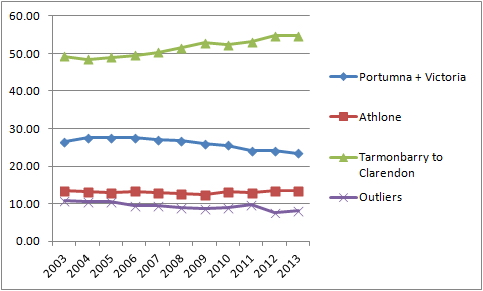
I wondered whether the figures might show any change in the geographical distribution of activity. WI’s reports don’t show separate figures for private and hired boats for the individual locks, but it seems to me that the hire business is becoming more concentrated on northern waters, from Lough Ree upwards. If that is so, then there might be an increase in the proportion of passages through the northern locks, from Tarmonbarry upwards, and a decrease in the proportion passing through Portumna Bridge and Meelick (Victoria) Lock.

I put the WI reporting stations in four groups:

  • Portumna + Meelick
  • Athlone
  • Tarmonbarry, Clondra, Roosky, Jamestown (Albert), Knockvicar (Clarendon)
  • the also-rans: the three locks leading to Lough Allen, Pollboy leading to Ballinasloe, the Limerick sea-lock (Sarsfield).

The figures suggest that the distribution is indeed changing, but gradually rather than dramatically. Athlone’s figures are pretty steady, the outliers are declining slightly and Portumna + Meelick are declining a bit more; the northern locks (Tarmonbarry to Knockvicar) are taking the gains. Comments or alternative interpretations welcome.

Change by region

Lock passages by group

The figures for 2013 are for the six months January to June; those for other years are for twelve months.

The locks could of course be grouped in other ways, and I may try some of them in future months.

Pumping algae

Do algae pass through pumps? I don’t know, but I ask because boating, bathing and animals have been banned in Lough Ennell where blue-green algae have been found. Lough Ennell is to supply water to the Royal Canal, although I presume it will take some time before it begins to do so. But perhaps, even if algae made it through the pumps, they would die in the Royal. If you know, Gentle Reader, do please leave a Comment below.

Dialogue

Some time ago I noted that Waterways Ireland was now down wid da kidz in da hood, doing groovy things like social meeja with a Youtube thingie. It features (inter alia) a flight in a helicopter gunship along a restored Clones Sheugh. At least, that’s what I presume was going on, although I couldn’t work out how to fire the rockets at the suspiciously large number of narrowboats found along the way. The scenic highlight of the journey was Clones.

There’s also a Facebook page, from which I learned that there is now a skippered boat available for hire on the Barrow. And there is a Twitter whatsit, which does two interesting things.

First, it has summaries of marine notices, which will be useful to those cruising on the waterways without internet access.

Second, it shows signs of WI’s engaging in public dialogue with users, even when their comments might be critical. This is very welcome; it will be interesting to see the extent to which such public dialogue is permitted to develop.


Domestic travel

The current appalling weather, with temperatures over 18C, seems to have increased the number of folk going boating on the inland waterways; it will be interesting to see how it affects the Shannon lock passage figures for July when they appear in August. But Constantin Gurdgiev says, of the data for the first quarter of 2013, that …

Data shows sustained declines in domestic trips undertaken for holiday purposes by Irish residents. Weather effects are of course a factor, but it is worth noting that holiday travel abroad by irish residents also contracted y/y in Q1 2013. In other words, it looks like even disregarding weather conditions, things are grim.

But in Q2 we may have to take “seasonal factors” literally.

Living on boats in Dublin

Clare Daly [Socialist, Dublin North] elicited some information via written answers on 10 July 2013; h/t KildareStreet.

Clare Daly: To ask the Minister for Arts, Heritage and the Gaeltacht the recommendations of the Waterways Ireland consultation process on utilising Dublin’s waterways and the reason recommendations for the development for spaces for houseboats were not implemented; and his plans for same.

Jimmy Deenihan [FG; Kerry North/West Limerick]: I wish to advise the Deputy that Waterways Ireland is committed to utilising Ireland’s waterways to the greatest extent possible. In relation to the Deputy’s query regarding utilising Dublin’s waterways for the development for spaces for houseboats, I am informed that Waterways Ireland has plans to develop provision for houseboats in the Dublin City area on the existing floating moorings at Grand Canal Dock in Ringsend.

The Deputy should be aware that when Waterways Ireland applied to the Dublin Docklands Development Authority for permission to install floating moorings around the Waterways Ireland Visitor Centre to provide approximately 55 berths for boats/vessels back in 2003, the Authority issued a Certificate of approval under Section 25 of the Dublin Docklands Development Authority Act, 1997 which included the condition that ‘This Certificate permits the use of the 55 berths for boats/vessels used solely for amenity on the waterways and not as permanent residential or commercial units’. Waterways Ireland is currently in discussion with the Dublin Docklands Development Authority with the aim of having 25 berths designated for permanent residential or commercial use at Grand Canal Dock.

Second h/t to Clare Daly. I trust that Waterways Ireland will auction the residential berths to maximise the revenue from these prime city-centre locations.

How low can you get?

Here’s a report from Hawthorn about Shannon water levels; here is a press statement from a political chap on the matter [PDF]; here is a post showing quite how important agriculture is to the Irish economy.

In brief: it isn’t. As Constantin Gurdgiev says:

[…] Irish agriculture is an extension of the welfare state, in so far as most of the value added in it is provided for by the subsidies.

Given that the sector as a whole includes the relatively small number of productive farms, the value of marginal farms may well be negative. Those occupying such land should be encouraged to abandon it and to take up some more productive activity elsewhere; Mongolia seems like a good bet. Activities designed to help the landlords to continue to pretend to be engaged in an economic activity are a waste of resources.

The Ulster Orangeway

I am happy to say that the ineffable Professor Billy McWilliams [Visitin’ Lekturer at the Ulster Scots School o’ Dancin’, Ballymena] has provided the answer to one of WI’s problems. I have pointed out that a walking route along the Clones Sheugh would be much cheaper than a restored canal; Professor McWilliams has shown how to make such a route more attractive to members of the Ulster-Scots Community. WI could adopt his idea from Comber and declare the route to be the Ulster Orangeway.

The decreasing importance of cruising

I wrote here about the continuing decline in the numbers of boats recorded as passing through locks (and moveable bridges) on the Shannon. For the first five months of the year, the total number of recorded passages was jusst over half what it was in 2003. Maybe the current hot weather will increase the numbers, but the long-term trend has been downward for ten years, despite a Celtic-Tiger-inspired spike in usage by private boats.

I don’t know to what extent that decline affects Waterways Ireland’s policy-making. Are the hundreds of economists, marketing gurus, MBAs and other high-powered bods in WI’s marketing department engaged in a major search for new and profitable markets? Certainly its sponsorship programme [can’t find info on the WI website], its lists of events and its descriptions of activities are much broader in scope than mere boating, and even within that category small-boat activities are prominent.

WI is cooperating with other official bodies in developing walking [h/t Industrial Heritage Ireland] and cycling routes [h/t KildareStreet] and. with the Irish Sports Council and Irish Leisure Consultants, it has recently published A Guide to Planning and Developing Small Vessel Water Trails in Ireland [PDF]. WI does not, as far as I know, have a strategy for promoting increasing use of its waterways by cruising boats (private or hired), although I’d be happy to be corrected about that if I’m wrong.

All of this is good stuff, and I’m all in favour of widening the, er, user base (apart from those events for which people dress in fluorescent underwear and run around the streets: I share the late Mrs Patrick Campbell’s concern for the horses).

But three points strike me. The first is that the older waterways businesses — hotel boats, hire firms, marinas — involved capital investment and created reasonable numbers of jobs. I do not know whether Waterways Ireland measures employment, or other economic benefits, as an output of its sponsorship, marketing and organisational activities but it seems to me that it would be nice if it were able to show that the benefits outweigh the costs. It would also be interesting to know to what extent the newer activities can profitably attract tourists from overseas: with the water trails, for instance, is it possible for anyone to make a profitable business out of overseas visitors, given the costs of marketing and selling, or are these trails purely for the domestic market?

The second point is that one sector, that of professional event organisers, may indeed be benefiting from WI’s support. But if that disempowers local or voluntary groups, renders them unable to run events without professional assistance or makes the cost of doing so too high, it may not be an unmixed blessing.

The third is that there is a representative body for owners of inland cruising boats, but these new activities do not have inland-waterway-specific user bodies (if they have user bodies at all). That, I think, must make for a different type of relationship between the service provider, Waterways Ireland, and the users: most inland cruiser owners have nowhere else to go, but canoeists or anglers or walkers can easily switch to the sea or to non-WI inland waters, so WI has to compete for their custom.

This piece is written not to provide answers but to ask some questions.


Lough Derg search: addenda

Some additional information from the Clare Champion and the Limerick Post. The Irish Mirror has one of the few accounts that includes discussions with participants.

More to come.