Category Archives: Built heritage

The Barrow Navigation Company’s fleet

Here is an account of the October 1871 half-yearly meeting of the Barrow Navigation Company. It is interesting for the information it provides about the company’s finances and in particular about the size of its fleet and the number of horses required.
Notes from the north

Some observations from a trip to the hyperborean regions.

Navigation

The 2015 edition of Shannon Leisure Development Company’s Navigational Guide to the Shannon and Erne Waterways includes the numbers of some of the markers; I found that helpful, especially on the longer river stretches.

The Guide is wrong about Clonmacnoise: there is no water supply. At Hodson Bay, a suggested course appears to cross a shoal.

Eh?

Eh?

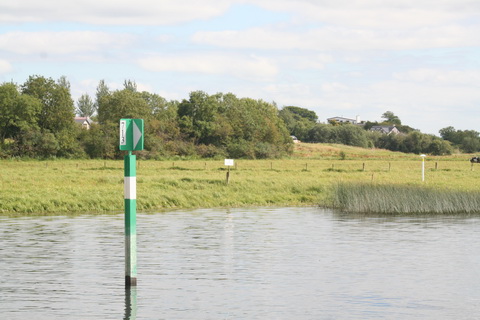
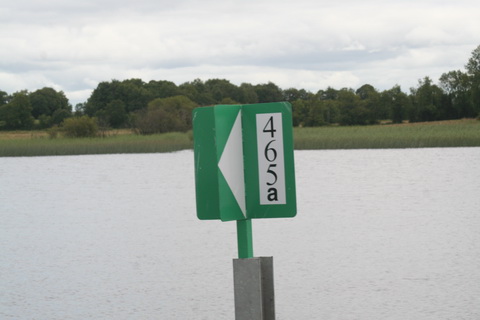
This was the first marker I noticed with a suffix to its number; I presume that means it’s a new marker.

Boxty

As far as I know, boxty is the only contribution made by the north midlands to world cuisine. We bought several varieties in Lanesborough, and jolly good they were too; I regret that I did not record the manufacturers’ names so that I could provide links to their websites.

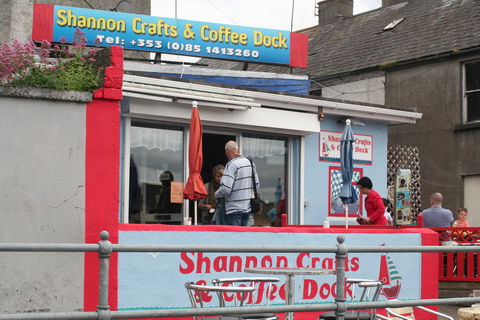
However, boxty was not the only comestible to be found north of Portumna Bridge. Shannon Crafts and Coffee Dock in Athlone, on The Strand across the river from the lock, provides excellent cakes; boaters can tie up outside and stock up.

TripAdvisor folks liked it too.

Had I been there on a Saturday, I’d have had bratwurst.

Shannon Crafts and Coffee Dock

Shannon Crafts and Coffee Dock

The Em’raldstar Galactica

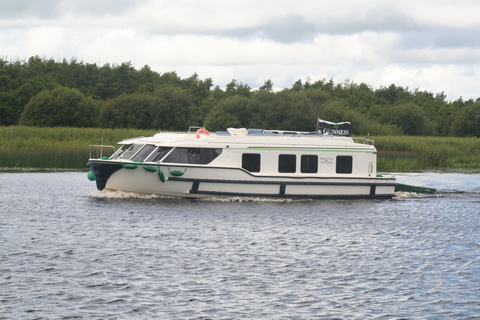
Les grands bateaux de Monsieur Thibault must have been breeding: we met several of the things.

Emraldstar Galactica 2015 01_resize

It’s big …

Emraldstar Galactica 2015 03_resize

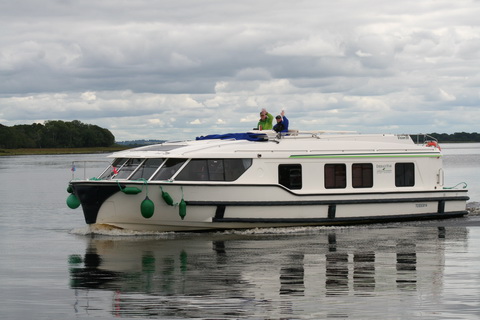
… and, I’m told, luxuriously fitted out …

Emraldstar Galactica 2015 04_resize

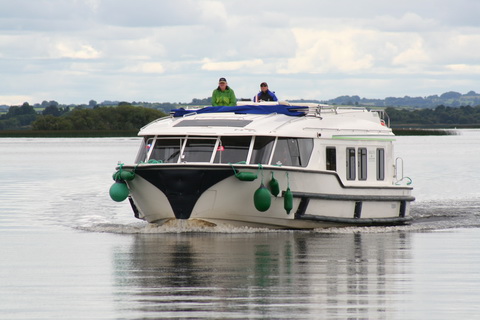
… with good outdoor space on the roof …

Emraldstar Galactica 2015 02_resize

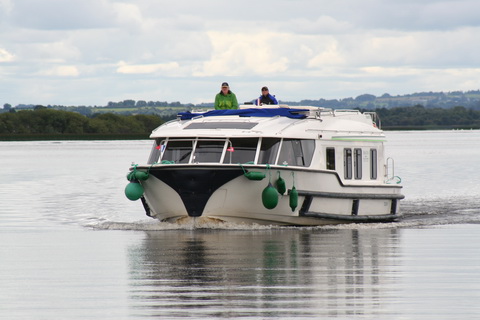
… and it accelerates quickly and smoothly from rest, suggesting a good underwater shape …

… but I still think it’s the boating equivalent of the SsangYong Rodius.

Work in progress

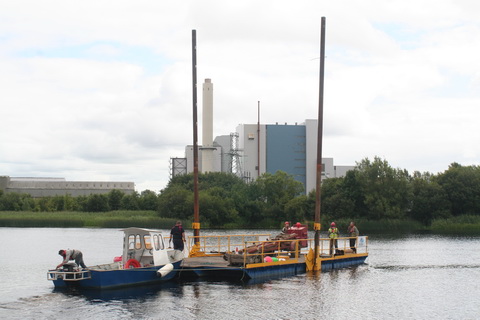
Geotechnical investigation works on the N63 bridge at Lanesborough were being carried out from this pontoon, which was assembled at Hanleys Marina at Ballyleague.

Moving the pontoon into position

Moving the pontoon into position

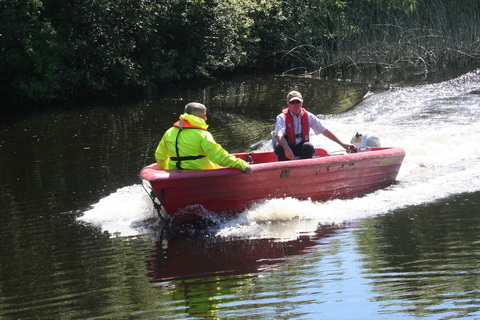
And here’s a Waterways Ireland boat, a Pioner I think, returning upstream to its launch site at Meelick Quay. Perhaps it had been investigating the possibility of providing berths near Meelick village.

WI Pioner

WI Pioner

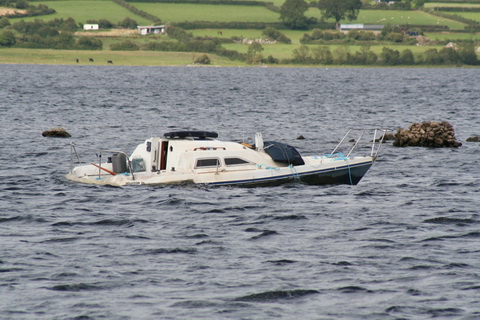
Wrecks?

Iskeraulin wreck 03_resize

On the Iskeraulin shoal on Lough Ree

Copy of Boat ashore between Blackbrink and Galey bays

On shore between Blackbrink and Galey bays

I don’t know anything about either of these vessels. The second might, I suppose, have been careened for work on its hull.

Out to lunch

The closing of locks at lunchtime has got to stop.

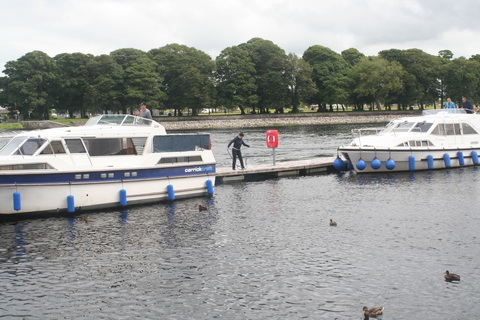
At Meelick, on a windy day, the lower gates were open at lunchtime and two boats were blown forward on to the sill. There, and at Athlone, the waiting pontoons and quays are utterly inadequate to the volume of traffic. Two boats occupied the whole of the Athlone pontoons and only two boats (one a barge) were able to fit on the quay wall. The combined length of boats waiting was about two and a half times the length available for tying to.

Athlone waiting pontoons

Athlone waiting pontoons

Why is it not possible to have staggered lunchtimes? Or to come up with some other arrangement that puts the interests and the safety of the boaters first?

Oddities

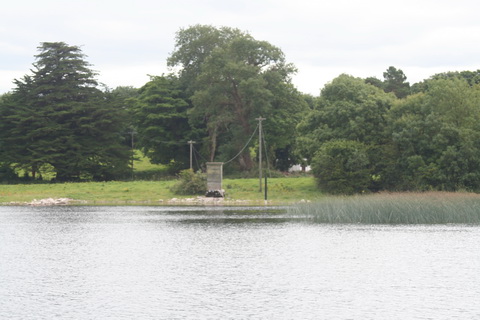
Is this a waterside thunderbox or privy?

Perh privy above Athlone_resize

Outdoor sanitation above Athlone?

In the next photo, the small white sign in the middle says “No shooting”, which is about tweetiebirds rather than citizens. But what is the long-stemmed mushroom on the right? It looks like those gas thingies youo see scattered around the countryside, presumably to provide shelter while you strike a match to light your pipe, and there’s another on the other side of the river. Does that mean that there’s a gas pipe under the river? Or what?

Mushroom_resize

What’s the white thing on the right?

Imperfections

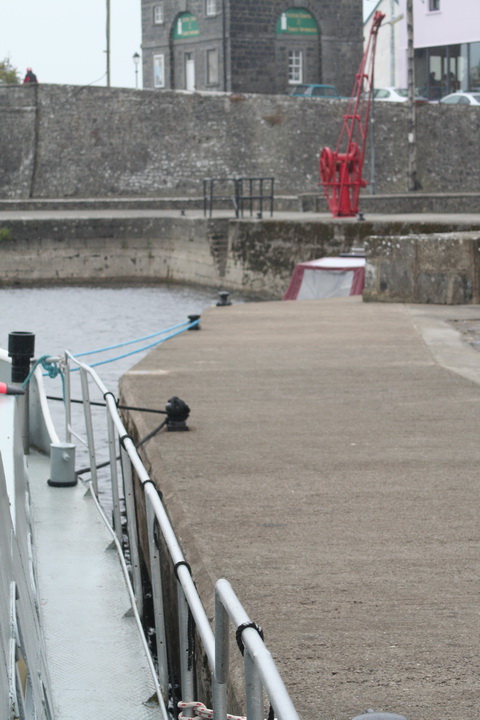
The pale patch of concrete suggests that the corner bollard is missing at the quay below the bridge in Shannonbridge. That makes the short angled section of wall very difficult to use.

Missing bollard at Shannonbridge_resize

Missing bollard?

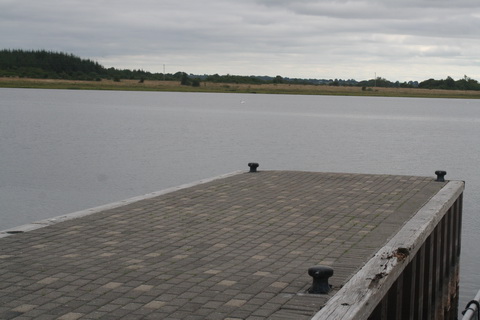
At Portrunny, some of the timber edging to the pier has rotted; it may be a trip hazard.

Portrunny pier edge 2015_resize

Portrunny pier

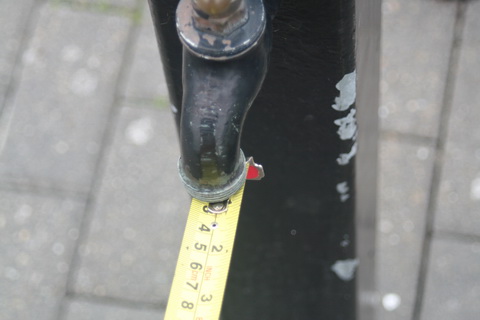
The taps on Portrunny pier defeated us. I would be grateful to anyone who could give me the specification of the adapter required to connect these taps to standard garden/boat hoses.

Portrunny tap

Portrunny’s giant taps

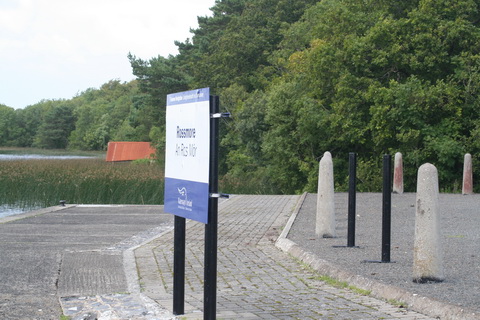
Back on Lough Derg, we found that a barrier had been erected at the end of the pier at Rossmore.

Rossmore barriers 01

Rossmore

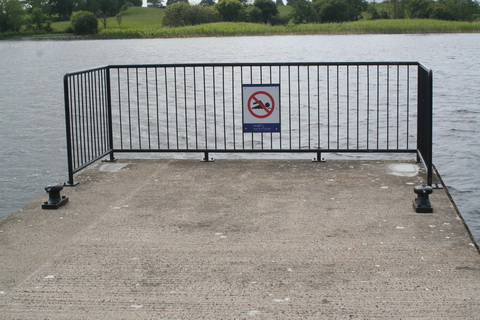
This barrier makes the end of the pier unusable by boats. I have twice seen the end used when strong winds, and waves rolling into the bay, made conditions dangerous.

On one occasion a boat, pinned against the outer (upwind, exposed) side of the pier, worked around to the other side with ropes around the end of the pier; the barrier would have made that manoeuvre impossible.

On another, again with wind and waves coming into the bay, and with the head of the T occupied by other boats, a boat tied to the end of the pier, with its bow into the waves, using strong ropes from bow and stern to bollards along the pier. Again, the barrier would have made that impossible.

Rossmore barriers 02

The barrier

I do not know whether such considerations affected the decision to erect this barrier. If they did not, I suggest reconsideration.

Enterprise

Romaris in Athlone

Romaris in Athlone (no, no: I took this one)

Romaris Motor Yacht is offering upmarket cruises in Athlone. And Baysports water park in Hodson Bay seems to attract favourable reviews.

Richmond Harbour

Finally, some thoughts on Richmond Harbour, our terminus ad quem. It is quite a delightful place and Waterways Ireland has done much to improve the amenities and maintain its appearance. Furthermore, Paddy, the patroller who let us up into the harbour, is helpful, friendly and enthusiastic about the Royal Canal.

But what a pity that WI doesn’t do more to promote both Richmond Harbour and the Royal Canal.

First, the Guide might usefully include Paddy’s phone number so that boaters, especially those (like hirers) without lock keys, might be enabled to get into the harbour. The numbers given on p15 don’t include Paddy’s.

Second, the text of the Guide might be updated: it makes it clear (p7) that some hire boats are allowed to use the Grand Canal but makes no equivalent statement about the Royal.

Third, WI might do more to establish an identity for Richmond Harbour itself, with information about its history, layout, buildings and other features. Maybe there was an information display; if so, I missed it.

Fourth, WI might provide information at Richmond Harbour (and perhaps elsewhere) to encourage boaters to venture even a few miles up the Royal. Such information might say what’s where (village X is Y miles/Z hours away), why X is worth a visit, what help is available, where a boat can turn, why it’s worth doing, what boaters should watch out for (mainly, I imagine, weed on prop or in filters). Or perhaps the RCAG or IWAI could do that.

Fifth, folk who use Richmond Harbour for free parking should find their boats below (or even above) the 45th Lock, thus leaving more space for visiting boats.

Boats arrive at the end of the Royal Canal; the canal itself, and the Harbour, should be promoted to them.

Incidentally, the Clondra Canal needs traffic lights: the cheerful and inventive keeper does his best with hand signals, but the systemn is scarcely foolproof. And it would be useful to have something (other than trees) to tie to at either end of the canal.

Weather

There were days to make Tim O’Brien eat his heart out. But some really bad days that are likely to damage next year’s tourism. I’ll get to the traffic figures anon.


€200 million for the sheugh?

What does Chris Lyttle [Alliance Party MLA] know that I don’t?

On 16 June 2015 he submitted this written question [AQW 47282/11-15], to which he has yet to receive an answer:

To ask the Minister of Culture, Arts and Leisure what consideration the Executive has given to supporting the Lagan Canal Trust objective of reopening the Lagan Canal from Belfast Harbour to Lough Neagh in light of the Irish Government’s approval of €200 million investment by Waterways Ireland in the Ulster Canal.

To the best of my knowledge, the WI “investment” is €2 million, not €200 million. But perhaps I’m missing something? If, Gentle Reader, you can explain Mr Lyttle’s figure, please leave a Comment below.

Given that the restoration of the Lagan would be quite as insane as that of the Clones Sheugh, it seems that the Alliance Party gets its economic ideas from the Shinners.


From the blatts

Walls

Low wall on the right

Low wall on the right

The Irish Times reported on 24 August 2015 [may disappear behind a paywall at some stage] that a woman with “a blood alcohol level of 280mg per cent” [I am unable to make sense of that measurement] had drowned in the Grand Canal near Portobello in Dublin. The account includes no evidence that the woman tripped over the low wall that borders the canal; I do not know whether such evidence was presented. Nonetheless

Dr Farrell [the coroner] said he would write to Waterways Ireland for the matter of the height of the wall to be evaluated in the public interest.

I hope that the first step will be a cost-benefit analysis of any proposed change.

Percy Place

On 26 August 2015 [possible paywall alert] the Irish Times said that

Waterways Ireland is to sell an infill development site at 53 Percy Place, Dublin 4, which could accommodate a four-storey office block or residential scheme. CBRE is seeking more than €1.6 million for the 0.04 hectare (0.1 of an acre) site on which there is a two-storey derelict building.

53 Percy Place, Dublin

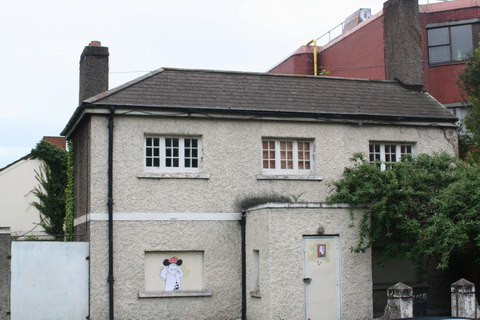
53 Percy Place, Dublin

The price is interesting. The property was valued at €1.6 million in 2008. WI’s Annual Report and Accounts for 2013 say

Surplus assets represent those assets that the Body deem are not strategic and are available for sale. Valuations of surplus assets are based on Recoverable Market Value from Internal and External valuations reports.

Plot 8 valued at €7,000,000 (2012: €7,000,000); this was valued in September 2013 by GVA Donal O’Buachella.

Percy Place was valued at €800,000 (2012: €650,000) by Felicity Fox FRICS FSCSI Auctioneers Valuers & Estate Agent in December 2013.

47 Lennox Street was valued at €270,000 (2012: €195,000) by Richard Fawcett BSc (Hons) Valuation & Estate Management Valuer, Waterways Ireland based on expected sales proceeds at December 2013. Previously valued at €380,000 by CBRE in October 2008.

The Hatch Bar valued in 2012 at €45,000 (2012: €45,000) by Richard Fawcett BSc (Hons) Valuation & Estate Management Valuer, Waterways Ireland in 2012.

The first three properties were to be sold to fund the construction of the Clones Sheugh. I have heard nothing more of the other two sites, Lennox Streeet near Portobello and Plot 8 in the Grand Canal Dock at Ringsend, and I didn’t see what WI got for the Hatch Bar. However, WI may have done very well on the sale of some other surplus assets, achieving four times what it expected:

The Barges were valued in 2013 at €51,000 based on bids received. Previously valued in 2011 by Bryan Millar, Consultant Engineer Naval Architect and Marine Engineer at €13,000.

On the basis of its asking price for Percy Place, WI seems to believe that the property collapse is over; perhaps it is even now in negotiation to develop Plot 8 and build a sheugh all the way to Clones. In the meantime, if it gets €1.6 million for Percy Place, that will help to alleviate the damage caused by the smash-and-grab raid carried out by the Department of Fairytales to pay for Saunderson’s Sheugh.

Derg Marina

The same edition of the Irish Times reports that Derg Marina in Killaloe has been sold for €1.7 million to “a local investor”. It suffered in the floods of 2009 and would need considerable investment were it to be restored to its former use. The site may contain remains of the PS Lady Lansdowne.

Greenway blues

The Weekly Observer of 26 August 2015 reports in its print edition [the story is not yet online] that Great Southern Trail Ltd, the voluntary body that manages part of the old Limerick to Tralee railway route as a greenway, is to cease doing so on 8 November 2015. GST, said to be the only voluntary group in Europe to manage a greenway, hopes that CIE and Limerick City and County Council will take over the management of the route. The newspaper account suggests that the burden of maintaining the greenway and cycleway to EU standards was too great for a voluntary group:

In particular, a very small number of farm crossings are the subject of unfavourable comment due to the difficulties encountered in keeping them clean.

Art

The Ulster Canal Greenway has an artwork. Waterways Ireland is to be in charge of the Ulster Canal Greenway. But the Shinners haven’t gone away, you know:

[…] Sinn Féin councillor Brian McKenna voiced strong criticism of the efforts made at Government level over the past two decades to put in place the substantial funding necessary to guarantee that the reopening of the Canal – long identified as a crucial project for Co Monaghan tourism – was realised in full.

If their dedication to the Clones Sheugh is a mark of Sinn Féin’s approach to economic policy and public investment, we may expect grants for flax-growing to be reinstated immediately they’re elected. And for opening coal-mines and carrying corn to Dublin.


Barrow cot

The Kildare Nationalist tells us that folk in Athy intend to build replicas of a cot formerly owned by Cassidy’s of Monasterevin.

They say that

The whiskey and beer was transported to Dublin on canal boats and the Barrow Cot Boat would have been used to keep the river and canal clear for the bigger boats.

I don’t understand that. First, the bigger boats wouldn’t have needed to enter the river en route from the distillery to Dublin. Second, keeping the canal clear was the job of the Grand Canal Company, not of carriers or traders on the canal. I would be grateful for more information about this.

Cassidy’s actually operated until around 1921, early twentieth rather than early nineteenth century. Perhaps the Edgar Holmes who owns the cot is related to the Samual Edgar Holmes of the engineering firm said to have taken over the premises in 1934.


A new book

Andy Wood’s Abandoned & Vanished Canals of Ireland, Scotland and Wales [Amberley Publishing, Stroud 2015] is now available. It is a companion to his Abandoned & Vanished Canals of England.

Many (but by no means all) of the Irish canals are covered on this site; the author sought and was granted permission to draw on this material and has generously acknowledged that.

I have not yet had time to read the book but I did note that the author seems to have confused Grand Canal Harbour and Grand Canal Docks.

Deadlock?

Victoria Lock, Meelick

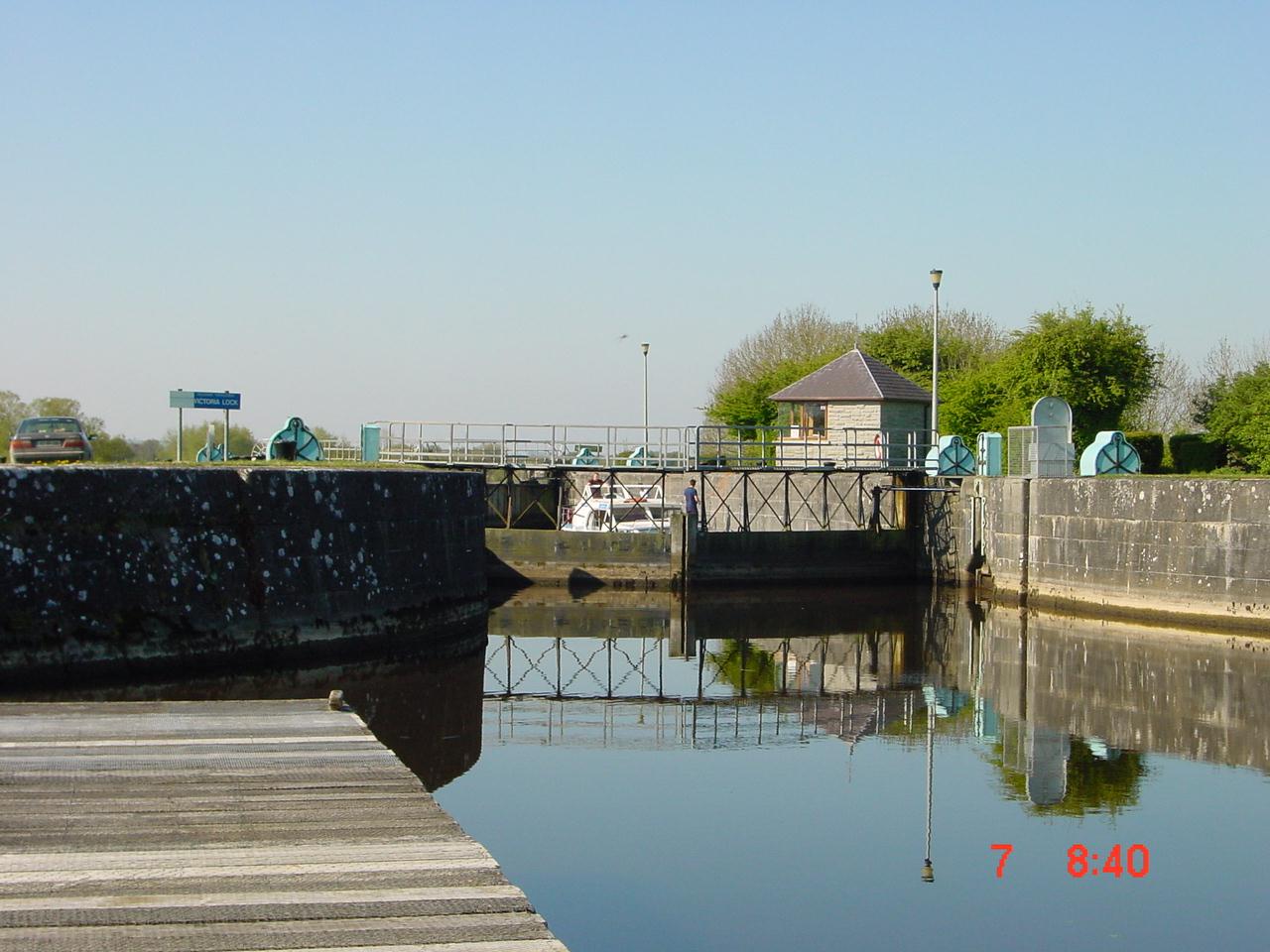
Victoria Lock, Meelick

I like spending the night above the lock at Meelick: a pleasant, sheltered and quiet place. But there is a mystery about it.

Last time we were there, several groups of young folks came down to the lock after the keeper had knocked off for the night and gone home. It had been a warm day and I imagine that they were there to swim below the lock. Afterwards, some of them stayed around, chatting and hitting balls with their hurling mallets. They were quiet and caused no annoyance to anyone (although they might have removed their rubbish, in accordance with Waterways Ireland’s Leave no Trace policy).

But I did wonder what would have happened if there had been any horseplay, or even a mild slip, and someone had fallen into the lock chamber.

Both sets of gates were closed for the night, so the victim (even if conscious and uninjured) would have been unable to swim out and no rescue boat could get in.

There are no ladders in the lock chamber, so the victim could not have climbed out and any rescuer could only dive in, which would mean two people in the chamber rather than one. Nor was there anything in the chamber on which the victim might rest.

There was no information (that I could see) at the lock to tell the victim’s friends what to do, how to summon help or to get the gate opened. Any boater present might use VHF to call the Coast Guard and request a helicopter, but non-boaters might not think of that (or even of asking for the Coast Guard on ringing 999 or 112).

So that’s the mystery: if someone falls into a closed lock after operating hours, how is that person to be rescued? And how are others present to know what they should do? It would be nice if Waterways Ireland were to make information available on the spot.


Waterways Ireland draft heritage plan

Boogie on over to the WI website for a copy of the WI draft heritage plan, and send WI your comments by 6 November 2015.

WI staff have put a lot of work into this and consulted various people, including me. I argued for a more activist approach, with more history and less about communities, and I would have let the twitchers and other nature-lovers look after themselves and their little feathered friends …

Birds hijacking facility at Athlone intended for (and paid for by) humans

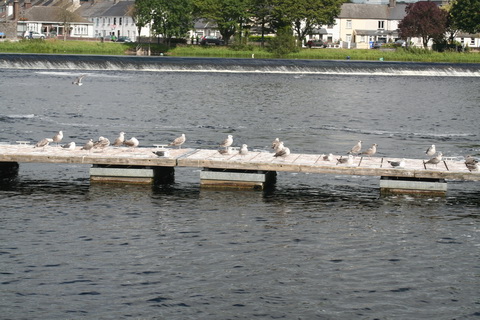
Freeloading birds hijacking facility at Athlone intended for (and paid for by) humans. And who’s going to have to pay for cleaning it? Humans, that’s who. Human rights, that’s what we need …

… but I quite appreciate that Waterways Ireland has to be polite to all these people and can’t disobey the law, no matter how insane the legislation is.

But I digress. Get some comments in, preferably plugging industrial and transport heritage and economic history.

Portumna drawbridge

BORRISOKEEN, July 14. — The Solicitor-General, Mr Doherty, will arrive here to-morrow for the purpose of investigating the late unfortunate occurrences of this town on the 26th and 28th ultimo. This measure of the Government seems to restore some confidence to the minds of the people. Had this investigation not been granted, no person could calculate on the consequences of the expressed resolution of the peasantry to come into Borrisokeen, in a body of 50,000 or 60,000, to have vengeance for the loss of their relatives and neighbours.

On Saturday last a person named Dagg, a Protestant, residing in Borrisokeen, but who left it on account of the late occurrences, was apprehended at the mountains of Thoreebrien, when the country people held a consultation on the most effectual mode of putting him to death. Disregarding his entreaties and professions of innocence, he was dragged along by about 500 persons, and, on coming to Portumna, they determined to tie his legs to one part and his arms to the other part of the drawbridge across the Shannon, and then open it, that he might be drawn asunder. Fortunately at the time a gentleman from Borrisokeen passed by, and by his interference, with that of the parish priest, the life of the unfortunate man was spared.

Salisbury and Wiltshire Journal 27 July 1829

From the BNA

Newspaper accounts at the time suggest that there was an affray in Borrisokane at the end of the fair. Five mounted police either attacked or attempted to disperse the crowd; stones were thrown; Captain Dobbyn, a Stipendiary Magistrate, read the Riot Act and ordered the police to fire, which they did, killing two people. Two days later, during the funeral of one of those shot, one John L—, an Orangeman, and four companions, fired on the mourners from behind portholes on his house, or sallied forth to fire, killing four immediately and mortally wounding another. There is nothing to suggest that the unfortunate Mr Dagg was in any way involved.

Hamilton Lock

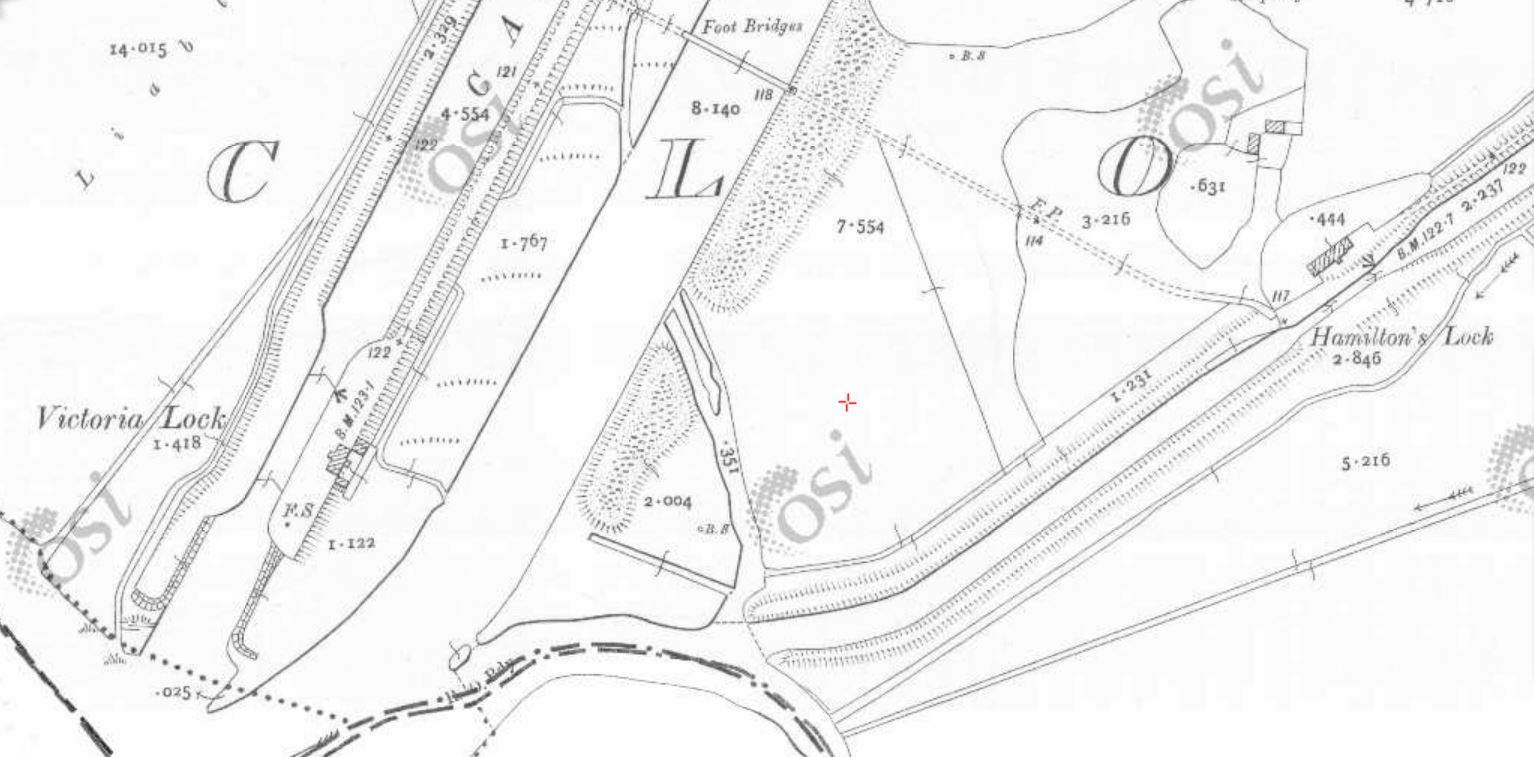
Victoria (Meelick) and Hamilton Locks (OSI ~1900)

Victoria (Meelick) and Hamilton Locks (OSI ~1900)

Lord Dunkellin: Do you know the Victoria lock at Meelick?

Sir Richard Griffith: I do.

Victoria Lock, Meelick

Victoria Lock, Meelick

Dunkellin: Do you know what is called the Old Cut, the old canal?

Griffith: Yes.

Dunkellin: The Victoria lock is a new work, is it not?

Griffith: It is.

Dunkellin: Should you be surprised to hear that vessels do not use that frequently, but go by the old cut?

Griffith: In times of very high flood I am aware that the canal boats find it advisable and beneficial to go by the Hamilton lock, on the old cut, in preference to the other.

Dunkellin: Prima facie, one would have thought that a new work like the Victoria lock would have the effect of regulating the state of things?

Griffith: It arises from the Counsellers’ Ford, as it is called, above Meelick; it has not been sufficiently excavated, and there is a strong current, and the boats are not able to get up to it in times of high flood.

Dunkellin: Then the boats made use of the old canal instead of the new lock?

Griffith: Under those peculiar circumstances they did.

Evidence of Sir Richard Griffith to the Select Committee on the Shannon River 12 June 1865

My OSI logo and permit number for website