Category Archives: Built heritage

Salmon at Ardnacrusha

Might a salmon cannon work?
Where do correct ideas come from?
Where do correct ideas come from? Do they drop from the skies? No. Are they innate in the mind? No. They come from social practice, and from it alone; they come from three kinds of social practice, the struggle for production, the class struggle and scientific experiment.

Readers will not, I am sure, need to be reminded that those are the words of the late Comrade Mao Tse-tung [or Mao Zedong, as the younger comrades say] in the Draft Decision of the Central Committee of the Chinese Communist Party on Certain Problems in Our Present Rural Work of May 1963.

Maurice Semple, in By the Corribside [self-published, 1981], lists writers who, from 1868 onwards, agreed with the view of the Cong Canal expressed by Sir William Wilde:

[…] for it was discovered, that like many other undertakings, the great canal at Cong “would not hold water.”

Those writers’ view is echoed by local people, and even by engineers, to the present day. Their case is, in effect, that the Board of Works engineers did not know what they were doing or did not properly survey the ground and were therefore surprised to find, on admitting water to the bed of the canal, that it vanished into sinkholes or swallow-holes in the karst.

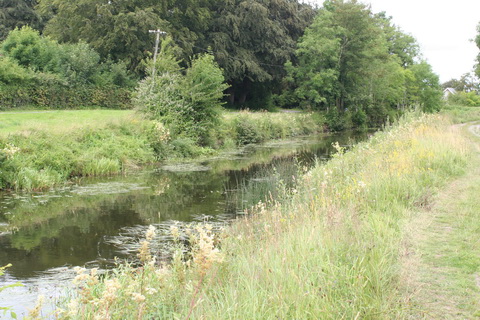
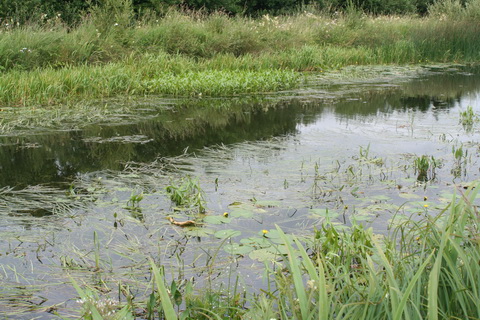
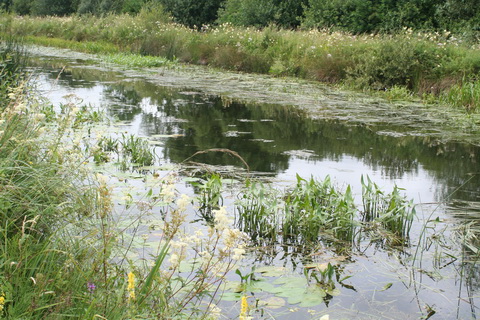
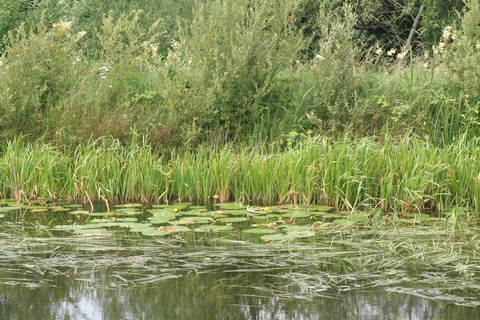
One oddity about that belief is that the Cong Canal does actually hold water: it is full in winter, as the photos on this page, taken in February 2013, clearly show. It is empty in summer, but that is because water is unable to get in at the upper end, not (I suggest) because it flows out through the bottom.

What interests me at the moment is that I can find no evidence to support Wilde’s contention. Samuel Roberts, the engineer in charge of the work, knew that the work would be difficult but there is no hint in any of his annual reports that he feared that the difficulties might be insuperable. Furthermore, it is clear from his own reports and from other evidence that he was ordered to cease work on the navigation aspects of the canal before it was finished: there was never a moment when water was admitted to a completed navigation canal.

I have not been able to find any report from the 1850s in the Freeman’s Journal, the Cork Examiner, the Dublin Evening Mail or the Belfast News-Letter, or in any British newspaper, that supports William Wilde’s account of events. What, then, is its basis?

Of course my inability to find evidence does not mean that it doesn’t exist, but I would be grateful if anyone could point me towards it. I should say that I do not regard later accounts, like Wilde’s, as valid unless they include some evidence from 1854, the year of which Roberts wrote

The masonry in the Cong lock was commenced in March, and was progressing rapidly when I received instructions from the Board, in April, to suspend the execution of all navigation works in this division of the district, and complete only such as were necessary for the regulation of the waters of Lough Mask, for drainage purposes.

What I am looking for is an eyewitness, an official or some other reliable account, from 1854, that says “the canal was completed; water was let in; it vanished, to the surprise of the engineers”. If no such account exists, I may be forced to conclude that Wilde’s style of work is opposed to the fundamental spirit of Marxism-Leninism. As the Great Helmsman put it in the Little Red Book:

To behave like “a blindfolded man catching sparrows”, or “a blind man groping for fish”, to be crude and careless, to indulge in verbiage, to rest content with a smattering of knowledge — such is the extremely bad style of work that still exists among many comrades in our Party, a style utterly opposed to the fundamental spirit of Marxism-Leninism. Marx, Engels, Lenin and Stalin have taught us that it is necessary to study conditions conscientiously and to proceed from objective reality and not from subjective wishes; but many of our comrades act in direct violation of this truth.


Archives workshop: a reminder

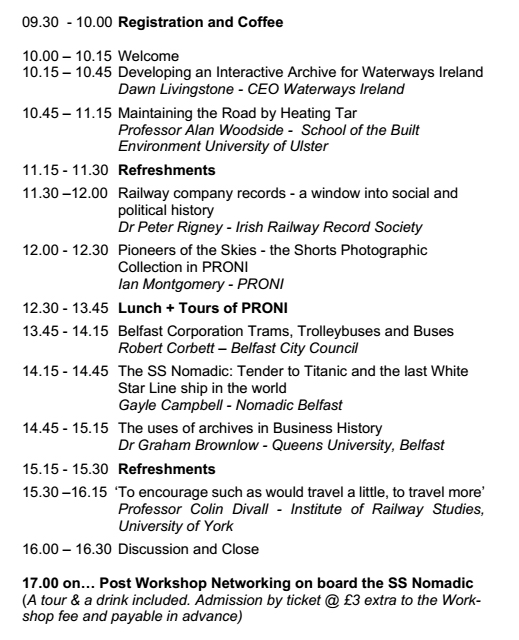
I mentioned, back in April, that an interesting-looking workshop is scheduled for Belfast on 8 September 2014. It’s being held in the Public Record Office of Northern Ireland [PRONI] in the Titanic Quarter and there’s an optional extra tour and reception on the SS Nomadic afterwards. This post is a reminder.

The programme covers waterways, roads, railways and flight. For this site, the opening session is of great interest: Dawn Livingstone, CEO of Waterways Ireland, is to talk about an interactive archive for Waterways Ireland.

By air, sea and land

By air, sea and land

The workshop is being organised for PRONI by A²SN, the Archives and Artefacts Study Network, supported by the Historical Model Railway Society, the Business Archives Council and the Postal History Society.

The [two-page PDF] brochure is downloadable here PRONI transport archives workshop. The workshop fee is £20/€25 with an extra £3/€3.50 for the SS Nomadic visit. Sterling cheques are accepted; there is provision for paying in euro by online banking.


The abandonment of the Cong Canal

I am speaking tomorrow, 23 August 2014, at Lough Mask School House’s Heritage Day about the history of the Cong Canal.

Apart from an overview of the initial proposal, the construction and the current state of the canal, I intend to present what I think is an entirely new explanation for its abandonment before completion. At least, it’s an explanation that I have not seen published elsewhere.

Mayo’s canal system

No, not the Belmullet Canal, nor the Cong Canal. James McParlan MD, in his Statistical Survey of the County of Mayo, with observations on the means of improvement; drawn up in the year 1801, for the consideration, and under the direction of The Dublin Society [printed by Graisberry and Campbell, Dublin in 1802 and available here courtesy of Messrs Google], after mentioning some lakes and navigable rivers, said:

Those are the only navigations or navigable rivers in this county, except the Marquis of Sligo‘s canal, which winds for several miles through his demesne; it serves for conveying sea and other manures to different parts of the demesne, for conveying among the fields turnips and green feeding, and for several purposes.

I have looked on the OSI 6″ maps [~1840] at the Browne estates listed on the Landed Estates Database, but I have found no sign of the canals. I didn’t know where to look, and the good marquis owned a lot of land, so I may have missed something; furthermore almost forty years elapsed between McParlan’s work and the publication of the OSI maps and the canals may have fallen out of use in that period. If anyone knows where they were, and whether any trace remains, I would be grateful for information.


Did you know …

… that Pollboy Lock, on the River Suck, can be filled in one minute and fifty-eight seconds?

Pollboy

Pollboy

Ballinasloe footbridge

Here is a new page with a brief account of the Ballinasloe Line of the Grand Canal and some photos of a footbridge that seems to have been built across it in the twentieth century.

Saving canals

Barrow Line 20140721 03_resize

Barrow Line 1

Barrow Line 20140721 06_resize

Barrow Line 2

Barrow Line 20140721 08_resize

Barrow Line 3

Barrow Line 20140721 09_resize

Barrow Line 4

When I get a moment, I must find out how many boats have been down that way in this warm, sunny July, the peak of the holiday season. The warmth will have encouraged the vegetation, but I suspect relatively few boats have been through. And only two boats entered the Royal through Dublin in July, even though two openings were offered.

Apart from giving artistic verisimilitude to an otherwise bald and unconvincing narrative about the value of the canal tourist industry and the abiding love of boaters for the canal, using canals helps to keep the weed down.


Effin mensuration

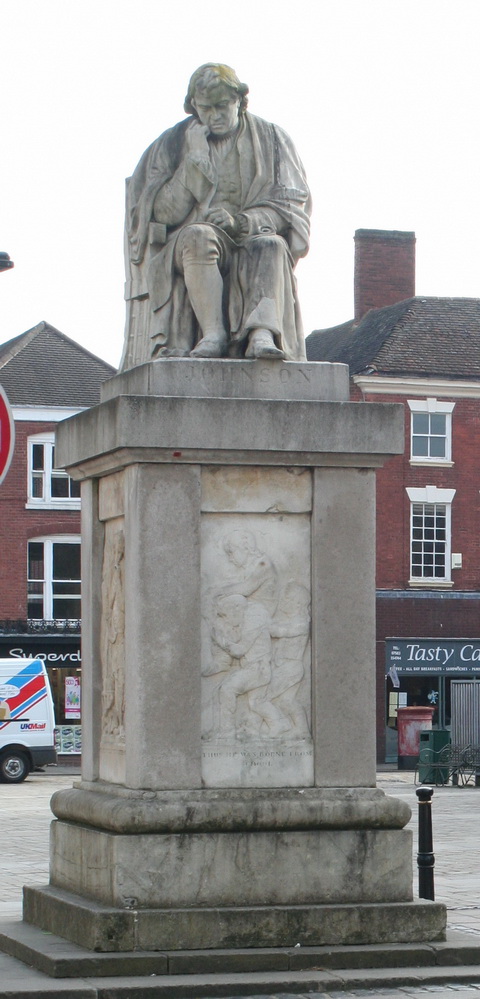
Statue of Dr Johnson near his birthplace in Lichfield

Statue of Dr Johnson near his birthplace in Lichfield

The learned readers of this site will not need to be reminded of the sapient advice of the late Dr Samuel Johnson:

[…] no man should travel unprovided with instruments for taking heights and distances.

There is yet another cause of errour not always easily surmounted, though more dangerous to the veracity of itinerary narratives, than imperfect mensuration. An observer deeply impressed by any remarkable spectacle, does not suppose, that the traces will soon vanish from his mind, and having commonly no great convenience for writing, defers the description to a time of more leisure, and better accommodation. […]

To this dilatory notation must be imputed the false relations of travellers, where there is no imaginable motive to deceive.

Samuel Johnson A Journey to the Western Islands of Scotland W Strahan and T Cadell 1775

The good doctor would, I think, have welcomed the invention of the digital camera with inbuild chronometer. Equipped with just such a device I arrived yesterday at the first lock on the Royal Canal to witness the lifting of the railway bridge and the passage thereunder of fleets of boats. I thought it would be interesting to record how long each stage took.

I have written before about this bridge: reporting a question by Maureen O’Sullivan TD in October 2013 and another in November 2013 and providing statistics on usage a few days later:

  • only 58 boats went through in 2013
  • the bridge was lifted on seven dates
  • two other scheduled lifts were cancelled as no boats wanted to travel
  • Irish Rail charged Waterways Ireland €1200 per weekday lift and €2000 per weekend lift.

The first 45 minutes

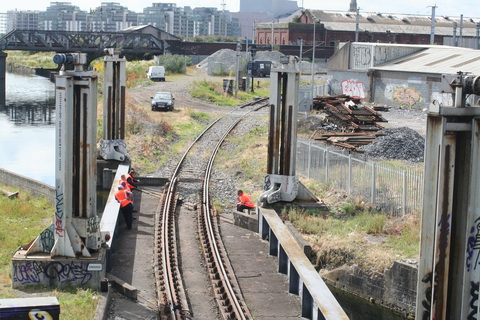
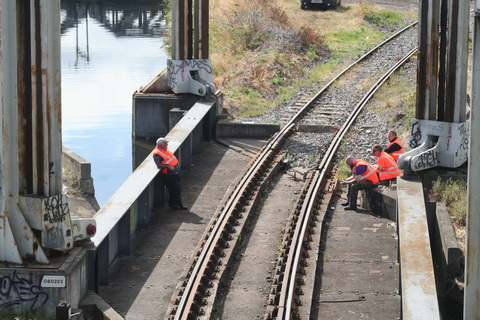
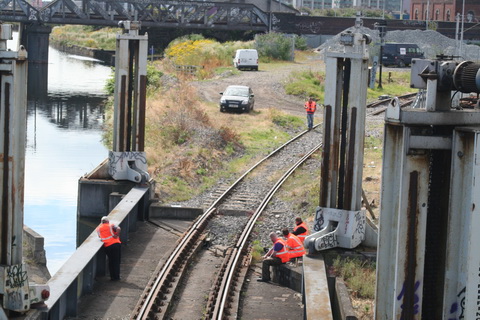
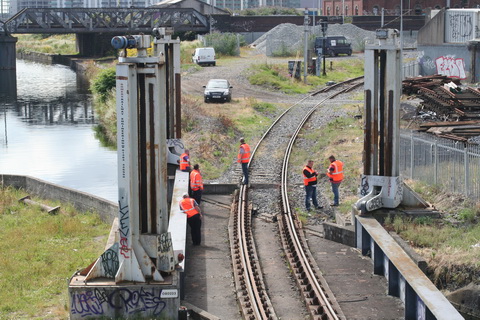
A lift scheduled for early July 2014 was cancelled; yesterday’s lift catered for just two boats, whose passage was assisted or monitored by eight Irish Rail staff and four from Waterways Ireland. Four of the Irish Rail people may have been in training as others seemed to be demonstrating things to them, but that’s only a guess. Three of the WI staff travelled together in WI’s stealth van and operated the first lock; the other, who travelled separately in a 4WD vehicle, visited from time to time. As far as I could see there was no contact between the Irish Rail and WI teams.

The bridge was scheduled to be lifted by 1100.

Before the lift 0945

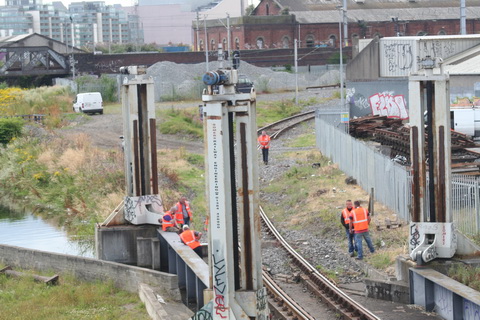
Before the lift: 0945. The lifting bridge is on the right of the photo

Before the lift 0946

One minute later: 0946. A separate group of workers, perhaps contractors, is going down the west side of Spencer Dock with equipment

Before the lift 0949

Four men still on the bridge 0949

Before the lift 0951

Two minutes later

Before the lift 0956

On the bridge 0956

Before the lift 0958

Still there 0958

Before the lift 0959

One minute later

Before the lift 1006

The bridge 1006

Before the lift 1012

The bridge 1012

Before the lift 1015

The bridge 1015: another person approaches

Before the lift 1020

Six men at the bridge at 1020

Before the lift 1028

A seventh man approaches at 1028

Preparing to lift

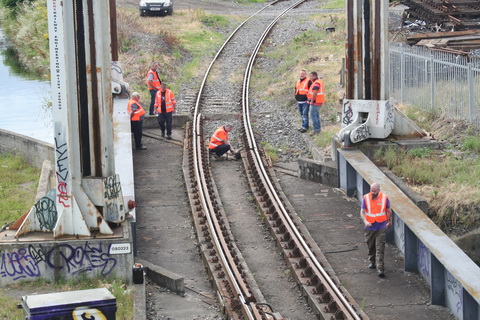
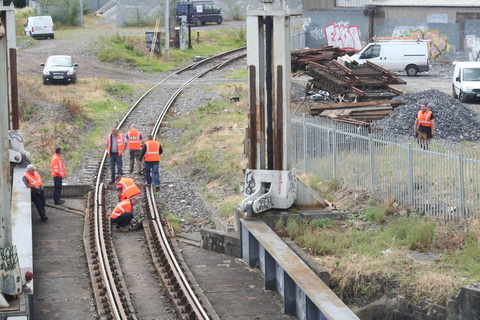
The preparation stage, presumably involving the unlocking of some mechanism, took about five minutes altogether.

Preparing the bridge 5 mins 03_resize

One man worked on the far end while another walked to do the same at the near end

Preparing the bridge 5 mins 06_resize

An eighth man, behind the fence on the right, seemed to summon two of the men on the bridge

Preparing the bridge 5 mins 14_resize

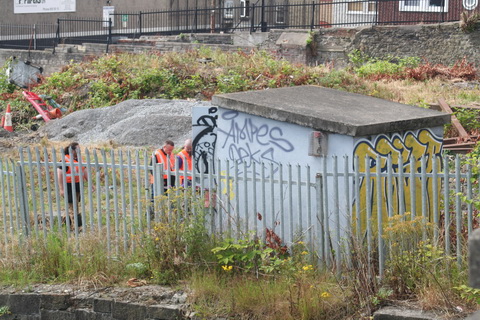
They went to this building, which I guess houses the controls for the bridge

Preparing the bridge 5 mins 15_resize

Meanwhile work continued on the bridge itself

Preparing the bridge 5 mins 19_resize

Almost done

Preparing the bridge 5 mins 22_resize

A final check

Preparing the bridge 5 mins 25_resize

Everybody was off the bridge by 1033

Lifting

The lift itself took just over nine minutes; the bridge was up before 1044, in good time for the arrival of the boats.

The lift 9 mins 02_resize

After about one minute

The lift 9 mins 08_resize

Another minute later

The lift 9 mins 11_resize

Another minute (or so)

The lift 9 mins 15_resize

About four minutes have elapsed

The lift 9 mins 18_resize

After five minutes. The sides are clear of the water in which they usually rest; they are dripping on to the canal below

The lift 9 mins 20_resize

Six minutes in

The lift 9 mins 23_resize

Seven minutes

The lift 9 mins 24_resize

The men behind the fence may be controlling the lift

The lift 9 mins 28_resize

Not much further to go

The lift 9 mins 32_resize

Eight minutes

The lift 9 mins 40_resize

It’s up

The bridge up 16_resize

One of the jacks

After the boats passed_resize

Side view (taken after the boats had gone through)

The bridge up 13_resize

Water under the bridge

Boats go through

It took just over three minutes for the two boats to go under the bridge.

Boats approach 12_resize

Cruiser approaches; steel boat visible through the bridge

Cruiser goes through 03_resize

Cruiser about to enter

Cruiser goes through 04_resize

Heads down

Cruiser goes through 06_resize

Half way through

Cruiser goes through 07_resize

Leaving

Cruiser goes through 08_resize

Out

Steel boat goes through 12_resize

Steel boat entering

Steel boat goes through 20_resize

Almost through

Steel boat goes through 22_resize

Looking ahead to the lock

Steel boat goes through 25_resize

Done


I did not record the lowering of the bridge, which I presume took much the same time as the raising.

Preparation 5 minutes, lifting 9 minutes, passage 3 minutes, lowering and locking say another 14 minutes: say 45 minutes altogether, allowing some margin. But a large number of boats would take much longer as the rate at which they could move on from the bridge would be limited by the time taken to work through the lock.


Tullamore in 1947

T W Freeman “Tullamore and its environs, Co Offaly” in Irish Geography (Bulletin of the Geographical Society of Ireland) Vol 1 No 5 1948 (based on material collected in 1947):

The original geographical advantage lay in the canal, which placed it on the main line from Dublin to Limerick around 1800, but canal traffic, though still important, is no longer crucial.

However …

Social activities in Tullamore include a wide range of clubs for athletics, dances, bridge, a modern cinema, and the occasional extra shows and matches that mean so much to the people of a country town and its surroundings. On the athletic side the new swimming pool is the most attractive recent addition (but no mixed bathing) ….