Category Archives: Built heritage

Are we there yet?

Some folk get bored by the Shannon between Athlone and Portumna. I don’t share that feeling, but those who do might like to be able to make a guess at how far they are from the next major feature.

Waterways Ireland’s numbering of its assets, including navigation markers, provides one possible way of assessing progress. The numbering of the markers is not quite sequential but it’s pretty good. I think that WI has GPS locations for all its assets, but GPS takes all the fun out of things; wouldn’t it be much better to try to photograph and tick off all the markers on paper? Far more exciting than train-spotting!

As a start, here are some rough locations. These are not the nearest markers to the places mentioned but they’re in the right general area:

  • 827 above Shannonbridge
  • 848 just above the Shannonbridge speed limit signs
  • 1014 above Shannon Harbour
  • 1029 above Banagher Bridge
  • 1036 below Banagher
  • 1065 green above Meelick cut
  • 1101 green just below high-level power cables
  • 1110 above Portumna Bridge
  • 1122 below Hayes’s Island
  • 1128 goalposts lower green.

Isn’t this exciting? Any more numbers for locations?

Canal carrying 1846: the Royal Canal

Isaac Slater’s Directory[i] of 1846 lists those carrying goods on inland waterways. There is a long list for Dublin; entries for other towns list those providing local services [there are some conflicts between the lists: see below]. However, the Dublin list shows only two carriers on the Royal Canal:

  • the Royal Canal Company [RCC] itself (Samuel Draper, Secretary) at the Broadstone in Dublin
  • John M’Cann & Sons, Liffey lock, North Wall, where the Royal Canal joins the River Liffey.

I noted here that two published histories of the Royal Canal, and a history of the Midland Great Western Railway [MGWR], suggested that the RCC/MGWR did not commence carrying goods themselves, on their own canal, until the 1870s. However, I had come across an MGWR ad, from 1853, beginning

The Directors will receive Proposals for the Haulage of their Trade Boats to and from Dublin and Longford and the River Shannon […].

The material in Slater’s Directory strengthens the notion that the RCC/MGWR did engage in carrying well before the 1870s, although the nature of the contractual relationships is not clear. Note also that Peter Clarke’s Appendix C[ii] lists “Boat Owners operating on the Royal Canal 1826 to 1847” including four RCC boats as well as four MGWR boats.

Destinations

M’Cann and RCC both provide long lists of the destinations they serve:

  • RCC: Athlone, Ballinafad, Ballymahon, Balnacarig, Balnalack, Boyle, Boyne aqueduct, Carrick on Shannon, Castlerea, Colooney, Coolnahay, Downs Bridge, Dromod, Drumsna, Ferns, Glasson, Hill of Down, Junction [which may be the junction between the main line and the Longford Branch], Kenagh, Kilcock, Lanesborough, Leixlip, Longford, Maynooth, Moyvalley, Mullingar, Newcastle, Newtownforbes, Rathowen, Roscommon, Ruskey, Rye aqueduct, Sligo, Terlicken, Thomastown, Toome Bridge
  • M’Cann: Arvagh, Athlone, Ballaghaderin, Ballina, Ballinamore, Ballyfarnon, Ballymahon, Ballymore, Ballymote, Boyle, Carrick on Shannon, Castlerea, Dromod, Drumkerrin [Drumkeeran?], Drumlish, Drumshambo, Drumsna, Dunmore, Edgeworthstown, Elphin, Fenagh, Granard, Lanesborough, Longford, Mohill, Roscommon, Ruskey, Strokestown, Tenelick Mills, Tulsk.

I thought it might be interesting to show these destinations on a map. Note that the map is from the 25″ Ordnance Survey map of around 1900 rather than the 6″ of around 1840: I used it because it was clearer, but it shows features (eg railway lines) that were not present in 1846.

Click on the map to get a slightly larger version.
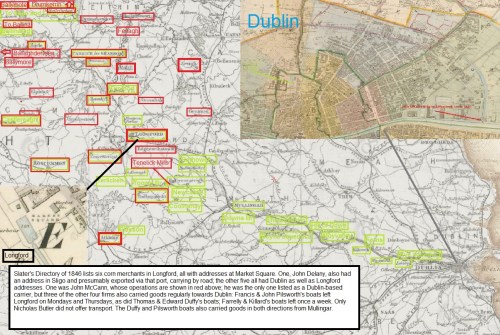
Royal Canal carriers M'Cann and RCC 1846 (OSI)

Royal Canal carriers M’Cann and RCC 1846 (OSI)

I can’t stand over every location marked on the map (as it were). Spellings of place-names were sometimes not those in use today; some place-names (Ballinamore, Ballymore, Newcastle) are used of two or more places that might have been those intended; I could not identify two places, Dunmore and Junction, although I suspect the latter may be the junction between the main line and the Longford Branch of the canal.

What is interesting, though, is the different emphases in the two firms’ marketing. The Royal Canal Company lists almost every location along its canal; M’Cann offers a wide range of destinations beyond the canal, presumably linked by cars on the roads, into Counties Longford, Cavan, Roscommon, Westmeath, Mayo and Sligo. The RCC serves some such destinations, but a smaller number of them.

Some of the locations listed are small places; my presumption — which I have not yet checked, but for which I have found some supporting examples — is that such places have mills, quarries or other industries that provide cargoes for the canal.

The Shannon and the roads

Both operators offer to serve destinations on the River Shannon, to which the Royal Canal is joined at Clondra/Richmond Harbour:

  • RCC: Athlone, Carrick on Shannon, Dromod, Drumsna, Glasson, Lanesborough, Ruskey
  • M’Cann: Athlone, Carrick on Shannon, Dromod, Drumshambo, Drumsna, Lanesborough, Ruskey.

It is possible that goods to those places were carried by water, although (if steam tugs were not available) that would have been slow and uncertain; given that there were good roads leading from the west to the Shannon and throughout the region, it is, I think, likely that these destinations were served by road. I have no evidence on the matter save that the directory entries for Carrick-on-Shannon, Drumsna and Jamestown do not mention the availability of water transport.

Some of those destinations were served by direct road services from Dublin:

  • Athlone, Ballina, Castlerea, Dunmore, Longford, Roscommon, Sligo, Thomastown.

Competition presumably kept charges down.

Other carriers

Slater’s Directory lists six corn merchants in Longford, all with addresses at Market Square. One, John Delany, also had an address in Sligo and presumably exported via that port, carrying by road; the other five all had Dublin as well as Longford addresses.

One was John McCann, whose operations are shown in red on the map; he was the only one listed as a Dublin-based carrier, but three of the other four firms also carried goods regularly towards Dublin: Francis & John Pilsworth’s boats left Longford on Mondays and Thursdays, as did Thomas & Edward Duffy’s boats; Farrelly & Killard’s boats left once a week. Only Nicholas Butler did not offer transport. The Duffy and Pilsworth boats also carried goods in both directions from Mullingar. My guess is that carrying goods from others helped these merchants to cover the costs of their own fleets.

Peter Clarke’s Appendix C suggests that M’Cann’s fleet was the smallest of those based in Longford. The list is of “Boat Owners operating on the Royal Canal 1826 to 1847” but I am not entirely clear what the list shows. It seems unlikely, for instance, that the Midland Great Western Railway owned four boats throughout the period, as the company did not exist for most of it. Is the number of boats the largest that an owner had, or used, in a peak year, or an average over several years?

I don’t, therefore, know how to interpret the list but, assuming that the same methods were applied to all owners, it seems that the fleet sizes were these:

  • Duffy Bros 12
  • Pilsworths 9
  • M’Cann 5
  • Royal Canal Company 4.

Neither Farrelly nor Killard is listed, but there are many others: Dunne 8, Kelly 6, Murtagh 6, Murphy 5, MGWR 4, Williamson 4, and many others with 1, 2 or 3 boats each. Again, it is not clear in which years those owners had those numbers of boats.

More

As far as I know, little has been written about the carrying companies, especially those of the nineteenth century. I would be glad to hear from anyone who can correct, supplement or comment on this information.


[i] I Slater’s National Commercial Directory of Ireland: including, in addition to the trades’ lists, alphabetical directories of Dublin, Belfast, Cork and Limerick. To which are added, classified directories of the important English towns of Manchester, Liverpool, Birmingham, Sheffield, Leeds and Bristol; and, in Scotland, those of Glasgow and Paisley. Embellished with a large new map of Ireland, faithfully depicting the lines of railways in operation or in progress, engraved on steel. I Slater, Manchester, 1846

[ii] Peter Clarke The Royal Canal: the complete story ELO Publications, Dublin 1992

My OSI logo and permit number for website

Sinn Féin sheughs again

Sinn Féin demonstrates its continuing commitment to the unification of Ireland reconstruction of the Clones Sheugh. KildareStreet tells us that Sandra McLellan, TD for Cork East, no doubt motivated by the wealth of waterways in her own area, asked a written question on 18 July 2013:

To ask the Minister for Arts, Heritage and the Gaeltacht the position regarding the Ulster Canal restoration project; the remaining steps that must be taken to complete the project; if he will provide an indicative timeline for the completion of the project; and if he will make a statement on the matter.

She got a more or less standard answer from the minister, Jimmy Deenihan [FG, Kerry North/West Limerick]:

As the Deputy will be aware, in July 2007, the North/South Ministerial Council (NSMC) agreed to proceed with the restoration of the section of the Ulster Canal between Clones and Upper Lough Erne. The then Government agreed to cover the full capital costs of the project, which were estimated at that time to be of the order of €35m.

It was always the intention that the Ulster Canal project would be funded from the Waterways Ireland annual allocations, as agreed through the annual estimates processes in this jurisdiction, as well as the deliberations of NSMC in relation to annual budgets. It was a key consideration throughout the process that the Ulster Canal project would be supported by a significant level of projected income from the commercialisation of certain Waterways Ireland assets. However, as the Deputy will be aware, the economic downturn has had a negative impact on those plans.

In the meantime, the Ulster Canal project is progressing on an incremental basis. Planning approvals have recently been secured for the project in both jurisdictions. I welcome these developments, which, I am sure the Deputy will agree, are a significant milestone for the project.

I am continuing to explore all possible options to advance this project within the current fiscal constraints. In this regard, an Inter-Agency Group on the Ulster Canal has been established to explore and examine ways to advance the project and to examine possible funding options for it, including existing funding streams and the leveraging of funding from other sources, including EU funding options.

Isn’t it funny? Every so often the shinners ask a question to remind the minister that they, er, haven’t gone away, you know. They don’t get really aggressive about it and they don’t seem to be organising mass rallies in Clones to demand a sheugh. And the minister is equally polite, saying in effect “we haven’t shot your horse”.

This project is not very important: it’s a waste of money and will be of no benefit to the national economy, and a government seeking savings could easily kill it off. Yet it has refused, over several years, to take that obvious step. Instead, it’s devoting departmental time, and that of other public servants, to (admittedly low-cost) measures that seem to be intended to show that the project will be maintained on life support, even if it never rises from its bed.

Is there something in the St Andrew’s Agreement, or some other bit of northsouthery, that promises a sheugh to Sinn Féin, to enable them to claim credit for some high-profile but non-threatening all-Irelandism? Is the Clones Sheugh the price of SF support for the Police Service of Northern Ireland? I don’t know, but there must be some explanation for the failure to kill off the sheugh.


Pumping algae

Do algae pass through pumps? I don’t know, but I ask because boating, bathing and animals have been banned in Lough Ennell where blue-green algae have been found. Lough Ennell is to supply water to the Royal Canal, although I presume it will take some time before it begins to do so. But perhaps, even if algae made it through the pumps, they would die in the Royal. If you know, Gentle Reader, do please leave a Comment below.

Dialogue

Some time ago I noted that Waterways Ireland was now down wid da kidz in da hood, doing groovy things like social meeja with a Youtube thingie. It features (inter alia) a flight in a helicopter gunship along a restored Clones Sheugh. At least, that’s what I presume was going on, although I couldn’t work out how to fire the rockets at the suspiciously large number of narrowboats found along the way. The scenic highlight of the journey was Clones.

There’s also a Facebook page, from which I learned that there is now a skippered boat available for hire on the Barrow. And there is a Twitter whatsit, which does two interesting things.

First, it has summaries of marine notices, which will be useful to those cruising on the waterways without internet access.

Second, it shows signs of WI’s engaging in public dialogue with users, even when their comments might be critical. This is very welcome; it will be interesting to see the extent to which such public dialogue is permitted to develop.


Bock goes boating …

… on the Shannon Estuary, the second most interesting coast of Clare (the inland coast is the most interesting, the north-west coast the least). Includes nice pics of the Scattery battery.

How low can you get?

Here’s a report from Hawthorn about Shannon water levels; here is a press statement from a political chap on the matter [PDF]; here is a post showing quite how important agriculture is to the Irish economy.

In brief: it isn’t. As Constantin Gurdgiev says:

[…] Irish agriculture is an extension of the welfare state, in so far as most of the value added in it is provided for by the subsidies.

Given that the sector as a whole includes the relatively small number of productive farms, the value of marginal farms may well be negative. Those occupying such land should be encouraged to abandon it and to take up some more productive activity elsewhere; Mongolia seems like a good bet. Activities designed to help the landlords to continue to pretend to be engaged in an economic activity are a waste of resources.

The Washington gandalow

See here.

The mysterious Pill

Some questions and speculations about trade on St John’s Pill in Waterford.

The Exchequer Bill Loan Commission

I noted the other day that the North South Ministerial Council’s inland waterways meeting discussed how it might get the Irish government off the hook of its rash promise to fund the Clones Sheugh. It noted that:

[…] sponsor departments have agreed to examine the potential social benefits and leveraged funding opportunities in that context.

The interesting point is that the blasted thing wonderful investment opportunity was originally funded, using the same excuse, by a loan from the Exchequer Bill Loan Commission set up under the Poor Employment Act 1817. John Strettell Brickwood, Secretary to the Exchequer Loan Commissioners for Public Works [sic], said* that the Commission’s first £1.5 million was allocated in 1817 and that by 1835 £5.5 million had been advanced.

Of that, £200,000 (at 3¼% interest) was allocated to Ireland in 1827 and the Ulster Canal was allocated £120,000 of that; it drew down £40,000 in 1833 and the same again in 1835. Mr Blackwood said that the Ulster Canal money was issued under an express act of parliament, leaving the commissioners no discretion. There would be no repayment until the canal was complete, with the interest and principal payable only from the prospective income.

Isn’t economic development wonderful?

First and Second Reports from the Select Committee appointed to inquire into the amount of advances made by the Commissioners of Public Works in Ireland with the Minutes of Evidence, Appendix and Index Ordered, by the House of Commons, to be Printed, 26 June and 27 August 1835
