Category Archives: Canals

Walking the Royal

Great walking match

A CELEBRATED MATCH is now performing by W F Simpson, a Native of Dublin, at RUSSELL-STREET, or JONES’S-BRIDGE, Royal Canal. He purposes Walking

1000 Quarter Miles in 1000 Quarter Hours!

for a Wager of £100 to £50. Such a feat has never been performed by any Pedestrian trained in England.

Admission, 2d each.

Freeman’s Journal 25 September 1850

From the British Newspaper Archive run by Findmypast Newspaper Archive Limited, in partnership with the British Library.

The mystery of Mr Worrall

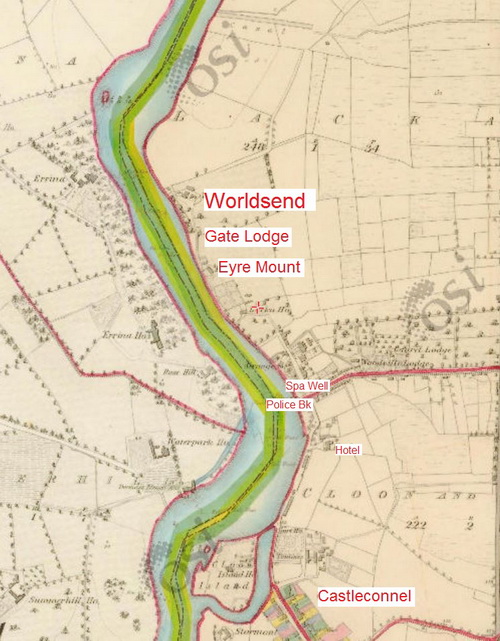
Castleconnell and Worldsend, Co Limerick (OSI 6" ~1840)

Castleconnell and Worldsend, Co Limerick (OSI 6″ ~1840)

The authors of a book called Village by Shannon, about Castleconnell, Co Limerick, say that the area of Worldsend, at the northern end of Castleconnell, derives its name from Worrall’s Inn, an establishment operated by a Mr Worrall in the early eighteenth century.

That may be so, but the book’s accounts of river-borne traffic — to a quay at the inn — do not seem to accord with what is known about the history of the Shannon navigation, and in particular of the Limerick Navigation between the city and Killaloe. Here are some of the problems.

My OSI logo and permit number for website

Sailing canal boats

Very interesting account. And here’s the Hudson Sloop Club.

New Engine and Propellers for Canal Navigation

Mr Peter Taylor, of Hollinwood, has recently taken out patents for two inventions — one for a rotary high-pressure marine steam engine on a new principle; and the other, that which chiefly calls for notice, for paddles or propellers, also of an entirely new construction. His principal object was to attain that desideratum in steam navigation on canals, sufficient motive power for considerable speed, without the injury to the canal banks caused by the action of the ordinary paddles.

The apparatus consists of a series of vanes or curved blades, placed obliquely, like the sails of a windmill, or like portions of a continuous screw. The apparatus is placed at the stern of the vessel in a small enclosure of water, the sides of the boat being continued beyond the stern, and the rudder being fixed beyond the propellers. They occupy a space of about a yard and a half in length, and, in the instance under notice, seven feet in breadth.

There are two parallel axes or shafts, which project from the stern, each shaft having four pairs of vanes or blades, at short distances, and so placed as to strike the water in quick succession, and obliquely, like the scull of a boat. The oars or blades on one shaft have an action like that of a right-hand screw, and those of the other like that of a left-hand one; and the vanes of each shaft work nearly up to the other shaft, and thus their joint action has the effect of propelling the boat forward, or when reversed, by altering the motion of the driving-wheel, in a direction stern first. They are said to differ (amongst other respects) from all propellers previously invented, both in their screw-like action, and in the axles being wholly under water.

By way of trying experiments with these propellers, Mr Taylor has had a set of them fitted to an old iron boat, about fifty-two feet in length, and seven feet in width, formerly worked on the canals by Messrs Buckley, Kershaw and Co. One of Mr Taylor’s new rotary engines of only five horses’ power has been fitted into the boat, which has been named “The Experiment of Hollinwood“. After several private trials, this boat made its first experimental trip on the river Irwell, yesterday week.

Mr Taylor and a few friends proceeded from the Old Quay, Manchester, as far as Barton-on-Irwell, and on the whole they state that the action of both engine and propellers was satisfactory; though in returning there was a deficiency of steam, from the filling-up of the fire-tubes with coke; a casualty which was remedied as soon as discovered. The speed was regarded as in a high degree satisfactory; being, it is stated, generally at the rate of six, and occasionally seven miles an hour. The motive power was deemed inadequate to accomplish all that the inventor had a right to anticipate; but it is mentioned as one proof of the superiority of his inventions, that the Jack Sharp, a passage boat belonging to the Old Quay Company (whose first trip, after being fitted with engine and stern paddles, we noticed some time ago), was not at all able to keep up with the Experiment, though the engine of the former is twelve horses’, and that of the latter is only five horses’ power.

On Wednesday the Experiment steamed down to Runcorn, by river and canal, and the whole distance was accomplished in about five hours’ working; including the stoppages at the locks, and those caused by the parties on the boat having themselves to open the bridges on the Runcorn Canal. The boat stopped a short time at Barton, and several hours at Warrington, which place it did not leave until dark, and performed the distance between Warrington and Runcorn (which, it is said, is about seven miles and three quarters) in about an hour, including delays from the cause just noticed. This increased rate was attributed to having obtained a better description of coke at Warrington.

The boat remained at Runcorn for some hours, and, having so far performed her work to the satisfaction of the voyagers, they determined to proceed in her to Liverpool. They started from Runcorn at half-past three o’clock on Thursday morning, with the tide, and reached the Rock Ferry, opposite Liverpool, by five o’clock, performing the distance in about an hour and a half.

The Experiment is considered to be by no means well adapted for the purposes of canal steam navigation. She is described as in form more like a box than a boat, and as drawing two feet nine inches water; a manifest disadvantage with so small an engine. We are informed, that all who have seen the boat’s performance, including several engineers who took a trip in her, have expressed themselves much pleased with her speed and general action. We understand there is some probability of the Old Quay Company making a trial of the propellers and engine in one of their twin quick passage boats on the Runcorn Canal.

The Experiment, in these trips, was placed under the care of Isaac Taylor, an experienced captain in the Old Quay Company’s employ, the aid of whose services, as pilot and steersman, was afforded for the occasion by Mr T O Lingard. Taylor says the boat answers her helm readily, turns well, and is very manageable. When at her greatest speed, it was found that the agitation and swell caused by her passing through the water, and by the propellers, had very little effect on the canal boats, the stream from the propellers being thrown off in the centre of the canal, leaving a considerable wake there.

Newcastle Courant 5 June 1840, quoting the Manchester Guardian

From the British Newspaper Archive run by Findmypast Newspaper Archive Limited, in partnership with the British Library.

Gondolas

A superb boat or gondola has been recently finished at the Grand Canal, and is painted and decorated in a most elegant manner. It is of a smaller size than the packet boats, and intended for convenience or pleasure of the directors of that great national and useful undertaking, in order to make occasional excursions therein on the different lines of that navigation — it now lies in one of the harbours near the city Bason.

Saunders’s News-Letter 20 April 1795

The elegant gondola which we mentioned to be lying at the Canal Harbour, and to be intended for the use of the Directors, we learn is not for the use of those Gentlemen, but to carry passengers from and to Portobello, to and from the first lock to meet the passage-boats (as lately advertised) and to gratify with a short voyage on the Canal, from Portobello to James’s-street Harbour, such persons as, having no call of business or pleasure towards the county of Kildare, have not otherwise an opportunity of enjoying that gratification, which latter use of the boat is now making by many persons every fine day.

Saunders’s News-Letter 23 April 1795

From the British Newspaper Archive run by Findmypast Newspaper Archive Limited, in partnership with the British Library.

Horses for towing? Bullocks!

The Colthurst canals.

It hasn’t gone away, you know …

Yes, the Clones Sheugh, one of Sinn Féin’s favourite inland waterways, hasn’t gone away, although SF is now allowing FF to make the running. From the invaluable KildareStreet.com:

Brendan Smith [FF, Cavan-Monaghan]: To ask the Minister for Arts, Heritage and the Gaeltacht the stage of the proposal to restore the Ulster Canal; the funding provided in her Department estimates in 2016 for this project; when this project will proceed to the next stage; and if she will make a statement on the matter.

I suppose he could have read the Estimates himself, but maybe that would be too much to ask. Anyway, his constituency colleague [Heather Humphreys, FG, Cavan-Monaghan] replied:

Government approval to restore a 2.5km stretch of the Ulster Canal from the Shannon-Erne Waterway to the International Scout Centre at Castle Saunderson, Co. Cavan, was granted on 24 February 2015. The project, which comprises three work phases, is being undertaken by Waterways Ireland.

Phase 1, the site investigation work, has been completed. Phase 2, dredging of the River Finn, is in progress. I have been informed by Waterways Ireland that completion of this phase has been delayed as a result of contractual issues but that efforts to resolve these matters are ongoing. It is intended that Phase 3 of the restoration work, the construction of a new bridge and canal section, will proceed following completion of phase 2.

Waterways Ireland has an allocation of €2.7m in its 2016 budget for the Ulster Canal project. This is comprised of €1m from my Department’s capital allocation to Waterways Ireland of €2.689m for 2016, with the balance coming from the organisation’s own resources.

We are, it will be recalled, pretending that the River Finn is part of the Ulster Canal, and that Castle Saunderson, that shrine of Ulster Unionism, was on the canal’s route: we don’t want to upset the shinners, so say nothing to them.

Quite why folk are expected to want to visit the scouting establishment now on site I do not know; boating does not seem to be amongst the activities offered.

Baffled

According to a story in the dead-tree version of today’s Sunday Business Post [and regarded as Premium Content, and thus gated, in the online version],

A €22 million bridge is needed to allow for the construction of 2000 homes on the derelict Irish Glass Bottle site [in Ringsend, Dublin]. […] The necessary bridge over the River Dodder needed to make the site viable will have a lifting mechanism to enable ship traffic into the Grand Canal basin and the Liffey.

The Department of the Environment etc thinks €22 million is too much and would make the houses too dear; Green Party leader Eamon Ryan TD thinks the state should pay for it, presumably to facilitate all the motorists who might want to live on the site.

The site is here. There’s an aerial photo here. Here’s the Google version.

I can’t see why a lifting bridge over the Dodder is needed, unless the plan is to run traffic along a new route from Britain Quay to York Road, which would simply jam up the city centre. Can anyone explain what this is about?

Fares

We hear that the Committee of the Navigation Board, have settled the rates for passengers from Dublin to Monastereven and the intermediate places, as follows: to Hazel-hatch, eight miles, one shilling and a penny; to Sallins, fourteen miles, two shillings and two pence; to Monastereven, 31 miles, three shillings and nine pence halfpenny; steerage passengers half price.

Saunders’s News-Letter 19 August 1786

From the British Newspaper Archive run by Findmypast Newspaper Archive Limited, in partnership with the British Library.

Barrow Passage Boat

Will, from the 1st of October, depart every morning from Athy at eight o’clock, and arrive at Carlow at or before eleven o’clock, and again on each day leave Carlow at two o’clock, and arrive at Athy by five o’clock in the evening. To continue at these hours until further notice – and it is intended very shortly to run a boat to Leighlin bridge.

27th Sept 1799

Saunders’s News-Letter, and Daily Advertiser 23 December 1799

From the British Newspaper Archive run by Findmypast Newspaper Archive Limited, in partnership with the British Library.

The passage boats were not a success, nor were the hotels at Carlow and Graiguenamanagh, and the last passage boats from Carlow to Athy ceased to operate in 1809.

V T H & D R Delany The Canals of the South of Ireland David & Charles, Newton Abbot 1966