Category Archives: Historical matters

Grand Canal carrying 1816

GRAND CANAL

Reduction of Freights etc

B Hyland and Sons return their most grateful Thanks to their Friends and the Public, for the very flattering Encouragement they have received since their commencement in Business, above 20 years, and hope, that by their constant care and attention to merit a continuance thereof. They now take the opportunity of acquainting the Friends of their Trade, that all goods committed to their care, will be forwarded as usual, with the utmost expedition. Three of their Boats leave Dublin every week, for the conveyance of all kinds of Building Materials; Wines, Spirits, Porter, Tea, Sugar, Cotton Goods, and all kinds of Merchandize &c, at tge following reduced Prices, viz:

Dublin to Rathangan                                        8s 10d per Ton
Do. to Monastereven                                      10s    6d do.
Do. to Vicarstown                                            12s    4d do.
Do. to Athy                                                        14s    2d do,

They beg leave to state to their Friends and the Public that they have got each of their Boats Hatched (so that it is impossible for Goods to meet with the slightest injury) and each Hatch is properly iron barred, with cross bars of Iron, in the most secure manner, and the moment the Goods are put into each Boat, the Hatches are put on, and locked down with brass-warded Locks of the best description, and then sealed. Each of their Agents at the above-named Stages have counter keys to open the Boats to get out the necessary Goods that is for each place. They have also provided excellent Stores at each of the above Harbours, for the general accommodation of all those who are pleased to favour them with the carriage of their Goods.

They return their best thanks to the Grand Canal Company, for their having so kindly reduced their Tolls, by which means they are thus enabled to carry Goods at the above Rates, and also to carry all kinds of Goods, Flour, Meal, Malt, Corn, &c at the under-mentioned rate of Freight to Dublin, where three of their regular fast-sailing Boats arrive each week from the country.

Athy to Dublin                                                 12s   6d per Ton
Vicarstown to do.                                            11s    6d do.
Monastereven to do.                                      10s    6d do.
Rathangan to do.                                              8s  10d do.

Exclusive of the above arrangement they have also commenced plying another Boat drawn by two Horses, which Boat leaves Monastereven every Friday evening at Four o’Clock, and arrives in Dublin on the Saturday night following; this same Boat leaves Dublin every Tuesday morning at Five o’Clock, and arrives in Monastereven on the Wednesday evening following.

They hereby give notice, that any Grain or Corn that may come by their Boats, in bulk, to Dublin, will not be entitled to the above reduction of Freight; but if the Owners of such Grain or Corn, put it into Sacks, they will then be only charged at the above-mentioned Rates (so regulated and ordered by the Grand Canal Company).

They have also established Drays with Covers for the accommodation of their Customers in Dublin, and also in the Country, for the purpose of delivering all kinds of Goods that may be conveyed by their Boats to their respective Owners.

Samples are taken from all Wines and Spirits sent to their care, the instant they are laid down off the cars, in the presence of the Carrier, in small Vial Bottles, sealed, one of which is sent to the Owners, the other retained as a proof; and they are in all cases accountable.

Their Boat Agents are Mr Henry Farrell, at Rathangan; Mr John Coyle, at Monastereven; Mr Thomas Doyle, at Vicarstown; and Mr Michael Commins, at Athy; each of whom are purchasers of Grain, and will give the full value for Wheat, Bere, Barley, Oats and Rapeseed.

Wanted, 800 new Hemp Sacks of the best Irish Manufacture; each Sack must weigh 7 lb exactly standing beam.

They have always a large supply of the best KILKENNY COALS, on reasonable Terms.

Dublin Evening Post 12 September 1816

The progress of new technology in America

So safe and useful has this mode of conveyance been found in America, that, in a New York Paper of the first of July, now before us, we observe seven Steam Boats advertised to sail from that City to different points of the Union.

Dublin Evening Post 10 August 1816

Clever chaps, those Americans: they’ll go far.

The rules of the road

Another subject which has engaged our attention has been the frequent accidents that have of late occurred from steam-vessels coming into collision with other vessels, and it appears that from the recent introduction of this mode of navigation no defined rules have been adopted to guard against such occurrences.

A Select Committee of the House of Commons was appointed in the year 1831 to consider the question of steam navigation, and the numerous accidents arising from the employment of steam-vessels. This branch of the subject came under their consideration, and in the Report which they laid before the House thet expressed their opinion of the necessity of establishing some regulations, which they briefly suggested; these, however, have never been adopted, and the evil continues to increase.

With sailing vessels the rule which has been laid down and admitted in courts of law, viz, that, when two vessels meet upon contrary tacks, the one on the larboard tack shall bear up, and that upon the starboard tack shall keep her wind, has been attended with the best effect.

We are aware that the same rule is not strictly applicable to steam-vessels, and that there exists great difficulty in treating a subject involving the varying nature of the circumstances in which steam-vessels are placed in a river as regards the state of the tide, the depth of water in the river, the draught of water of the steam-vessel, and particularly the more or less crowded state of the river, from the number of other vessels in motion, and their relative position.

But rules upon this subject have been laid down, and are enforced, in the Firth and River of Clyde; and we consider it of the highest importance that some “rule of the road” should be established, to be acted upon whenever circumstances will admit. We therefore annex to our Report a set of rules which have been laid before us, and which, we think, may be adopted with advantage.

[…]

Appendix C. Proposed Regulations for the Navigation of Steam Vessels

I. In the Thames, and in all the rivers and channels of the United Kingdom, and in all cases of wind, weather, and tide, steam vessels are to endeavour to keep on that side of the river or channel which lies on their starboard hand.

II. When two steam vessels are standing in contrary or nearly contrary directions, if their courses should lead them near each other, each vessel shall keep towards the starboard side of the river or channel, and thus leave each other on the larboard hand.

III. Whenever  a steam vessel may have to meet or to cross the course of a sailing vessel, or of a rowing boat, the steamer shall in all cases yield to the sailing or rowing vessel, whatever may be the state of the wind, weather, or tide.

IV. In passing any small rowing or sailing boat every steamer shall, if necessary, slacken or stop her paddles, so as not only to prevent the danger of too near an approach, but even so as to avoid giving them any just cause of alarm.

V. Although a vessel propelled by steam in any of the four above cases, may also have had recourse to the assistance of her sails, this circumstance shall in no wise alter the foregoing restrictions; for otherwise she would only have to hoist some small sail to evade them.

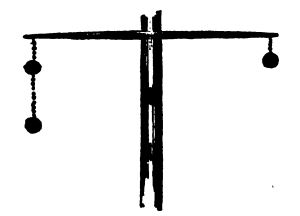
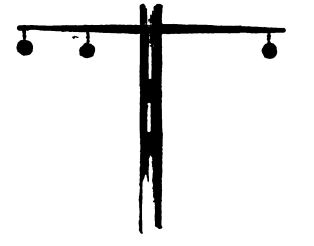
VI. All these regulations shall be equally in force at night as well as by day. And for their more effective execution at night every steam vessel, when in Pilotage water, shall carry between sun-set and sun-rise three sufficiently strong lights, in lanterns, so as to be seen in all directions, and attached to a yard which must be kept square, and raised at least six feet above the tops of the paddle-boxes; this yard may be attached to the mast, or otherwise raised to the requisite height above the vessel’s bow for that purpose.

VII. These three lights shall be arranged in the following manner:— One light on each yard arm at the distance of six feet from the mast, that is, twelve feet apart; and on the larboard yard arm one additional light, which shall be placed horizontally with respect to the other light, or vertically under it, according to the following conditions:

(1) All steam vessels which may be coming up any river or channel shall show the additional light three feet directly under the light at the larboard yard arm, viz:—

(2) All steam vessels which may be going down any river or channel shall show the additional light at the same height as the two other lights, and at the distance of three feet inside the larboard light, or half-way between it and the mast, viz:—

VIII. For any infraction of the foregoing regulations a fine, varying according to the culpability of the offender, but not exceeding five pounds, should be summarily levied upon the party and, as the only means of making those regulations effectual, one-half of the fine should be payable to the common informer.

Report from the Commissioners appointed to inquire into the Laws and Regulations relating to Pilotage in the United Kingdom Presented to both Houses of Parliament by Command of His Majesty. HMSO, London 1836

Just Arrived

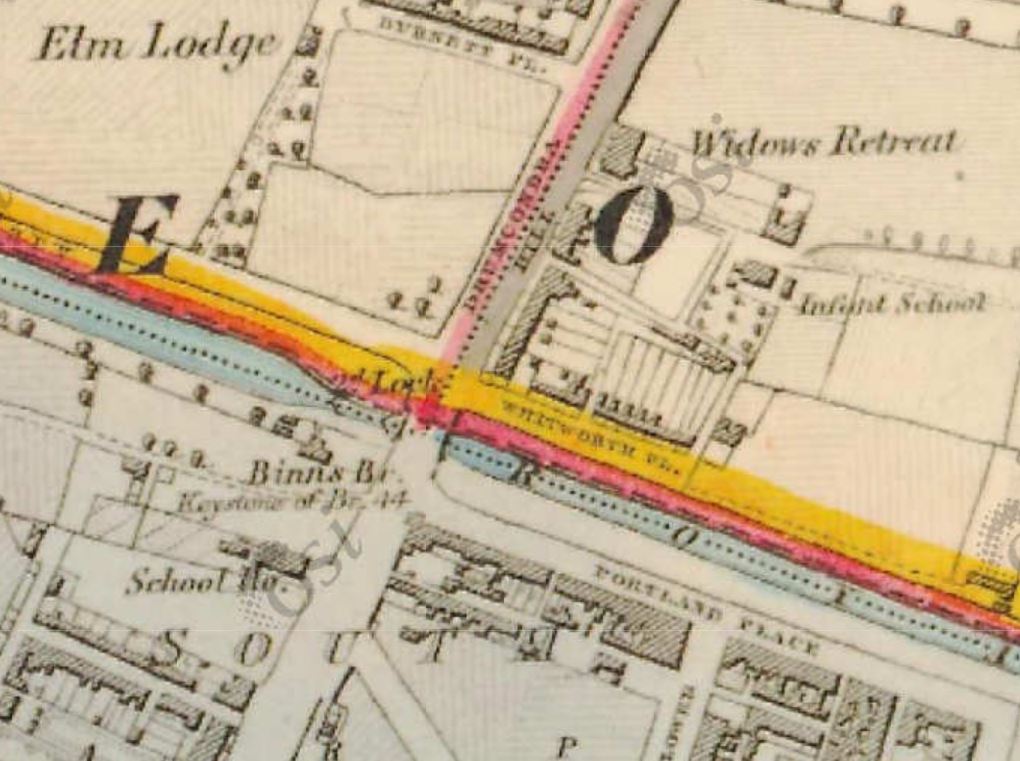
Royal Canal 2nd Lock (OSI 6″ ~1840)

Inland Navigation from Connaught,

A Large quantity of POTATOES, selling as follows, at the Canal Bridge, Lower Dorset-street, engaged good and Dry, at 7d per Stone. One Hundred Weight sent home to any part of the City, on the North Side of the River Liffey, for 4s 8d, carriage Free.

Encouragement to wholesale Dealers, by Grant, at the Coal and Turf Stores, Second Lock, Royal Canal.

Saunders’s News-Letter 30 June 1830

Not asking for more

At the Police-office on this day, 64 boys, inmates of Mountkennett workhouse, were brought up for effecting an entrance into the stores of the Dublin Steam Packet Company, which are underneath the workhouse, and converting to their own use 432 bottles of porter [6¾ bottles each], the property of Mr Hurley.

Tralee Chronicle 3 August 1850 citing Limerick Chronicle 31 July 1850

Ennis to Dublin 1838

The public car from Ennis to Williamstown was quite a treat in the way of public travelling; a leather strap, and afterwards a branch of a tree, sufficed for a whip, until an innocent country lad was coaxed into an exchange pro tempore — that is to say, he very good-naturedly lent our driver his whip on a simple promise to return it, and took the branch instead. Although half an hour too late at starting, our loquacious conductor assured us that we would arrive in due time at Williamstown to meet the packet, ‘barring accidents’ — which was well put in, for the wheels were once or twice so hot and the horses so lazy that a stoppage at one time seemed inevitable.

A voyage in a large steamboat of one hundred horse power was quite a novelty to be enjoyed in an inland piece of water, and I greatly enjoyed both this and the voyage up the Shannon, in a less steamboat of twenty four horse power. I had never in my life travelled in a canal passage-boat, and the voyage therein from Shannon Harbour to Dublin was described by a Limerick attorney as a nuisance, horrible beyond endurance. I have never, however, been disposed to rely so much on the opinion of others as on my own experience, and therefore I resolved to try the voyage.

Never was I more agreeably surprised that to find, after sailing in it eighteen hours, I arrived at Dublin too soon, so far as the pleasantness of the journey was concerned. I heard the best Irish songs and recitations, and had a most interesting account of Irish scenery and superstitions from Mr Dennis Leonard, of Kilrush; besides this, I had a very comfortable night’s rest and was altogether much interested and pleased with my first journey on a canal.

From Chapter XV Ireland and the Irish 1838 of Benjamin Ward Richardson Thomas Sopwith MA CE FRS, with excerpts from his diary of fifty-seven years Longmans, Green & Co, London 1891


Limerick and Newport

Newport in South Wales, that is. If you’ve taken a ferry from Rosslare Harbour to Fishguard or Pembroke, and you’re driving across South Wales, you might like to stop at Newport. It’s got a transporter bridge, and not a lot of places can say that.

It also has the Cefn Flight of Fourteen Locks, which raises an interesting question about the Limerick Navigation.

Is Brendan Smith a disguised Theresa May?

Theresa May, who is Prime Minister of Unicornia, is renowned for her inability to take “No”, or indeed “Definitely not”, or “What part of NO do you not understand?”, or “FOAD”, for an answer.

The same may be said of Brendan Smith, a Fianna Fáil TD for Cavan-Monaghan (in a region where mental health is a big issue). For many years, Mr Smith has been asking when a navigation (first proposed as one of W T Mulvany’s insane drainage-cum-navigation projects in the 1840s) is to be constructed between Belturbet and Lough Oughter. And, year after year, he is told, in the politest possible terms, that it’s a non-runner.

Here’s the latest example, where the unfortunate Minister for Fairytales devotes a lot of effort to telling him to FOAD. Waterways Ireland has the right idea:

There is already extensive existing underused navigation for example at Belturbet and Waterways Ireland has reiterated the potential in the waters of the Lough Oughter area being promoted as a distinct Blueway. The national context is that Blueways Ireland (National Trails Office, Canoeing Ireland and other state bodies) is currently considering the establishment of Blueways beyond the Waterways Ireland network of inland waterways.

To this end, Waterways Ireland has met with the Chief Executive of Cavan County Council, other council officials and elected representatives concerning Blueways developed successfully on the Waterways Ireland network to advise on possible ways forward. Waterways Ireland is happy to support Cavan County Council should it decide to develop a Blueway on the River Erne from Belturbet to Killykeen and Killeshandra but as the area is officially outside of their remit, this offer extends to advice and support only.

It would be nice if Mr Smith would stop wasting parliamentary time on the pursuit of unicorns. If he doesn’t, I’ll be forced to conclude that he and Mrs May are somehow related.

Extraordinary swimming feat

On Tuesday last Captain Kingsley, who is on a visit with his father, Capt Kingsley of Knigh Cottage, swam across Lough Derg, in the Shannon, from Dromineer Bay to Williamstown, a distance of five miles, and was not in the least fatigued at the end of his journey. Such a feat which has not been before performed within the memory of any person now living.

Tipperary Free Press 23 August 1864 quoting Nenagh Guardian

The cows of death

On Wednesday, a melancholy accident, attended with the loss of nine lives, occurred on Lough Derg, on the Upper [ie non-tidal] Shannon, by the upsetting of a boat in its passage across the lake from Williamstown to Dromineer. The nine men were jobbers, six of them belonging to Nenagh, and three to Cork, and were returning from a fair in the county Galway.

The accident is said to have been owing to their having carried two cows with them yoked to the boat, one of which, having burst the ties that confined it, became unmanageable, and in a few minutes the boat being upset, all on board were engulphed in the deep.

The Warder and Dublin Weekly Mail 3 March 1849, quoting Limerick Reporter