
Category Archives: Modern matters

Railway progress

It is proposed that six cwt should travel on the Rail-road between this City and Waterford, ten miles an hour, urged by the propelling and locomotive engines. Thus, on the sixth day, the heaviest goods will reach London from Limerick; the fourth, Liverpool; and the third, Bristol.

In case the navigation of the Suir should be found inapplicable, an extension of the Railway to Dunmore is intended.

The undermentioned are expected to form the Committee, some of whom have already signified their intention to that effect:—

The Duke of Devonshire, the Marquis of Lansdowne, Earls Darnley, Glengall, Kenmare, Charleville, Kingston, and Ennismore; Lords Oxmantown and Lismore; Messrs T S Rice MP, J Smith MP, R Wellesley MP, Captain Maberly MP, Sir C Flower, Alderman Heygate &c.

Dublin Evening Post 3 February 1825

From the BNA

Some later information here.

Nowadays, the average duration of the eight daily trains between Limerick and Waterford is four hours and five minutes, for say eighty miles, so speeds have doubled since the 1825 proposals were made.
 

Disentangling Waterways Ireland

A possible outcome of the dog’s brexit?

Saith Alan Bermingham, policy and technical manager of the Chartered Institute of Public Finance and Accountancy:

I assume some of the cross-border bodies such as Waterways Ireland with separate jurisdictions would need to be disentangled,

He says that closing cross-border projects could increase administrative costs.


Hibernia

I see that P&O Cruises [about which there is a not-very-accurate Wikipedia page here: not very accurate, I mean, about the history of the P&O Line] will seek public suggestions for a name for its latest vessel, which they call “the nation’s ship”:

P&O has also previously run a similar exercise, coming up with the stately Britannia for a ship that launched last year. The company hopes for something similarly dignified and patriotic this time round […].

I do hope there will be a concerted campaign to have it named Hibernia, to recognise that

  • the single most important person in the formation of the P&O Line, Richard Bourne, was Irish
  • four of the eight original directors were Irish (and one was Spanish)
  • 83% of the company’s original capital of £304,600 in ships, exchanged for paid-up shares, was Irish owned.

Of course, as this great Irish company expanded, it took on more British shareholders and directors, training them no doubt in how to run scheduled steam shipping services, but it is about time that the Irish role was acknowledged.

See Freda Harcourt “Charles Wye Williams and Irish steam shipping 1820–1850” in The Journal of Transport History Third Series Volume 13 Number 2 September 1992, Manchester University Press, and Freda Harcourt Flagships of Imperialism: the P&O Company and the politics of empire from its origins to 1867 Manchester University Press 2006 [ebook now also available].

The Irish family farm …

why we don’t need it.

h/t Alex Tabarrok on Marginal Revolution

Cussane lock

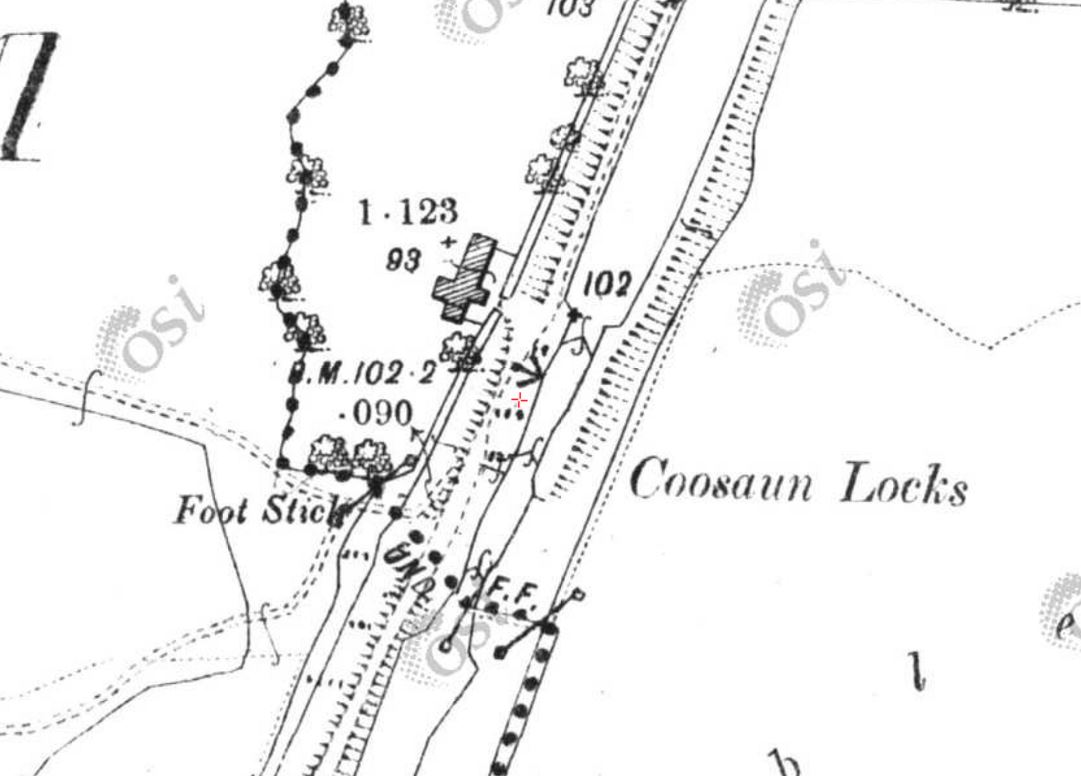
Cussane or Coosaun Lock was the lowest of three on the Killaloe Canal, which was the uppermost section of the Limerick Navigation. It was a double lock or “staircase pair”.

Cussane Lock (OSI ~1900)

Cussane Lock (OSI ~1900)


You can see what the lockkeeper’s house looked like in 2015 in the article “A Flooded Landscape Revealed“, written by folk who surveyed the area last year for Irish Water.

My OSI logo and permit number for website

RoI Budget 2016 for 2017

The Irish government’s Expenditure Report 2017 Parts I to III is available here [PDF]. The Department of Fairytales [aka Arts, Heritage, Regional, Rural and Gaeltacht Affairs] gets a 1% increase for Programme D, North-South Co-operation, subject to the approval of the North/South Ministerial Council.

This programme includes certain language bodies and, more importantly, Waterways Ireland. The estimate for capital expenditure, almost all (if usual patterns prevail) for Waterways Ireland, is the same as for 2016, at €2799000, which suggests that the good people of Clones won’t be getting a sheugh any time soon, although judging by today’s Irish Times [possible paywall], they don’t seem to be expecting one.

The Programme D estimate for current spending is up from €34925000 to €35166000, making for an overall increase of one per cent.

The department’s overall capital allocation is down, but changes in departmental functions and the ending of the special anniversary funding make it impossible to say anything useful about that. Looking forward, the department’s Gross Voted Capital Expenditure is shown as €119 million for 2017, €115 million for 2018 and €118 million for 2019.

Waterways are funded only in order to promote northsouthery:

The aim of this Programme is to maintain, develop and foster North-South co-operation in the context of the implementation of the Good Friday Agreement. Under this Programme, the allocation for 2017 will:

– Through Foras na Gaeilge and the Ulster-Scots Agency, promote the Irish and Ulster Scots language and culture; and
 Through Waterways Ireland, maintain the waterways for some 15,000 registered boat users.

I presume Waterways Ireland will get extra funding to work out a system of border controls for the Shannon–Erne Waterway.

More budget stuff here.


Building Ireland

There is a television series called Building Ireland, about “Ireland’s building and engineering heritage”. A series of six programmes will begin on Friday 30 September 2016 at 8.30pm on RTÉ One, which is a television station.

The third programme, on 14 October, covers Ardnacrusha and the sixth, on 4 November, is entitled “Galway’s Corrib Canal” and covers canals in Galway and, I believe, may have some material about the Cong Canal.

Here is a PDF describing the series.

building-ireland-series-info-and-billings


Celebrating Ireland’s floating heritage

Waterways Ireland
MARINE NOTICE No 126 of 2016

SHANNON NAVIGATION

Large Vessels Berthing  at Floating Moorings

Waterways Ireland wishes to advise all masters and owners of vessels with an overall length in excess of 11m, particularly those constructed in steel, of the following points in relation to berthing at floating moorings and also on finger jetties having a length of 9m:

  1. These vessels cannot be secured properly over their entire length thereby placing extra strain on the pontoon mooring cleats as mooring lines are doubled up.
  1. The large overhang of these vessels creates an obstruction to other vessels trying to manoeuvre onto the berth especially for novice recreational boaters and hire boat crews with limited experience.
  1. In adverse weather conditions of high winds and /or flood conditions with high flow rates there is a greater risk of breaking free of the mooring and causing damage to other vessels and the mooring infrastructure especially as these large vessels are primarily constructed in steel and are very heavy.
  1. The 9m finger mooring is designed for vessels with a max overall length of circa 10-11m.
  1. The fixings attaching the floating mooring to the main spine can be compromised due to excessive forces induced by inappropriate sized craft leading to premature wear.
  1. Such vessels place excessive strain on the mooring piles and anchor chains as water levels rise especially where masters have secured to both the cleats and the mooring piles themselves.

Masters of such vessels are requested to berth on appropriate lengths of fixed quay wall only. Waterways Ireland thanks its customers for their cooperation in this matter.

Charles Lawn, Inspector of Navigation. 23 rd September 2016


Why rural Ireland is doomed?

Lewis Davis says:

Empirically, I find a robust negative correlation between rainfall variation, a measure of exogenous agricultural risk, and a measure of individual responsibility. Using rainfall variation as an instrument, I find that individual responsibility has a large positive effect on economic development.

Abstract on Tyler Cowen‘s site. You can rent the whole article for $6.


Lakelands

According to the Irish Times of 27 August 2016

Fáilte Ireland has tendered [sic] for a company to help it develop a new tourism strategy for the swathe of land running down the middle of Ireland that falls outside the Wild Atlantic Way and Ireland’s Ancient East, the two linchpins of the State’s tourism marketing strategy.

The area, generally referred to in tourism marketing circles as “Ireland’s Lakelands” district, takes in parts of east Galway, Roscommon, Leitrim, much of north Tipperary, and runs down as far as the northern reaches of Cork. […]

The tender made no mention of the Lakelands moniker, but Ms Carroll [of Fáilte Ireland] […] said the Lakelands term, which is also used in the Programme for Government’s tourism strategy, may not end up being the final slogan that is used for the region.

I wonder what that does for Waterways Ireland’s Lakelands &  Inland Waterways marketing and product development Initiative and what it says about the success of the Lakelands Strategic Plan [PDF]. I note too that the Irish Times refers to “the State’s tourism marketing strategy” whereas WI’s initiative was a cross-border one and included the Erne as well as the Shannon.