Category Archives: People

Boris the Shinner

I have suspected for some time that Britain’s Brexiteers are actually Sinn Féiners.

After 1916 the Irish Shinners decided to leave a larger economic and political entity and to do so without any business plan or any realistic idea of how their proposed state would make a living.

After 2016 the British Shinners decided to leave a larger economic and political entity and to do so without any business plan or any realistic idea of how their proposed state would make a living.

One lot of Irish Shinners, led by the lunatic Éamon de Valera, wanted a hard Irexit and started shooting the soft Irexiteers who, happily, managed to keep control; it is to be hoped that matters don’t go that far in Britain.

It may be objected that the evidence for this contention, that Brexiteers are Shinners, is a little light, but I have now found confirmation: Boris Johnson is an enthusiast for insane canal construction projects.

The mark of the Shinner is upon him.

Sinn Féin asks useful PQ about waterways shock

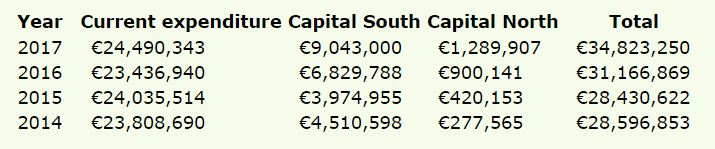
Yes, Caoimhghín Ó Caoláin, SF TD for Cavan-Monaghan, has asked a useful question about waterways, one that doesn’t seem to have been designed to promote an insane restoration proposal. He asked for “the current and capital expenditure by Waterways Ireland in each of the years 2014 to 2016; the estimated level of current and capital expenditure for 2017″. The answer included this table:

WI budgets


Current spending comes 85% from the Free State and 15% from Norn Iron; capital spending is paid for by the administration in whose territory the montey is to be spent.

There may be a problem here in that I have a feeling that, if there is no NI Executive, spending is limited to 90% of the previous year’s figure [I am open to correction on this], which might cut the NI contribution to current spending: I presume that the RoI contribution would then be cut too, to maintain the 85:15 ratio.

The Minister for Fairytales also said that WI gets money from “third-party funding contributions towards specific projects and from its own income from licences and property.” However, its own income is pathetically small.

I am writing less about current waterways affairs because I’m concentrating on those of the nineteenth century (unlike Sinn Féin, which focuses on the eighteenth), but I did read WI’s Annual Report and Accounts for 2016 [PDF] with interest. Despite the considerable challenges it faces [including the pensions nightmare], the organisation has been expanding its range of activities and looking to new users and new uses. I hope that the Brexit hard border, which I suspect is now unavoidable, doesn’t completely bugger things up.

If it does, we might need to ask Sinn Féin whether it can think of anyone who could help smuggle motor-cruisers across the border to enable boats to move between the Shannon and the Erne. Perhaps their day will come.


Mr Moran’s delusions

Kevin Moran is an independent TD for Longford-Westmeath and is now Minister of State for the Office of Public Works and Flood Relief. On 12 October 2017 he said in the Dáil:

I thank the Acting Chairman for giving me time to speak on the very important issue of budget 2018. Flooding is a huge issue that falls under the remit of my Department. Not one Deputy spoke about flooding during the budget debate. Nobody has come to my door to talk about flooding. Deputy Canney has not spoken yet. I assure the House that I have a sum of €432 million, which is a huge investment in flooding measures by the Cabinet. The funding for flooding schemes will increase from €45 million to €70 million next year. There will be a roll out of more schemes to protect people in their homes. There will be €5 million for the minor works scheme which is very important to protect people. Everyone has talked about putting diggers on the Shannon. I am the first Minister in the House to put a machine on the Shannon since Queen Victoria. I have heard every political party in here talk about it but they could not do it.

If Mr Moran would care to glance at this page on this site, he could look at photos of workboats and dredgers employed by Waterways Ireland (and some of them before that by his own department) on the Shannon and elsewhere — and considerably later than the time of Her late Majesty Victoria.

I am not sure, though, that “diggers on the Shannon” would be very useful: they would probably sink.

Down the Suir

Cheekpoint

Andrew Doherty runs the Waterford Harbour tides’n’tales blog which, starting with a focus on the traditional fishing community of Cheekpoint, has broadened out to take in the whole of the Suir estuary and a few other things besides. As he says

My unending passion is researching and writing about our way of life and more fully understanding the history and heritage that surrounds us here.

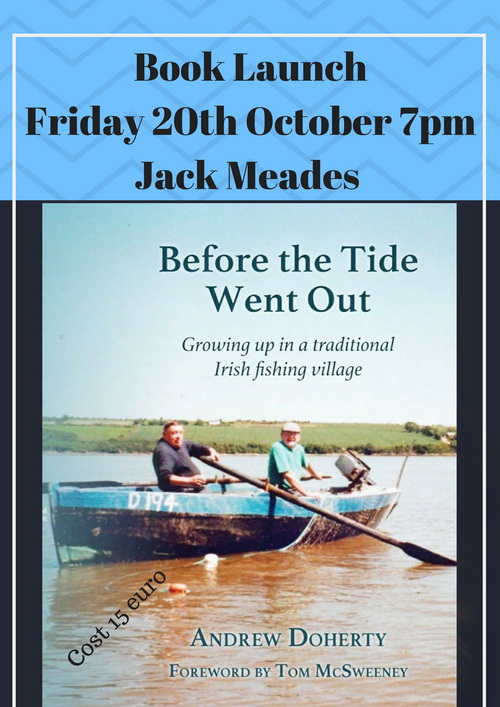
Before the tide went out

Andrew has now written a book, Before the tide went out, and it will be launched at Jack Meade’s on Friday 20 October 2017 at 7.30pm.

From the blurb:

Andrew Doherty vividly brings you into the heart of a now practically vanished fishing community, deep into the domestic lives of the people making a hard and precarious living from the river, only 6 miles from Waterford city centre. You share his affectionate memories of the local people and the fun that was to be had as a child playing in and around the fishing boats and nets on a busy quayside.

He also takes you out on the river, on bright and beautiful days, and on wild and dangerous nights, which he describes with a naturally story telling turn of phrase. You feel the cold, the misery of sea-soaked clothing and the pain of raw hands hauling on fish-scaled nets.

But what keeps you going is what kept him going for 15 years, the camaraderie and pride of spending time with brave, skilled and wise fishermen who could be grumpy, hilarious, sometimes eccentric, but never
boring.

Update: to buy the book see Andrew’s page here.


Canal restoration: Strabane and Broharris

Alas, the Derry Journal [h/t Industrial Heritage Ireland, the indispensable source of IH news] tells us that

STEVE BRADLEY believes Derry’s forgotten canal heritage could boost the region’s economic fortunes

No, it couldn’t.

Mr Bradley’s article is extremely interesting. He describes the history of the Strabane and the Broharris canals and, in the process, shows me that my page about the Broharris was entirely wrong. I am about to update that page but I am grateful to him for the information he provided. I hope he will forgive me, then, if I disagree with him about the economic potential of canal restoration.

He makes no exaggerated claims about the potential of the Broharris as anything other than a walking route; it could not be used by boats larger than canoes or kayaks and, even for them, there are no obvious launching or recovery sites.

But he wants more for the Strabane. He says that digging up the canal basin in the town, and restoring the navigable link to the Foyle, would provide a new Canal Quarter to attract investment even though it would, he concedes, be an expensive project.

But it is on the navigation aspects that he goes seriously astray:

Restoring the canal would hopefully also kick-start the use of the Foyle for leisure, recreation and tourism purposes. And restoring the 200 years old link between Strabane and the Foyle would be a great flagship project for a new council district with Derry and Strabane as its two main population centres.

Towns elsewhere have shown how restored canals can help bring new life and prosperity to the districts they flow through, yet locally we have neglected our water assets. It is time to give serious consideration to the role that our forgotten canal heritage could make towards improving the economic fortunes of our area.

I wrote about the Strabane Canal here and here. Sinn Féin, always keen on eighteenth century economics, tried to get Waterways Ireland to waste some of its money on the thing but, happily, failed.

The real problem with this is that there seem to be very few boats on the Foyle; I suspect that many of them are sailing boats that are not terribly suitable for use on canals, while others are fast seagoing vessels that would damage the banks. And boats will not come from Britain or Ireland or anywhere else to visit Strabane by canal: a boat suitable for the sea passage to the Foyle would be inherently unsuitable for the canal, even assuming that the delights of Strabane were sufficient to entice boaters to make the journey.

Irish waterways promoters have operated for years on the principle that, if the government gives them the money to build the canal, the traffic will come. Anyone who believes that should visit Tralee, where a similar canal, short and isolated, linking a town to the sea, is not used other than by walkers and the local rowing club. Seagoing boats go to Fenit instead.

And, on “how restored canals can help bring new life and prosperity to the districts they flow through”, I recommend a visit to the Royal Canal, which is very nice but has very little traffic. As, indeed, does the Grand Canal. English experience with a large connected network of canals is not relevant to Irish conditions, whether on geographic or on economic grounds.

 

The Hind

The River Hind Navigation is not well known, which may be attributable to its non-existence. There were several proposals to make the Hind navigable, to link the town of Roscommon to Lough Ree on the Shannon, but none of them were implemented. One of them almost made it, though, and such interest as the topic has is the result of the Hind’s inclusion (or semi-inclusion) on the list of navigations for which W T Mulvany, Commissioner for Drainage, was responsible in the late 1840s and early 1850s.

Mulvany was responsible for five drainage-cum-navigation projects (and many drainage projects), whereof the Hind was the least important. The other four were

  • the Lough Oughter navigation, upstream on Lough Erne from Belturbet, which was never completed: various (mostly Fianna Fáil) insane politicians in the area are still trying to have it completed
  • the Cong and Belturbet Canals, which were abandoned before they were finished
  • the Junction Canal in the Ballinamore and Ballyconnell Drainage District, later known as the Ballinamore and Ballyconnell Canal, which had a brief and notoriously unprofitable existence, but which was later transformed into the Shannon—Erne Waterway, which was a good investment for Ireland because the Germans [or someone] paid for it
  • the Lower Bann navigation, linking Lough Neagh (which already had two links to coastal ports) with the North Atlantic in the middle of a beach near Coleraine. This was the only one of Mulvany’s navigations that was completed and that remained open, despite its complete uselessness, as the railways got to the area before the navigation did.

In this catalogue of commercial nitwittedness, the Hind had the advantage that it was delayed: an even more insane proposal, to drain the Suck into the Hind, meant that the Hind navigation scheme was deferred long enough to be abandoned altogether, which was just as well as the railway soon made any navigation unnecessary.

However, the proposal was there and, if you are very bored, you might like to read about it. But this is for anoraks: the subject is unimportant, the detail [163 endnotes] outweighing what little interest the scheme possesses. There are no photos of boats or of locks, because there weren’t any; there aren’t even any cat videos.


They haven’t gone away, you know ….

There we were, about to breathe a sigh of relief that the Clones Sheugh had been buried at the crossroads, with a stake through its heart and numerous rows of garlic planted around it, when a crack appeared in the earth and the shriek of the undead made the night hideous.

Yes, it seemed that the Minister for Fairytales had successfully diverted everyone’s attention away from Clones by (a) designating the River Finn as the Ulster Canal, which would lead to a scout camp at the spiritual home of Ulster Unionism rather than to Clones, and (b) supporting a greenway walking route to take care of the handsacrosstheborder bit (although ministers from up there seemed to be scarce at the launch. I suppose they’re scarce anyway).

The greenway seems like a better idea to me, given that it’s significantly cheaper than canal restoration and likely to attract far more users, although I wasn’t impressed by the economic assessment in Waterways Ireland’s Ulster Canal Greenway draft strategy document from April 2017 [PDF]. Here is the assessment in full:

6.2 Economic Assessment
Ultimately, the cost of developing a route will play a part in the decision-making process. It may be technically possible to overcome an obstacle, but the cost might make it unfeasible and a longer route chosen. All factors in the Greenway Strategy will be assessed and the most sustainable routes chosen.

That seems to suggest that the costs and benefits of the plan have been thought through with as much care and attention as Her Majesty’s Government over the way has given to Brexit. Which, I imagine, will put paid to much handsacrosstheborderism anyway; I hope it doesn’t put paid to Waterways Ireland as well, although it’s bound to increase the difficulties under which that body labours.

But revenons à nos moutons. Just when we thought it was safe to go out, the dead arose. Sinn Féin MEP Matt Carthy said

Clones needs the Ulster Canal if it’s to have a viable tourism future.

Also from the report of the meeting:

A presentation at the meeting revealed that over 50 percent of buildings in Fermanagh Street in Clones are derelict.

Frustration at the lack of progress with the Ulster Canal was voiced, with representatives stating that it was on the agenda in 1999 and is still on it now.

Perhaps Clones has not got the message: the Ulster Canal is off the agenda. But there is a more fundamental problem: [some] small rural towns are dying because there is no longer any economic need for them. The scale of things has changed since the late nineteenth century; consumers can travel to Aldi and Lidl in larger towns; local markets and fairs are no longer how business is done.

Tourism is unlikely to rescue Clones: if it could do so, why isn’t the town already a tourist destination? Why aren’t its attractions well known throughout Germany and wherever else tourists come from? Enabling tourists to visit by water is not going to attract significant numbers from abroad: there are more scenic and interesting waterways elsewhere, in Ireland and on the continent. There would be a very poor return on the millions that a canal to Clones would cost — not helped by proposals for significant overpayment for land.

I still don’t understand why Sinn Féin is so keen on canals generally and the Clones Sheugh in particular. But Clones might find a new economic role as a post-Brexit smuggling centre.


Willie Leech interview

This article, about the last of the Royal Canal boatmen, was based on an interview, arranged by Niall Galway, with Willie Leech of Killucan. Niall has now made the original interview available on YouTube, in two parts [Part 1, Part 2], with apologies for the sound.

Big it up for Banagher

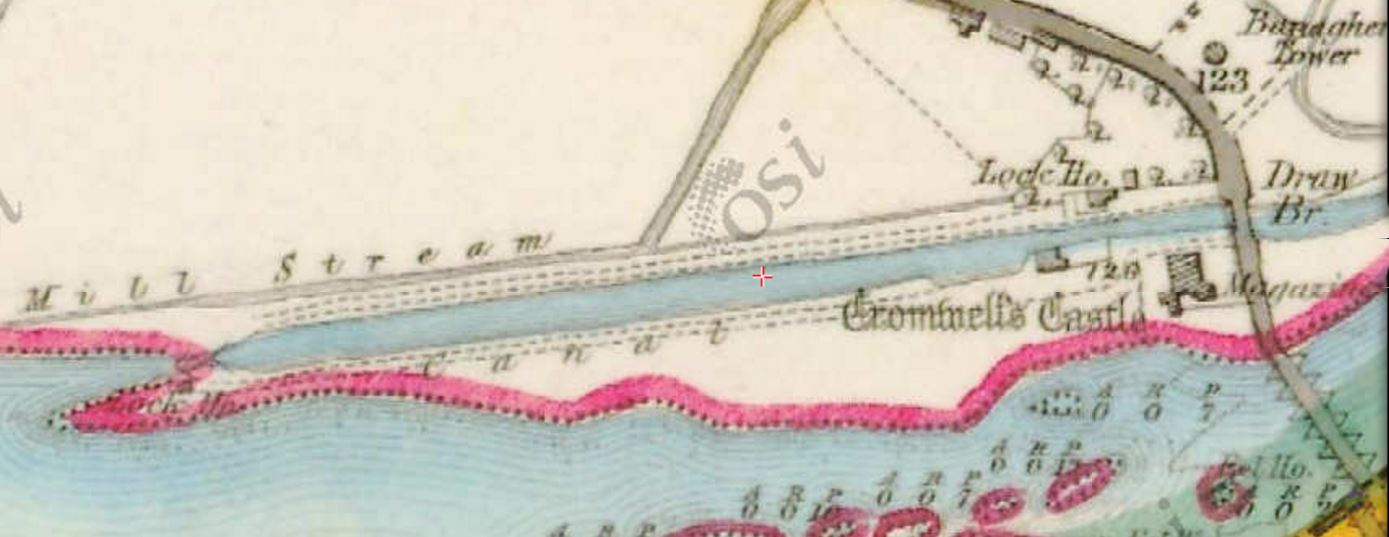
Banagher: the old canal (OSI 6″ map ~1830s)

I was in Banagher yesterday, visiting the site of the old (pre-Shannon Commissioners) canal on the north (virtual west) bank. The area is a park operated by a community group [I would welcome details and a link] and includes a pitch-and-putt course, an outdoor swimming pool in the river and storage for canoes (a group of young people was about to get afloat as I left).

It is also, as the map above shows, rich in waterways and military artefacts. Much of the waterways material can still be seen and a series of signs shows old drawings and provides useful information (though the lock, surprisingly, has no sign). I think I am right in deducing that the signs reflect the work of historian James Scully, one of those who gave an extremely enlightening and entertaining talk about Banagher Bridge a few years ago.

The park is well used by local people but it should also attract many tourists to take the short walk from their boats on the far side of the bridge. It is an excellent example of local initiative drawing on local expertise to illuminate local history and create a sense of place and it could be emulated at many other waterways sites along the Shannon.

Furthermore, added to Banagher’s other historic and literary associations, it shows the wealth of interesting material offered in this town. It is not, unfortunately, on the main tourist routes by road, but it should be possible to attract the interest (and the spending) of water-borne visitors.

I hope that will work for the community; in the meantime, I applaud their initiative.


Leave no trace? It’s rubbish

More folk believe that the Shannon is the great dividing line in Ireland: civilisation and a modern economy to the east, primitive tribalism to the west. Of course that isn’t true — except in one respect: rubbish bins on the lower Shannon.

There, counties Offaly and Tipperary, on the east side, provide rubbish bins for boaters at harbours; on the west side, counties Clare and Galway do not, save for a dog-poo bin at Portumna Castle Harbour.

Waterways Ireland has signs in some places saying that it has a “Leave no trace” policy: that is, I presume, intended to excuse it from providing bins, and paying for rubbish collection, at its own harbours. I guess — I am open to correction on this — that the local authorities on the civilised side of the Shannon are happy to bear the cost of providing for boaters, while those on the wilder side are not. It’s not just boaters, though: the new camper-van park at Portumna Castle Harbour, admirable in so many ways, has no bin service.

Now, having to take your rubbish home after a one-day picnic is not a particularly great problem. Doing so after a full week on a boat or in a camper is rather more difficult, especially if your rubbish includes the dog-poo that you have nobly and civil-spiritedly picked up. [Incidentally, I felt like an idiot in Ballinasloe, picking up a small dog-poo beside a vast pile of steaming horse-shit.]

Those boaters and camper-vanners who have cracked the code — worked out the distribution of bins — can of course hold on to their rubbish until they reach civilisation, but I met several folk (natives and visitors) who hadn’t worked it out. I didn’t meet anyone who thought the absence of bins was a good idea. And most people don’t have space on board their boats or vans for a week’s or two weeks’ worth of rubbish, never mind airtight storage to keep smells in and flies and rodents out.

The western local authorities are free-riding on the ratepayers of the eastern counties, and at some point the easterners may get fed up. A bank holiday weekend produced overflowing bins at Banagher: they were emptied very promptly on the Tuesday morning, so well done Offaly County Council. But I suspect that some of the rubbish should have been disposed of west of the Shannon. At what point will the eastern local authorities cry “enough!”?

Rational economic man, faced with the absence of bins at harbours in Clare and Galway, would adopt a simple solution: if on a boat, put everything into a bag with a large stone and throw it overboard in the middle of the river; if in a camper, sling it into a ditch somewhere. The policy of the western local authorities is designed to encourage littering.

And there’s no point in telling me about Leave No Trace Ireland, which strikes me as yet another Irish solution to an Irish problem:

Leave No Trace is an outdoor ethics programme designed to promote and inspire responsible outdoor recreation through education, research and partnerships.

Who thinks up this rubbish? There are many responsible boat- and camper-users who want to be able to dispose of their rubbish properly during their holidays. We need bins, not propaganda.