Category Archives: Politics

Levels

On 9 October 2013 minister Brian Hayes spoke in the Dáil about Shannon water levels, saying:

A meeting between the ESB, Waterways Ireland and the Office of Public Works to review the interim operating regime is due to take place shortly.

On 17 and 18 October 2013, in correspondence with Waterways Ireland, I learned that the meeting had not then taken place and that no date had been set. I have now sent WI another note asking whether the meeting has been held and, if it has, requesting a report on the proceedings and outcome.

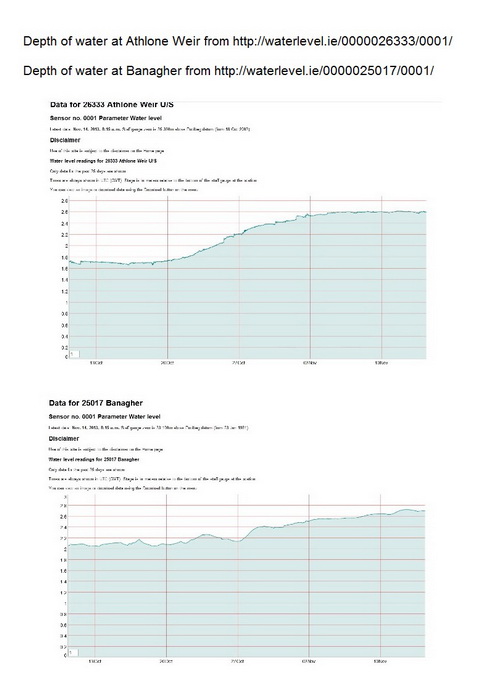
In the meantime, I have put together two charts nicked from waterlevel.ie for Banagher and Athlone:

Athlone and Banagher water levels

Athlone and Banagher water levels

Both of them show the levels for the last 35 days. I’m sure that more data and much more sophisticated analysis would be required to reach any reliable conclusion, but my untutored impression is that, in what has been a fairly dry autumn, keeping Lough Ree low didn’t do much to keep Banagher low. If that is so, and if I’m right in thinking that this autumn was dry (see below), the outcome would not show whether lowering Lough Ree would help in a very wet season; it may be necessary to repeat the experiment next year while performing rain dances. I would be glad, though, to have comments from more erudite folk and, if I get any information from TPTB, I’ll publish it here. In the meantime, this CFRAM PDF provides background reading.

On the dryness: Met Éireann’s monthly report for September 2013 is headed “Dry everywhere; warm and dull in most places” while that for October says “Rainfall was above average except in parts of the West, Northwest and North”. Its report doesn’t, AFAIK, specify any stations in the Shannon catchment (apart from Shannon Airport), but those to the west were generally below average while whose to the east were above; it may be that the Shannon rainfall was moderate.

Meath River Rescue

I have no idea what this Dáil written question and answer, from 12 November 2013, are about:

Peadar Tóibín [SF, Meath West]: To ask the Minister for Environment, Community and Local Government if his Department will provide direction for a safety procedure (details supplied) to be enforced; if this procedure been enforced in any other region or with any other community organisation; if he will reverse this decision and allow for Meath River Rescue to operate in a fully integrated and efficient manner.

Phil Hogan [FG, Carlow-Kilkenny; Minister for the Environment, Community and Local Government]: My colleague, the Minister for Transport, Tourism and Sport is the Minister with responsibility for receiving calls for assistance for inland waterways and mobilisation of appropriate response services. I have no function in the matter referred to in this question.

Googling suggests that Meath River Rescue got €278,358 for a boathouse and training room in Navan, with two FG TDs announcing the grant a year apart [or is one of those dates a typo?]. The service is known to Irish Water Safety but is not one of its Community Rescue Boats Ireland so it’s not a Coast Guard declared resource [which doesn’t mean there’s anything wrong with it]. Meath River Rescue’s own website and facebook page don’t seem to have been updated since April 2012 [although I am unfamiliar with facebook and may not be interpreting the dates correctly] but the service has been in action as recently as September 2013.

Unfortunately “details supplied” means supplied to the minister, not to readers of Dáil proceedings, so I have no idea what problem was being raised.


Ticking all the boxes

Sometimes an idea comes along that is just so good, so right, so advantageous on all counts that it is simply irresistible. This idea comes from the Americas, from the US Coast Guard. Adapted to the Irish inland waterways, and specifically to the Shannon, it could:

  • help to promote industry in recession-hit rural areas
  • create direct employment
  • help to stimulate indirect employment
  • promote Irish energy independence by reducing reliance on imported hydrocarbons
  • counter pollution of water-courses
  • reduce the number of heavy trucks using remote rural roads
  • use environmentally-friendly water transport, by barge along the Shannon
  • honour and promote the industrial heritage of Co Leitrim and the transport heritage of the Shannon
  • help to defray the costs of maintaining the Shannon Navigation
  • solve Dublin’s water supply problem, at least for non-potable water.

How could anybody resist?

The US Coast Guard has proposed that wastewater from fracking [PDF] should be transported by barge, rather than by truck or railway train, from the fracking sites to remote storage or treatment facilities. So, when fracking begins around Lough Allen, the wastewater could be carried down the Shannon by barge and, if necessary, pumped to Dublin.

It sounds like a winner to me.

No Newry is bad news

In October I wrote about a Northern Ireland Assembly debate on a proposed Newry Southern Relief Road. I said:

… the debate was remarkable for its demonstration of cross-party agreement: not so much on the desirability of public works (a desideratum of Irish politicians since the eighteenth century) as on the irrelevance of the Narrowwater bridge.

[…]

It must surely be unlikely that there will be two crossings of Carlingford or the Newry River [and canal] within a few miles of each other. But if one option, the Newry Southern Relief Road, helps to relieve Newry and Warrenpoint traffic and the other, the Narrowwater bridge, doesn’t do so, then the first option would seem to be the rational choice.

Yesterday, 12 November 2013, Martin McGuinness [SF, Mid Ulster] reported to the Northern Ireland Assembly on the recent plenary meeting of the North/South Ministerial Council. He and others expressed support for the Narrowwater project. This question is revealing:

Caitriona Ruane [SF, South Down]: Go raibh maith agat agus go raibh maith agat don LeasChéad-Aire as an ráiteas sin. I welcome the statement from the deputy First Minister. Does he agree that the Narrow Water bridge project is a very good project for everyone in the Louth/Down area, that the chambers of commerce are representing every single community — Kilkeel, Warrenpoint and Rostrevor — and that the project went through a very rigorous process in relation to the SEUPB and came out at the top of the competitive process?

She made no mention of Newry; nor did any other contributor to the debate.


Bolshevism, boats and bridges

The balance bridge crossing the canal, near Newcomen-bridge, as designed and erected under the superintendence of Mr Bindon Stoney, engineer of the Dublin Port and Docks Board, has been completed, and adds considerably to the facilities for carrying on the traffic. This bridge has been erected in substitution of a lift-bridge, constructed in 1872, but to which an unfortunate accident occurred in February, 1878.

Ralph S Cusack, Chairman, in the report of the Directors of the Midland Great Western Railway, 19 February 1879, quoted in the Freeman’s Journal 27 February 1879

In mid-October I mentioned that Maureen O’Sullivan [Ind, Dublin Central] had asked the unfortunate Jimmy Deenihan [FG, Kerry North/West Limerick, and minister for waterways] about Effin Bridge, the lifting railway bridge below Newcomen Bridge on the Royal Canal in Dublin. The bridge is lifted, to allow boats through, on [IIRC] one Saturday each month in the summer, making five lifts a year. Waterways Ireland says on its website [click Bridges if necessary]

The Newcomen Lift Bridge in Spencer Dock is owned and operated by Irish Rail, and requires a rail possession to be lifted. It can only be lifted for boats at limited prearranged times organised with Waterways Ireland. For details of opening times and to arrange passage contact the Eastern Regional Office on 01 868 0148.

Maureen O’Sullivan wanted

… a meeting of interests concerned with the operation of the lifting bridge with a view to devising a management and operational system that is less hostile to the use of the waterway as currently it is an impediment and discouragement to navigation on the Royal Canal and an obstacle to navigation-communication between the Royal Canal and River Liffey and between Royal Canal and Grand Canal at their eastern reaches […].

Jimmy Deenihan said

The bridge is operated by Irish Rail staff on a request basis at Waterways Ireland’s expense.

However, he wasn’t giving any hostages to fortune by making rash promises or even by commenting on whether the bridge was an impediment to navigation. But Ms O’Sullivan was undeterred: she returned to the topic with two written questions on 5 November 2013 and a priority question, no less, on 7 November 2013 [for certain values of “priority”]. On 5 November she asked two questions of Jimmy Deenihan

To ask the Minister for Arts, Heritage and the Gaeltacht further to Parliamentary Question No. 59 of 16 October 2013, the extent of railway track that needs to be closed by Irish Rail in order for a vessel on the Royal Canal, Dublin, to be given access between the First and Sea Levels of the Royal Canal; if there has been an assessment of whether the extent of track closure could be reduced to facilitate greater ease of navigation on the Royal canal; and if he will make a statement on the matter.

To ask the Minister for Arts, Heritage and the Gaeltacht further to Parliamentary Question No. 59 of 16 October 2013, if the option of a introducing a drop lock to replace the need of the lifting bridge has been considered since the establishment of Waterways Ireland or if that assessment was made by Waterways Ireland’s predecessors; the level of use of the sea level assumed in relation to the assessment; if the impact of the Spencer Dock Greenway was taken into account and vice versa, was account taken of the impact on the Greenway were the sea level to be made accessible to navigation by replacing the lifting bridge; if the assessment includes analysis of whether the effective re-opening of the sea level of the Royal Canal to meaningful levels of year-round traffic would be consistent with the EU’s commitment to the ‘protection and preservation of cultural heritage, in view of the fact that Dublin’s waterway’s heritage is part of the cultural infrastructure of Europe, contributing to economic attractiveness, job opportunities and quality of life; and if he will make a statement on the matter.

The ever-patient Mr Deenihan replied:

I am advised that the option of constructing a drop lock to replace the need for the lifting bridge at the location in question has been considered by Waterways Ireland but it was not deemed viable due to the estimated costs involved, given that the minimum cost for a drop lock to replace the bridge would be of the order of €5m. Work to install a drop lock at this location would also involve considerable temporary works, the extent of which would be unknown until ground conditions were assessed in detail.

I am also advised that there have been no assessments or analyses undertaken by Waterways Ireland in respect of the level of use or impact on the Spencer Dock Greenway.

I can inform the Deputy that the length of railway track disconnected from the rest of the loop line from the station when the bridge is in the ‘up’ position is approximately 16 metres. However, as the control and operation of the railway line in the vicinity of the lifting bridge lies entirely with Irish Rail, only it can indicate the extent of the permanent rail line that needs to be closed when the bridge is opened.

He might also have pointed out that €5m is more than WI’s entire capital budget, which is under €4m for all southern waterways for 2014. And if he were an argumentative chap, he might have pointed out that there is no evidence of a demand for

… the effective re-opening of the sea level of the Royal Canal to meaningful levels of year-round traffic …

and no evidence that it would be of any economic benefit to anyone, least of all the residents of Dublin Central, even if boats were travelling that way every day of the week.

He might, if he were an impatient sort of chap, have pointed to the idiocy of the “cultural heritage” argument: with one or two minor exceptions, pleasure craft were not part of the “cultural heritage” of the Royal but, even if they were, such “heritage” wouldn’t be worth millions that might be spent instead on bringing soup to the deserving poor of Dublin Central.

Ms O’Sullivan was back with more on 7 November, this time trying to get Leo Varadkar [FG, Dublin West] to get the National Transport Authority to include Effin Bridge and the Sheriff Street non-lifting bridge (not a Scherzer) included in a National Transport Authority study of “the management and movement of people and goods to, from and within Dublin city centre”. Ms O’Sullivan’s rather confused and confusing case seemed to be that there was a greenway, and there were walking and cycling routes along the canal, so a road bridge (that works perfectly well for carrying a road) and a railway bridge (that works perfectly well for carrying a railway) should be included  in the study because the canal has navigational potential.

Or something. She even managed to bring water polo [does she mean canoe polo?] into the argument.

As far as I can see, walking, cycling, road travel and rail travel — and even water polo — are not in any way adversely affected by the current arrangements, while the canal is of negligible importance in the movement of people and goods. Boating on the canal is a leisure activity for a small number of people who are sufficiently well heeled to own pleasure-boats; I am rather surprised to find that their interests are a matter of such concern.

As the expenditure on reopening the Royal Canal is a sunk cost, I am all in favour of making its use easier — provided that it can be demonstrated that (a) there is a demand for increased use, (b) such increased use will have benefits that outweigh the costs of any improvements and (c) no alternative investment offers better returns. As far as I can see, Ms O’Sullivan has demonstrated none of the three: indeed I see no evidence that she has even considered them.

What’s depressing here is the absence of any indication of a rational approach to capital spending on waterways. They’re still cargo: a magical source of wealth, that will bring peace and prosperity as long as we all believe in fairies and avoid facts, thinking and analysis.

No wonder the country is in a state of chassis.

Update 15 November 2013: some information about demand for passage under Effin Bridge.

No queue for the quay …

… at Querrin on the Shannon Estuary. The page discusses its building and the early years of its operation.

Northsouthery and sheughery

The North South Ministerial Council secretariat has been remarkably quick to publish the joint communiqué from today’s plenary meeting. They must have adopted the Quaker practice of agreeing the minutes before the meeting ends (as opposed to the diplomatic practice of agreeing them before the meeting starts). The short version is that nothing happened; the only excitement was another brainfart from Our Glorious Leader, which occurred before the NSMC meeting.

Cavan-Monaghan FF TD Brendan Smith has been wasting civil service time again, asking about the Clones Sheugh:

Brendan Smith [FF Cavan-Monaghan]: To ask the Minister for Arts, Heritage and the Gaeltacht if he will indicate the current stage of the proposed restoration of the Ulster Canal; and if he will make a statement on the matter.

Jimmy Deenihan [FG Kerry North/West Limerick]: As the Deputy will be aware, in July 2007 the North/South Ministerial Council (NSMC) agreed to proceed with the restoration of the section of the Ulster Canal between Clones and Upper Lough Erne. The then Government agreed to cover the full capital costs of the project, which were estimated at that time to be of the order of €35m.

It was always the intention that the Ulster Canal project would be funded from the Waterways Ireland annual allocations, as agreed through the annual estimates processes in this jurisdiction, as well as the deliberations of NSMC in relation to annual budgets. It was a key consideration throughout the process that the Ulster Canal project would be supported by a significant level of projected income from the commercialisation of certain Waterways Ireland assets. However, the economic downturn has had a negative impact on those plans.

In the meantime, the Ulster Canal project is progressing on an incremental basis. Planning approvals have now been secured for the project in both jurisdictions. I welcome these developments, which, I am sure the Deputy will agree, are a significant milestone for the project.

I am continuing to explore all possible options to advance this project within the current fiscal constraints. In this regard, an Inter-Agency Group on the Ulster Canal has been established to explore and examine ways to advance the project and to examine possible funding options for it, including existing funding streams and the leveraging of funding from other sources, including EU funding options.

What news of the Inter-Agency Group? Has it found a rainbow with a pot of gold buried beneath it?

I do not find the minister’s statement that …

It was always the intention that the Ulster Canal project would be funded from the Waterways Ireland annual allocations, as agreed through the annual estimates processes in this jurisdiction […].

… to be entirely consistent with the historical record or even with his further statement that …

It was a key consideration throughout the process that the Ulster Canal project would be supported by a significant level of projected income from the commercialisation of certain Waterways Ireland assets. However, the economic downturn has had a negative impact on those plans.

The plan seemed to be to sell the WI assets, thus using capital to fund what might laughingly be described as a capital asset (as opposed to a millstone around WI’s neck), rather than to rely on income from the use of its surplus assets. Maybe allowing the Corpo to run the Dublin “docklands” [Irish Times report, which will disappear behind a paywall at some stage; the Corpo’s website doesn’t yet cover this] will restore the overvaluations of the recent bubble and allow WI to flog off its three sites and splurge on the Clones Sheugh.

That seems to be what ThemUns in the Northern Ireland Assembly are expecting, if we are to judge by the discussion held on 21 October 2013, when several shinners, and a few others too, enthused about the “potential” of canals:

Phil Flanagan [SF] asked the Minister of Culture, Arts and Leisure [SF] for an update on the current funding position on the re-opening of the Ulster canal.

Carál Ní Chuilín [SF]: I thank the Member for his question. Work by Waterways Ireland on the restoration of the Ulster Canal has been solely focused on the section from Upper Lough Erne to Clones. The project will be advanced in line with available resources. The Ulster canal interagency group has been tasked to examine all possible options for financing the project. DCAL economists are reviewing the business case to update the estimated costs and identify social as well as economic benefits for the first section of the canal. The Ulster canal interagency group is exploring funding options with the Special EU Programmes Body.

Phil Flanagan [SF]: Go raibh maith agat, a LeasCheann Comhairle. Gabhaim buíochas leis an Aire as ucht a fhreagra. I thank the Minister for her answer. I welcome the Minister’s continuing commitment to the Ulster canal, particularly the section from Upper Lough Erne to Clones. However, one of the difficulties that it faces is an absence of funding. Will the Minister provide more information on potential funding options for completing the work on that section of the canal?

Carál Ní Chuilín [SF]: The work of the interagency group is focused not just on funding options but on what we can do with current available funding. It is really important that we look at the Ulster canal with a view to how we can open up waterways to improve tourism and the local economy. It is important that we get started on the restoration of the Ulster canal in that area because it has experienced a lack of investment for decades.

We are looking not just towards the Irish Government, within DCAL and towards Europe but at other opportunities, possibly through the Lottery Heritage Fund and many others to see whether we can get this started by looking at options to bring the work forward, rather than waiting until all the money is in. We can do that only on the basis of secured funding. Once that happens, I will be happy to make a statement to the House that will be a bit of good news that the Member and other Members for that area have been waiting to hear for a long time.

I suspect that “what we can do with current available funding” is “buy a shovel”, there being no large amounts available from the Free State. But perhaps the reason that the Clones area “has experienced a lack of investment for decades” is that it is not possible to make any adequate (legal) return on investment there; a policy of assisted emigration might be best. But it is gratifying to learn that SF is trying to get the Free State government off the hook of its rash promise to pay for the sheugh and is hoping to raise the money from within HM Realm.

There was a hint of a sensible question from the UUP.

Tom Elliott [UUP]: I thank the Minister for that update. Will she tell us how much the overall project was estimated to cost, based on the business case, and what income it projected?

Carál Ní Chuilín [SF]: Overall, it goes into tens of millions of pounds. I believe that the business case needs to be updated, and that will be part of discussions involving me, Minister Deenihan, and Minister McGinley. Some of the work that is being done by DCAL economists is bringing a fresh approach to the economic appraisal. We are sharing that with our Irish Government colleagues and the interagency group. That is because I believe that, rather than waiting for all the money to be secured at once, we need to look at the potential for phased approaches. It is good news that we now have full planning permission across all the councils and from our Planning Service here.

We now need to look at what capital moneys are available, what we can do and our plan to secure additional funds for that area. As I said to Phil Flanagan, it is really important — I am sure that the Member is more aware of this than I am — that we get parts of that canal opened and try to get some construction work done on it.

Unfortunately Mr Elliott did not insist on getting an answer to his question about the projected income, which I expect to be nil.

Joe Byrne [SDLP]: Can this issue be raised at the next meeting of the North/South Ministerial Council? What potential does she expect could accrue to the areas of Fermanagh and Tyrone in future tourism?

Carál Ní Chuilín [SF]: The Member should take comfort in knowing that this is always raised at the North/South Ministerial Council. Certainly, within the waterways sectoral aspect of DCAL’s North/South arrangements, it is constantly brought up. The key here is to look at what we can do now for rural communities and what moneys are available. I appreciate that, when the Irish Government said that they would fully fund the project, they were in different economic circumstances. However, they still remain committed to doing something.

In DCAL, I am looking at a new economic appraisal to see what the real costs are and what parts of the work I could try to start, possibly in conjunction with Ministers Deenihan and McGinley. There is a lot of expectation around the project, and rightly so, no more so than among the people who live and work in the surrounding area and those who are waiting for work on the restoration of the canal.

Anna Lo [Alliance]: Parts of the UK and many other countries have reinvented canals as tourist facilities and attractions. What lessons does the Minister intend to adopt from other people’s experiences?

Carál Ní Chuilín [SF]: Certainly, we regularly receive reports from Waterways Ireland about tourist potential. The royal canal has brought great potential. There are festivals across all the canals and waterways the length and breadth of this island. Unfortunately, those are some of the very few opportunities that people who live in rural communities near waterways have of generating a local economy. So the tourist potential is absolutely huge. Not only is it huge for people who live on this island; it is huge for those who want to visit here and travel. There is big interest, particularly in Europe, in canals and waterways. It is incumbent on us to do what we can to get the project financed. We need to make a start on it. We do not have all the funds yet, but it is time to make a start on it rather than sit and wait on free money coming. People who are looking for tourists and have a tourist product to offer and people who are willing and able to work look to us for opportunities to get this moving. I think that is what it could do.

Ms Lo’s question should be enough to deter people from voting Alliance. Note that Ms Ní Chuilín’s answer was all about potential: we have no cost-benefit analysis of the restoration of the Royal Canal and indeed no idea what the restoration cost, but I do not believe that the economic benefits will be significant. And while it may be that …

There is big interest, particularly in Europe, in canals and waterways.

… the prospect of travelling to Clones by water is not significantly more enticing than that of travelling there by road.



Air, not water, but …

Today’s edition of the Independent on Sunday [not to be confused with the Irish Sunday Independent] has an article about Tracey Curtis-Taylor and her proposed flight from Cape Town to Goodwood in Sussex in commemoration of the first light-aircraft flight from South Africa to Britain, which was made by Mary, Lady Heath in 1928.

The newspaper account says:

The journey is being touted as a boost for Britain. Maria Miller, the Culture, Media and Sport Secretary, said: “The groundbreaking achievements of Lady Heath deserve recognition. I hope everyone who watches as [Curtis-Taylor] retraces the route will be inspired to visit the country that she comes from.”

How kind of Ms Miller to promote Irish tourism: Mary, Lady Heath was from Co Limerick in Ireland.

Lusmites rejoice

P J Norris commented here on the need for a walkway across Meelick Weir. The excellent KildareStreet.com tells us that the drought will end, as a Dáil written answer on 22 October 2013 showed.

Michael Kitt [FF, Galway East] had asked the Minister for Arts, Heritage and the Gaeltacht

… when it is proposed to reopen the walkway which spans the weir on the River Shannon in Meelick, County Galway; if funding has been provided for this work; if his attention has been drawn to the fact that this is an important local and tourist amenity; and if he will make a statement on the matter.

Jimmy Deenihan [FG, Kerry North/West Limerick] said

I am informed by Waterways Ireland that it is currently preparing a submission for planning permission to construct a new walkway over the River Shannon at Meelick. Indeed, environmental studies are underway to support the planning application.

I must advise the Deputy that construction work may only commence when all necessary permits have been received. It is Waterways Ireland’s intention to undertake works at the weir during 2014, subject to the appropriate statutory approvals being granted and financial resources being available.

Financial resources, eh? Perhaps a coin- (or note-)operated toll-gate on the walkway would be best.

London Docklands

Big it up for the Museum of London Docklands, near Canary Wharf. You can go there on the DLR, always a bonus, which will counteract the queasiness you feel at proximity to a large number of bankers, accountants and lawyers.

Apart from any temporary exhibitions, the Museum offers a chronological account of the ports of London from Roman times to the present day; you start on the third floor and work downwards. The timeline anchors the narrative, but there is no attempt to pretend that there is a single uncontested history: conflicts over slavery, dock labour schemes and modern redevelopment are all presented, using a mixture of text, displays of artefacts large and small, models, paintings, audio and video. Easy to spend several hours there; the Docklands at War section was particularly interesting.

And if you have time afterwards, nip around to The Grapes for bangers and mash (£6.50) [or whatever you like] and a pint of Timothy Taylor’s Landlord, which (weather permitting) you may be able to consume on the balcony overlooking the Thames, with the shingle below on which the mudlarks worked, while you remember all those Conrad novels and sing “Sweet Thames flow softly” .