
In Foreign Parts.
h/t Tyler Cowen
In Foreign Parts.
h/t Tyler Cowen
Posted in Economic activities, Foreign parts, Modern matters, Sea, Shannon, The fishing trade, Waterways management
Tagged eels, fishing, Lough Mask, Lough Neagh, Maine, Shannon
Here is a piece about the Aaron Manby, the first iron steamer to make a sea voyage, and its links to Irish inland waterways transport.
The piece was first published in the rally magazine of the Inland Waterways Association of Ireland Lough Derg Branch in July 2017.
Posted in Charles Wye Williams, Economic activities, Engineering and construction, Extant waterways, Foreign parts, Historical matters, Industrial heritage, Ireland, Irish inland waterways vessels, Operations, Passenger traffic, People, Sea, Shannon, shannon estuary, Sources, Steamers, The cattle trade, Tourism, waterways, Waterways management
Tagged Aaron Manby, Charles Napier, Charles Wye Williams, Irish Sea, iron, John Grantham, John Oldham, Liverpool, Shannon, steam
I see from the blatts that there are
Fears over future of Narrow Water bridge project
and that
Planning permission for development at Carlingford Lough due to expire in October.
This is encouraging: I hope that the planning permission will be allowed to expire, unmourned by anyone, and that the project will be buried at the crossroads with a stake through its heart.
Like the Clones Sheugh, this scheme put symbolism over practicality and usefulness. It would require motorists from the south to drive to the middle of nowhere to cross the Newry River, when what is needed is an eastern bypass of Newry. Those living towards the eastern end of Carlingford Lough would be better served by a ferry, and I see that such a service is now proposed, to run between Greenore and Greencastle.
The only possible justification for the proposed bridge would be to build it without access roads, name it Garvaghy Road and allow — nay, sentence — Orange Order members to march up and down it in perpetuity.
Posted in Ashore, Economic activities, Engineering and construction, Extant waterways, Foreign parts, Ireland, Irish inland waterways vessels, Modern matters, Non-waterway, Operations, Passenger traffic, Politics, Sea, Tourism, Ulster Canal, waterways
Tagged border, bridge, bypass, Carlingford, ferry, Garvaghy Road, Greencastle, Greenore, Narrow Water, Newry, Orange Order, river
While running trip-boats has not always been the way to wealth on Irish waterways, we must always be alert to new business opportunities arising from changing circumstances. Brexit, the impending departure of HM Realm from the European Union may offer one such opportunity for a tourism-related business on the Shannon–Erne Waterway, perhaps around Aghalane.
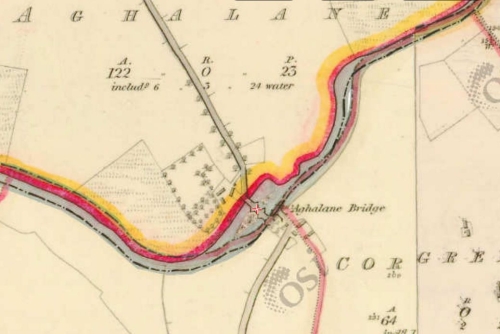
The old bridge at Aghalane (OSI ~1840)
Here, scenic boat trips could be provided. Of course not everybody likes long boat trips, so there could be a market for short trips, perhaps from one side of the Woodford River (which here constitutes the Shannon–Erne Waterway) to the other.
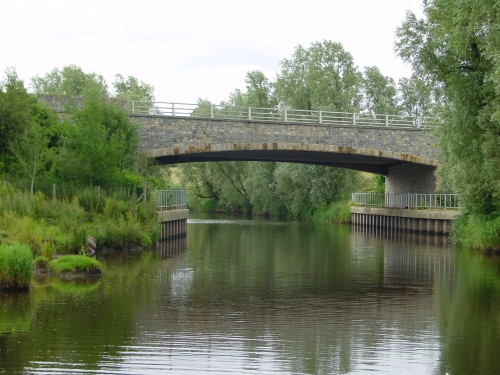
The new bridge at Aghalane
Such trips could feature in package tours, including flights into Ireland, accommodation and leisure activities. But the Irish tourism board (whatever it’s called nowadays) needs to open up new markets: these tours might be attractive to our fellow-EU citizens from Eastern Europe.
There is another possibility for development here, combining economic growth with humanitarianism. Ireland could offer to open refugee camps in the area, thus sharing the burden with Calais, Greece, Italy and other places currently accommodating these unfortunates. This would not be entirely selfless: there would be a stimulus to the local economy from the construction and operation of the camps. Should demand for camps along waterways exceed supply, the re-opening of the Clones Sheugh could be considered.
I regret that the north side of the river is blank on the modern OSI map; that area is part of the United Kingdom of Great Britain and Northern Ireland.

Posted in Ashore, Built heritage, Drainage, Economic activities, Engineering and construction, Extant waterways, Foreign parts, Historical matters, Industrial heritage, Ireland, Modern matters, Non-waterway, Operations, Passenger traffic, Politics, Restoration and rebuilding, Sea, Tourism, Ulster Canal, waterways, Waterways management
Tagged Aghalane, brexit, bridge, Clones sheugh, Northern Ireland, OSI, refugee, Shannon–Erne Waterway, tourism, Woodford River
I was thinking of buying a (secondhand) copy of Juliana Adelman and Éadaoin Agnew eds Science and technology in nineteenth-century Ireland Four Courts Press, Dublin 2011. But, even though the secondhand copy was much, much cheaper even than the publishers’ reduced price, I thought I should check what I’d be getting for my money. I therefore had a look at the contents list, which I reproduce here having nicked it from the publishers’ web page:

The list of contents
Is it just me, or is there a big gap there? How can you discuss nineteenth-century technology without an extended discussion of steam power, whether in ships, on railways, for drainage or in mills and other manufactories?
Posted in Ashore, Built heritage, Canals, Charles Wye Williams, Drainage, Economic activities, Engineering and construction, Extant waterways, Historical matters, Industrial heritage, Ireland, Irish inland waterways vessels, Irish waterways general, Operations, Passenger traffic, People, Rail, Sea, Shannon, shannon estuary, Sources, Steamers, The turf trade, Ulster Canal, waterways, Waterways management
Tagged Ireland, nineteenth century, power, science, steam, technology
Here is a site with links to many old books, mostly late nineteenth and early twentieth century, on several forms of transport[ation]. Not all the links are to free online copies, but it’s a useful list nonetheless.
Many thanks to the learned Eoin C Bairéad for the information that the good people at logainm.ie have scanned many old maps, and other documents, and made them available here, free of charge. They include maps of counties bordering the Shannon, Murdoch Mackenzie’s 1775 chart of the Shannon Estuary (with some soundings) and Mackenzie’s Views of the West Coast of Ireland.
Note: some of the files are very large.
Posted in Ashore, Engineering and construction, Extant waterways, Historical matters, Ireland, Operations, People, Safety, Sea, Shannon, shannon estuary, Waterways management
Tagged chart, estuary, map, Murdoch Mackenzie, Shannon

 Irish waterways history