
Two interesting PDF documents available on this page:
- 2015 summer work programme [PDF]
- an account of the Tarmonbarry lock replacement work [PDF].
No mention of Saunderson’s Sheugh, but I suppose dredging of the River Finn is proceeding.
I realise that many folk visit this website in order to find out what is hip and trendy, cool and with-it, in all sorts of fields, from beer to boating, casual dining to cost-benefit analysis. So, in order to keep readers down wid da kidz in da hood [as the young folk say], I’ve been checking out the latest, baddest [which means ‘goodest’, I gather, or what in the old days we would have called ‘best’], grooviest developments on tinterweb. It’s a thing called FaceTweet, and those cool dudes at Waterways Ireland have one of them. Hep to the jive, daddy-o [which means ‘How perfectly splendid, old boy’.]
As far as I can see, FaceTweet is in general intended for folk whose attention span renders them unable to read more than a single paragraph of continuous prose. But brevity is sometimes the soul of wit and good goods come in small parcels [sentiments for whose veracity I have not found peer-reviewed evidence]. And I was interested in Waterways Ireland’s self-description on the page:
Waterways Ireland is the Recreation Authority for over 1000km of Ireland’s Inland navigable waterways.
That phrase, Recreation Authority, does not occur in Waterways Ireland’s Business Plan 2015 [as approved by the North South Ministerial Council on 18 December 2014 and screwed up by the Council shortly afterwards] or in its Corporate Plan 2014–2016 [ditto]. Nor, according to its own search engine, is the phrase used on Waterways Ireland’s proper website [the search engine rather bafflingly reports “We don’t have any refiners to show you”].
Yet the concept of Waterways Ireland as a Recreation Authority is almost entirely in tune with the thinking underlying both of the plans and it is the neatest encapsulation I have yet seen of what WI is about.
I put in ‘almost’ there because the Corporate Plan‘s Executive Summary includes this:
Central to our vision for the future is the development of recreational, heritage and environmental opportunities that link people, history and nature, providing both local communities and visitors with compelling reasons to spend more time in the waterways environment.
While I’m all — well, somewhat — in favour of heritage and environment, the words seem to sit uneasily in that sentence: added as a form of ritual obeisance to the shade of Michael D Higgins, who ripped the rivers and canals from the sheltering embrace of the Office of Public Works engineers and proclaimed the waterways to be heritage artefacts. Heritage is no longer of great interest to TPTB and most people’s experience of it [whatever it is] is as entertainment or recreation; much the same applies to environment, which — for most people — is of interest only as providing a scenic background for more interesting activities.
So both heritage and environment can be subsumed under the heading of recreation, leaving Waterways Ireland with a neat, well-focused description of itself, a subheading for its title, and one that matches its Mission and Vision.
Mind you, it’s not entirely clear what a recreation authority is — Google finds relatively few [129000] instances of the term’s use, most of them in the Americas — but that might be no harm.
Waterways Ireland — the recreation authority
Hep to the jive, daddy-o: I like it.
Posted in Ashore, Built heritage, Canals, Economic activities, Engineering and construction, Extant waterways, Foreign parts, Industrial heritage, Ireland, Irish inland waterways vessels, Irish waterways general, Natural heritage, Non-waterway, Operations, People, Politics, Restoration and rebuilding, Safety, Scenery, Shannon, Sources, Tourism, Water sports activities, waterways, Waterways management
Tagged business plan, corporate plan, department of arts heritage and the gaeltacht, environment, heritage, Ireland, Operations, recreation, waterways, Waterways Ireland
Riverfest is an annual, er, happening in Limerick. I don’t know much about it: I’ve never been because I dislike both crowds and festivals and it would take something remarkably interesting to outweigh my dislike and persuade me to attend any part of the thing. I took notice of this year’s event only because I wanted to find out what streets would be closed to traffic; the festival organisers did not, alas, think to provide a map showing the closures.
I have only two other comments on the event:
But I acknowledge that I am not really entitled to comment; Brian Leddin, on the other hand, has a better informed view.
Posted in Ashore, Built heritage, Charles Wye Williams, Economic activities, Extant waterways, Foreign parts, Industrial heritage, Ireland, Irish inland waterways vessels, Non-waterway, Operations, People, Sea, Shannon, shannon estuary, Steamers, The cattle trade, The grain trade, The turf trade, Tourism, Water sports activities, waterways, Waterways management, Weather
Tagged Ireland, Limerick, Milk market, Riverfest, Shannon

Heading down the estuary past Shannon Airport

Working in Limerick
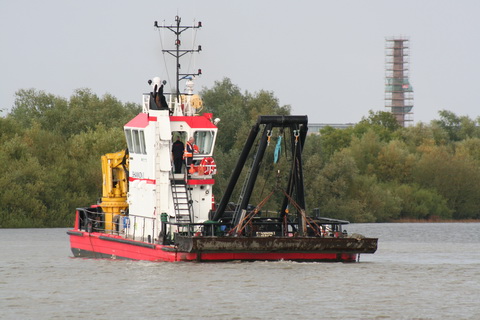
Almost as much kit as WI’s Swiss Army Knife
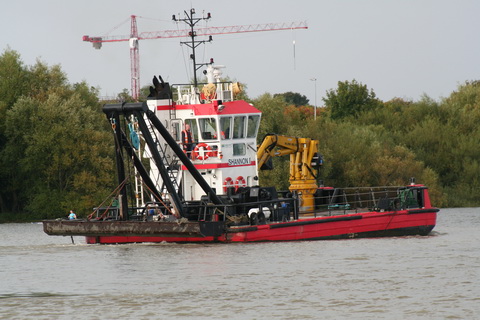
The big crane, though, is not part of the kit
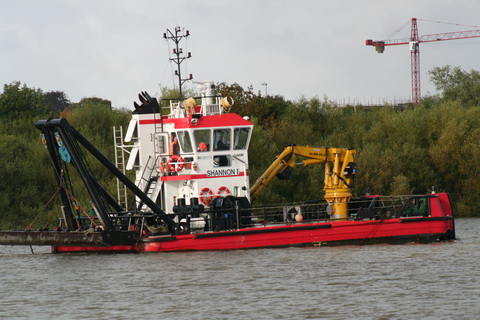
Great view from the cab … er, wheelhouse

Pusher bow?
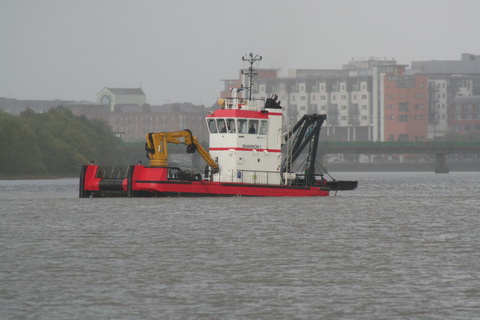
Limerick in the background

Shannon 1’s predecessor Curraghgour II
Posted in Economic activities, Engineering and construction, Extant waterways, Ireland, Irish inland waterways vessels, Operations, Sea, Shannon, shannon estuary, waterways, Waterways management
Tagged boats, Curraghgour II, estuary, Ireland, Limerick, Shannon, Shannon 1, Shannon Foynes Port Company, vessels, waterways, workboat
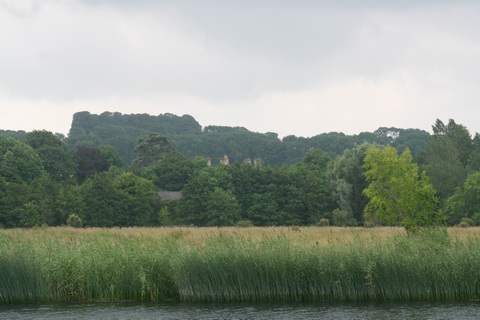
Chimneys of Portland House seen from the Shannon
Here is a good article about the destruction of Portland House, just upstream of Portumna on the east bank of the Shannon, by ruffians in 1938.
A memorial to the lord lieutenant from the gentry and landed proprietors of Sligo, Leitrim, Fermanagh, and Cavan, lies in Enniskillen for signatures. It prays that a canal may be formed which will connect Lough Earne [sic] with Lough Allen, and that again with Lough Gill, which is navigable to Sligo. This, with the canal already sanctioned between Lough Erne and Neagh, will open a communication across the kingdom, from Sligo to the ports of Newry and Belfast. In a commercial point of view, this undertaking is of the greatest importance to Ireland.
Windsor and Eton Express Saturday 28 May 1825
Posted in Canals, Economic activities, Engineering and construction, Extant waterways, Foreign parts, Ireland, Sea, Shannon, Ulster Canal, Unbuilt canals, waterways
Tagged belfast, boats, canal, Cavan, Enniskillen, Fermanagh, Ireland, Leitrim, Lough Allen, Lough Erne, Lough Gill, Lough Neagh, Newry, Sligo, waterways
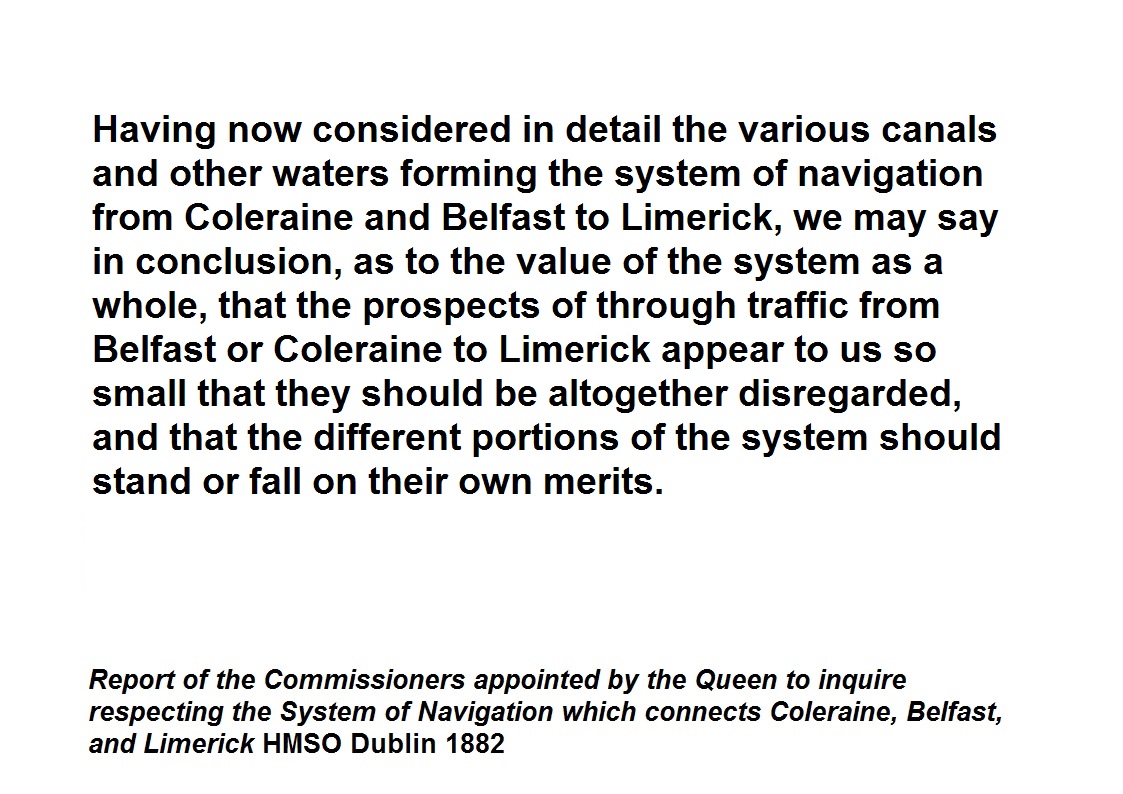
… even today.
Posted in Built heritage, Canals, Economic activities, Engineering and construction, Extant waterways, Foreign parts, Forgotten navigations, Industrial heritage, Ireland, Operations, Restoration and rebuilding, Shannon, Sources, Tourism, Ulster Canal, waterways, Waterways management
Tagged belfast, boats, canal, Clones, Clones sheugh, Coleraine, department of arts heritage and the gaeltacht, Erne, Ireland, Limerick, Lough Neagh, Operations, Saunderson's Sheugh, Shannon, Ulster Canal, waterways

 Irish waterways history