
Mr Kernaghan’s steamer is navigating Lough Gill, which has increased the value of country produce in Sligo market 15 per cent, and it is proposed to connect the Lough with the Shannon four miles distant.
Roscommon & Leitrim Gazette 11 May 1844

Mr Kernaghan’s steamer is navigating Lough Gill, which has increased the value of country produce in Sligo market 15 per cent, and it is proposed to connect the Lough with the Shannon four miles distant.
Roscommon & Leitrim Gazette 11 May 1844
On Tuesday sennight sailed his Majesty’s gun-boat, the General Lake, commanded by Mr James Patterson; and on Wednesday the Bishop, Lieut S Dunn, an experienced officer, who had served in the Royal Navy during the whole of the American war — these, with two others now fitting out, are to join the Kingsmill and Gen Duff gun boats at Carrigahoult bay, where they are to be stationed for the purpose of defending the entrance of the Shannon, the whole under the command of Lieut Augustus Margett, senior officer of division.
The Hon Capt Pakenham, who arrived at Limerick some time back to survey the works on the river, had the boats constructed upon his own plan, and they are found to be in every respect both capable of standing the shock of cannonading, and of annoying an enemy. There is a signal post, with a proper person to conduct it, stationed on Ray Hill, a commanding eminence near Loophead, from whence there is an extensive prospect of the offing. The gun-boats are furnished with private signals, so as to communicate with the person who conducts the signals on shore, by which means friends or enemies at sea are easily ascertained, long before they can come near the shore, and regular and certain intelligence conveyed to the commanding officer of the district.
The following is a list of the gun-boats stationed in the River Shannon, with the names of their commanders, forces, and complement of men:
Vessels Guns Pounders Men Commanders
Pakenham 1 24 19 A Markett
Kingsmill 1 18 19 J Alexander
Gen Duff 1 18 18 — Wing
Bishop 1 18 18 S Dunn
Gen Lake 1 18 18 J Patterson
The Shannon 1 18 18 Geo Perry
The whole completely equipped, with every description of small arms, ordnance stores, &c.
Dublin Evening Post 6 May 1797. From the British Newspaper Archive run by Findmypast Newspaper Archive Limited, in partnership with the British Library.
Yesterday dispatches were received at the Admiralty from Vice Admiral Kingsmill at Cork, brought over in the Waterford mail. Intelligence is received by this conveyance that the River Shannon is now rendered perfectly secure from any designs of an enemy, by the judicious stationing of several gun-boats, which wholly command the entrance and port of Limerick in every direction. The Naval Agents in Ireland, it also appears, continue, by order of Government, to purchase stout ships, which are converted into floating batteries for the defence of other harbours of the kingdom in like manner.
Hereford Journal 9 August 1797. From the British Newspaper Archive run by Findmypast Newspaper Archive Limited, in partnership with the British Library.
The Hon Capt T Pakenham, who shortly after went to Limerick, converted some turf-boats into gun-vessels, each of which carried a twenty-four pounder, constructed to traverse on a platform, and to fire in every direction with the same facility. We are gratified to learn that the system is to be generally adopted.
The Monthly Mirror: reflecting men and manners. With strictures on their epitome, the stage May 1798 in Vol V, Thomas Bellamy, London
Posted in Engineering and construction, Extant waterways, Historical matters, Ireland, Irish inland waterways vessels, Non-waterway, Operations, People, Sea, shannon estuary, Sources, The grain trade
Tagged 1798, Augustus Markett, Captain Pakenham, Carrigaholt, edward fitzgerald, estuary, General Lake, Kilrush, Kingsmill, Limerick, loop head, Paterson, Royal Navy, Shannon, turf boat, Vinegar Hill
The principal export trade of Tralee is in grain, cattle, and pork; they are sent to Cork by land. The harbour is exceedingly bad and dangerous, and, at the time of my visit, a ship-canal was in process of cutting from the bay. By some men of intelligence and experience, a railway was considered preferable.[1]
[1] Jonathan Binns The Miseries and Beauties of Ireland Longman, Orme, Brown and Co, London 1837
Posted in Ashore, Built heritage, Canals, Economic activities, Engineering and construction, Extant waterways, Historical matters, Industrial heritage, Ireland, Modern matters, People, Rail, Restoration and rebuilding, Sea, Sources, The cattle trade, The grain trade, waterways, Waterways management
Tagged Cork, Jonathan Binns, ship canal, Tralee
The Company’s Swift Trade Boats start with the strictest punctuality daily to the following stations, viz: — Athlone, Ballinasloe, Limerick, Tullamore, Kilbeggan, Mountmellick, Philipstown, Monasterevan, Portumna, Dromineer, Williamstown, Killaloe, Shannon Harbour and Banagher, Belmount, Naas, Corbally, Sallins, Portarlington, Rathangan.
Sailing Bills containing all particulars may be had upon application at the Company’s Offices, JAMES’S-STREET HARBOUR or WILLIAM STREET.
The Company’s Boats do not trade to Carrick-on-Shannon or Lanesborough.
By Order, John M’Mullen, Grand Canal House, 29th May, 1861
Freeman’s Journal 1 June 1861. From the British Newspaper Archive run by Findmypast Newspaper Archive Limited, in partnership with the British Library.
Relatively little has been published about the horse-drawn cargo-carrying trade boats used by the Grand Canal Company in the latter half of the nineteenth century, before it adopted semi-diesel engines. Here is some information and some speculation about the subject, but there is much that is not clear.
Boogie on over to the WI website for a copy of the WI draft heritage plan, and send WI your comments by 6 November 2015.
WI staff have put a lot of work into this and consulted various people, including me. I argued for a more activist approach, with more history and less about communities, and I would have let the twitchers and other nature-lovers look after themselves and their little feathered friends …
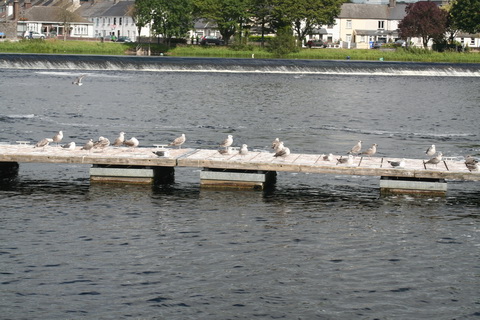
Freeloading birds hijacking facility at Athlone intended for (and paid for by) humans. And who’s going to have to pay for cleaning it? Humans, that’s who. Human rights, that’s what we need …
… but I quite appreciate that Waterways Ireland has to be polite to all these people and can’t disobey the law, no matter how insane the legislation is.
But I digress. Get some comments in, preferably plugging industrial and transport heritage and economic history.
Posted in Ashore, Built heritage, Canals, Economic activities, Engineering and construction, Extant waterways, Historical matters, Industrial heritage, Ireland, Irish inland waterways vessels, Modern matters, Natural heritage, Non-waterway, Operations, People, Politics, Safety, Scenery, Shannon, Steamers, The cattle trade, The grain trade, The turf trade, waterways, Waterways management
Tagged heritage, plan, Waterways Ireland
BORRISOKEEN, July 14. — The Solicitor-General, Mr Doherty, will arrive here to-morrow for the purpose of investigating the late unfortunate occurrences of this town on the 26th and 28th ultimo. This measure of the Government seems to restore some confidence to the minds of the people. Had this investigation not been granted, no person could calculate on the consequences of the expressed resolution of the peasantry to come into Borrisokeen, in a body of 50,000 or 60,000, to have vengeance for the loss of their relatives and neighbours.
On Saturday last a person named Dagg, a Protestant, residing in Borrisokeen, but who left it on account of the late occurrences, was apprehended at the mountains of Thoreebrien, when the country people held a consultation on the most effectual mode of putting him to death. Disregarding his entreaties and professions of innocence, he was dragged along by about 500 persons, and, on coming to Portumna, they determined to tie his legs to one part and his arms to the other part of the drawbridge across the Shannon, and then open it, that he might be drawn asunder. Fortunately at the time a gentleman from Borrisokeen passed by, and by his interference, with that of the parish priest, the life of the unfortunate man was spared.
Salisbury and Wiltshire Journal 27 July 1829

Newspaper accounts at the time suggest that there was an affray in Borrisokane at the end of the fair. Five mounted police either attacked or attempted to disperse the crowd; stones were thrown; Captain Dobbyn, a Stipendiary Magistrate, read the Riot Act and ordered the police to fire, which they did, killing two people. Two days later, during the funeral of one of those shot, one John L—, an Orangeman, and four companions, fired on the mourners from behind portholes on his house, or sallied forth to fire, killing four immediately and mortally wounding another. There is nothing to suggest that the unfortunate Mr Dagg was in any way involved.

 Irish waterways history