Tag Archives: Barrow

Comments closing

Very large numbers of new readers have visited this site in recent days and have read my posts about the draft WI canals byelaws. I am grateful to them and even more grateful to those who took the trouble to comment.

I have spent pretty well the whole week on this, between reading the legislation and draft byelaws, writing up posts and responding to comments. I have fallen behind with other work, and accordingly I need to turn my attention to other issues.

I have invited one person to write a guest post on an aspect of the byelaws issue that I think is important, but that apart I won’t be adding new material on the subject for some time. Furthermore, later this evening I will close the existing posts to comments. Those posts, latest first, are:

Draft canals byelaws: comments on what I sent to WI as my contribution to the consultation process

Bang em’ up? Alas, no more on the enforcement mechanisms

Pull the plug: drain the canals on WI’s financial situation. I hope it is clear that I don’t really want to see them drained, but that I do think action is needed

Asleep at the wheel on why the production of new draft byelaws should not have come as a surprise.

The posts themselves and the existing comments will remain visible.

I hope that readers have found the discussion and information useful — even those who didn’t agree with my views.

My next substantial post will be on the Dublin & Kingstown Canal.

If you are interested in the mix of contemporary and historical waterways matters, you are welcome to subscribe to the site’s RSS feeds or by email. Note that the site is non-commercial and does not carry advertisements.

Jimmy Deenihan, cricketer

Jimmy Deenihan, minister for waterways and some other stuff, supporter of the Lartigue Monorail in Listowel, is known to have played two forms of football: rugby and Gaelic. His cricketing expertise is perhaps less well known but, in a written answer to four Dáil questions yesterday, he showed his mastery of the straight bat.

I was surprised to find Bernard Durkan [FG, Kildare North] referring to “traditional canal boat dwellers”. I suppose it depends on your timescales: in my view, anything that began after 1850 isn’t really traditional.

Draft canal byelaws: comments

I have sent to Waterways Ireland my comments on the proposed canals byelaws, on everything from the structure of the document to the finer points of wording. Here is a summary of what I said about the more important points.

Legal basis

I am not a lawyer, but as far as I can see the draft byelaws are, and are being made, in accordance with the provisions of the Canals Act 1986 and the Maritime Safety Act 2005.

The structure of the new byelaws document

I suggested that the structure of the document would be improved, and the document would be easier to follow, if each new concept had:

  • a definition
  • a mention in a byelaw
  • an entry, giving the charge, in the schedule.

As it is, eight concepts (excluding Waterways Ireland) are introduced in the definitions section:

  • annual canals cruising permit
  • annual extended canals mooring permit
  • annual houseboat mooring permit
  • Barrow open fishing boat licence
  • continuous cruising
  • fixed payment notice
  • houseboat
  • visitor cruising permit.

The second and third concepts are implicitly, but not explicitly, covered by Byelaw 3. Its heading includes fishing but the text does not. The sixth concept, the fixed payment notice, is covered in Byelaw 7 and the seventh concept, the houseboat, is covered in Byelaw 4.

However, the three cruising concepts, two of which have permits, and the Barrow licence are not discussed in any of the draft byelaws, although the concepts are just as novel as those of the various mooring permits. That leaves the attentive reader wondering why some new concepts are covered by, or discussed in, byelaws and other are not.

I suggested that it would be better to

  • group the cruising concepts together, and then the mooring concepts, in the definitions
  • devote at least one byelaw to each set of concepts, treating them in the same order as in the definitions
  • follow the same order in the schedule of charges.

Apart from being easier to follow, that would ensure that all the new concepts have the same level of legal cover: at present some are covered by byelaws and others are not.

I suggested therefore that Byelaw 3 might cover the use of the canals and Barrow for navigation and Byelaw 4 might cover their use for the mooring of boats. Each byelaw would list the types of use that Waterways Ireland is providing for, state the permit required and state that the charge is set out in the schedule.

For the moorings, the byelaw would also state that WI will designate the areas or stretches of canal bank that may be used for each type of mooring; it might also state that those areas or stretches may not be used by boats without the appropriate permits. And it would make it clear that WI can set different rates depending on the size of boat, location and services provided.

Both byelaws should, as at present, give the legal basis, but I recommended sticking closely to the wording of the appropriate parts of Section 7 (1) of the Canals Act 1986.

Categories of cruising activity

The draft envisages permitting three types of cruising activity:

  • year-long cruising
  • continuous cruising
  • visitor cruising.

The definitions seem to be slightly contradictory: the annual canals cruising permit is said to be required by all boats but the definitions for the other two forms suggest that those activities may be undertaken without an annual canals cruising permit.

I suggested that the concept of continuous cruising be dropped. It describes the cruising permitted to holders of visitor permits, which Byelaw 5 can deal with adequately. Given that real continuous cruising is barely possible on the canals and Barrow, especially in the winter, providing for it seems pointless, and it might tempt customers to try to avoid paying for mooring permits.

I suggested that Waterways Ireland include a provision empowering itself to issue cruising permits for designated journeys, as in Byelaw 6 of the 1988 byelaws. The provision could be phrased so as to allow (but not require) Waterways Ireland to offer special permits, perhaps at discounted rates, to boats or groups of boats undertaking specific journeys, perhaps taking longer than one month, or travelling to specific events.

For example, a boat might not be able to complete the round trip from the Shannon to Dublin via the Royal, and back via the Grand, within one month, given the restricted schedule of bridge lifts, but WI might like to encourage boaters to undertake that trip by offering discounts on tolls. Similarly, if a waterside community were organising a festival, it might like to encourage boaters to travel there and WI might support the event by offering a package deal to festival-goers.

Categories of mooring

I noted that, as far as I can see, the Combined Mooring and Passage Permit will no longer exist. I take that to mean that there will be no uncontrolled mooring on the canals and Barrow. The definitions envisage permitting three types of mooring:

  • annual extended canals mooring permit (perhaps the word “extended” could be dropped)
  • annual houseboat mooring permit
  • Barrow open fishing boat licence. I asked (again) about the difference between licence and permit (I don’t understand the answer I got last time) and why open non-fishing boats should not be licensed too.

I suggested that the byelaw should state that WI can designate moorings for boats that are touring, visiting or cruising (or whatever the appropriate term is) and also state that other boats may not use those moorings without permission.

I said that the byelaw, rather than (or as well as) the schedule, should make it clear that WI can set different rates depending on the size of boat, location and services provided; it should also cover the annual and daily charges for the Grand Canal Dock and Spencer Dock.

I am not clear whether it is intended that a houseboat should hold the annual extended canals mooring permit as well as the annual houseboat mooring permit. The first is said to be required of all boats not navigating or continuously cruising, and that definition includes houseboats. I suggested that houseboats should not be required to hold both permits and that the definitions and byelaws should make that clear. If, on the other hand, it is intended that houseboats should hold both permits, that too should be made clear.

I said that the definition of houseboat must be fireproof, as must the power to decide what is and what is not a houseboat. The current definition, I felt, invites endless argument about the definition of “principal” and about whether or not the sleeping practices of the owner or occupant mean that the boat is a principal residence.

Finally, I suggested considering a canals equivalent of the Shannon’s winter mooring scheme, albeit with higher charges, or perhaps an annual permit that combined cheaper winter with more expensive summer mooring. That would cater for boats that spend the winter on the canals (presumably near their owners’ homes) and the summer on the Shannon. In winter, they could use visitor moorings or bank moorings near Dublin with little likelihood of their depriving anyone else of access.

Navigations

I suggested that it be made clear that “canals” includes “Barrow navigation”. Neither the Canals Act 1986 nor the existing byelaws make that clear.

The definition of the visitor cruising permit confines it to boats “visiting the canals from another navigation”. I asked whether the Liffey, the tidal Barrow and indeed the sea come within the term “navigation”.

Compliance and enforcement

I have given my interpretation here.

Price and revenue

I said that I do not imagine that WI knows, or could find, the price elasticity of demand for the various types of moorings. As a result, I suggest that WI should retain the maximum flexibility in price-setting and should be willing to change prices year by year to discover the best price points.

I have no objection to the rates shown in the first schedule but I wonder whether they make sufficient allowance for any future inflation. I raised some minor points about the Dublin passage charges; in particular I suggested that the per-boat charge for the Newcomen railway bridge should be changed to a per-lift charge to encourage numbers of boats to travel together and thus to reduce the number of lifts required.

Bang ’em up? Alas, no more

According to the Sindo,

Concerns were also expressed that the new system of fines “will see the canals fall into a similar state of dereliction to the 1960s, when entire sections of the waterways were filled in”.

Right. Well. Yes. The Sindo evidently has its own definition of the word “new”. This is from Section 7 of the Canals Act 1986:

(3) A person who contravenes a bye-law under this section shall be guilty of an offence and shall be liable—

(a) on summary conviction, to a fine not exceeding £1,000 (together with, in the case of a continuing contravention, a fine not exceeding £100 for every day on which the contravention is continued and not exceeding in total an amount which, when added to any other fine under this paragraph in relation to the contravention concerned, equals £1,000) or to imprisonment for any term not exceeding six months or, at the discretion of the court, to both such fine or fines and such imprisonment, or

(b) on conviction on indictment, to a fine not exceeding £5,000 (together with, in the case of a continuing contravention, a fine not exceeding £500 for every day on which the contravention is continued) or to imprisonment for any term not exceeding two years or, at the discretion of the court, to both such fine or fines and such imprisonment.

Emphasis mine.

So a Sindonian “new” includes anything up to twenty-eight years old.

The provisions of the Canals Act 1986 were modified by the Maritime Safety Act 2005. Now, I am not a lawyer, but this is what I think is happening. I would be glad to hear from any of My Learned Friends who happen to be passing. My interpretation, open to correction, is this:

  • under the Canals Act 1986 and the 1988 byelaws, contravention of a byelaw is an offence for which offenders can be fined or imprisoned or both; the severity of the sentence depends on whether there is a summary conviction (District Court) or a conviction on indictment (higher courts)
  • the Maritime Safety Act 2005 increased the level of fines, removed the threat of imprisonment and made all but one of the offences subject to summary conviction, thus confining all prosecutions to the District Court
  • the exception is that contravention of byelaws relating to fees, tolls and charges is no longer an offence: Waterways Ireland may instead initiate civil court proceedings to recover amounts owed and may (presumably) seek to have any judgement enforced through the usual channels
  • the Maritime Safety Act also provides an alternative to prosecution for alleged breach of those byelaws whose contravention is still an offence. In such a case, Waterways Ireland may issue a fixed payment notice, seeking the sum of €150 which, if paid, will avoid prosecution. The proposed Byelaw 7 will enable this provision to be implemented.

Working out how a speedy system of enforcement will lead to the filling in of waterways requires an exercise of the imagination that is beyond me. But the only thing that is new here is that Waterways Ireland is implementing a power that it has had for seven years. Under the system introduced in 2007:

  • offending boaters can no longer be imprisoned
  • a breach of the byelaws is now a summary and not an indictable offence
  • non-payment of fees etc is no longer an offence but WI can recover the money through a civil court proceeding and by enforcing a judgement
  • for those breaches of byelaws that are still offences, there is a fixed-penalty alternative that avoids prosecution.

I think that the explanatory note at the end of WI’s draft byelaws document is badly drafted in that it does not explain the difference between breaches of byelaws that constitute offences and those (relating to fees etc) that do not. On the whole, the 2007 rules, now being implemented, seem to me to represent an easing of the rules on enforcement.

I repeat: I am not a lawyer; my interpretation may be mistaken. Caveat lector.

Pull the plug: drain the canals

The worst aspect of the piece published by the Indo last Sunday is that information is presented entirely without context. Persecuted boatowners are, it seems, to be forced to pay money, and the economy of the canals (such as it is) is to be damaged, for no reason whatsoever. The assertions of the boatowners go unchallenged.

Happily, this site provides a bilge-cleaning service. Here is the news.

1. Waterways Ireland is in dire financial straits

I have written extensively here about Waterways Ireland’s finances. I pointed out that there is a continuing dispute between the NI minister responsible for waterways and her southern counterpart, but that if the RoI government gets its way WI’s income will be cut by one third between 2010 and 2016. I showed that WI’s operating income is negligible and that most categories of expenditure have already been cut; I also showed that retirements will increase the cost of pensions benefits from just under €1000000 in 2011 to just under €2400000 in 2016, which will account for 10% of the total real staffing budget.

The combined effect is that Waterways Ireland needs to make further cuts in its spending, but that its scope for doing so is extremely limited: further cuts are bound to affect the staffing budget. WI’s only other option is to increase its (pathetically small) operating income.

2. canals and Barrow are disproportionately expensive

Here, I gave WI’s programme costs for 2011, taken from the annual report for that year (the most recent available). Here they are again, rearranged:

Royal Canal €2908k
Grand Canal €1556k
Barrow €600k

Total Canals + Barrow €5064k

Shannon €1882k
Erne & Lower Bann €478k
Shannon–Erne Waterway €658k

Total other waterways €3018k

There are all sorts of caveats to be entered about these figures: for instance, as I observed here, WI has different levels of non-navigational responsibilities on different waterways, and programme costs do not include staffing costs; nor do they include overheads like IT, marketing, personnel and so on.

But the Canal-and-Barrow costs clearly offer more scope for cutting than those for other waterways, as WI’s Corporate Plan 2011–2013 recognised. I showed here that it proposed these cuts for the period:

  • Grand Canal €910,000
  • Royal Canal €503,000
  • Barrow Navigation €387,000
  • Shannon Navigation €662,000
  • Shannon–Erne Waterway €232,000
  • Erne System €70,000
  • Lower Bann €69,000.

That’s €1800ooo in reductions from Canals + Barrow, €1033000 from the rest. However, budget developments since that plan was drawn up are likely to have increased the amounts required to be cut.

3. Canals and Barrow boaters get huge subsidies

I do not have up-to-date figures for the numbers of boats on the waterways, but suppose for the sake of argument that there are 500 on the Canals + Barrow and 8000 on the rest. I am confident that those figures are of the right order of magnitude.

In that case, counting only WI’s programme costs for the waterways in question and excluding staffing and central overheads, the costs to the taxpayer are:

  • Shannon, Erne, Shannon–Erne, Bann: €377.25 per boat
  • Grand, Royal, Barrow: €10128 per boat.

I hope to be able to provide better figures later, but the exact figures don’t matter very much: the point is that every boat on the canals and Barrow is benefiting to an enormous extent from taxpayer support. The poor persecuted boaters are seeking the continuation of a very, very privileged position: owners of camper vans, for instance, get no comparable benefit.

4. Canals and Barrow boaters contribute very little

I have figures for the numbers of boats on the canals and Barrow that held permits in September 2013. I have sought those for December, but I suspect that the number did not greatly increase by the end of the year.

By September:

  • 254 boats had Combined Mooring and Passage Permits
  • 134 boats had Extended Mooring and Passage Permits.

So the total contribution by boaters to the cost of the canals and Barrow was (254 X €126) + (134 X €152) = €52372, about 1% of the programme costs for the three waterways, which means it was considerably less than 1% of the total costs including salaries and overheads.

Let me dwell on that for a moment. The poor persecuted boaters, some of them members of organisations that claim to value the canals, themselves think that the canals are worth only €50000 a year, because that’s all they’re prepared to pay. It is not clear to me why anybody else, like the taxpayer, should pay more.

The poor persecuted boaters are now being asked to pay more than 1% of the total cost of the waterways they use (and, presumably, support). I would have thought that they would welcome an opportunity to contribute.

These figures also suggest that the level of compliance on these waterways is low, although I accept that my figures are inadequate and I will try to obtain more comprehensive information.

5. canals and Barrow are a poor use of public money

It is not clear how the taxpayer benefits by keeping the canals and Barrow open to navigation. Suppose Waterways Ireland were to open all the racks, drill holes in the bottoms of aqueducts and run off all the water. What then?

I suspect that it wouldn’t be that simple: that there are engineering-type reasons why some structures would need to be maintained and some water flow kept up. Perhaps the Morrell Feeder would suffice to keep the Grand Canal in Dublin looking nice; the flow from the Milltown Feeder, the canal’s main supply, could be sold off to Irish Water to relieve the Dublin drought. The Royal could simply be abandoned altogether; the Barrow would continue to be navigable by canoes and small craft. Shannon Harbour and Richmond Harbour could be kept in water (by pumping if necessary) and operated as commercial marinas, charging commercial rates.

Staffing could be reduced: even if there were no immediate redundancies (or transfers to Irish Water), the need for any new recruitment would be avoided for some time. Overtime would never be required and Irish Rail wouldn’t have to lift Effin Bridge.

So who would lose? The Irish tourist trade would hardly notice: as far as I can see, very few tourists go boating on canals or Barrow. There are two small hire firms on the Barrow Line, but apart from them there are (as far as I know: correct me if I’m wrong) only individual boats for hire here and there. Unless a large, well-capitalised firm, with a large marketing budget, moves in here, I can’t see there being any significant tourism activity that relies on there being water in the canals. Walking and cycling routes could be improved along the towing-paths, while the Barrow could also cater for canoeing and kayaking.

Who else benefits from having the canals and Barrow navigable? A publican or two in rural areas will sell an extra pint or two to passing boaters whose money might otherwise have been spent in Dublin; a takeaway in Tullamore will have a tiny increase in turnover … but that’s about it. This vast expenditure moves the spending of a few quid from Dublin to Daingean, but I doubt if the total is enough to create even one job in any location. I cannot see that there is any multiplier effect worth talking about.

Furthermore, such business as there is is highly seasonal, with very few boats moving any considerable distance other than in short periods in spring and autumn. Traffic is low in winter and summer.

Over the last ten years canal businesses have closed down. There were four hire fleets on the Barrow: they’ve all gone. Various trip boats have gone. Lowtown Marina is for sale. All of that during a period when capital expenditure on the canals was rising, facilities were being improved and charges to users ranged from low to non-existent.

I suggest therefore that spending on the canals and Barrow is not of any benefit to the tourist industry and is of minimal benefit to commercial service providers along the waterways. Instead the benefits go largely to two groups: the employees, who work for what they get, and the boat-owners.

6. Waterways Ireland should share the benefits

The cost of a year-round berth for a 60′ barge at a marina in a small village on the east (Dublin) side of Lough Derg is €3000. Lower rates are available on the west side.

The cost of a year-round berth for a 60′ (or any other size) barge in Shannon Harbour, a small village on the east (Dublin) side of the Shannon is currently that of an Extended Mooring and Passage Permit, €152. Thus Waterways Ireland is providing a benefit worth over €2800 to someone keeping a barge at Shannon Harbour.

I can see no good reason why Waterways Ireland should allow the Shannon Harbour owner the whole of that benefit: it would seem reasonable that Waterways Ireland should claw back at least half of it. Most marinas charge by the foot (or metre) of length, so rates for other boats could be worked out in proportion.

A berth at Shannon Harbour enjoys easy access to the Shannon; a berth in (say) Pollagh is less favourably situated and might thus be charged for at a lower rate. But berths closer to Dublin – say at Sallins or Hazelhatch or at the Leinster Mills on the Naas Branch — should attract a premium. And folk who are saving money by living in boats should be happy to share part of their savings with Waterways Ireland. (I don’t know what the premiums should be but, in another post, I’ll discuss pricing.)

The point here, the point ignored by the Indo, is that Waterways Ireland needs to narrow the gap between income and expenditure on the canals and Barrow. It is entirely fair that it should charge for the services it provides and that the burden should be borne by those who benefit.

However, it should be noted that WI’s charges are not inescapable: anyone who does not want to pay them is at liberty to remove his or her boat from the canal or Barrow and place it elsewhere, or to sell it and buy a camper van.

That being so, I see no more ground for objecting to any level of charge that WI might bring in than there is for objecting to the prices in, say, Brown Thomas.

Envoi

If (as seems to be the case) boaters’ organisations are incapable of engaging in rational discussion of the funding and management of the waterways, I suggest that Waterways Ireland should ignore them. Just pull the plug, shut down the canals and spend the savings elsewhere.

WI and the state should not continue to spend ridiculously large amounts of public money subsidising the leisure activities of a small number of people, who don’t themselves value what they’re getting, when there is little benefit to the economy as a whole. There has to be some better balance between income and expenditure on the canals and Barrow.

Asleep at the wheel

I see from one of the blatts that some boating folk are complaining about the prospect of reduced taxpayer subsidies for their canal-and-Barrow holidays. I’ll deal with the burden of their song later, but I was struck by the lack of foresight suggested by Mr Drennan, the author of the Indo story:

[…]  concern is growing about the shortness of a consultation period, which will close on February 3.

The timetable for consultations on proposed Waterways Ireland byelaws is set out in the Maritime Safety Act 2005, which amended the Canals Act 1986 and the Shannon Navigation Act 1990, giving people 21 days to submit objections to proposals. I cannot see why anyone should now be surprised or concerned that Waterways Ireland is obeying the law.

Furthermore, it’s not as if Waterways Ireland’s intentions were not known. For instance, on 25 September 2012 WI said in a press release:

Waterways Ireland has proposed a small number of draft amendments to the current Bye-laws which date from 1988. These include proposals to provide a range of charges for mooring permits that reflect the location and services provided throughout the canals and also will take into account the size of boat. These proposals include low cost rural moorings on soft banks to ensure the canals are accessible for everyone who owns a boat and requires a mooring. Boat owners allocated an extended mooring location in key areas in villages or towns or with services should be aware that if the new Bye-laws are approved Waterways Ireland will increase the charges for moorings in the future to reflect the location, services, and size of boat.

Anyone who has been paying attention to waterways affairs for the past few years must have been well aware of the direction of change. There has been plenty of time for folk to formulate their objections — or even to come up with sensible alternative long-term strategies.

Matters of minor importance

Some recent(ish) discussions amongst the People’s Representatives. I haven’t time to analyse them all. All links courtesy of the estimable KildareStreeet.com.

Brendan Smith [FF, Cavan-Monaghan] wants a sheugh in Clones; he got the usual answer. And he allowed Jimmy Deenihan [FG, Kerry North/West Limerick] to announce, on 19 December 2013, the death of the suggested extension of the Erne navigation to Lough Oughter [loud cheers]:

Brendan Smith: To ask the Minister for Arts, Heritage and the Gaeltacht if he has received the feasibility study on the proposed extension of the Erne navigation from Belturbet to Killeshandra and Killykeen; and if he will make a statement on the matter.

Jimmy Deenihan: I am informed by Waterways Ireland that it commissioned a Strategic Environment Assessment for the possible extension of the Erne Navigation from Belturbet to Killeshandra and Killykeen.

On reviewing the environmental information from this process, Waterways Ireland considers that the environmental designations of this lake complex make the feasibility of the proposed navigation extension highly unviable. For that reason, I am advised that Waterways Ireland does not propose to pursue this project any further at this time.

Well, that’s one minor victory for sanity. Here’s how a dredger got to Lough Oughter in 1857.

Maureen O’Sullivan is anxious to recreate the economy of the eighteenth and nineteenth centuries by using canals for carrying cargoes. Especially on the Shannon–Erne Waterway, where commercial carrying was so successful before. [What is it about the Irish left?] Thank goodness that the sainted Leo Varadkar gave not an inch: someone should make that man Taoiseach, President and Minister for Finance. And Supreme Ruler of The Universe and Space.

The web-footed inhabitants of the midlands, who have discovered that they live in a flat area with rivers, keep wittering on about Shannon flooding, failing to realise that it is a message from The Lord, telling them to either (a) move to higher ground, eg Dublin, or build arks. On 15 January 2014 Brian Hayes told Denis Naughten, inter alia, that info from the recent OPW/CFRAM monitoring of water levels on Lough Ree (which I think was when the levels were lowered) would be placed on the OPW website “in the coming days”; I haven’t been able to find it yet so I’ve emailed the OPW to ask about it. And on 21 January one James Bannon said that he intends to introduce a bill setting up a Shannon authority, which will have magical powers. Well, if it doesn’t have magical powers it won’t be able to stop the Shannon flooding, but perhaps it’s designed to allow the unemployed landowners of Ireland another forum in which to demand taxpayers’ money to prop up their uneconomic activities.

Finally, a senator called John Whelan wants a longer consultation period on the proposed amendments to the canals bye-laws. I suppose I’d better read them  myself.

A query

I have emailed this query to Waterways Ireland today:

I would be grateful if you could tell me

(a) which, if any, persons Waterways Ireland has appointed as authorised persons for the purposes of Part 2 of the Maritime Safety Act 2005

(b) which, if any, authorised persons have been provided with training and instruction in the exercise of the power of arrest, as provided for in Section 13 (2) (b), and have been issued with warrants as
provided for in Section 13 (2) (c).

I note in Section 17 that

(9) Every authorised person appointed under this section shall be furnished with a warrant of his or her appointment as an authorised person and when exercising any power conferred on him or her by this Part as an authorised person shall, unless in uniform, if requested by a person affected, produce the warrant or a copy thereof to that person.

I regret that I had not noticed those provisions earlier.

Reading list

Waterways Ireland has been putting out more and more stuff on its website.

If you haven’t already seen them, you can get the full set of Product Development Studies, in PDF format, here.

Even more interesting, to this site, are the waterway heritage surveys. Those for all waterways other than the Shannon are available here. The Shannon study was done some years ago (I remember making some comments on it at the time) and will be uploaded “in due course”.

I was in a WI office yesterday and had a quick look at the Lower Bann survey, which was done by Fred Hamond (so we know it will be good), and I’m looking forward to learning more about the waterway I know least about. It is done thematically and has lots of illustrations: Fred is able to see and present the bigger picture, but a full database, with all the supporting information, is available on request.

Ballinlaw ferry

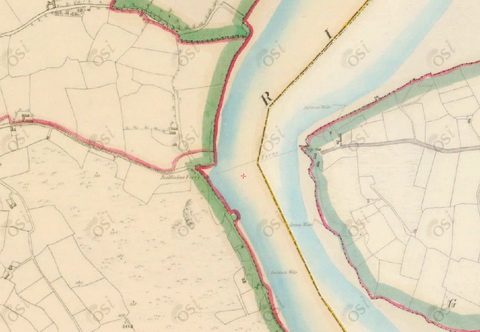
A visitor to my page on the tidal Barrow is a descendant of ferrymen at Ballinlaw on the Barrow. He would like to find a photograph (or, presumably, other illustration) of the ferry boat and I would welcome more information about the service (eg when it ended).

Ballinlaw ferry (OSI ~1840)

Ballinlaw ferry (OSI ~1840)

If anyone knows of a possible source of information or illustration, I will pass it on to the enquirer.

Update January 2019: much information about Ballinlaw Ferry from Andrew Doherty here.

My OSI logo and permit number for website