Tag Archives: Dublin

Canal carrying 1846: the Grand Canal

Isaac Slater’s Directory[i] of 1846 lists those carrying goods on inland waterways. Most of the carriers on the Grand Canal, which runs from Dublin to the River Shannon with various branches, claim to serve a modest number of places, but Thomas Berry & Co have a very lengthy list. So long is their list that it will require two maps to show all the places they served, with a third map for the rest of the carriers.

Note that the maps are from the 25″ Ordnance Survey map of around 1900 rather than the 6″ of around 1840: I used it because it was clearer, but it shows features (eg railway lines) that were not present in 1846.

There may be some cases where I have misidentified a destination; I would be grateful to have my attention drawn to such cases.

Click on a map to get a slightly larger version.

Thomas Berry & Co
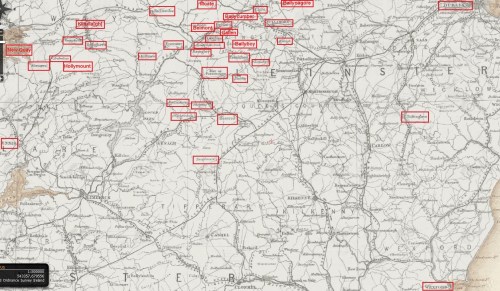
Thomas Berry & Co midland and south routes

Thomas Berry & Co midland and southern destinations (OSI)

The canal runs from Dublin, at the top right, left (roughly west) through Tullamore to Shannon Harbour, where it meets the river; there was an extension to Ballinasloe on the far side of the Shannon. Berrys served places along the canal and several others fairly close to it, but it looks to me as if there were three routes by road beyond that:

  • via Banagher (which has a bridge across the Shannon) to Eyrecourt and Killimor
  • from Ballinasloe to Loughrea and district and then south-west to Ennis in Co Clare
  • perhaps from Tullamore to Birr [Parsonstown], Roscrea (including Shinrone, Cloughjordan and Borrisokane) and Templemore.

There are also two outliers for which I can think of no plausible explanation: Baltinglass and Wexford. Perhaps their inclusion was a mistake. Certainly Berrys, like John M’Cann & Sons on the Royal Canal, seem to have had extensive road networks (perhaps using car-owning subcontractors?) to supplement their water-borne routes, but I don’t see why they would take on a route no part of which could sensibly have been conducted by inland navigation.

The next map shows the north-western destinations served by Berrys.
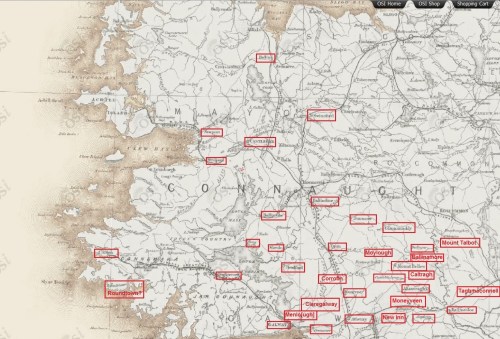
Thomas Berry & Co western routes

Thomas Berry & Co north-western destinations (OSI)

You can see that their network covered much of County Roscommon and went almost as far west into County Galway as it was possible to go; it also extended northwards into County Mayo.

I have not attempted to check what industries might have made these towns and villages worth serving. Berrys certainly seemed keen to take as much as possible of the traffic from west of the Shannon towards Dublin — excluding such of it as went by the Royal Canal: it is interesting to compare these maps with that for M’Cann on the Royal.

Finally, note that along the canal itself Berrys listed only destinations towards the western (Shannon Harbour) end: it seems likely that the roads took the valuable traffic from the eastern end into Dublin. There were no doubt turf boats taking fuel in from closer to Dublin, but they were not general carriers.

Other carriers

Now for the rest of the carriers.
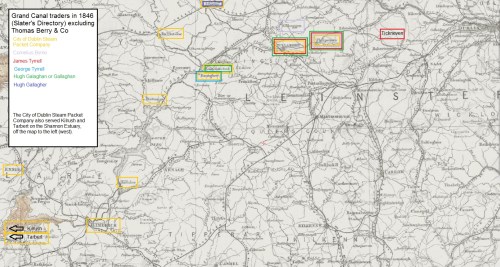
Grand Canal carriers 1846 excl Thomas Berry

Grand Canal carriers 1846 excluding Thomas Berry (OSI)

I have included the Shannon here as well as the Grand Canal; however I have covered the Barrow Line of the Grand Canal, as well as the navigable rivers Barrow, Nore and Suir, in a separate post. Of the carriers listed here, only the City of Dublin Steam Packet Company [CoDSPCo] (which employed horses to pull its boats on canals) ventured on to the Barrow Line, serving Portarlington and Mountmellick.

Berrys and the CoDSPCo were by far the largest firms on the Grand. I don’t know the size of the Berrys fleet, but the CoDSPCo had 52 barges in addition to its Shannon (and Irish Sea) steamers. Note that only on the middle Shannon, around the junction with the Grand Canal, and at Ennis did the two firms serve the same destinations: the CoDSPCo seems to have had the lower Shannon trade to itself.

With one exception, all the carriers, including Berrys, had Dublin depots at Grand Canal Harbour, James St; the Grand Canal Docks at Ringsend, joined to the Liffey, were not mentioned.

The exception is Hugh Gallagher, whose only listed destination was Athlone. It would be interesting to know how he served Athlone: whether by road or by water and, in the latter case, whether he used a steamer. I do wonder whether Hugh Gallagher might be the same person as the Hugh Galaghan (also Gallaghan) who served Philipstown [now Daingean], Tullamore and Shannon Harbour.

George Tyrrell is another who is listed with but a single destination, Banagher, whereas James Tyrrell is listed as serving Tickneven, Philipstown, Tullamore — and Edgeworthstown, which must be a mistake as it is closer to the Royal Canal.

Finally, Cornelius Byrne is shown as serving two destinations: Philipstown and Kilbeggan (which has its own branch off the main line of the canal).

Other information

A little extra information is available from the entries for towns other than Dublin in the Directory:

  • Naas has its own branch from the main line of the canal, but the directory says that “TO DUBLIN, there are Boats, as occasion require, but they have no fixed periods of departure.”
  • Edenderry also has its own branch, short and lock-free, but there is no mention of its being served by trade boats
  • Kilbeggan, with a longer, leakier, lock-free branch, was served by the CoDSPCo’s and Thomas Byrne’s boats travelling to Dublin three times a week. Is this Thomas Byrne related to the Cornelius Byrne mentioned above? It seems that Byrne went only eastward for only the CoDSPCo’s boats went westward (to Shannon Harbour, Ballinasloe and Limerick) two or three times a week
  • at Banagher, Fleetwood Thomas Faulkner of Main Street was the CoDSPCo agent; a downstream steamer left Shannon Harbour after the [passenger] boat from Dublin arrived and called at Banagher’s Bridge Wharf; an upstream steamer from Limerick called every afternoon at 3.00pm and met the night boat travelling to Dublin by the Grand Canal. I presume that this happened on every day except Sunday.

More

As far as I know, little has been written about the carrying companies, especially those of the nineteenth century. I would be glad to hear from anyone who can correct, supplement or comment on this information.

My OSI logo and permit number for website


[i] I Slater’s National Commercial Directory of Ireland: including, in addition to the trades’ lists, alphabetical directories of Dublin, Belfast, Cork and Limerick. To which are added, classified directories of the important English towns of Manchester, Liverpool, Birmingham, Sheffield, Leeds and Bristol; and, in Scotland, those of Glasgow and Paisley. Embellished with a large new map of Ireland, faithfully depicting the lines of railways in operation or in progress, engraved on steel. I Slater, Manchester, 1846
Canal carrying 1846: the Royal Canal

Isaac Slater’s Directory[i] of 1846 lists those carrying goods on inland waterways. There is a long list for Dublin; entries for other towns list those providing local services [there are some conflicts between the lists: see below]. However, the Dublin list shows only two carriers on the Royal Canal:

  • the Royal Canal Company [RCC] itself (Samuel Draper, Secretary) at the Broadstone in Dublin
  • John M’Cann & Sons, Liffey lock, North Wall, where the Royal Canal joins the River Liffey.

I noted here that two published histories of the Royal Canal, and a history of the Midland Great Western Railway [MGWR], suggested that the RCC/MGWR did not commence carrying goods themselves, on their own canal, until the 1870s. However, I had come across an MGWR ad, from 1853, beginning

The Directors will receive Proposals for the Haulage of their Trade Boats to and from Dublin and Longford and the River Shannon […].

The material in Slater’s Directory strengthens the notion that the RCC/MGWR did engage in carrying well before the 1870s, although the nature of the contractual relationships is not clear. Note also that Peter Clarke’s Appendix C[ii] lists “Boat Owners operating on the Royal Canal 1826 to 1847” including four RCC boats as well as four MGWR boats.

Destinations

M’Cann and RCC both provide long lists of the destinations they serve:

  • RCC: Athlone, Ballinafad, Ballymahon, Balnacarig, Balnalack, Boyle, Boyne aqueduct, Carrick on Shannon, Castlerea, Colooney, Coolnahay, Downs Bridge, Dromod, Drumsna, Ferns, Glasson, Hill of Down, Junction [which may be the junction between the main line and the Longford Branch], Kenagh, Kilcock, Lanesborough, Leixlip, Longford, Maynooth, Moyvalley, Mullingar, Newcastle, Newtownforbes, Rathowen, Roscommon, Ruskey, Rye aqueduct, Sligo, Terlicken, Thomastown, Toome Bridge
  • M’Cann: Arvagh, Athlone, Ballaghaderin, Ballina, Ballinamore, Ballyfarnon, Ballymahon, Ballymore, Ballymote, Boyle, Carrick on Shannon, Castlerea, Dromod, Drumkerrin [Drumkeeran?], Drumlish, Drumshambo, Drumsna, Dunmore, Edgeworthstown, Elphin, Fenagh, Granard, Lanesborough, Longford, Mohill, Roscommon, Ruskey, Strokestown, Tenelick Mills, Tulsk.

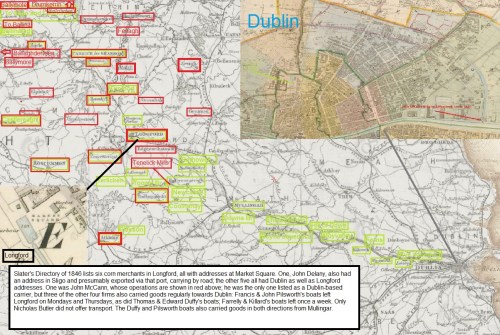
I thought it might be interesting to show these destinations on a map. Note that the map is from the 25″ Ordnance Survey map of around 1900 rather than the 6″ of around 1840: I used it because it was clearer, but it shows features (eg railway lines) that were not present in 1846.

Click on the map to get a slightly larger version.

Royal Canal carriers M'Cann and RCC 1846 (OSI)

Royal Canal carriers M’Cann and RCC 1846 (OSI)

I can’t stand over every location marked on the map (as it were). Spellings of place-names were sometimes not those in use today; some place-names (Ballinamore, Ballymore, Newcastle) are used of two or more places that might have been those intended; I could not identify two places, Dunmore and Junction, although I suspect the latter may be the junction between the main line and the Longford Branch of the canal.

What is interesting, though, is the different emphases in the two firms’ marketing. The Royal Canal Company lists almost every location along its canal; M’Cann offers a wide range of destinations beyond the canal, presumably linked by cars on the roads, into Counties Longford, Cavan, Roscommon, Westmeath, Mayo and Sligo. The RCC serves some such destinations, but a smaller number of them.

Some of the locations listed are small places; my presumption — which I have not yet checked, but for which I have found some supporting examples — is that such places have mills, quarries or other industries that provide cargoes for the canal.

The Shannon and the roads

Both operators offer to serve destinations on the River Shannon, to which the Royal Canal is joined at Clondra/Richmond Harbour:

  • RCC: Athlone, Carrick on Shannon, Dromod, Drumsna, Glasson, Lanesborough, Ruskey
  • M’Cann: Athlone, Carrick on Shannon, Dromod, Drumshambo, Drumsna, Lanesborough, Ruskey.

It is possible that goods to those places were carried by water, although (if steam tugs were not available) that would have been slow and uncertain; given that there were good roads leading from the west to the Shannon and throughout the region, it is, I think, likely that these destinations were served by road. I have no evidence on the matter save that the directory entries for Carrick-on-Shannon, Drumsna and Jamestown do not mention the availability of water transport.

Some of those destinations were served by direct road services from Dublin:

  • Athlone, Ballina, Castlerea, Dunmore, Longford, Roscommon, Sligo, Thomastown.

Competition presumably kept charges down.

Other carriers

Slater’s Directory lists six corn merchants in Longford, all with addresses at Market Square. One, John Delany, also had an address in Sligo and presumably exported via that port, carrying by road; the other five all had Dublin as well as Longford addresses.

One was John McCann, whose operations are shown in red on the map; he was the only one listed as a Dublin-based carrier, but three of the other four firms also carried goods regularly towards Dublin: Francis & John Pilsworth’s boats left Longford on Mondays and Thursdays, as did Thomas & Edward Duffy’s boats; Farrelly & Killard’s boats left once a week. Only Nicholas Butler did not offer transport. The Duffy and Pilsworth boats also carried goods in both directions from Mullingar. My guess is that carrying goods from others helped these merchants to cover the costs of their own fleets.

Peter Clarke’s Appendix C suggests that M’Cann’s fleet was the smallest of those based in Longford. The list is of “Boat Owners operating on the Royal Canal 1826 to 1847” but I am not entirely clear what the list shows. It seems unlikely, for instance, that the Midland Great Western Railway owned four boats throughout the period, as the company did not exist for most of it. Is the number of boats the largest that an owner had, or used, in a peak year, or an average over several years?

I don’t, therefore, know how to interpret the list but, assuming that the same methods were applied to all owners, it seems that the fleet sizes were these:

  • Duffy Bros 12
  • Pilsworths 9
  • M’Cann 5
  • Royal Canal Company 4.

Neither Farrelly nor Killard is listed, but there are many others: Dunne 8, Kelly 6, Murtagh 6, Murphy 5, MGWR 4, Williamson 4, and many others with 1, 2 or 3 boats each. Again, it is not clear in which years those owners had those numbers of boats.

More

As far as I know, little has been written about the carrying companies, especially those of the nineteenth century. I would be glad to hear from anyone who can correct, supplement or comment on this information.


[i] I Slater’s National Commercial Directory of Ireland: including, in addition to the trades’ lists, alphabetical directories of Dublin, Belfast, Cork and Limerick. To which are added, classified directories of the important English towns of Manchester, Liverpool, Birmingham, Sheffield, Leeds and Bristol; and, in Scotland, those of Glasgow and Paisley. Embellished with a large new map of Ireland, faithfully depicting the lines of railways in operation or in progress, engraved on steel. I Slater, Manchester, 1846
[ii] Peter Clarke The Royal Canal: the complete story ELO Publications, Dublin 1992

My OSI logo and permit number for website

Canal carrying 1846: Dublin to Waterford

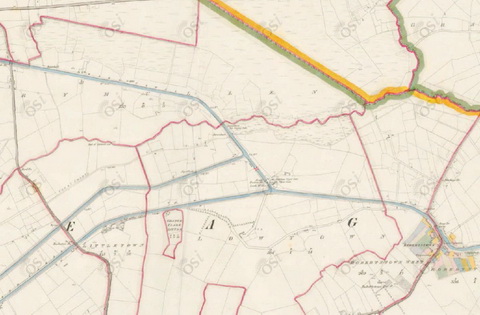
Lowtown is at the western end of the summit level of the Grand Canal; it thus has some claim to be the highest point on the canal. It is close to the village of Robertstown in County Kildare.

Lowtown is also the site of the junction between the main (Dublin to Shannon) line of the Grand Canal and its most important branch, the Barrow Line.

Lowtown (OSI ~1840)

Lowtown (OSI ~1840)

The main line from Dublin comes in from near the bottom right and exits near the top left. The two cuts leaving near the bottom left are the Old and New Barrow Lines, which join together just off the map. The Barrow Line runs to Athy, in south County Kildare, from which the Barrow [river] Navigation runs to the tidal lock at St Mullins, downstream of Graiguenamanagh.

The River Nore joins the Barrow a litle further downstream; the Nore is navigable on the tide upstream to Inistiogue. The combined rivers flow south through the port of New Ross and eventually join the estuary of the River Suir. Turning right at that point takes you up the Suir to Waterford, Carrick-on-Suir and Clonmel. Thus the Barrow Line, from Lowtown, forms an inland waterway link between Dublin and some towns along the Barrow, Nore and Suir.

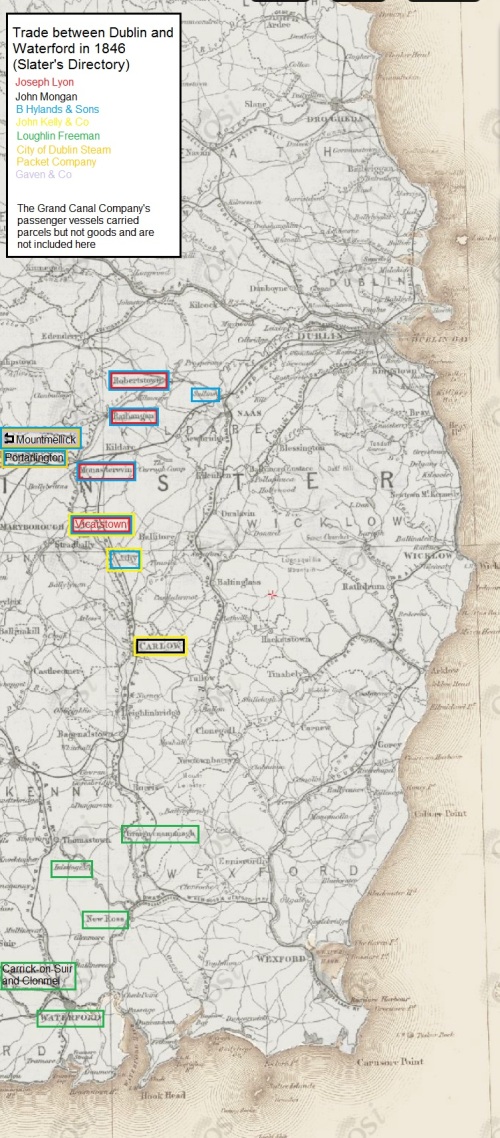
Isaac Slater’s Directory[i] of 1846 lists those carrying goods on inland waterways. There is a long list for Dublin; entries for other towns list those providing local services. There are some conflicts between the lists (see below).

The map below shows those carrying on the Barrow Line of the Grand Canal and on the rivers Barrow, Nore and Suir. Each carrier is assigned a colour, which is used to frame the name of each place served by that carrier. Some towns (Mountmellick, Carrick-on-Suir, Clonmel) are off the map, further to the west. Note that the map is from the 25″ Ordnance Survey map of around 1900 rather than the 6″ of around 1840: I used it because it was clearer, but it shows features (eg railway lines) that were not present in 1846.

Click on the map to get a slightly larger version.

Dublin to Waterford: inland waterway traders 1846 (OSI)

Dublin to Waterford: inland waterway carriers 1846 (OSI)

Notes

All but one of the carriers are shown as having Dublin premises at Grand Canal Harbour, James Street. The exception is Gaven & Co, which is mentioned only in the Mountmellick entry.

I have not included the Grand Canal Company’s passenger-carrying boats, which carried parcels but not goods.

The City of Dublin Steam Packet Company entry for Dublin does not include Portarlington and Mountmellick amongst the towns served but the entry for Mountmellick says that the company’s boats leave for Dublin every Tuesday and Friday (its agent being John White) while that for Portarlington says they leave weekly. Boats from Mountmellick had to pass through Portarlington as well as Monastereven and other towns en route to Dublin.

Similarly, the entry for Mountmellick says that the Hylands boats leave there every other day while that for Portarlington says that they pass through weekly.

There is a page missing from the electronic copy of the directory that I consulted so the entry for Monastereven is incomplete.

The entry for Carlow says

To DUBLIN, and also to [New] ROSS, Boats depart, at uncertain periods, from the Wharfs of Lawrence and James Kelly, the Quay.

It does not say whether Lawrence and James Kelly owned any boats. They may have had boats but used them only for their own goods.

The entry for Mountmellick says “Bryan Hyland” rather than “B Hylands”.

The entry for Mountmellick includes the only mention I have found of Gaven & Co’s boats (James Waldron, agent).

The entry for Rathangan says

There are Boats for the conveyance of Goods, but no fixed period of departure.

Thomas Berry & Co, the most important carrier on the Grand Canal, did not venture south of Lowtown.

More

As far as I know, little has been written about the carrying companies, especially those of the nineteenth century. I would be glad to hear from anyone who can correct, supplement or comment on this information.


[i] I Slater’s National Commercial Directory of Ireland: including, in addition to the trades’ lists, alphabetical directories of Dublin, Belfast, Cork and Limerick. To which are added, classified directories of the important English towns of Manchester, Liverpool, Birmingham, Sheffield, Leeds and Bristol; and, in Scotland, those of Glasgow and Paisley. Embellished with a large new map of Ireland, faithfully depicting the lines of railways in operation or in progress, engraved on steel. I Slater, Manchester, 1846
My OSI logo and permit number for website

Sinn Féin sheughs again

Sinn Féin demonstrates its continuing commitment to the unification of Ireland reconstruction of the Clones Sheugh. KildareStreet tells us that Sandra McLellan, TD for Cork East, no doubt motivated by the wealth of waterways in her own area, asked a written question on 18 July 2013:

To ask the Minister for Arts, Heritage and the Gaeltacht the position regarding the Ulster Canal restoration project; the remaining steps that must be taken to complete the project; if he will provide an indicative timeline for the completion of the project; and if he will make a statement on the matter.

She got a more or less standard answer from the minister, Jimmy Deenihan [FG, Kerry North/West Limerick]:

As the Deputy will be aware, in July 2007, the North/South Ministerial Council (NSMC) agreed to proceed with the restoration of the section of the Ulster Canal between Clones and Upper Lough Erne. The then Government agreed to cover the full capital costs of the project, which were estimated at that time to be of the order of €35m.

It was always the intention that the Ulster Canal project would be funded from the Waterways Ireland annual allocations, as agreed through the annual estimates processes in this jurisdiction, as well as the deliberations of NSMC in relation to annual budgets. It was a key consideration throughout the process that the Ulster Canal project would be supported by a significant level of projected income from the commercialisation of certain Waterways Ireland assets. However, as the Deputy will be aware, the economic downturn has had a negative impact on those plans.

In the meantime, the Ulster Canal project is progressing on an incremental basis. Planning approvals have recently been secured for the project in both jurisdictions. I welcome these developments, which, I am sure the Deputy will agree, are a significant milestone for the project.

I am continuing to explore all possible options to advance this project within the current fiscal constraints. In this regard, an Inter-Agency Group on the Ulster Canal has been established to explore and examine ways to advance the project and to examine possible funding options for it, including existing funding streams and the leveraging of funding from other sources, including EU funding options.

Isn’t it funny? Every so often the shinners ask a question to remind the minister that they, er, haven’t gone away, you know. They don’t get really aggressive about it and they don’t seem to be organising mass rallies in Clones to demand a sheugh. And the minister is equally polite, saying in effect “we haven’t shot your horse”.

This project is not very important: it’s a waste of money and will be of no benefit to the national economy, and a government seeking savings could easily kill it off. Yet it has refused, over several years, to take that obvious step. Instead, it’s devoting departmental time, and that of other public servants, to (admittedly low-cost) measures that seem to be intended to show that the project will be maintained on life support, even if it never rises from its bed.

Is there something in the St Andrew’s Agreement, or some other bit of northsouthery, that promises a sheugh to Sinn Féin, to enable them to claim credit for some high-profile but non-threatening all-Irelandism? Is the Clones Sheugh the price of SF support for the Police Service of Northern Ireland? I don’t know, but there must be some explanation for the failure to kill off the sheugh.


Watering Dublin

Someone asked me recently about the progress of the scheme to supply Dublin with water from the Shannon. I had to confess that I haven’t been keeping up with the matter, because I don’t think it’s very important, but happily KildareStreet.com has provided an update. On Tuesday 16 July 2013 one of the Sinn Féin chappies, Brian Stanley of Laois-Offaly, asked a priority question:

54. To ask the Minister for Environment, Community and Local Government the progress being made on the Dublin, Garryhinch, Shannon water supply project; and the timeframe for planning, construction and completion phases of this project.

I suspect that most folk think of the scheme as one involving Dublin and the Shannon, so that the inclusion of Garryhinch may have been puzzling. It seems that Garryhinch is on the road from Portarlington to Mountmellick, just after that nasty bend where folk go to commit golf.

And Mr Stanley is interested not because he wants Garryhinch, Portarlington Golf Club, or indeed Portarlington and Mountmellick to be flooded but because he wants his constituents to be employed digging a hole in the ground there (a bit like the Clones Sheugh, really) and working in a water-based ecopark that will include a reservoir where the Shannon’s water will be stored.

Anyway, Fergus O’Dowd [FG, Louth], who is a Minister of State for something, replied:

The Dublin water supply scheme long-term water source is listed as a scheme at planning stage in my Department’s water services investment programme 2010 to 2013. Dublin City Council is the lead authority for this scheme, on behalf of all of the water services authorities in the greater Dublin area.

Studies carried out for the city council and a strategic environmental assessment have identified a preferred option which involves abstraction of raw water from Lough Derg and pumping the abstracted water through a new pipeline to a proposed storage reservoir at Garryhinch cut-away bog in County Offaly, forming part of a proposed midlands water-based eco-park. After treatment, water would then be conveyed to the west of Dublin where the new supply would be integrated with the existing storage and trunk distribution system.

In December 2012, the Department approved a brief for the engagement of consultants for the planning and statutory approval phase of the scheme. Dublin City Council has carried out a procurement process and I understand it will shortly be in a position to appoint a consultant to advance the further planning of this scheme.

The programme for project implementation has been developed based on the planning and statutory approval phase taking approximately two years. The detailed design and procurement phase should take a further two years, while the construction and commissioning phase should be completed in three years.

Following their appointment by Dublin City Council, the consultants will undertake the environmental impact statement and other statutory requirements in preparation for a submission to An Bord Pleanála which will adjudicate on the matter.

He forgot to mention “best practice”, so he’s lost some brownie points. Mr Stanley wanted it all to happen much faster, to be completed before 2021, but the discussion provided no more useful information. Bord na Móna has some more information about the eco-park here. All good stuff, much as I suggested for Lough Oughter, but I’d lose the eco title: eco stuff is so last millennium.

Living on boats in Dublin

Clare Daly [Socialist, Dublin North] elicited some information via written answers on 10 July 2013; h/t KildareStreet.

Clare Daly: To ask the Minister for Arts, Heritage and the Gaeltacht the recommendations of the Waterways Ireland consultation process on utilising Dublin’s waterways and the reason recommendations for the development for spaces for houseboats were not implemented; and his plans for same.

Jimmy Deenihan [FG; Kerry North/West Limerick]: I wish to advise the Deputy that Waterways Ireland is committed to utilising Ireland’s waterways to the greatest extent possible. In relation to the Deputy’s query regarding utilising Dublin’s waterways for the development for spaces for houseboats, I am informed that Waterways Ireland has plans to develop provision for houseboats in the Dublin City area on the existing floating moorings at Grand Canal Dock in Ringsend.

The Deputy should be aware that when Waterways Ireland applied to the Dublin Docklands Development Authority for permission to install floating moorings around the Waterways Ireland Visitor Centre to provide approximately 55 berths for boats/vessels back in 2003, the Authority issued a Certificate of approval under Section 25 of the Dublin Docklands Development Authority Act, 1997 which included the condition that ‘This Certificate permits the use of the 55 berths for boats/vessels used solely for amenity on the waterways and not as permanent residential or commercial units’. Waterways Ireland is currently in discussion with the Dublin Docklands Development Authority with the aim of having 25 berths designated for permanent residential or commercial use at Grand Canal Dock.

Second h/t to Clare Daly. I trust that Waterways Ireland will auction the residential berths to maximise the revenue from these prime city-centre locations.

Not Grand

Limerick’s SmarterTravel initiative aims to promote cycling, walking, car sharing and public transport. It has a little leaflet (I can’t find a downloadable version) describing five walking and cycling routes and including information on bus routes, a cycle to work scheme and car sharing.

One of the cycling and walking routes is along the towing path of the Limerick Navigation from Limerick to Plassey. It is described thus:

The Tow Path was part of the Grand Canal system stretching to Dublin and was used by the Guinness brewery to bring stout to Limerick.

The towing-path was not part of “the Grand Canal system”, although I suppose it might be described as a facility used by the Grand Canal Company. The Park Canal in Limerick, and the towing-path on the river navigation to Plassey, were not built or owned by the Grand Canal Company; they were part of the independent Limerick Navigation until subsumed into the Shannon Navigation in the 1840s. The Grand Canal Company was permitted to use its vessels on the navigation when it began carrying cargoes, which it did for, amongst others, Guinness; Guinness itself did not own or operate boats on the Shannon Navigation or the Limerick Navigation.


Elfinsafety and DUKWs

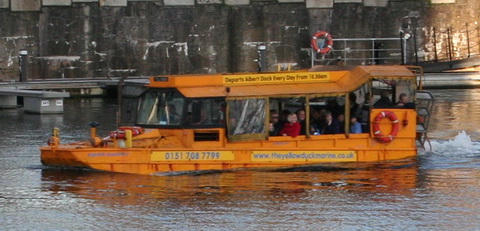
In October 2011 I was in Liverpool, where I took a couple of photos of DUKWs taking trippers around the still waters of the no-longer-used docks.

DUKW in the Salthouse Dock, Liverpool

DUKW in the Salthouse Dock, Liverpool

DUKWing under the bridge into the Albert Dock, Liverpool

DUKWing under the bridge into the Albert Dock, Liverpool

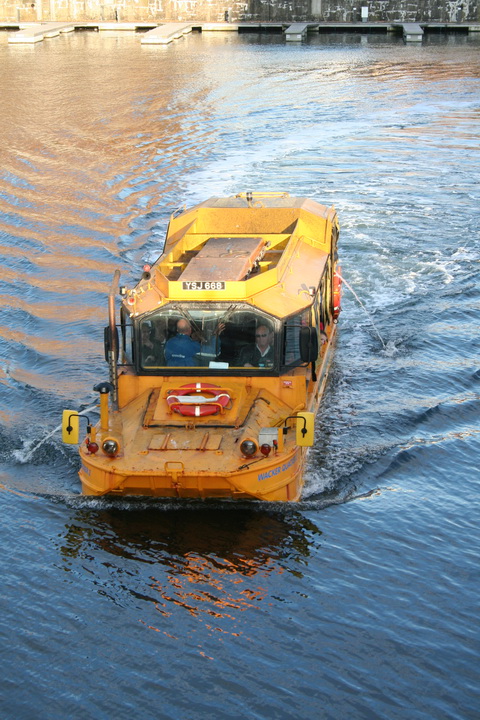
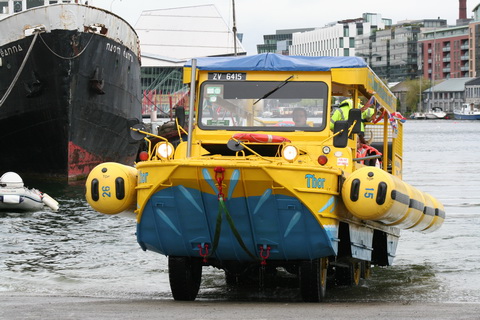
In Dublin, Viking Splash offers similar tours, with the regrettable addition of horned helmets, as not worn by Vikings. The Dublin operation seems to have added two other items that were not discernible on the Liverpool DUKW.

VikingSplash DUKW Thor 18_resize

Extra buoyancy on the Dublin DUKWs

First, before they enter the water at Grand Canal Dock, Ringsend, the DUKWs are fitted with extra buoyancy in cylinders that slide into racks along their sides. I saw the VikingSplash crew removing the cylinders from the yellow DUKW; it took only a couple of minutes, and I presume that it didn’t take much longer to put the cylinders on.

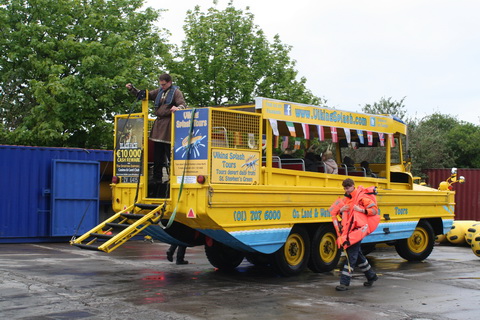
VikingSplash DUKW Thor 25_resize

Buoyancy aids being collected after the trip around the dock

Second, the Dublin passengers are issued with buoyancy aids before they take to the water. I can’t see any buoyancy aids on the Liverpool passengers, although it’s possible that they are out of camera shot.

Sometimes we complain about extra health and safety (which often means insurance) requirements. Then something like this happens: a yellow DUKW sank yesterday in Liverpool — for the second time this year. I don’t know whether the precautions taken in Dublin would have averted the accident or enhanced the safety of the passengers but it does suggest that the Maritime Safety Directorate bods in Dublin do have a point.

Addendum: the speaker on this clip says that passengers began putting on buoyancy aids, which suggests that aids were issued but not worn. Given how quickly the vessel sank, and how constricted the space inside is, it seems to me that passengers should wear their buoyancy aids throughout the waterborne trip.

Later: scary video.

Later still: a BBC story saying that a tyre may have caused the problem, the Liverpool mayor’s opinion (and some good photos) and the firm going into administration.

Rail

In evidence to the Select Committee appointed to inquire into the amount of advances made by the Commissioners of Public Works in Ireland on 22 May 1835 James Pim, Treasurer to the Dublin and Kingstown Railway, said:

1431. Can you tell the average length of time which the [horse-drawn] cars took in going [between Dublin and Kingstown/Dun Laoghaire], and the distance? — I should think the average length of time taken by the cars after they got in motion, was probably 45 or 50 minutes, from Dublin to Kingstown.

1432. Are you not able to do it in 11 minutes? — Easily.

I’ve just had a look at the DART website. As far as I can see, the DART takes 19 minutes to travel from Dublin Pearse [Westland Row] to Dun Laoghaire [Kingstown]. Is the difference attributable to the number of stops?

FF -v- SF on C18 economic development

More from the splendid KildareStreet.com, this time an actual Dáil debate, with real people speaking, on 30 May 2013. The debate was initiated by Micheál Martin [head honcho in FF, Cork South Central], who asked the minister …

… his plans for capital investment in Waterways Ireland in the coming year; and if he will make a statement on the matter.

There are three odd aspects to that question.

The first is that Micheál Martin should already know that the capital expenditure allocation for WI within RoI for 2013 is €4 071 000: I can understand that he wouldn’t have wanted to plough through the vast wodges of budgetary bumpf, but I’m sure he would have read the highlights on this site.

The second oddity is that Micheál Martin must have known that the minister would not himself have any plans for capital expenditure: they would be WI’s plans.

The third oddity is that FF didn’t seem to have any particular reason for asking this question: the rest of the debate (see below) seems rather desultory. Could it be that it’s trying to reclaim the waterways limelight from the Shinners, who’ve been keeping an eye on WI dredging as well as on thon sheugh?

To be honest, it all seems a bit pointless: waterways may be interesting to me, and presumably to readers of this site, but they’re hardly of great national importance. A serious debate, by informed participants, might be useful, but (with all due respect to the contributors) there was little sign of that here.

Jimmy Deenihan did actually give some interesting, albeit minor, details about WI’s plans for this year. I omit the first two paras and the last, which are boring boilerplate bumpf that will be familiar to regular readers.

Jimmy Deenihan [FG, Kerry North/West Limerick]: While the Waterways Ireland 2013 business plan and budget is the subject of ongoing discussions with the co-sponsoring Department of Culture, Arts and Leisure in Northern Ireland and will require formal approval by the North-South Ministerial Council, I have provided an indicative funding allocation of €4.071 million to Waterways Ireland for capital projects in this jurisdiction in the coming year. This will facilitate capital works by Waterways Ireland in developing, restoring and improving infrastructure for water based and activity recreation and tourism, consolidating facilitates and improving access to the waterways across the navigations.

I am advised that the Waterways Ireland draft 2013 business plan has a development schedule providing for 1354 m of additional moorings across the navigations. Works planned within this jurisdiction include a range of major projects such as upgrading Bagenalstown Lock on the Barrow; provision of a slipway and stabilisation of the dock walls at Grand Canal Dock, dredging the Grand Canal; development of houseboat facilities at Lowtown and Sallins; lifting the bridge at Tullamore depot; bridge upgrades, works on weirs and locks on the Shannon; and commencement of work on the Belturbet Service Block on the Shannon Erne and purchase of plant and machinery.

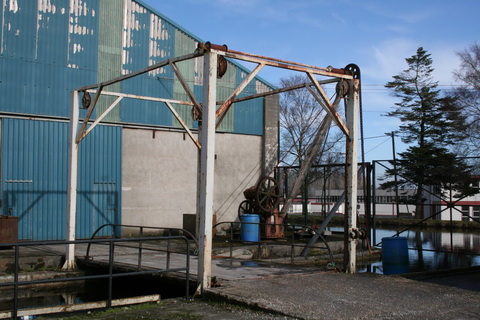
I said that I would welcome information about what “lifting the bridge at Tullamore depot” means. The answer was provided in the Comments below; here is a photo of the bridge in question.

The (currently non-lifting) lifting bridge at Tullamore

The (currently non-lifting) lifting bridge at Tullamore


Most of the rest is unsurprising.

The FF follow-up came from Seán Ó Fearghaíl [FF, Kildare South], who said:

I welcome the many positive developments to which the Minister referred but one of our concerns is that since 2011 the funding available for Waterways Ireland has been cut from €35 million to approximately €32 million.

Studies over the years have shown that waterways tourism is one of the activities that is most likely to generate return visits. As a regular user of places like the Shannon Navigation, one never ceases to be amazed at the number of non-nationals one meets on that waterway who have been coming back to Ireland year in, year out. I wonder to what extent the funding the Minister has available to him should be augmented by the Department of Transport, Tourism and Sport. These waterways are of immense value to the local populations privileged to live in the catchment area of each amenity, along with their huge tourism importance. What sort of interaction does the Minister have with tourism bodies north of the Border and the Department of Transport, Tourism and Sport? Is anything planned for the waterways under the auspices of The Gathering?

What has happened in Kildare this week? We had Bernard Durkan [FG, Kildare North] the other day and Clare Daly [Socialist Party, Dublin North, but originally from Newbridge, Co Kildare] a moment ago; now we have a new chap from Kildare South.

Anyway, it can’t have come as any surprise to Mr Ó Fearghaíl that WI’s budget has been cut: so has everybody else’s, and the budgets were announced last December. I note that he didn’t ask how the Clones Sheugh was to be funded, never mind the Cavan Sheugh to Lough Oughter. But his question is the sort that a journalist might ask: vague, unfocused, couched in generalities, lacking in evidence of research into the subject. I would like to know more about his “Studies over the years”, with particular reference to the balance between and the allocation of the costs and benefits of investment in waterways; generating return visits is not in itself terribly useful (I really do not want Great Aunt Maud here again).

Not that the minister offered many hard facts in his reply:

I have seen for myself the provision of moorings at Killaloe and Ballina. Those have made a major difference to both towns in different counties on either side of the Shannon. The result of that investment is obvious and local people would accept that.

As regards involvement from Fáilte Ireland, Waterways Ireland is augmenting Fáilte Ireland’s promotion of the waterways. Waterways Ireland is providing funding on an annual basis for the promotion of tourism on its waterways. It is a North-South body, which is also very important, because Tourism Ireland promotes the entire island and the waterways network of more than 1,000 navigable kilometres can really be pushed on an all-island basis and we are doing that. I have tried to minimise the reduction in funding for Waterways Ireland because of its North-South significance and its potential and considerable work has been done. We have improved facilities for tourists so we are now ready to proactively promote this great facility.

Any, like, figures? Statistics? References to analyses? How much of WI’s budget is being diverted to the tourism bods and what is the benefit?

Next (and last) up was Peadar Tóibín [SF, Meath West], with “now for something completely different“:

A number of groups are actively trying to create a green way along the Boyne from the estuary to its source. The Boyne is littered with internationally recognised heritage monuments and would be a fantastic tourist attraction that would bring people into the region. People who holiday in the region visit Trim Castle and Newgrange on coach trips and as ar result Meath does not get the full value of their tourism. The Boyne Canal runs from Navan to Drogheda. It is not covered by the Waterways Ireland network. Would the Minister agree that such a canal should be brought within the ambit of Waterways Ireland, along with other canals, and would he consider the funds that might be available to help with the development of such a green way along the River Boyne?

The minister’s reply is interesting:

We have no plans to extend the present 1,000 kilometres of navigable waterways. The focus of our investment in capital development will be from Clones to Lough Erne to the value of €35 million.

What? No Cavan Sheugh? No Kilbeggan, Longford or Mountmellick Branch?

Oh, and note that the figure of €35 million is being quoted for the Clones Sheugh, although the last estimate I had form WI was higher than that.

The minister continued:

As regards the green way, I do not have direct responsibility but any way I can help through Waterways Ireland, I will do so. As a keen cyclist and walker, I am all for encouraging green ways wherever possible. If the Deputy has a proposal I can forward to Waterways Ireland for discussion, I will gladly take it.

Well, well. A Monaghan greenway is being developed; why not a Clones greenway too, instead of an expensive canal?