Tag Archives: Killaloe

The perils of duck-shooting

On Tuesday morning, Mr Ounsel, of Portland near Portumna, left Killaloe at 6 o’clock, to walk down the bank of the Canal to O’Brien’s Bridge, there to meet the packet boat — he took with him a long gun for the purpose of shooting ducks. As no account could be had of him at O’Brien’s Bridge, it was supposed he fell into the river, and in the course of the day a hat, and a book belonging to him were found on the shore; there is no doubt but he has met a watery grave — to-day several boats are searching for the body.

Clonmel Herald Wednesday 3 February 1830 quoting Limerick Chronicle Saturday 30 January 1830

Two Limerick footbridges

The Black Bridge at Plassey has long had a place in the hearts of Limerick people. It was damaged in the floods of 2009 and has been closed to the public ever since. Limerick Council says it can’t afford to repair it. Limerick Council is, as far as I can see, in breach of the terms of its lease of the bridge from the Department of Finance; the Department of Finance could, but has chosen not to, insist that the Council repair the bridge.

In the meantime, the Minister for Finance, for reasons best known to himself, wants a new, er, iconic footbridge in Limerick city and is prepared to spend €6 million of taxpayers’ money, via Fáilte Ireland, on a structure that can scarcely avoid blocking some of the finest views in the city.

Now, the Limerick Leader tells us, the ghastly edifice is to cost almost €18 million: €6 million from the Minister for Finance (who represents Limerick), €4 million to be borrowed and €7.8 million from the leprechauns’ pot of gold under the thorn bush. Or somewhere. Even Fianna Fáil councillors think this is insane, which is saying something.

This ridiculous proposal should be abandoned immediately and a much smaller sum should be spent instead on repairing the Black Bridge as part of a European Route of Industrial Heritage.

The Minister’s €6 million is a gift-horse that should not only have its teeth inspected: it should be taken out and shot and its carcass sent to the burger factory.

Greyways and the Black Bridge

Martin McGuinness [SF] was asked recently, in the Northern Ireland Assembly, about blueways:

Leslie Cree [UUP]: It was interesting to read that Waterways Ireland has developed this first blueway in the Carrick-on-Shannon area. Can he share with us if, in fact, Waterways Ireland has developed any projects for the Erne waterway itself?

Mr McGuinness said:

These projects are under ongoing consideration by Waterways Ireland, as the development of blueways and greenways could add to our tourist potential. It is clear from how greenways have been used, particularly in the west of Ireland, that they have huge health benefits for those now walking and cycling and involved in physical activity.

There is a proposal for another greenway from Derry city to County Donegal. Blueways and greenways offer important tourist potential, and it is exciting to see that Waterways Ireland is considering the linkage in the Leitrim area and how it can be extended to Lough Erne.

But, if I might remind TPTB, not everybody likes walking, cycling and physical activity; not everybody is going to be rolling around in a kayak or paddling a canoe. There are older folk, there are those who rightly view exercise with the gravest of suspicion and there are those whose interests simply lie elsewhere.

The Greyway concept

It is for such folk that I have developed the Greyway [TM]  concept. It’s the same as a blueway or a greenway but without the sweating or the lurid dayglo clothing.

The basic idea is that you form a “route” or “way” as a marketing concept to get more people using your existing assets. Your expenditure is low: research, product development, marketing and information provision rather than infrastructure; self-guided rather than staffed user experiences. Direct income might be low too, although there may be ways to extract cash from users; there might also be spin-off opportunities for other providers. [All my usual reservations about small-scale providers apply here too.]

There might be Greyways catering for

  • walkers: gentle walks with opportunities for sitting down, drinking tea and getting a taxi back to the start
  • drivers: long-distance routes taking in several sites
  • boaters: most of Waterways Ireland’s sites are accessible by water and by road. Furthermore, some trip boats might use elements of the Greyway material in providing information for their passengers.

Themes

You need a theme to attract people: “come and walk/drive the X Greyway and see all the lovely/interesting Ys”. No doubt there are several possible values for Y: bunnies, trees, fish, bogs, hills …. But the main thing that Waterways Ireland has to sell, and that it does not currently sell, is its industrial heritage. The Shannon, in particular, exists as an improved navigation only because of (a) steam, (b) the British industrial revolution, (c) Irish agriculture and (d) low politics. And industrial heritage is something that interests some at least of the older folk. Package it into routes and sell it for grey pounds, euros or dollars.

There is all sorts of interesting stuff along the Shannon, mostly just lying there, and it should be put to work. The most concentrated section is along the old Limerick Navigation, from Limerick to Killaloe: for instance, last time I looked seven of the original twelve milestones were still present. [The distance was 12 Irish miles, approx 24 km or 15 statute miles.] It’s a walkable route and it includes

  • the neglected Black Bridge at Plassey, whose very existence reflects the Victorian version of Just-in-time delivery
  • the bridge and artefacts at O’Briensbridge
  • the richest waterways heritage site in Ireland at Killaloe.

But there could also be driving tours along the middle Shannon, between Portumna and Athlone, where there is lots to see, and from Lanesborough upwards. Shannon Harbour might eventually house a museum ….

ERIH

What I’m suggesting is that Waterways Ireland should designate the Shannon as the first route (as opposed to site) in Ireland within the European Route of Industrial Heritage [ERIH] framework. ERIH’s website includes descriptions of the route system and of anchor points, which may be too advanced for present use, but why not a European Theme Route in Transport and Communication? Ireland might even make a case for the use of advanced (or at least interesting) transport technology (steamers) in carrying agricultural produce to industrial markets.

Furthermore, if CIE were to cooperate, the railways might be brought in too, and the livestock trade, and Dublin Port, and a regional route linking to Liverpool and the railway to Manchester ….

There is an interesting story to be told about the Shannon and its links to the east coast and beyond; its industrial heritage could be used to attract tourists and entertain natives.


Rail, road and river: steam in 1829

Four news items, all in the Varieties section of the Hampshire Chronicle on 19 October 1829.

Rail

The trial of the locomotive carriages near Liverpool was continued on Saturday, when Mr Stephenson’s engine, the Rocket, disencumbered of every weight, shot along the road at the almost incredible rate of 32 miles in the hour! So astonishing was the celerity with which the engine, without its apparatus, darted past the spectators, that it could be compared to nothing but the rapidity with which the swallow darts through the air.

Road 1

Mr Gurney’s steam carriage can be stopped dead within the space of two yards, though going at the rate of from 18 to 20 miles an hour, and this without any inconvenient shock to the machinery or passengers. It is capable of dragging a carriage, weighing three tons and containing 100 passengers, over a level road, at the rate of eight, nine, or ten miles an hour: will drag the same carriage, containing 25 passengers, up the steepest road in England, at the same rate. On ascending hills, for every cwt that is shifted from the front to the hind wheels, the carriage requires an additional drawing power of 4 cwt and on level ground an additional power of half a ton. The contrivance by which the carriage may be retarded at pleasure on descending hills, acts independently of the wheels, so that the sliding and cutting effect of the ordinary drags is entirely avoided.

Road 2

Sir James Anderson has entered into a contract with the Irish Post Office, by which he undertakes to convey the mails throughout Ireland at the rate of 12 miles an hour, in coaches impelled by steam, calculated to carry two or three passengers, in addition to the coachman and guard. This invention of Sir James Anderson, for which he has obtained a patent, has seldom been exhibited out of the yard in which it was constructed; but it is said to bear very little resemblance to the drag-coach of Mr Gurney. The contract is understood to be for 14 years, and the only pecuniary stipulation made by Sir James is, that he shall receive half the money which the Government shall save by adopting his system. He will shortly commence carrying the mails between Howth and Dublin. The road is level and good, and the distance not more than nine or ten miles.

[Note: an 1841 proposal by Sir James Anderson is covered here. And here is a longer piece about Sir James and the Steam Carriage and Waggon Company of Ireland.]

River

An iron steam boat of a peculiar construction, and having the paddles in the centre, has been built at Liverpool, by Messrs Fawcell and Co for the Irish Inland Steam Navigation Company. This vessel was tried in the Mersey on Monday, and the result was highly satisfactory. Another iron vessel, of 60 tons burden, was launched on Tuesday from Messrs Wm Laird and Son’s yard, on the banks of Wallasey Pool.

[Note: the Fawcett steamer and the 60-ton barge were destined for the Shannon. The barge was the first iron vessel built by Lairds.]

Nenagh Canal

Canal between Nenagh and the River Shannon

At a numerous and highly respectable Meeting of the Gentry, Merchants, Traders, and Freeholders of the Baronies of Upper Ormond, Lower Ormond, and Owney and Arra, held at Nenagh, County of Tipperary, on Wednesday, the 30th day of January, 1839.

PETER HOLMES, Esq, JP, and DL, in the Chair.

Moved by John Bayly, Esq; seconded by the Rev J H Poe, Rector of Nenagh:

Resolved — That we consider a Canal communication between Nenagh and the River Shannon, of vital importance to the prosperity of the town and neighbourhood, as increasing commerce, lessening the cost of fuel, facilitating intercourse with the sea ports of the country, and giving employment to the poor.

Moved by John Bouchier, Esq; seconded by the Reverend Ambrose O’Connor, PP of Nenagh:

Resolved — That we have heard with interest the Report of Mr Henry Buck, Engineer, on the proposed line of Canal; and recommend the adoption of the line he has surveyed.

Moved by John M’Keogh Dwyer, Esq; seconded by Thomas Maguire, Esq:

Resolved — That we recommend the adoption of the Prospectus that we have heard read.

Moved by Hastings Atkins, Esq; seconded by J J Poe, Esq:

Resolved — That we appoint Peter Holmes, Esq, a Commissioner, who is to name a second, the second a third, and so on, until the whole are appointed.

Moved by O’Brien Dillon, Esq; seconded by John Bayley, Esq:

Resolved — That the names of Lords Dunally, and Orkney be added to the list of Commissioners.

Moved by Doctor Quin; seconded by Doctor Dempster:

Resolved — That we recommend the proceedings of the Meeting to be published in the Nenagh Guardian, Limerick Chronicle, and other Papers, and that the Secretary be instructed to get printed 300 copies of the Prospectus.

Moved by John M’Keogh Dwyer, Esq; seconded by Thos Maguire, Esq:

Resolved — That we now enter into a Subscription list for Shares, according to the provisions of the Prospectus read at this Meeting.

PETER HOLMES, Chairman.
O’BRIEN DILLON, Secretary.

Mr Holmes having left the Chair, and Mr Bayley having been called thereto —

Resolved — That the thanks of the Meeting are due, and hereby given, to Peter Holmes, Esq, for his impartial conduct in the Chair, and for the spirited example he has set in being the first to subscribe for Fifty Shares.

JOHN BAYLEY, Chairman.
O’BRIEN DILLON, Secretary.

Dublin Monitor 7 February 1839

Down to the sea in steps

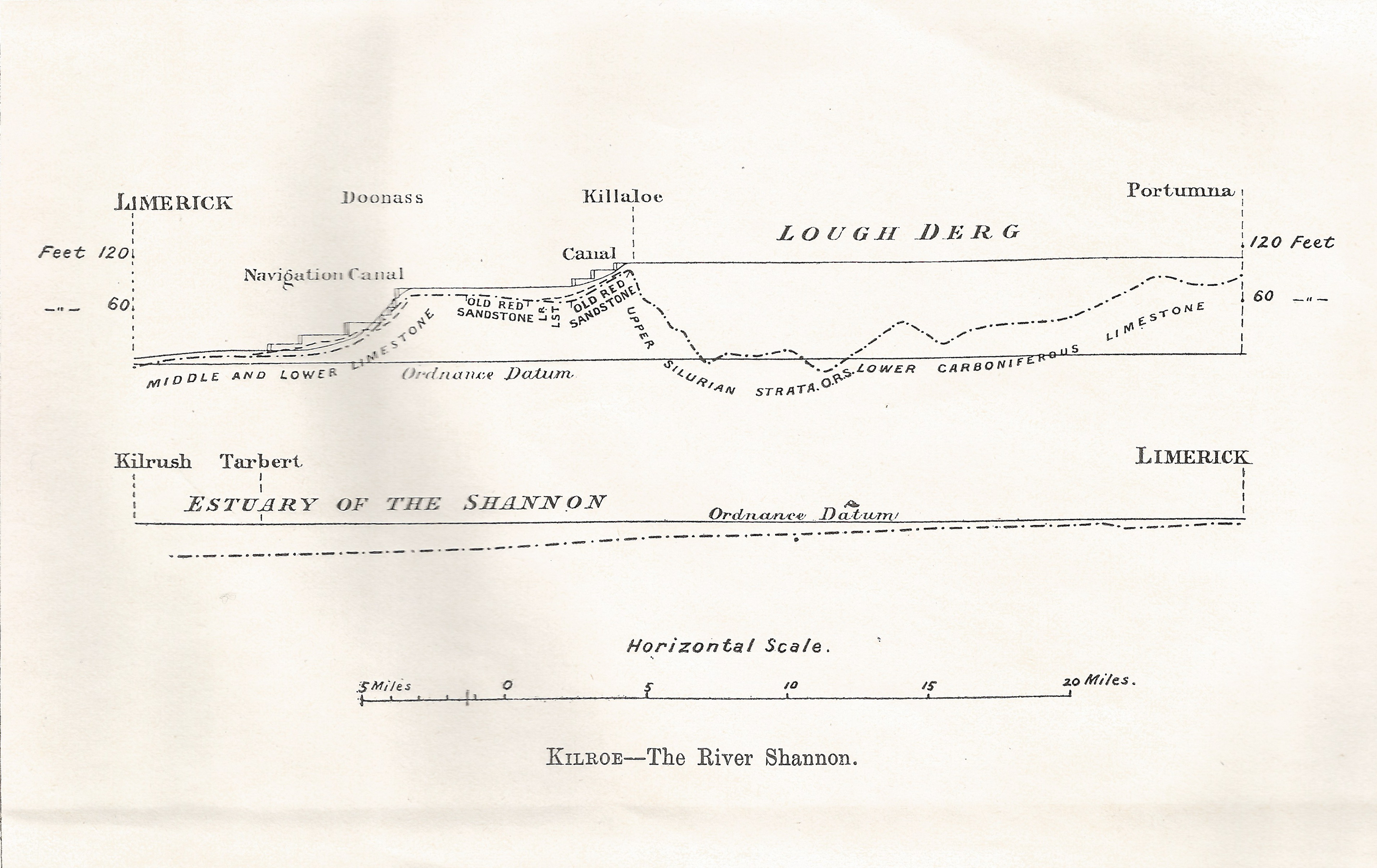
On 28 January 1907 James Robinson Kilroe [near the bottom of the page] of H M Geological Survey read to the Royal Irish Academy a paper on “The River Shannon: its present course and geological history” [Proceedings of the Royal Irish Academy Vol XXVI Section B No 8 Hodges, Figgis & Co Ltd, Dublin; Williams & Norgate, London 1907]. I thought that Plate V was interesting.

Shannon Derg to sea

Plate V

Kilroe wrote:

It will be perceived that instead of the river being shallow over the unyielding Silurian slate-rock, set almost vertically, and striking across the river-course, it is deeper than over the limestone of Lough Derg, and much deeper than over the comparatively easily eroded Old Red Sandstone at Killaloe. The river-bed actually drops below the datum line above the town, while at the town it is 100 feet above datum.

Old Red Sandstone strata are here to be seen in the river-bank, and Silurian rocks in situ in its bed. A barrier is thus formed, partly of Silurian, and partly of Old Red Sandstone rocks, which without the artificial impounding weir would retain the waters of Lough Derg to a depth of some 104 feet opposite Derrycastle — two miles above Killaloe.

One might have expected to find a fairly level shallow bed from Killaloe northward, a sudden drop from slate-rock to the sandstone floor, and  a pronounced wide, well-formed valley in the limestone district southward to Limerick.

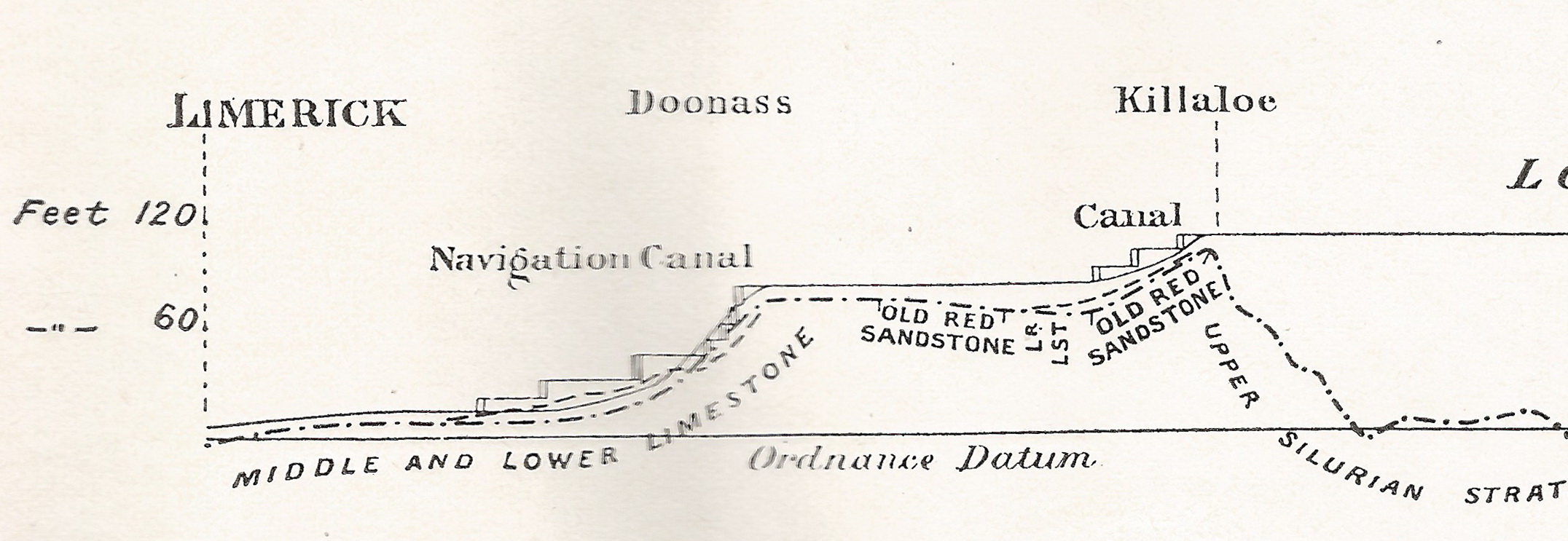
None of these elements exist; instead, we have the formidable barrier at Killaloe, naturally damming up a considerable depth of water in Lough Derg, and the river falling away southward by a series of rapids which correspond with drops in the canal, south of O’Briensbridge […], along an alternative course, possibly one used by a branch of the Shannon.

Here is an extract from the Plate V map, showing the steps of the (pre-Ardnacrusha) Limerick Navigation between Lough Derg and the sea.

Shannon Killaloe to Limerick

The steps of the canal (click to enlarge)

Upstream

Kilroe wrote of Lough Ree:

The waters of Lough Ree stood some 10 feet higher within recent times than they now do, as proved by evidence of solution, with under-cutting of limestone blocks, to be seen about five miles north-west of Athlone, close to the railway, in the townland of Cornaseer.

Under these conditions the lake must have been, perhaps, twice its width, and for a considerable period. Its ancient surface-level is clearly indicated by the caps of the mushroom-shaped blocks.

And of the Shannon between Lough Ree and Lough Derg:

The extreme flatness of the river between Athlone and Meelick is such that, consequent upon the completion of the Suck Drainage-works in 1892, it was found that the callows along the Shannon above the confluence of the Suck at Shannonbridge were much more liable to sudden and frequent floodings than they previously had been.

The more rapid discharge of the Suck waters into the Shannon, before ordinary extra water had time to pass away, had the effect of modifying the regimen of the main stream to an extent which resulted in an action at law [La Touche -v- The Suck Drainage Board].

I have found only one account of that case, in the Freeman’s Journal of 1 July 1893. The plaintiffs, Messrs Harrison and La Touche, owned land at Cappaleitrim, on the west bank of the Shannon above Shannonbridge. They said that the actions of the Suck Drainage Board had caused their lands to be flooded:

[…] that the defendants brought water from the Suck into the Shannon, containing a drainage of 40 miles, with such velocity and such volume that the Shannon was penned back, and that the back water caused the damage to the lands complained of.

[…] The jury disagreed and were discharged.

I don’t know whether the matter ever again came before a judge.

The agency model

I have been told that, until recent years, travel agents in Germany and elsewhere would buy packages of weeks on Irish hire-boatsa and then sell them on to their own clients. I have also been told that this “agency model” ceased to be used [or became less used], perhaps because of the growth of internet booking. And it has been suggested that this was one of the factors in the decline of the Shannon hire-boat trade, to which I have repeatedly drawn attention [most recently here].

I do not know whether this phenomenon has been documented or formally studied. If it has, I would be grateful if any reader can point me to the documents or studies. I would also welcome other Comments on the proposition.

Packaging and marketing

I mention it now because, when launching the Shannon Blueway project, the waterways minister Heather Humphreys said:

The launch of the Blueway will allow local businesses [to] capitalise on an increase in demand for transport, equipment hire, accommodation and entertainment.

I think that the Blueway is an excellent idea, but I am concerned about whether small local companies will be able to package and market it effectively to overseas tourists. If the long-established cruiser-hire-firms were or are finding effective marketing difficult, why would (say) a canoe- or bicycle-hire-firm in Drumshanbo find it any easier?

Marketing to anglers

There was an interesting discussion at the Joint Oireachtas Committee on Transport and Communications about “Depletion of Inland Fish Stocks and Impact of Estuary Poaching: Inland Fisheries Ireland” on 22 October 2014. Note in particular the contributions of Dr Ciaran Byrne from 10:25 onwards about how Inland Fisheries Ireland markets Irish angling to overseas anglers.

What struck me was not that IFI uses any particularly magical marketing methods but that it is dealing with a well-defined interest group: people who are committed to a particular activity and have invested heavily in it (buying rods and stools and nets and umbrellas and maggots and whatever else anglers use).

Identifying potential customers

Anglers form one segment of the market for inland waterways holidays, but the task of selling to other segments is harder if they lack a single compelling interest. Hence, no doubt, those rather demented attempts by Fáilte Ireland or Tourism Ireland to categorise potential customers as ‘Sightseers and Culture Seekers’, ‘Family & Loved Ones’, ‘Relaxers’ and ‘Outdoor Actives’. None of their interests strikes me as being exactly compelling: there are several countries where you can relax, engage in outdoor activities or look at sights.

What you really need is obsessive customers: folk, with money to spare, who are really interested in one thing. Then you entice them to your area and take their money from them: not, as Brian Ború would have done, by hitting them over the head and stealing it, but by selling them overpriced goods and services.

Lough Derg

If you don’t have obsessive customers, who are compelled by their inner urges to dangle maggots in your waters (or whatever else turns them on), then you might try offering a compelling attraction: something that is so interesting that folk put it on their to-do lists. Unfortunately, as Fáilte Ireland’s Lakelands Lough Derg Roadmap [PDF, 6.7MB; well worth reading] admits,

Lough Derg does not have suffient key attractions that act as a draw to the area.

The same thought has often struck me. As you drive around the lake, you see signs pointing towards it. But suppose you’re a casual tourist who hasn’t already booked an activity. When you get to the lake, about the only thing you can do is look at the water (which becomes less interesting after a while) or at the jolly people enjoying themselves on boats (ditto).

You can, in some places, go to a pub or eatery, but you don’t need to come to Ireland to do that. Or you can paddle. If you fish, you can fish, but I’m trying to think of things for non-anglers. In Killaloe, you can take a boat trip; in Dromineer, you can hire a sailing boat; in Mountshannon, you can visit Holy Island. But there is nothing you would come to Ireland for: nothing you can’t do in other places.

Roadmap remedies

The Roadmap proposes these remedies:

The following three key tourism products are proposed:

  • A Discovery Point and Trailhead at the Portroe lookout
  • A Lough Derg Canoe/Kayak trail
  • An enhanced offering and facilities at University of Limerick Activities Centre (ULAC).

Two additional tourism products are proposed:

  • Portumna eco-park (masterplanning required)
  • Publications to promote and support active enjoyment of Lough Derg and surrounds.

There is, alas, another set of categories of potential visitors:

The three market segments identified with the best potential for delivering international visitors to Lough Derg have been identified as Curiously Cultural, Great Escapers and Nature Lovers.

Other, less exploitable, market segments are identified too, but I can’t bring myself even to name them.

Finding the punters

I’d hate it to be thought that I was a marketing expert, but it seems to me that this segmentalisation is coming at things from the wrong end. In effect, it’s saying “We have these things; what sort of person might be induced to buy them?” Then you give each of those sorts of person a category and say that you’ve found your market.

But compare that with what the fisheries folk do. They can identify magazines that anglers read, maybe (for aught I know) television programmes they watch, trade shows they visit. Identification is easy: the titles will include words like “fishing” or “angling”.

But what magazines — other than those on the top shelf — have “Curiously Cultural” or “Nature Lovers” in the title? How do you track down “Great Escapers”? It seems to me that these categories might help you to tailor a message that is broadcast to large audiences through mass media: in such cases it doesn’t matter if you appeal to only 1% of the audience, provided that that audience is large enough. However, that’s not an option available to those with small budgets: they need cheaper marketing through channels that will provide much higher returns.

Small operators

And that’s where we come back to the fact that most of the potential tourism operators around Lough Derg are pretty small. Who is going to put together packages of activities that will appeal to the curiously cultural? I’m interested only in filling my B&B and you’re interested in hiring out bicycles. I’m happy to refer customers to you and vice versa, but are we going to get together to provide packages and to share our marketing budgets? There is a Lough Derg Marketing and Strategy Group, but it seems to be dominated by representatives of public sector bodies, and there is a limit to what they can do.

To compete on a European scale, what’s really needed is a large commercial organisation. I suggest, therefore, that the best thing to do would be to get Goldman Sachs to advise on how Lough Derg might be privatised.

Second-best would be the formation of a tourism cooperative.


The captain and the perjurer

Mary Meehan’s was a dramatic story.

In April 1847 she had gone to the house of William Dwyer at Cuphaunhane [Cappanahanagh?]. She heard voices inside and stopped to listen. The door opened and William Dwyer ran out. She went in and saw William’s wife Mary dragging the seemingly lifeless body of Ellen Dwyer, William’s sister, into the room. Mary Dwyer then ran off and Mary Meehan raised Ellen’s head; she saw blood on the left side of the head.

She went home and told her husband about it; he told her to say nothing. About two hours later she was in the haggard and saw William and Mary Dwyer digging at the brink of the ditch. She gave a deposition to Edward J Bell RM on 8 October 1849, adding on 16 December 1849 that, if Bell were to dig in the field near the Dwyers’ house, or in the nearby quarry, he would find the remains of a human body.

Bell, with Mr Head and the Castleconnell police, dug more than forty times in the field in question, but with no success. They then drained four feet of water from the quarry and found a skull and some human bones in the mud. Constable Swan delivered them to Dr Thomas Travers Riordan at Castleconnell.

Dr Riordan thought that the skull was more likely to be that of an old woman than that of a fifteen-year-old girl. The bones had been in water or earth for much more than two years and belonged to a tall muscular person: the skull and the bones were almost certainly from two different people. The church at Abington was close to the quarry.

On 14 March 1840 Mary Meehan was indicted …

… for that she with felonious intent to injure William Dwyer …

… did swear to an untrue story. She was described as …

… a woman of about forty years of age, […] dressed in a blue cloth cloak, clean white cap, and white woollen shawl, as the wife of a farmer in comfortable circumstances. Her appearance was not unprepossessing, but there was a peculiarly sinister expression about the eyes.

Mr Bell had taken depositions from William and Mary Dwyer; they contravened Mary Meehan’s statements but she stuck to her story. No witnesses supported her.

William Dwyer said that he had sent his sister to England [en route to America?] that April: his wife had accompanied her to Killaloe and seen her aboard one of the [City of] Dublin Steam Packet Company’s boats. He had not heard from her since then.

Mary Dwyer said that she and her sister-in-law had slept at the house of Mary’s father Michael Healy, in Killaloe, the night before Ellen’s departure. The following morning they went to the house of Nancy Preston, who accompanied them to the steamer to help Ellen get a cheaper fare. Michael Healy confirmed that evidence, as did Nancy Preston. Mary Dwyer said that she was on board with her sister-in-law until the boat left.

The final witness was the steamer’s captain, Captain Winder. He said he remembered the circumstances perfectly and had charged Ellen only 4s 3d for the passage to Dublin.

His Lordship charged, expatiating on the enormity of the prisoner’s offence, and the revolting exhibition of the remains of the skull and bones of a human being on the table, and adding that from the evidence they could hardly hesitate in finding a verdict of guilty.

The Jury returned a verdict of Guilty accordingly.

The Limerick Reporter and Tipperary Vindicator 15 March 1850

Before Ardnacrusha

Waterworks sluices 06_resize


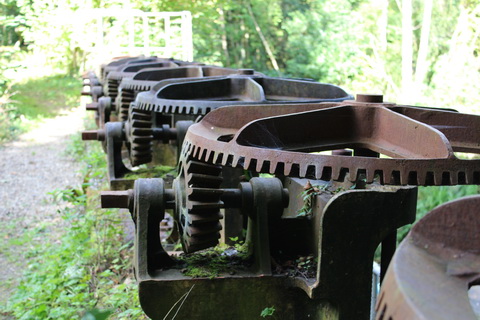
The power of the Shannon, falling 100 feet in 15 miles from Killaloe to Limerick, is nowadays tapped by the hydroelectric power station at Ardnacrusha. But in earlier times it did not go entirely unused. I have already written about the bleach mill at Doonass; here is a page about the other bleach mill, at Clareville, and about the water works in the same area. These works are on a stretch of the Shannon navigable only by cots (then) and kayaks and canoes (now).


Murder on a Grand Canal Company boat

At the inquest on the body of Myles Crofton, who was, as alleged, murdered on board one of the Grand Canal Company’s boats on the Limerick Canal, the jury returned the following verdict:— “That the deceased, Myles Crofton, aged 45 years, dies at Killaloe on Sunday, the 29th November, 1891, from certain wounds inflicted on him in boat No 17, plying on the canal, but we find there is not sufficient evidence before us to enable us to say who the guilty person or persons are that inflicted said wounds. We unanimously wish to put before the Grand Canal Company the unhappy position of the wife and large family of the deceased, and to pray the merciful consideration of the company on their behalf.”

Freeman’s Journal 5 December 1891

From the issue of 1 December 1891 we learnt hat, on 30 November 1891, two Grand Canal Company boatmen, and a third man, were charged with the murder. The boat had left Limerick for Killaloe on Saturday 28 November with Crofton, two other crewmen and a fourth person, not a boatman, on board. When it reached Killaloe, Crofton was found to be unconscious “with seven wounds about the head and over both eyes”. The police were called and the dispensary doctor attended but Crofton died next morning “in great agony”. The other three were remanded to Limerick Jail for a week. Crofton left eight children.

On Tuesday 29 December [FJ 30 December 1891] the three men were brought before the magistrates. They were defended by P S Connolly, solicitor. District Inspector M’Donald said that one of the accused had made an important statement but, as he had not yet received instructions from Dublin Castle, he requested an adjournment which, despite Mr Connolly’s opposition, was granted. On the following day [reported in FJ 31 December 1891] the DI said that one of the men, George Farrell, had been released from prison and was prepared to give evidence against Frank Egan.

On being sworn, Farrell deposed he had heard a row in the cabin of the boat between Frank Egan and the deceased, Myles Crofton, and afterwards saw them fighting with their fists. Subsequently he saw Egan strike the deceased with his boot.

Dr John Keogh, who had attended Crofton before he died [was he the dispensary doctor?], said that the wounds were caused by violence, not by accident.

The Belfast News-Letter [1 January 1892] had a slightly different account:

[…] one of the men turned Queen’s Evidence, and confessed that while going down [sic] the Shannon a comrade named Miles [sic] Crofton was repeatedly assaulted while all the party were drinking.

Egan was committed for trial; Farrell had already been released and now the third, Nutterfield [Yorkshire Post and Leeds Intelligencer 1 January 1892] or Netherfield [Hampshire Telegraph and Oxford Journal, both 2 January 1892], was also released.

I have not been able to find anything about Egan’s trial, if there was one, or subsequent fate.