Tag Archives: Shannon

Carrying on the Grand Canal around 1800

Some new items about early carrying on the Grand Canal or by the Grand Canal Company.
The Bishop of Killaloe and the bridge at Moys

That would be the Bishop of the United Church of England and Ireland, as established by the fifth article of the Acts of Union of 1800, of course.

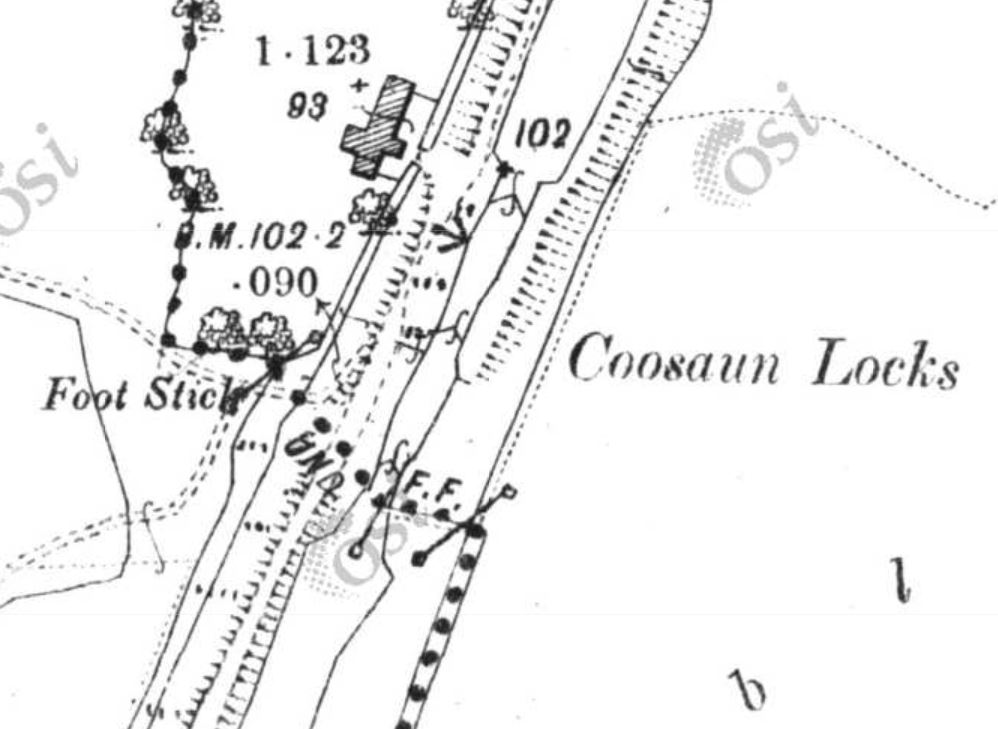
Cussane lock (OSI 25″ ~1900)

Cussane (or Coosaun, as above) Lock was the furthest downstream of the three locks on the Killaloe Canal. It was submerged by the “Flooded Area” created by Parteen Villa Weir as part of the Ardnacrusha hydroelectric scheme.

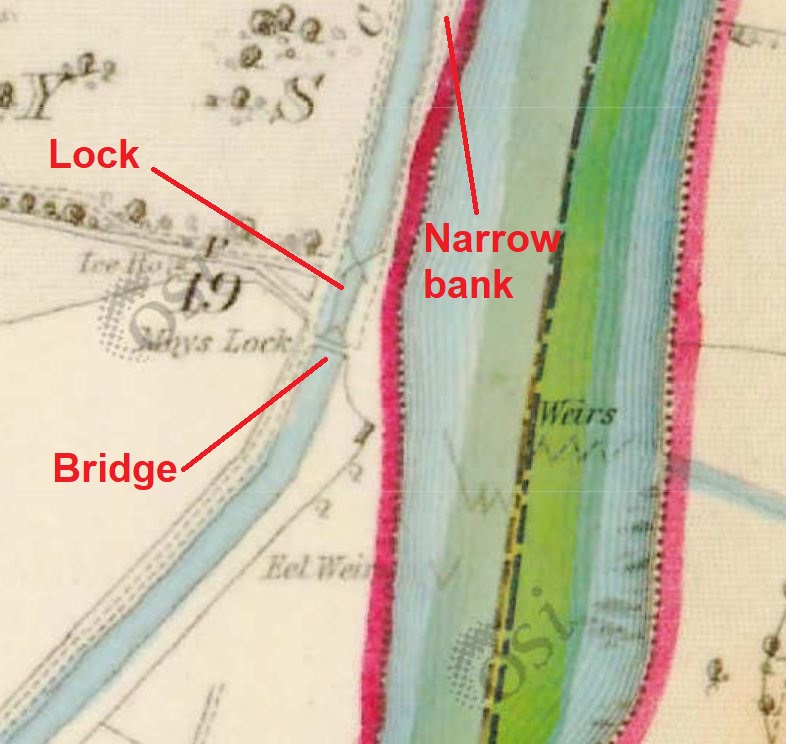
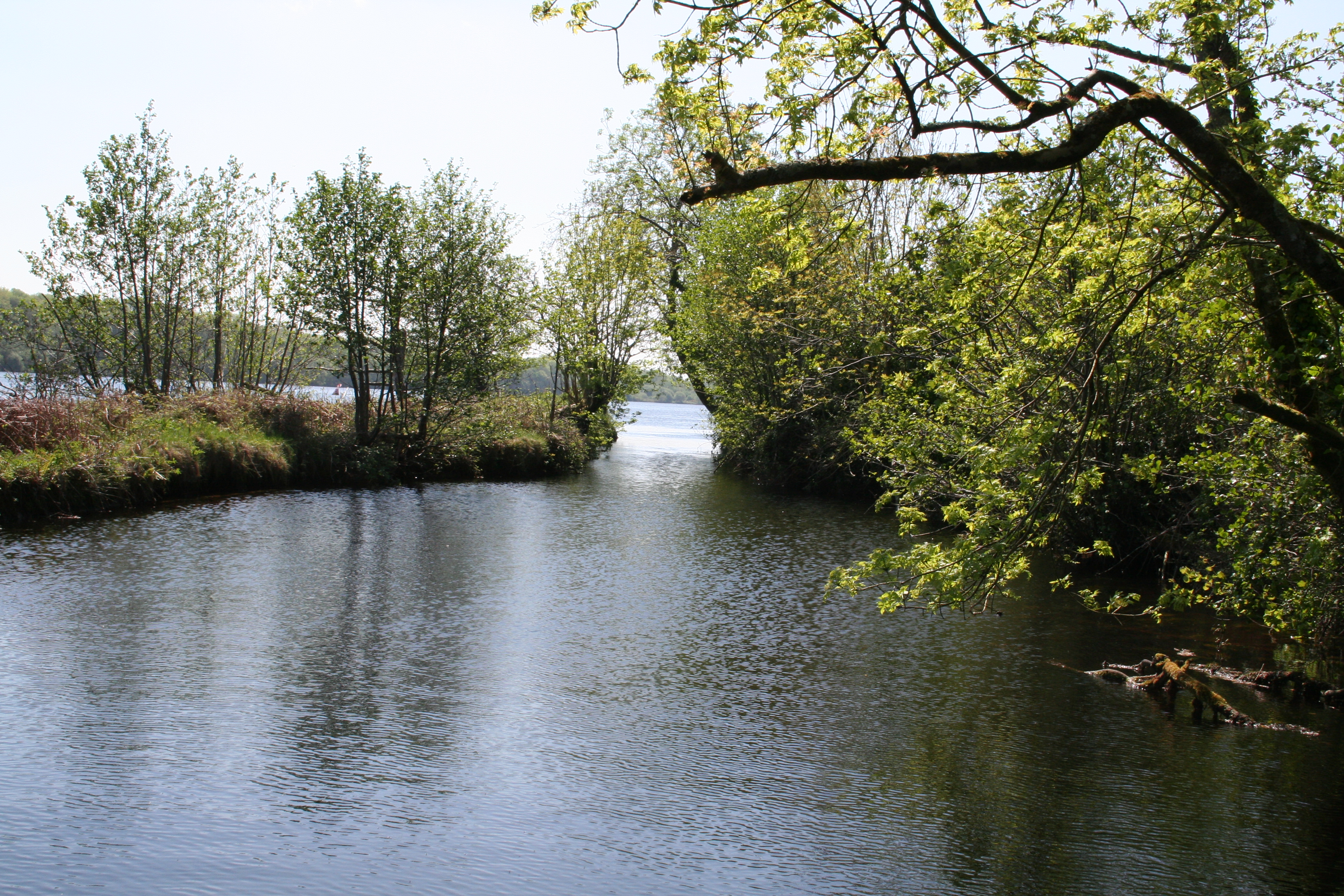
The middle lock on the Killaloe Canal is at Moys and its remains are visible, just above the water, in normal non-flood conditions. It is (or was until recently) still possible to go through it by (small) boat, though of course without needing to use the lock mechanisms.

Approaching Moys Lock from upstream

However, although the lock itself survives, the bridge that crossed it is no longer there. It was shown on the 6″ (~1840) and 25″ (~1900) Ordnance Survey maps; I would guess that it was removed as part of the Ardnacrusha works, but I don’t know and would welcome information.

The lock and bridge at Moys (OSI 6″ ~1840)

The other thing I don’t know about the bridge is why it was built in the first place. Hely Dutton [Statistical Survey of the County of Clare, with observations on the means of improvement; drawn up for the consideration, and by direction of the Dublin Society The Dublin Society, Dublin 1808] wrote that

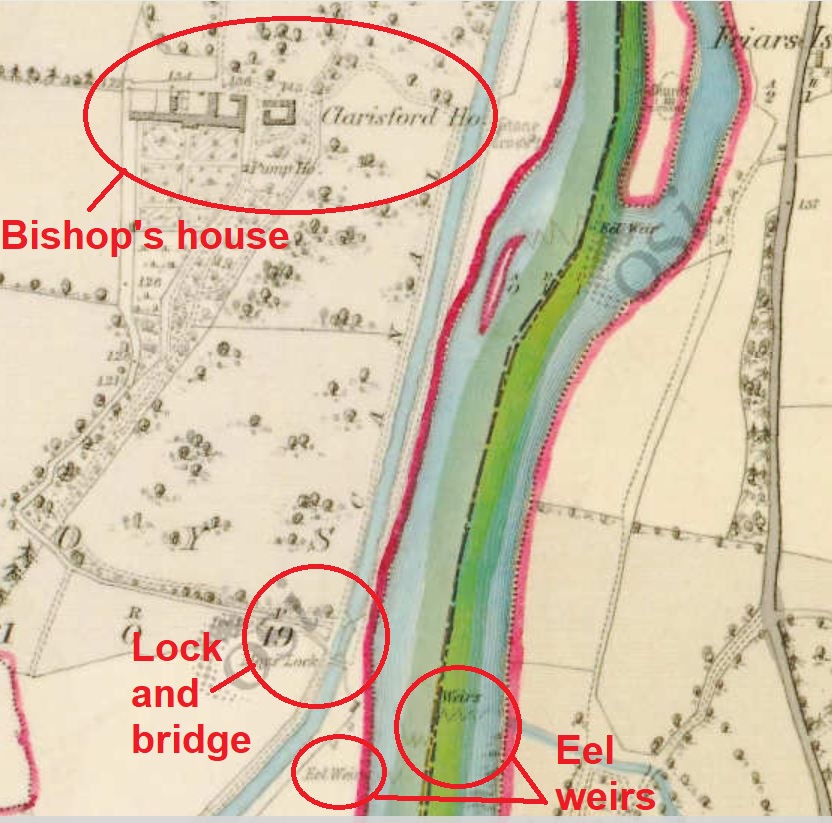
It seems to be the general opinion in Killaloe, that the canal has been cut in the most improper direction; they think it should have been brought in a valley between Killaloe and Dr. Parker’s, and to the north of the Bishop’s house, and not parallel to the Shannon as at present. Bishop Bernard offered several thousand pounds, if this line had been pursued; for, instead of cutting his demesne off from the Shannon, as at present it does, it would have gone at the back of his house; if this was the only objection, I think the engineer acted very impartially, as all public officers should, but very seldom do.

That suggests that the bishop was not best pleased to have a canal in front of his house; if he was willing to pay “several thousand pounds” to have the canal put somewhere else, the Limerick Navigation’s promoters must have been able to deploy considerable firepower (political and financial) to overcome his opposition. I wonder whether promotion to Limerick might have helped: according to a later estimate [Dublin Weekly Register 21 September 1822], promotion from Killaloe to Limerick would have increased a bishop’s income from £7000 to £8000 a year.

Charlotte Murphy [“The Limerick Navigation Company 1697–1836” in North Munster Archaeological Society Journal Vol 22 1980], describing John Brownrigg’s report on the navigation in 1801, said

This latter [Moys] lock had a bridge over the tail to accommodate the Bishop of Killaloe, whose demesne was served by the canal.

But what accommodation did the bishop need? A small strip of land downstream of the lock was insulated by the canal; perhaps the bridge provided access for cattle.

Another possibility is that the bridge provided access to the episcopal eel weirs. According to Mr Blackburne QC, addressing the Shannon Commissioners in 1837 on behalf of the Bishop of Killaloe and Sir Gilbert King Bart of Jamestown [Saunders’s News-Letter 29 December 1837],

The bishop, his tenants, and his predecessors had from time immemorial been in the habit of using twenty-five eel weirs, extending from the tail of Lough Dearg down the whole line of the rapids of Killaloe, which place, from natural impediments, could never be made navigable.

I think I have read somewhere that the eel weirs were worth £75 a year to the bishop, but I can’t remember where I saw that so I haven’t been able to check it.

The bishop’s house, the lock and the bridge (OSI 6″ ~1840)


There is one other aspect. The bridge was used by the horses towing boats on the canal and, of course, by the men leading them. We know that because the towing-path changed sides at Moys Lock. It was on the west side of the canal from Cussaun to Moys but on the east from Moys to Killaloe: it is marked on the 6″ OSI map and named on the 25″.

That forced horses and men to walk on a narrow embankment rather than on the shore. But it kept them out of the bishop’s garden and a little further from his house. Might that have been the intention?

I would be glad to hear from anyone who knows more about Moys.


Races at Castleconnell

There was a considerable multitude of persons at Castle-Connell, yesterday, to enjoy the spectacle of boat-racing. Vehicles of all descriptions were in requisition, and the pedestrians of both sexes were numerous. The weather was delightful, and the enchanting scenery of this far-famed watering place appeared to the very best advantage. The band of the County Limerick Regiment, which attended in full uniform, gave a new zest to the festivities of the occasion.

The contest on the river was between Castleconnell and O’Brien’s-bridge for the premiums advertised last week, and the Castleconnell men were victorious.

We understand the Strand men have challenged Castle-Connell to pull from O’Brien’s-bridge to Castle-Connell for £7, any day next week.

Dublin Observer 8 September 1832

Limerick Navigation lockkeepers

The Limerick Navigation was in five sections — three canals with river sections in between — and joined Limerick to Killaloe and the rest of the inland Shannon. The canal sections had locks, each controlled by a lockkeeper who lived on site. The job passed from generation to generation: some of the lockkeepers’ cottages are still inhabited by descendants of the lockkeepers.

Cussane lock (OSI 25″ ~1900)

Cussane was the furthest downstream of the three locks on the Killaloe section of the canal. It was covered by water when the Ardnacrusha hydroelectric scheme created the “flooded area” below Killaloe. If memory serves, Cussane was known as Crowe’s Lock.

In the online searchable catalogue of the Registered Papers of the Chief Secretary’s Office in the National Archives, there is a letter dated 15 February 1830 [CSO/RP/1830/815]

[…] from James Saurin, Henry R Paine, and John Radcliffe, [Directors General of Inland Navigation], Board of Control, [Dublin], to Hugh Percy, 3rd Duke Northumberland, [Lord Lieutenant of Ireland, Dublin], recommending Denis Crow to succeed Lott Corboy sheriff as lockkeeper on the Limerick Navigation.]

There is also a letter dated 2 June 1830 [CSO/RP/1830/836]

from James Saurin, J Armit, and Henry R Paine, [Directors General of Inland Navigation], Navigation Office, [Dublin], to Hugh Percy, 3rd Duke Northumberland, [Lord Lieutenant of Ireland, Dublin], recommending dismissal of Simon Johnston, lockkeeper on the Limerick Navigation, for irregularities and for deception; asking to employ Michael Gully in his stead, for Stg£9-4-9 per annum.

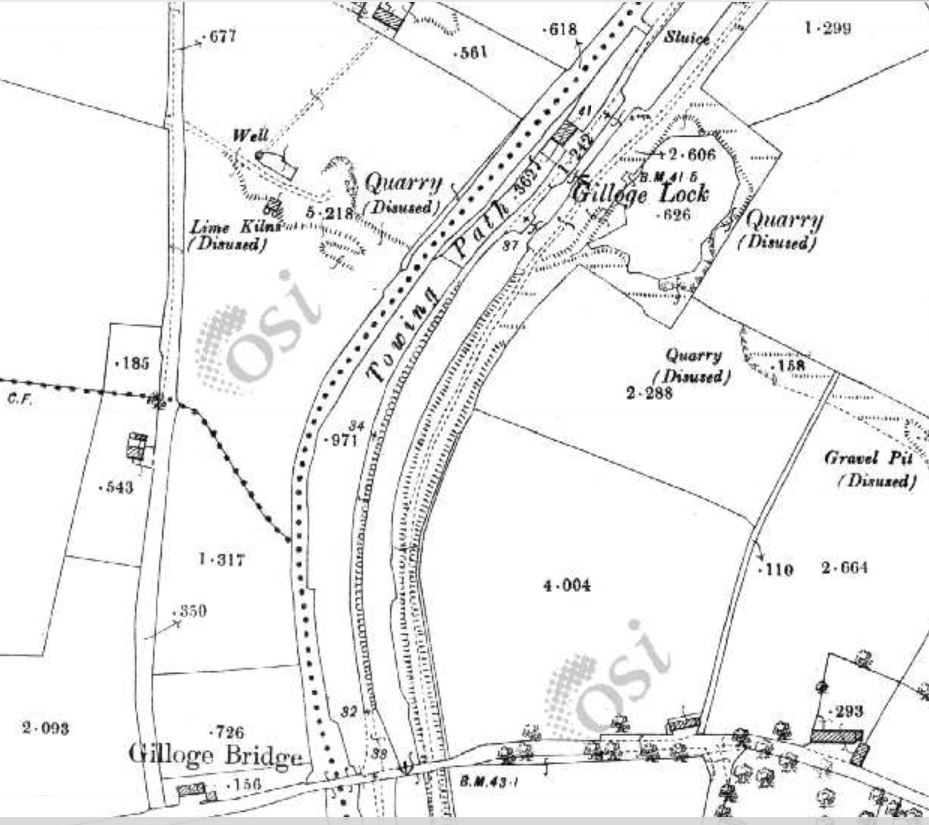
Gully’s Lock is at Gillogue, on the central canal section known as the Plassey–Errina Canal.

Gillogue lock (OSI 25″ ~1900)


Waterways update: work in progress (1759)

Here is some information about the work of Messrs Ockenden and Omer on Irish waterways up to 1759. It is extracted from a book by Henry Brooke; Ockenden had, twenty years earlier, subscribed to support Brooke’s play. It is not impossible that they were acquainted, in Ireland or in England. Apart from anything else, both were supporters of Frederick, Prince of Wales: see A N Newman “The Political Patronage of Frederick Lewis, Prince of Wales” in The Historical Journal Vol 1 No 1 1958 on Ockenden’s post in the prince’s household at £100 a year and here on Frederick’s “many attentions” to Brooke.

Brooke’s account contains some information about Ockenden’s work that I have not seen elsewhere. I found the reference to Brooke in Thomas McIlvenna This Wonder-Working Canal: a history of the Tyrone Navigation Coalisland Canal Branch IWAI 2005.

Who was William Ockenden?

William Ockenden has been described as a Dutch engineer who worked on three eighteenth century Irish navigations: the Mallow to Lombardstown canal, the Kilkenny/Nore navigation and the Limerick Navigation [Park Canal section], all of them notably unsuccessful.

It seems likely that he was English, not Dutch, but may have lived in Ireland before inheriting property in England. But was he an engineer or a mill-owner and MP? Were there one or two William Ockendens at the time?

Here is some information and some speculation. I would welcome more of the first.

The Newry bypass

I hesitate to criticise the Newry & Portadown Branch of the Inland Waterways Association of Ireland, admirable folk who conduct regular work parties improving the Newry Canal. So perhaps I should say that I disagree with them instead — at least on the proposal for a Southern Relief Road, aka bypass, around Newry, linking “the Warrenpoint Dual Carriageway to the A1 Dublin/ Belfast Road“.

Such a bypass is a very good idea and, of course, far better than the insane Narrow Water handsacrosstheborder project. But the new road must cross  the Newry River and the Newry Ship Canal, and I would be vastly surprised if there were any economic justification for the cost of an opening section or for the disruption that each opening would cause to traffic. Certainly six or twelve sailing vessels would no longer be able to reach the Albert Basin in Newry, but the greatest good of the greatest number should surely prevail.

I can’t see that the absence of sailing pleasure craft from Newry would in any  way diminish the heritage or historic value of the ship canal or the basin, and they are of course entirely irrelevant to the stillwater canal.

A spokesman from the Inland Waterways Association of Ireland” says that

The IWAI was formed in 1954 to stop the building of low bridges on the River Shannon. Fortunately this campaign was successful otherwise there would be no hire boats on the Shannon today. Think of the loss of revenue. This should be a lesson to the bridge builders in Newry.

This is rubbish, for two reasons. First, sailing vessels on Carlingford Lough are never going to be available for hire on the Newry Canal, so their inability to reach Albert Basin would have little effect.

Second, the IWAI campaign on the Shannon was notably unsuccessful. Instead of swivelling bridges that would allow masted vessels through, the Shannon now has fixed bridges (Banagher, Shannonbridge, Athlone) and lifting bridges (Roosky, Tarmonbarry) that lift enough to allow motor cruisers through, but not enough for sailing vessels.

Ruth Delany [in Ireland’s Inland Waterways: celebrating 300 years Appletree Press, Belfast 2004] says that the IWAI Shannon campaign resulted in there being a minimum clearance of 4.3m on the Shannon, which is a long way from the 35m that the Newry & Portadown folk are seeking. The only Shannon bridge providing that clearance is Portumna, a swivel bridge, which (unlike the others mentioned above) was not — or its ancestor was not — built by the Shannon Commissioners.

By using the Shannon as a model, the N&P folk have actually weakened their case: the 9m clearance suggested for the Newry bypass is more than twice what the Shannon provides.


Dromineer

Not that many pubs, surely.

Ireland’s mystical waterway

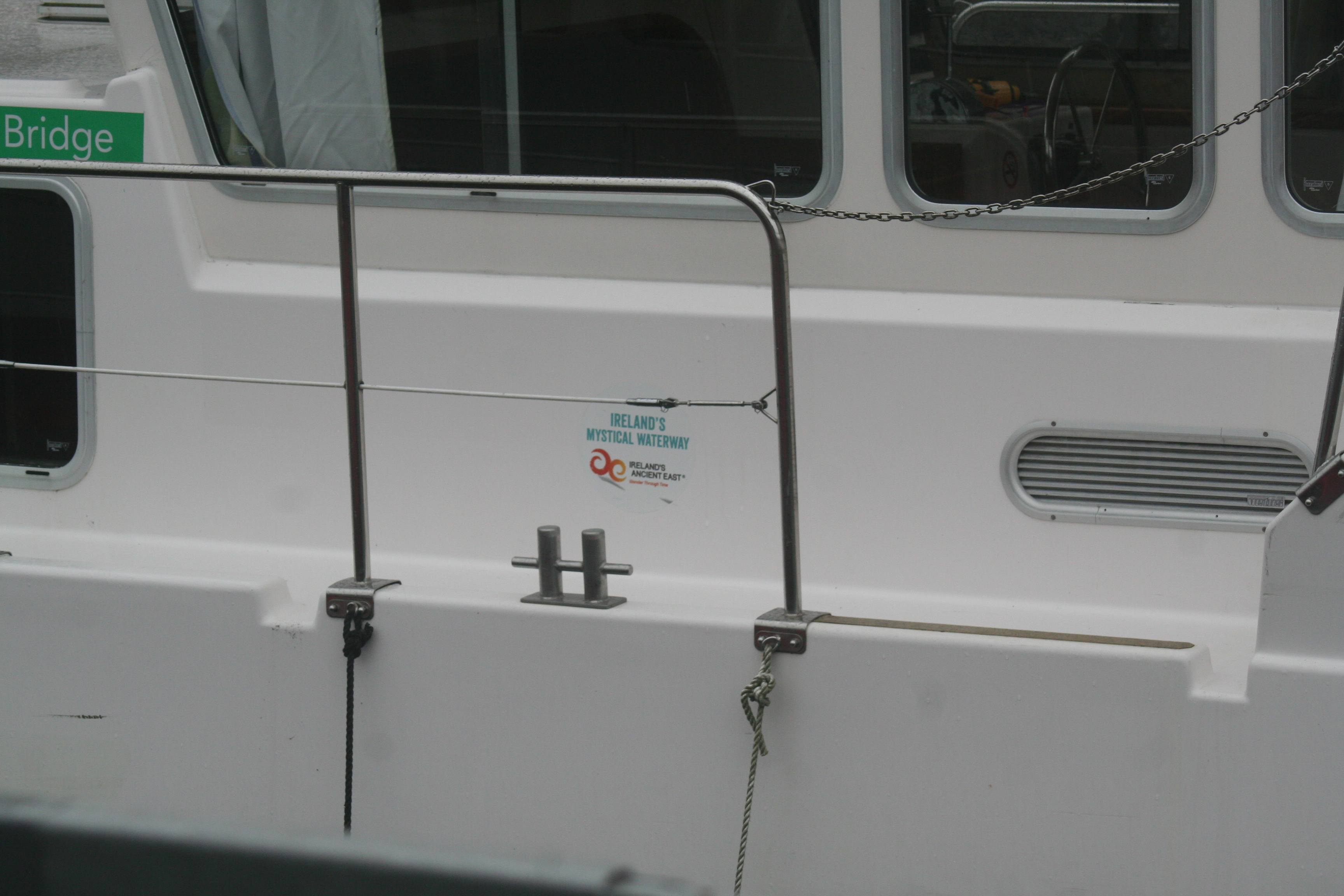
Mystical logo

Perhaps you’ve noticed an outbreak of strange stickers on Shannon hireboats, proclaiming that the river is “Ireland’s mystical waterway”. Cynics will dismiss this as just more marketing bollocks, in this case associated with the claim that the Shannon, which is in the middle of Ireland, is part of something called “Ireland’s Ancient East“. I do wish that, when marketing dudes get these brainwaves, they’d keep them to themselves.

But wait! What if we’re all wrong? What if the Shannon really is a mystical waterway? After all, wasn’t there recently a miracle in Athlone?

Mind you, you may need an encounter with spirits yourself after reading that lot: the spirits that come in 70cl bottles.


The port of Limerick

Limerick was formerly an important place for exporting grain and provisions. At that time a fine fleet of schooners, principally employed in the trade to London, was owned there; and some large brigs, barques, and ships, engaged in the passenger and timber trade with North America, hailed from the port. But the maritime trade has declined greatly of late years, and the number of vessels has become proportionably reduced. At present the shipping consists of a few colliers and timber vessels, and a fleet of five screw steamers. The latter monopolize so much of the trade between the city and the English ports as the railways do not absorb. A number of foreign vessels, principally with grain from the Mediterranean, arrive at the port, and the seamen that are met with here are for the most part Italians, French, and Austrians. There is now a large floating dock at Limerick with gates 75 feet wide. A Sailors’ Home was recently erected here, but it has never been opened, as there are at present hardly any sailors to be found at the port, except a few such foreigners as have been just described.

“Visits to the Sea Coasts” in The Shipwrecked Mariner Vol VIII No XXIX January 1861